

The 2026 Fleet Maintenance Budget Template: A Guide to Rugged Reliability

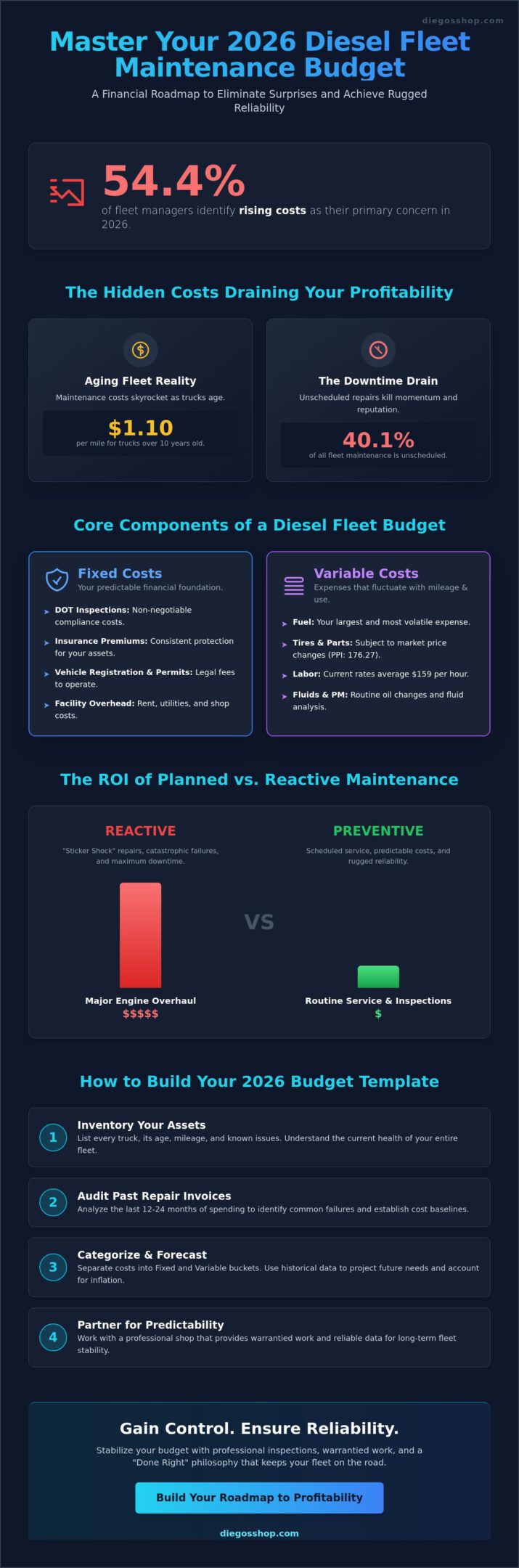
With 54.4% of fleet managers identifying rising costs as their primary concern in 2026, the difference between a profitable year and a financial disaster often comes down to a single spreadsheet. You likely already feel the pressure of an aging fleet, where maintenance costs can jump to $1.10 per mile once a truck passes the ten year mark. It’s frustrating to watch your margins disappear into unpredictable “sticker shock” repairs, especially when navigating Utah’s harsh mountain winters and steep grades that punish diesel engines.
You deserve a financial roadmap that offers peace of mind and rugged reliability. We created this professional fleet maintenance budget template to help you master your total cost of ownership and eliminate expensive surprises. By reading this guide, you’ll learn how to account for current $159 per hour labor rates, leverage the March 27, 2026, EPA guidance on DEF sensors to reduce downtime, and transition toward predictive maintenance. We’ll show you how to build a diesel-focused framework that keeps your trucks on the road and ensures your service is always “Done Right.”
Key Takeaways
- Learn how to build a fleet maintenance budget template that tracks fixed, variable, and emergency costs to eliminate financial surprises.
- Identify the critical difference between fixed expenses like DOT inspections and variable costs such as fuel to stabilize your monthly spend.
- Discover the high ROI of preventive maintenance by comparing the cost of routine service against major engine overhauls.
- Follow a step-by-step process to inventory your assets and audit past diesel repair invoices for more accurate future forecasting.
- Understand how professional inspection protocols and warrantied work provide the reliable data you need for long-term fleet stability.
The Blueprint for Fleet Stability: Why Every Diesel Fleet Needs a 2026 Maintenance Budget
A fleet maintenance budget template is more than a simple expense log; it’s a specialized forecasting tool designed to track fixed, variable, and emergency costs. In the diesel world, where a single turbocharger failure or an aftertreatment issue can cost thousands, this blueprint serves as your financial defense. It allows you to visualize where your capital is going before it leaves your bank account. By categorizing every dollar, you transform your shop from a cost center into a strategic asset.
The year 2026 presents unique challenges that older budgeting methods can’t handle. With the Producer Price Index for heavy-duty truck manufacturing reaching 176.27 in March 2026, parts and new vehicles are more expensive than they were just twelve months ago. Complex emission systems and the recent March 27, 2026, EPA guidance on DEF sensors mean your maintenance strategy must be agile. Effective Fleet management requires a “Done Right” philosophy that treats your budget as a shield against business-killing downtime. You can’t afford to be a firefighter, reacting to every dashboard light with panic. You need a proactive plan that turns unpredictable repairs into manageable, scheduled events.
The True Cost of Unplanned Downtime
When a truck sits idle, you aren’t just losing the revenue from that specific load. You’re paying for driver idle time, facing potential late-delivery penalties, and often swallowing expensive emergency tow fees. Since 40.1% of maintenance is currently unscheduled across the industry, these hidden leaks can sink a small fleet’s profitability quickly. Downtime is the primary enemy of fleet profitability because it robs you of both your mechanical momentum and your professional reputation.
Budgeting as a Tool for Rugged Reliability
Rugged reliability isn’t an accident; it’s the result of technical mastery backed by financial foresight. Using a fleet maintenance budget template helps you justify necessary fleet maintenance to stakeholders by showing the clear ROI of prevention. When you know your numbers, you aren’t guessing about the health of your Ford F-250s or your heavy-duty long-haul giants. This clarity provides a psychological benefit that’s hard to measure but easy to feel: the peace of mind that comes from being in total control of your operation.
Core Components of a Diesel Fleet Budget: Fixed vs. Variable Costs
Every successful fleet maintenance budget template starts by separating the “knowns” from the “variables.” In the world of diesel repair, these categories look different than they do for standard gasoline fleets. You’re managing heavier loads, more complex emissions systems, and higher parts costs. To achieve rugged reliability, your financial planning must mirror the technical mastery required in the shop. By breaking down your expenses into fixed and variable categories, you gain the clarity needed to make confident business decisions.
Fixed Costs: The Non-Negotiables
Fixed costs are the expenses that remain consistent regardless of how many miles your trucks travel. These include insurance premiums, vehicle registration, and facility overhead. Compliance is a major fixed cost that you can’t afford to overlook. Scheduling regular DOT truck inspections near me is a non-negotiable part of your calendar. These inspections ensure your fleet stays legal and safe, preventing heavy fines that can wreck your quarterly projections. Amortizing these costs across twelve months helps you avoid cash flow bottlenecks during peak inspection seasons.
Variable Costs: The Moving Targets
Variable costs fluctuate based on workload and mileage. Fuel is your largest variable, but tires for heavy-duty long-haul giants like Peterbilt or Kenworth follow closely behind. With the Producer Price Index for heavy-duty truck manufacturing sitting at 176.27 in March 2026, the price of replacement parts and rubber has seen steady growth. Your fleet maintenance budget template should account for standard oil change intervals and comprehensive fluid analysis. This data-driven approach allows you to spot internal engine wear before it leads to a catastrophic failure on the road.
Diesel engines require specific attention to components that generic templates often ignore. You must budget for high-ticket items like Diesel Particulate Filter (DPF) cleaning and Exhaust Gas Recirculation (EGR) service. While the March 27, 2026, EPA guidance on DEF sensors helps reduce certain downtime issues, Diesel Exhaust Fluid consumption remains a recurring cost that scales with your mileage. If you want to ensure your variable costs stay under control, it helps to schedule a professional inspection to get an honest assessment of your fleet’s current health.
Finally, we recommend the 10% Rule for your contingency fund. Since 40.1% of maintenance in 2026 is currently unscheduled, you need a financial buffer. This fund protects you from the “sticker shock” of emergency roadside calls or major diesel repairs. A robust contingency plan ensures that an unexpected breakdown doesn’t stop your business from moving forward. It’s about having a plan that is as durable as the trucks you drive.
Planned vs. Reactive Maintenance: Calculating the ROI of Prevention
The most critical column in your fleet maintenance budget template isn’t the one tracking what you spent last month; it’s the one that forecasts what you’ll save next year. There is a massive financial gulf between a $500 preventive maintenance (PM) service and a $15,000 engine overhaul. When you choose to invest in scheduled care, you aren’t just buying oil and filters. You’re buying the technical mastery that catches a weeping water pump or a frayed belt before it strands your driver on a mountain pass. Consistent inspections allow our team to identify “the small stuff” while it’s still affordable to fix.
At Diego’s Shop, we believe that warrantied repairs are a budget’s best friend. When service is “Done Right” the first time, you eliminate the “double spend” that occurs when cut-rate repairs fail prematurely. Our 100% warrantied work provides a layer of financial protection that generic shops simply don’t offer. Industry data confirms this approach works. Fleets that prioritize comprehensive diesel maintenance typically save 25% annually on total repair costs compared to those that wait for a dashboard light to scream for help.
The Financial Anatomy of a Breakdown
A roadside turbo failure is a masterclass in wasted capital. Beyond the repair itself, you’re looking at emergency towing and lost revenue. Because you’re forced to buy parts immediately to get back on the road, emergency sourcing is often 30% more expensive than planned inventory. You lose the ability to shop for value or wait for the right component. As we often tell our partners: “In the diesel world, an ounce of prevention is worth ten pounds of steel.”
Predicting the Unpredictable
Rugged reliability requires looking at the long game. By using historical data, you can forecast the lifespan of major components like injectors and turbos. This allows you to build a “Sinking Fund” within your fleet maintenance budget template specifically for major 500,000-mile overhauls. We also utilize advanced fluid analysis to monitor engine health from the inside out. This diagnostic data tells us exactly when a component is nearing the end of its reliable life, allowing you to schedule the replacement during a slow week rather than during your busiest season. This level of control is what separates a profitable fleet from one that is constantly fighting financial fires.
How to Build Your 2026 Fleet Maintenance Budget Template Step-by-Step
Building a reliable budget isn’t about guesswork; it’s about translating technical data into financial foresight. A well-constructed fleet maintenance budget template allows you to see the road ahead clearly, ensuring that your capital is always working as hard as your trucks. By following a methodical, step-by-step process, you can move from reactive spending to a position of total control. This approach ensures that every Ford F-250 or heavy-duty Peterbilt in your yard is accounted for with technical mastery.
Step 1 & 2: Data Collection and Auditing
Start by creating a comprehensive inventory of your assets. You must record the year, make, model, and specific engine type for every vehicle. Gathering VIN-specific data for your Kenworth or Volvo fleets is essential because maintenance cycles vary wildly between different engine platforms. Once your inventory is complete, audit your previous year’s diesel engine repair invoices. Look for patterns in your spending to identify “problem children.” These are the vehicles that consistently cost more in repairs than they generate in revenue. When reviewing these costs, remember to normalize your data for 2026 inflation. With the Producer Price Index for heavy-duty truck manufacturing at 176.27 as of March 2026, you should expect parts to be slightly more expensive than they were last year.
Step 3: The Utah Factor (Springville to the Wasatch Front)
Generic templates often fail because they ignore regional geography. If your fleet operates between Springville and the Wasatch Front, your fleet maintenance budget template needs a “Utah Factor” adjustment. Heavy mountain hauling puts immense strain on braking systems, requiring more frequent pad and rotor replacements than flat-land operations. You must also budget for increased cooling system maintenance to handle summer heat on steep grades. Finally, don’t forget the hidden cost of winter road salt. Corrosion prevention and frequent undercarriage cleanings are necessary to protect your chassis from the aggressive salt used on Utah’s mountain passes.
After adjusting for your environment, follow these final steps:
- Step 4: Categorize your spend by PM intervals. Group your costs into A (basic), B (comprehensive), and C (major) services to create a predictable rhythm.
- Step 5: Review and adjust monthly. Compare your actual spend against your budgeted projections to catch small variances before they become large deficits.
If you want to ensure your audit data is accurate, it helps to start with a professional baseline. You can schedule a service with our team to get a comprehensive health report on your entire fleet, giving you the honest numbers you need for a rock-solid budget.
Partnering for Predictability: How Diego’s Shop Stabilizes Your Budget
A fleet maintenance budget template is only as strong as the data you put into it. While software can record expenses after they happen, it can’t turn a wrench or listen for the early signs of a failing bearing. That’s where a strategic partnership with Diego’s Shop changes the math for your business. We provide the technical mastery required to turn mechanical uncertainty into financial predictability. Our “Done Right” inspection protocols are designed to feed your budget with accurate, real-world data so you never have to guess about the health of your vehicles.
Choosing the right partner for diesel repair in Utah means choosing a team that stands behind its work. We provide 100% warrantied repairs, which acts as a secondary insurance policy for your maintenance spend. When we fix a component, we eliminate the risk of premature failure that could otherwise wreck your monthly projections. This level of accountability is essential for fleets moving from a generic forecasting tool to a high-performance operational plan that prioritizes uptime.
Technical Mastery Meets Financial Clarity
Our certified mechanics serve as your most valuable budgeting consultants. They understand the specific needs of light-duty pickups like Ford F-250s and the heavy-duty demands of long-haul giants like Peterbilt and Volvo. By leveraging our advanced diagnostics, we help you prevent “budget-buster” failures that often occur when small issues are ignored. We’re committed to honest, transparent pricing for all commercial fleets. This transparency ensures that your fleet maintenance budget template reflects reality, not just optimistic estimates. You gain the peace of mind that comes from knowing your service is being handled by experts who value your bottom line.
Ready to Start Your 2026 Planning?
Rugged reliability isn’t just a slogan; it’s a standard we’ve built our reputation on. As you look toward the remainder of 2026, it’s the perfect time to review your fleet’s current health and future needs. A custom fleet service plan moves you beyond the limitations of a spreadsheet and into a proactive management strategy. We’re ready to help you build your most accurate budget yet by providing the data and the “Done Right” service your trucks deserve. Contact us today for a full consultation at our Springville location to keep your fleet moving forward with confidence.
Take Control of Your Fleet’s Financial Future
Managing a diesel fleet in 2026 requires more than mechanical skill; it demands financial precision. You’ve seen how a fleet maintenance budget template transforms unpredictable “sticker shock” into a manageable monthly spend. By prioritizing planned maintenance over reactive “firefighting” and accounting for Utah’s unique terrain, you protect your margins and your equipment. Rugged reliability is built on this foundation of technical mastery and honest data.
Don’t let another month of unscheduled downtime erode your profits. Our certified diesel specialists have the deep expertise to service everything from light-duty Ford pickups to heavy-duty giants like Peterbilt, Kenworth, and Isuzu. We stand behind every turn of the wrench with 100% warrantied repair work, giving you the peace of mind you deserve. It’s time to move beyond guesswork and start operating with total confidence. Schedule a Fleet Maintenance Consultation with Diego’s Shop today to build a strategy that keeps your business moving. You have the tools to master your budget, and we’re here to help you get it done right.
Frequently Asked Questions
What is the most common mistake in fleet budgeting?
Underestimating the cost of unscheduled downtime is the most frequent error fleet managers make. While 53.7% of maintenance is scheduled, the remaining 40.1% is reactive and often carries a much higher price tag. An honest fleet maintenance budget template must account for lost revenue and emergency tow fees to remain realistic. Ignoring these “hidden” costs leads to significant financial gaps by the end of the second quarter.
How much should I set aside for emergency diesel repairs?
You should set aside at least 10% of your total estimated maintenance budget as a contingency fund for unexpected repairs. For fleets with vehicles over 10 years old, this reserve should increase to 15% or 20% because these older trucks account for 34% of total service expenditures. This buffer protects your operation from the “sticker shock” of major component failures during peak hauling seasons.
How do I calculate the Total Cost of Ownership (TCO) for a diesel truck?
Calculate TCO by adding the purchase price, financing interest, insurance, fuel, and total lifetime maintenance costs, then subtracting the vehicle’s resale value. In 2026, data shows maintenance costs rise from $0.06 per mile for new trucks to $1.10 per mile for those over 10 years old. Tracking these numbers allows you to determine exactly when a truck becomes too expensive to keep in service.
What diesel-specific maintenance items are often forgotten in a budget?
Diesel Particulate Filter (DPF) cleaning and Exhaust Gas Recirculation (EGR) system services are the most commonly overlooked items. These emissions components require specialized attention at specific mileage intervals to prevent engine derate. While the March 27, 2026, EPA guidance on DEF sensors provides some operational relief, your fleet maintenance budget template still needs to include regular aftertreatment system inspections to ensure rugged reliability.
How often should I review my fleet maintenance budget?
Review your budget on a monthly basis to compare actual spending against your initial projections. This monthly cadence allows you to spot variances early, such as a sudden spike in parts prices or a recurring issue with a specific engine type. A quarterly deep dive is also essential to adjust your year-end forecasts based on current labor rates, which averaged $159 per hour in early 2026.
Can preventive maintenance really lower my annual insurance premiums?
Yes, maintaining a documented history of preventive maintenance can lead to lower insurance premiums over time. Insurance carriers view well-maintained fleets as lower risks because they experience fewer mechanical failures and roadside accidents. Providing proof of regular DOT inspections and warrantied repairs demonstrates a commitment to safety that can be a powerful tool when negotiating your annual policy rates.
Is it better to use a spreadsheet or fleet management software for budgeting?
Spreadsheets are ideal for building your initial framework, but specialized software is more efficient for real-time tracking as your fleet expands. A spreadsheet allows for total customization when you are first defining your costs. However, once you manage more than five vehicles, software helps reduce human error and automates data entry. The priority is ensuring your data is accurate and your service is “Done Right.”
What Utah-specific factors affect fleet maintenance costs the most?
Steep mountain grades and aggressive winter road salt are the primary drivers of increased maintenance costs for Utah fleets. Operating along the Wasatch Front requires more frequent brake pad replacements and cooling system flushes than operations in flatter states. You must also budget for corrosion-resistant undercoating to protect your chassis from the heavy salt used on mountain passes during the winter months.