
Fleet Maintenance: A Complete Guide to Preventing Downtime

A single truck down isn’t just an inconvenience-it’s a direct hit to your bottom line. When you’re juggling unpredictable repair costs, chaotic schedules, and the constant worry of DOT compliance, it’s easy to feel like you’re always one breakdown away from a crisis. But that reactive chaos isn’t a required cost of doing business. The solution is a proactive, comprehensive fleet maintenance program built on rugged reliability-the difference between constantly putting out fires and having a trusted system that prevents them.
This guide delivers that system. We provide the complete roadmap you need to reduce unpredictable costs, maximize vehicle uptime, and ensure your assets are always safe, compliant, and ready to roll. It’s time to take control of your maintenance, protect your investments, and get the job done right.
Key Takeaways
- Shifting from reactive repairs to a proactive strategy is the first step in turning your fleet into a reliable business asset instead of a constant expense.
- Unplanned downtime, emergency repairs, and lost revenue are often far more expensive than the cost of a planned maintenance program.
- A successful fleet maintenance program is a coordinated effort that requires clear communication and defined roles for drivers, managers, and technicians.
- Deciding between an in-house team and an expert outsourced partner is a critical choice that impacts your costs, capabilities, and long-term efficiency.
What is Proactive Fleet Maintenance (And Why It’s Not Optional)
For any business that depends on its vehicles, fleet maintenance should be treated as a core business strategy, not an unpredictable cost center. It’s the disciplined practice of servicing your commercial vehicles on a regular, preventative schedule to keep them operating at peak performance. This approach is a critical component of comprehensive fleet management, directly protecting your revenue, reputation, and bottom line. Waiting for a breakdown is no longer a viable option, especially with the growing complexity of modern diesel engines and their sophisticated emissions systems. The goal is to transform maintenance from a reactive emergency into a predictable, scheduled process that you control.
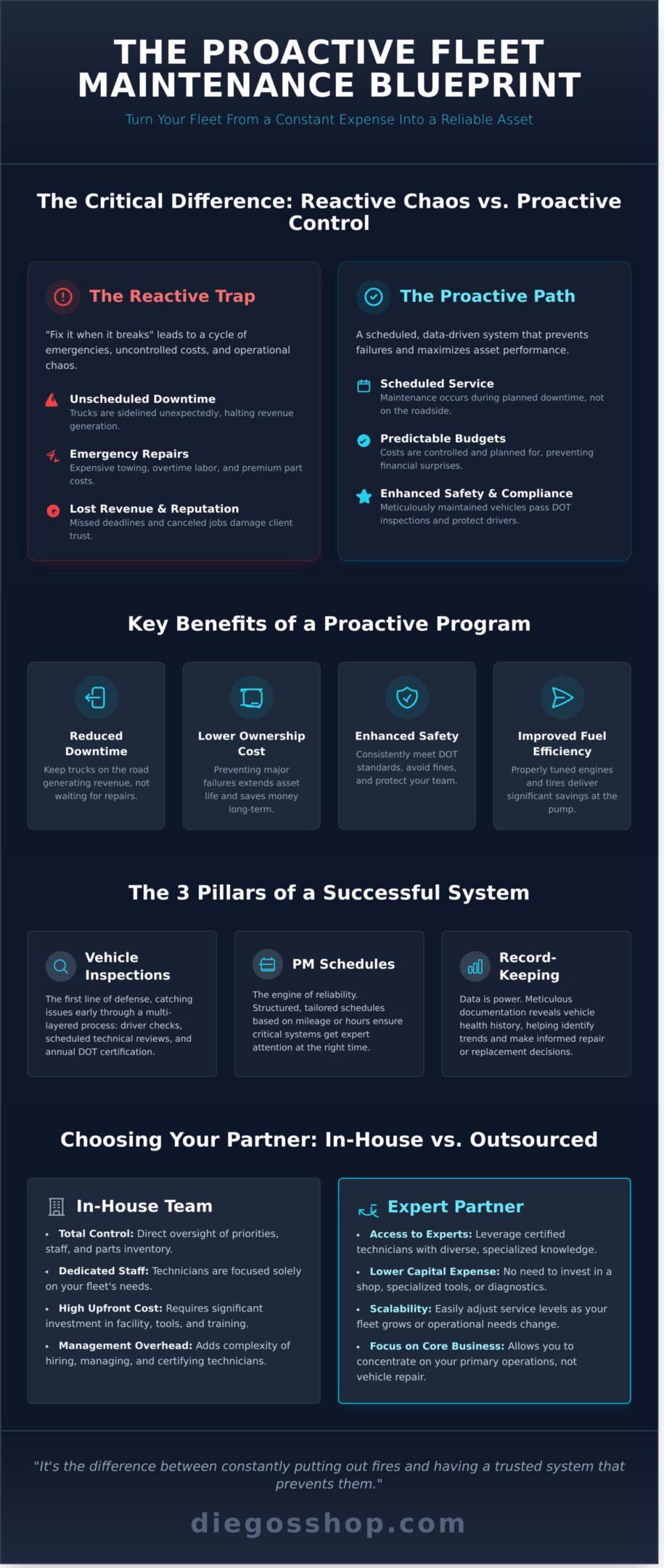
Reactive vs. Proactive: The Critical Difference
Think of it like your own health. A reactive approach is like rushing to the emergency room-it’s stressful, expensive, and happens at the worst possible time. Proactive care is like a scheduled annual check-up, designed to catch small issues before they become critical. For your fleet, the difference is just as stark.
- Reactive Maintenance (‘Fix When It Breaks’): This leads directly to unscheduled downtime, roadside emergencies, expensive towing bills, and potential safety hazards. Costs are uncontrolled and catastrophic failures can sideline a vehicle for weeks.
- Proactive Maintenance (Scheduled Service): This puts you in command. Service is scheduled during planned downtime, budgets are predictable, and potential failures are identified early. This ensures your vehicles are safe, reliable, and always ready to work.
Key Benefits of a Formal Maintenance Program
Implementing a proactive maintenance program delivers tangible results that go straight to your bottom line. It’s one of the most effective investments you can make in your fleet’s long-term health and profitability.
- Reduced Vehicle Downtime: The primary goal is to keep your trucks on the road, completing jobs and generating revenue. Scheduled service minimizes unexpected breakdowns.
- Lower Total Cost of Ownership: Preventing a major engine or transmission failure is exponentially cheaper than repairing one. Proactive care extends the operational life of your assets.
- Enhanced Safety & Compliance: A meticulously maintained vehicle is a safer vehicle. A formal program ensures you consistently meet or exceed DOT standards, avoiding fines and protecting your drivers.
- Improved Fuel Efficiency: Well-maintained engines, properly inflated tires, and clean filters all contribute to better fuel economy, delivering significant savings across your entire fleet.
- Professional Brand Image: The appearance of your fleet is a direct reflection of your company’s standards. Professional vehicle wraps and decals not only protect the paint but also turn your fleet into a powerful marketing tool. For more on this, yeahgor.com offers a comprehensive guide.
The Core Components of a Successful Fleet Maintenance Program
A truly effective fleet maintenance program is built on a foundation of proactive strategy, not reactive repairs. It is a disciplined partnership between your drivers on the road, your managers overseeing operations, and the certified technicians performing the work. When these three groups work in sync, supported by a clear framework, your fleet runs with rugged reliability and minimal downtime. Use the following core components as a reliable checklist to evaluate and strengthen your own system.
Comprehensive Vehicle Inspections
The first line of defense against unexpected breakdowns is consistent, thorough inspections. This process is multi-layered, starting with daily pre-trip and post-trip checks performed by your drivers to catch immediate issues. It is reinforced by scheduled, in-depth technical inspections at the shop, where our experts can identify developing problems. Finally, we ensure every vehicle in your fleet meets or exceeds its annual DOT inspection requirements, guaranteeing both safety and compliance.
Structured Preventive Maintenance (PM) Schedules
Preventive maintenance is the engine of reliability. Instead of waiting for a failure, we build structured PM schedules based on mileage, engine hours, or time intervals-whichever metric best suits your assets and operations. These schedules are never one-size-fits-all; they are tailored for the unique demands of light, medium, and heavy-duty vehicles. This ensures critical systems like the engine, transmission, brakes, and tires receive expert attention at precisely the right time, preventing costly on-road failures.
Detailed Record-Keeping and Analysis
Every service, from a simple oil change to a major engine overhaul, must be meticulously documented for each vehicle. This data does more than just track costs; it reveals the complete health history of each asset, allowing you to monitor its condition over time. By analyzing these records, you can identify recurring problems, spot underperforming vehicles, and make informed decisions about repairs or replacement. This data-driven approach aligns with the best practices outlined in the U.S. Department of Energy’s fleet management framework. Ultimately, a detailed service history proves an asset’s value and protects your investment.
The High Cost of Neglect: Risks of a Reactive-Only Approach
Many fleet managers view scheduled maintenance as a significant line item expense. But this perspective overlooks a critical truth: the cost of a reactive, “fix-it-when-it-breaks” strategy is always higher. Proactive fleet maintenance is not a cost center; it’s a powerful investment in operational reliability and financial stability. Neglecting it exposes your business to a cascade of expenses that go far beyond a simple repair bill.
Calculating the True Cost of Downtime
When a vehicle goes down unexpectedly, the tow and repair invoice is only the beginning. The true cost of downtime is a complex calculation that directly impacts your bottom line. Every hour a truck is off the road is an hour it’s not generating revenue, but the expenses don’t stop.
Imagine the impact on a time-sensitive, seasonal business. For a company like Snow Removal Denver, a truck failure during a major snowstorm means broken contracts and a damaged reputation—a scenario where proactive maintenance is non-negotiable.
- Lost Revenue: The direct income lost from canceled jobs or delayed deliveries, which can amount to hundreds or even thousands of dollars per day.
- Wasted Payroll: Paying a driver’s wage while their vehicle is sidelined is a significant and unproductive expense that erodes profitability.
- Damaged Reputation: Missed deadlines and unreliable service can permanently damage client relationships and jeopardize future business opportunities.
Compounding Failures and Spiraling Repair Bills
Ignoring a minor issue is one of the fastest ways to create a catastrophic failure. A small, unchecked coolant leak doesn’t fix itself; it can lead to overheating and a complete engine overhaul costing tens of thousands of dollars. A proactive maintenance plan catches that leak when it’s a simple, inexpensive fix. Furthermore, emergency roadside repairs are invariably more expensive than scheduled service in a controlled shop environment, often involving premium charges for parts, labor, and towing.
Safety, Liability, and Insurance Risks
Properly maintained vehicles are safer vehicles, period. Negligence in this area not only endangers your drivers and the public but also creates massive financial liability. In the event of an accident, your maintenance records will be scrutinized. A core component of professional fleet management is maintaining meticulous records that prove due diligence. A history of deferred repairs can be used to establish negligence, leading to devastating legal outcomes, soaring insurance premiums, or even the loss of your coverage entirely.
Choosing Your Partner: In-House vs. Outsourced Fleet Maintenance
Every fleet manager faces a critical decision: should you manage maintenance in-house or partner with an external specialist? There is no single right answer. The best choice depends entirely on your fleet’s size, complexity, and your company’s core operational focus. Making the right decision is fundamental to a successful fleet maintenance strategy that controls costs and maximizes uptime.
When In-House Maintenance Makes Sense
For massive, standardized fleets, an in-house shop can be a viable asset. This path makes sense if you have the operational scale to justify a dedicated facility, the capital to invest in advanced diagnostic tools, and the resources to consistently hire, train, and retain a team of certified technicians. It requires a significant, ongoing commitment of both capital and management attention.
The Strategic Advantages of Outsourcing to a Specialist
For most businesses, outsourcing your fleet maintenance is a strategic decision that delivers immediate value. Partnering with a dedicated diesel service provider allows you to convert the high fixed costs of a garage-tools, payroll, and parts inventory-into a predictable, variable expense. This approach provides several key benefits:
- Access to Expertise: You gain immediate access to master technicians and state-of-the-art diagnostic equipment without the upfront investment.
- Reduced Admin: Eliminate the complexities of managing parts procurement, technician schedules, and ongoing training certifications.
- Core Business Focus: Free up your team to concentrate on what your business does best-serving your customers and driving revenue.
What to Look for in a Fleet Service Partner
A reliable partner is more than just a repair shop; they are an extension of your team. When evaluating a provider, demand proven expertise with your specific vehicle types, from light-duty pickups to heavy-duty diesel trucks. Look for a commitment to clear communication, honest, transparent pricing, and 100% warrantied repair work. Your partner should stand behind their service with rugged reliability.
If you’re ready to explore how a dedicated partner can improve your operations, we invite you to see if partnering with Diego’s is right for you. Schedule a Consultation.
Diego’s Shop: Proactive Fleet Maintenance for the Wasatch Front
Understanding the principles of a great maintenance program is the first step. The next is finding a partner who can execute it flawlessly. At Diego’s Shop, we translate best-in-class theory into real-world results for businesses across the Wasatch Front. We deliver a comprehensive fleet maintenance program built on rugged reliability and technical mastery, ensuring your vehicles stay on the road and out of the shop.
Our specialization is clear: we are experts in light, medium, and heavy-duty diesel fleets. From Ford F-350s running local routes to Peterbilt and Kenworth rigs hauling cross-country, we have the expertise to minimize your downtime and protect your assets.
Customized Maintenance Plans for Your Fleet
Your fleet is unique, and your maintenance plan should be too. We reject the one-size-fits-all approach, instead working directly with you to build a comprehensive Preventive Maintenance (PM) schedule based on your specific vehicles, their age, mileage, and operational demands. We manage the schedule and the service reminders, freeing you to focus on running your business with confidence.
Technical Mastery and Advanced Diagnostics
Preventing downtime requires more than just routine oil changes. Our certified technicians possess a deep mastery of modern, complex diesel systems. We invest in the latest diagnostic tools and technology to accurately pinpoint issues before they become catastrophic failures. This commitment to precision ensures we get the job done efficiently and correctly, saving you the costly delays of repeat repairs. It’s the core of our promise: service Done Right the first time.
Your Trusted Partner in Utah County
We believe in building partnerships grounded in transparency and trust. When you choose Diego’s Shop for your fleet maintenance needs, you gain a partner dedicated to your success. We provide peace of mind through our unwavering commitment to quality and accountability.
- Detailed Service Records: We provide clear, comprehensive records for every vehicle in your fleet, giving you a complete service history for better management and resale value.
- 100% Warrantied Work: We stand behind our craftsmanship. All our repair and maintenance work is fully warrantied, so you can be confident in the reliability of our service.
- Long-Term Partnership: Our goal isn’t a single transaction; it’s to become an integral part of your operational team, helping you maximize vehicle lifespan and profitability for years to come.
Ready to build a more reliable and cost-effective maintenance strategy? Contact the experts at Diego’s Shop today or learn more about our comprehensive services at diegosshop.com.
Fleet Maintenance Done Right: Your Path to Maximum Uptime
Ultimately, the health of your fleet is the health of your business. Shifting from a reactive, “fix-it-when-it-breaks” model to a proactive strategy is not just a best practice-it is essential for preventing costly downtime and protecting your bottom line. A successful fleet maintenance program is the engine that drives operational reliability and long-term profitability, ensuring your vehicles remain assets, not liabilities.
For businesses in Utah County and across the Wasatch Front, the right partner makes all the difference. At Diego’s Shop, we deliver the technical mastery and rugged reliability your fleet demands. Our certified technicians are experts in light, medium, and heavy-duty diesel vehicles, and we stand behind our work with a 100% warranty. We provide the honest, comprehensive service you need to keep your fleet performing at its peak.
Stop letting unexpected repairs derail your operations. It’s time to take control. Request a Custom Fleet Maintenance Plan Today and let our team build a proactive strategy tailored to your specific needs. Keep your business moving forward with a partner you can trust.
Frequently Asked Questions
What is typically included in a preventive maintenance (PM) service?
Our comprehensive PM service includes full oil and filter changes, complete brake system inspections, tire pressure and tread depth checks, and battery health tests. Our certified technicians also perform a multi-point inspection of the engine, transmission, and drivetrain to identify potential issues before they cause a breakdown. We believe in proactive, thorough service that is always done right, keeping your vehicles reliable and on the road.
How do you track maintenance schedules and service history for my fleet?
We use a dedicated digital management system to meticulously track every vehicle’s service history and upcoming maintenance needs. Your fleet manager receives automated reminders for scheduled service, ensuring no vehicle is ever overlooked. This transparent system provides you with complete, accessible records, simplifying your management process and giving you full visibility into your fleet’s health and maintenance investment. We handle the details so you can focus on your operations.
Can you help ensure our vehicles are ready for DOT inspections?
Absolutely. We provide thorough, DOT-compliant inspections that cover every critical checkpoint, from brake systems and lighting to steering and exhaust systems. Our technicians are experts in federal and state regulations, ensuring your vehicles are not just road-ready but fully compliant. We help you pass inspections with confidence, a critical part of a successful fleet maintenance strategy that keeps you on the road and avoids costly fines.
What types of commercial trucks and diesel engines do you service?
Our technicians possess the technical mastery to service a wide range of commercial vehicles. We handle all major truck brands, including Peterbilt, Kenworth, Freightliner, Volvo, and International. We are also certified experts in diagnosing and repairing leading diesel engines like Cummins, Detroit Diesel, PACCAR, and Caterpillar. From vocational trucks to long-haul giants, we have the proven expertise to service your entire fleet.
How does your billing and approval process for fleet work operate?
Our process is built on honest communication and complete transparency. After diagnosing an issue, we provide a detailed, itemized estimate for your review. No work ever begins without your explicit approval, giving you complete control over your budget. Once the warrantied repair is complete, you receive a clear invoice with no surprises. We believe in a straightforward partnership where you are always informed and in command.
My fleet has mixed vehicles (light, medium, heavy-duty). Can you handle all of them?
Yes, we are fully equipped to be your single trusted partner for your entire mixed fleet. Our technicians have deep expertise across all vehicle classes, from light-duty pickups like Ford F-350s and medium-duty box trucks to heavy-duty Class 8 tractors. Consolidating your service with us simplifies your fleet maintenance program, ensuring consistent, reliable quality and streamlined management for every vehicle you operate, regardless of its size.