
DOT Truck Inspections and Diesel Emissions Repair in Utah County: 2026 Guide

What if your next DOT inspection wasn’t a source of anxiety, but a routine confirmation of your fleet’s reliability? For many operators across the Wasatch Front, the 2026 updates to emissions standards feel like a moving target. You’ve likely felt the frustration of unexpected out-of-service orders or the sting of lost revenue while a truck sits idle. It’s stressful to manage changing weight exemptions and the new compliance fees for older heavy-duty vehicles. You need more than just a quick fix; you need a strategy that ensures your equipment meets every technical requirement without the guesswork.
We promise to help you master the 2026 inspection process and show you how professional diesel emissions repair Utah County services keep your trucks on the road legally. This guide provides a clear look at the latest FMCSA standards and the specific testing requirements for your model year. We will examine the five-county rule, explain the visual and computerized testing protocols, and offer a roadmap for maintaining a compliant, high-performing fleet. By the end, you’ll have the technical insight needed to secure a clean inspection report every time.
Key Takeaways
- Understand the mandatory legal requirements for all commercial vehicles over 10,001 lbs GVWR to ensure your fleet meets FMCSA Title 49 CFR Part 396 standards.
- Differentiate between the six levels of DOT inspections, specifically focusing on the rigorous Level I North American Standard and Level II walk-around checks.
- Identify critical failure points such as brake system malfunctions and exhaust leaks that necessitate expert diesel emissions repair Utah County to prevent out-of-service orders.
- Learn how to conduct effective “mock” DOT inspections and organize maintenance records to streamline the 2026 compliance process and reduce roadside delays.
- Discover the benefits of specialized diagnostics for medium and heavy-duty diesel engines that go beyond basic checklists to ensure long-term vehicle safety and reliability.
What is a DOT Truck Inspection and Why is it Mandatory?
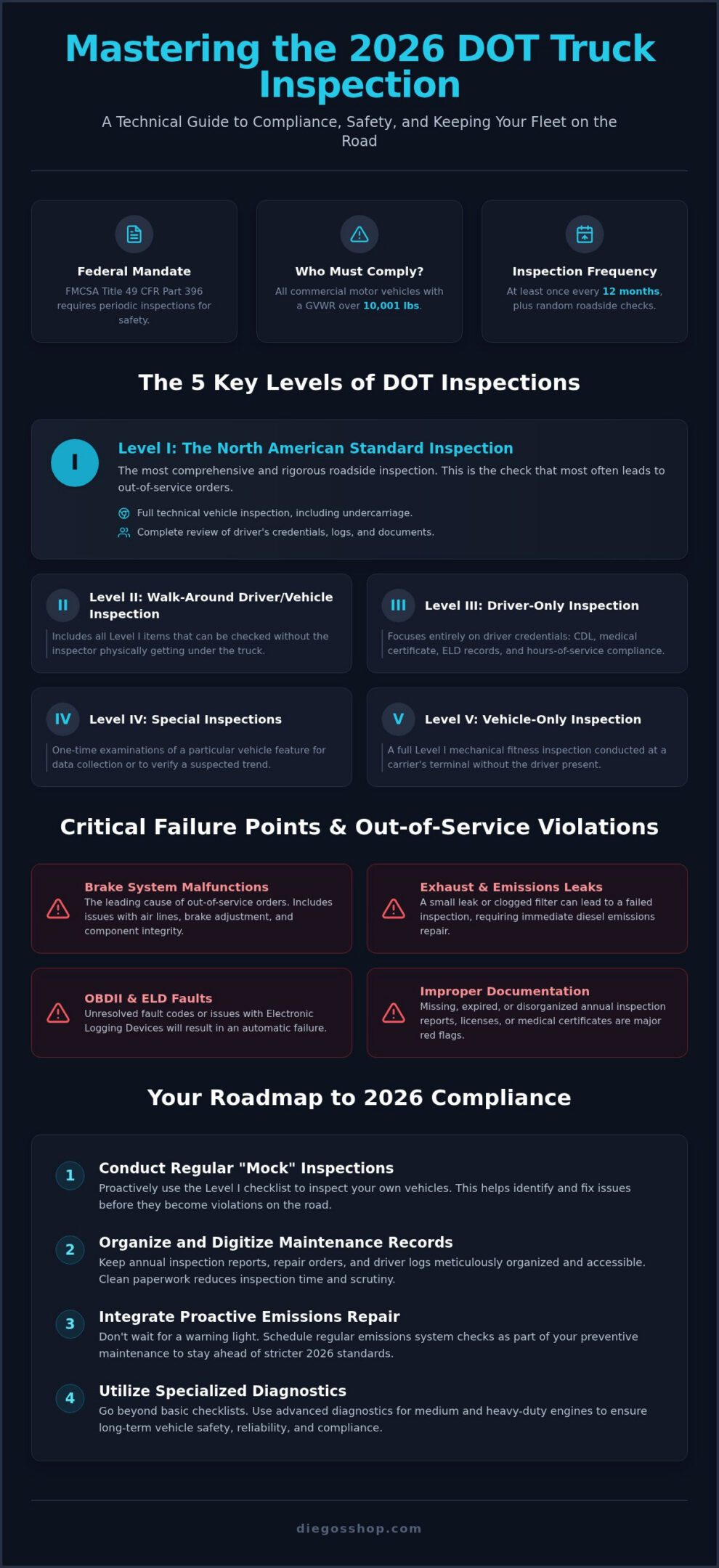
You can’t run a commercial fleet without facing the DOT. Under FMCSA Title 49 CFR Part 396, every commercial motor vehicle weighing over 10,001 lbs GVWR must undergo a periodic inspection at least once every 12 months. This isn’t a suggestion; it’s a federal mandate designed to keep unsafe equipment off the pavement. In 2026, these inspections have become increasingly technical. While Vehicle inspection in the United States provides a broad framework for road safety, Utah operators face specific scrutiny regarding their exhaust systems. Operators often find that a small leak or a clogged filter leads to a failed inspection, requiring immediate diesel emissions repair Utah County to get back on the road.
The 2026 regulations place a heavy emphasis on electronic logging devices (ELDs) and advanced safety technology. Inspectors now look for seamless integration between your vehicle’s computer and your safety records. If your truck’s OBDII system shows unresolved fault codes, you won’t pass. Effective maintenance schedules integrate safety checks with diesel emissions repair Utah County to address these issues before they become legal liabilities. We focus on total control over these complex systems to ensure your fleet stays compliant.
The Role of the FMCSA and UDOT in 2026
Your inspection data doesn’t just sit in a file. It feeds directly into your Compliance, Safety, Accountability (CSA) score. This score is a public record of your fleet’s performance. High scores lead to frequent roadside stops and higher insurance premiums. For Utah County operators, the Utah Department of Transportation (UDOT) has prioritized heavy-duty emissions compliance this year. They’ve implemented new fees for older, high-emissions vehicles and tightened weight exemptions for diesel engines. Failing to meet these standards results in heavy fines and potential out-of-service orders that halt your revenue. We provide the technical mastery needed to keep your equipment within these strict parameters.
Annual vs. Roadside: Knowing the Difference
It’s vital to distinguish between your scheduled annual check and a surprise roadside inspection. You’re required to keep a copy of your passed annual inspection report in the cab at all times. Roadside inspectors often use your annual data to decide which fleets to target for more rigorous checks. If your paperwork is messy or your annual report is nearing expiration, you’re more likely to be pulled over for a Level I inspection. The annual inspection is the minimum legal baseline for safety. Don’t treat it as the final goal. Instead, use it as part of a broader preventive maintenance plan to keep your trucks moving and your business profitable.
The 6 Levels of DOT Inspections: A Technical Breakdown
Understanding the different tiers of enforcement is the first step toward maintaining a compliant fleet. The North American Standard Inspection Program, managed by the CVSA, defines these levels to ensure consistency across state lines. While every stop is serious, the depth of the inspection varies significantly depending on which level the officer chooses to perform. Knowing what each level entails allows you to prepare your equipment and documentation with precision.
- Level I: The most stringent check. It includes a complete review of the driver’s credentials and a thorough mechanical inspection of the entire vehicle, including the undercarriage.
- Level II: A walk-around driver and vehicle inspection. This covers everything in a Level I except for items that require the inspector to physically get under the truck.
- Level III: A driver-only inspection. The focus stays on your CDL, medical examiner’s certificate, and ELD records to ensure hours-of-service compliance.
- Level IV: These are special inspections. They usually focus on a specific component, like a new type of electronic logging technology or a specific safety feature, for research purposes.
- Level V: A vehicle-only inspection. This follows the Level I mechanical checklist but is conducted without the driver present, often during a terminal audit.
Deep Dive into Level I Mechanical Requirements
The Level I inspection is the industry gold standard and the most common source of out-of-service orders. Inspectors follow a rigorous checklist that covers your braking system, fuel lines, lighting, and coupling devices. Under the hood, they look for fluid leaks and structural wear that could lead to a catastrophic failure on the road. For diesel operators, the exhaust system is a primary target. If an inspector finds a cracked DPF or an EGR leak, your truck will be grounded until you secure diesel emissions repair Utah County. We recommend scheduling expert fleet maintenance to catch these technical flaws before a roadside officer finds them for you.
Level VI: Hazardous Materials and Utah-Specific Cargo
Utah serves as a major corridor for sensitive cargo. A Level VI inspection is an enhanced version of the Level I standard, specifically for trucks hauling radioactive materials or specialized hazardous waste along the Wasatch Front. These inspections include extra requirements for radiological shipments and specialized trailer integrity checks. Because the criteria are so high, only technicians with deep technical mastery should handle the preparation. Ensuring your exhaust and cooling systems are in peak condition is vital, as any failure during a hazmat haul carries severe legal and financial penalties. Proper diesel emissions repair Utah County ensures your specialized equipment remains safe and accountable during these high-stakes routes.
Critical DOT Failure Points: Diesel Emissions Repair in Utah County
Brake system malfunctions remain the leading cause of out-of-service (OOS) orders along the Wasatch Front. When an inspector checks your air lines or drum thickness, they aren’t just looking for compliance; they’re looking for signs of potential failure. Beyond brakes, exhaust leaks and emission system failures often trigger immediate violations. If your DPF is cracked or your EGR is leaking, you will fail the 2026 Utah County Emissions Requirements. These technical flaws often lead operators to seek specialized diesel emissions repair Utah County to restore their fleet’s legal standing. We also see frequent fines for tire tread depth and sidewall integrity. While FMCSA sets a minimum, Utah’s harsh winter conditions demand more than just the legal baseline. Even small issues like peeling reflective tape or a burnt-out marker light can result in a major DOT fine that drains your profits.
Maintaining a clean inspection report requires attention to detail. Inspectors are trained to spot the difference between surface wear and structural neglect. A single frayed air line or a leaking wheel seal can ground your vehicle for hours, leading to missed deadlines and frustrated customers. We prioritize comprehensive checks that identify these vulnerabilities before they result in a roadside citation. Our focus is on providing peace of mind through technical mastery.
Utah-Specific Wear: Salt, Grades, and Air Lines
The Wasatch Front presents unique challenges for heavy-duty hardware. Road salt used during Utah winters accelerates corrosion on brake lines and chassis components at an alarming rate. When you combine this with the steep mountain grades of Parley’s Canyon or the climb into Spanish Fork, your brake and exhaust systems face extreme heat cycles. This environmental stress makes specialized diesel maintenance a requirement rather than an option. We ensure your air lines are resilient and your chassis is protected from the corrosive effects of winter travel. Durability is our standard.
EGR and DPF Failures in DOT Inspections
Can a “Check Engine” light fail your DOT inspection in 2026? Yes. For diesel vehicles with a model year between 2007 and 2021, Utah County now requires a computerized OBDII inspection. If your dash is lit up, your truck is not compliant. Most citations stem from three common sensor failures: NOx sensors, DPF pressure sensors, and EGR temperature probes. These components are the heart of your emission control. Modern diagnostics allow us to identify the root cause and perform diesel emissions repair Utah County before an inspector ever steps toward your cab. We maintain total control over your engine’s performance. Accountability is our promise.
How to Prepare Your Fleet for a 2026 DOT Inspection
Preparation is the difference between a clean CVSA decal and a costly towing bill. You shouldn’t wait for a roadside stop to discover a mechanical flaw. Instead, conduct a “mock” DOT check at your own facility. This proactive walk-around allows you to identify minor leaks or worn components before they reach an official scale. If you find a fault code during this process, you have the time to secure diesel emissions repair Utah County without the pressure of an out-of-service order. We recommend scheduling your official inspection at least 30 days before your current sticker expires. This buffer ensures that any required repairs won’t disrupt your delivery schedule.
Appearance matters more than most operators realize. A clean truck signals a well-maintained fleet. When an inspector sees a vehicle covered in thick road grime and oil spray, they assume the internal components are equally neglected. Cleaning your chassis and engine bay makes it easier for you to spot leaks and shows the inspector that you prioritize equipment integrity. Pair this with organized maintenance records. In 2026, inspectors expect instant access to digital ELD logs and service history. Having these documents ready for review demonstrates professional accountability and often leads to a smoother inspection process.
The 15-Minute Driver Pre-Trip Checklist
Every driver should be an expert in the basic safety systems of their vehicle. Start by testing the low-air warning buzzers and ensuring the brake pop-out functionality is responsive. These are high-priority items for any inspector. Next, verify that the fire extinguisher is fully charged and that your safety triangles are present and undamaged. Check every exterior light, including turn signals and high beams. Don’t overlook the reflective tape; if it’s peeling or faded, it’s a violation. These small details are the easiest to fix but the most common reasons for a citation.
Leveraging Preventive Maintenance Plans
Consistency is the foundation of a safe fleet. Professional fleet maintenance identifies potential DOT failures months before they occur. By following a structured service schedule, you ensure that every component, from the brake pads to the DPF, is inspected by a specialist. This is where technical mastery pays off. Choosing a partner that offers warrantied repair work provides peace of mind that your emissions failures are fixed right the first time. Digital maintenance tracking is now essential for 2026 regulatory compliance, as it provides a clear audit trail for state and federal authorities. If you want to ensure your fleet remains compliant and safe, book a comprehensive maintenance review to stay ahead of the regulations.
Professional DOT Inspections in Springville: The Diego’s Shop Advantage
Passing a DOT inspection is about more than just earning a sticker. It’s about the technical integrity of your fleet and the safety of everyone on the road. At Diego’s Shop in Springville, we treat every inspection as a comprehensive health check for your vehicle. Our team brings specialized expertise to Peterbilt, Kenworth, and Ford diesel systems, ensuring that every component meets rigorous federal standards. We don’t just check boxes. We provide deep diagnostics that identify potential failures before they result in a roadside citation. Because we serve the entire Wasatch Front from our strategic location, we understand the specific environmental stressors that Utah trucks face daily.
Technical mastery is the foundation of our service. When you need reliable diesel emissions repair Utah County, you can’t afford to settle for trial and error diagnostics. We maintain total control over complex engine systems, from the turbocharger to the aftertreatment sensors. If we identify a flaw during your inspection, we provide warrantied repair work that ensures you won’t fail for the same issue twice. This commitment to accountability gives you peace of mind and keeps your CSA score protected. Accountability is our promise.
Diesel Specialists vs. General Repair Shops
Modern diesel engines are highly sophisticated machines. General repair shops often lack the specialized software and technical training required to navigate modern emission systems effectively. A master diesel mechanic understands the delicate balance between the EGR, DPF, and SCR components. Choosing specialized diesel repair in Utah at Diego’s Shop saves you from the frustration of recurring out-of-service orders. We speak the language of your engine, allowing us to pinpoint issues that others might overlook. This level of precision is what separates a reliable fleet from one that is constantly sidelined by mechanical failures.
Booking Your 2026 Inspection at Diego’s Shop
We know a truck in the shop isn’t making money. Our inspection process is streamlined to minimize your downtime without sacrificing thoroughness. If a failure is identified during the check, we handle immediate on-site repairs to get you back on the road as quickly as possible. This integrated approach removes the stress of coordinating between an inspector and a separate repair facility. We offer a single, reliable point of contact for all your compliance needs. Don’t wait for a roadside scale to find a problem. Schedule your 2026 DOT inspection at Diego’s Shop today and ensure your fleet remains safe, compliant, and productive. Durability is our standard.
Secure Your Fleet’s Future on the Wasatch Front
Maintaining a compliant fleet in 2026 requires more than just reactive fixes. It demands technical precision. By conducting regular pre-trip checks and staying ahead of the five-county emissions schedule, you protect your CSA score and your bottom line. Whether you are dealing with brake line corrosion from canyon salt or need expert diesel emissions repair Utah County, having a reliable plan is essential for your success. We provide the mastery needed to keep you moving safely and legally.
At Diego’s Shop, we bring specialized expertise to every Peterbilt, Kenworth, and Ford engine that enters our bays. Our Springville location is perfectly positioned to serve operators across the Wasatch Front with warrantied repair work that stands up to the toughest mountain grades. We take personal accountability for your vehicle’s performance and durability. Don’t leave your compliance to chance when you can rely on honest, technical service. We are ready to help you stay on the road and focus on what you do best.
Keep your fleet moving-Book your DOT inspection at Diego’s Shop
Frequently Asked Questions
How much does an annual DOT inspection cost in Utah for 2026?
The price for a mandatory emissions test in Utah County is $49 for 2026. However, the total cost for a full DOT safety inspection varies depending on the service provider’s labor rates and the size of the vehicle. It’s best to contact your local shop for a specific quote that covers both the safety checklist and the required emissions testing.
How long does a Level I DOT inspection typically take?
A Level I DOT inspection typically takes between 45 and 60 minutes to complete. This is the most comprehensive inspection level, as it requires the officer to check the driver’s credentials and perform a thorough mechanical review of the vehicle. This includes inspecting the braking system, fuel lines, and the undercarriage for any signs of wear or failure.
Can I perform my own annual DOT inspection if I am a mechanic?
Yes, but you must meet the specific qualification requirements outlined in FMCSA Part 396.19. You need at least one year of training or experience in a truck maintenance program or as a mechanic. Most fleet operators prefer using a third-party specialist to ensure an unbiased review and maintain professional accountability during potential audits.
What happens if my truck fails a DOT inspection?
If your truck fails for a serious safety violation, the inspector will issue an out-of-service order. This means you can’t move the vehicle until the identified issues are fixed. For failures related to the exhaust system, you’ll need to schedule diesel emissions repair Utah County to clear fault codes and ensure the engine meets the 2026 standards before a re-inspection.
Is a DOT inspection the same as a Utah state safety inspection?
No, they are different requirements. Utah has eliminated general safety inspections for many private vehicles, but commercial vehicles over 10,001 lbs GVWR must still comply with federal DOT annual mandates. A DOT inspection is a federal requirement focused on commercial safety, whereas state emissions tests are specific to local air quality regulations along the Wasatch Front.
Does a “Check Engine” light automatically fail a DOT inspection?
Yes, for diesel vehicles with model years 2007 through 2021, an active “Check Engine” light results in a failed emissions test. The 2026 Utah County rules require an OBDII computerized inspection for these vehicles. If your truck’s computer shows unresolved fault codes or the light is on, the vehicle isn’t considered compliant and won’t pass.
What are the most common DOT violations for diesel trucks in Utah?
Brake system malfunctions are the leading cause of out-of-service orders in Utah. Lighting failures and tire tread depth issues are also frequent sources of citations. We also see an increase in failures related to diesel emissions repair Utah County, specifically involving leaking EGR valves or cracked DPF systems that trigger fault codes during the computerized portion of the test.
How often do I need to get my commercial trailer inspected?
Commercial trailers must undergo a DOT inspection at least once every 12 months. This annual requirement ensures the trailer’s braking systems, lights, and structural components are safe for the road. Keeping your trailer on the same inspection cycle as your tractor is a smart way to simplify your fleet maintenance and avoid missed deadlines.