

Common Peterbilt Engine Problems: 2026 Guide to PACCAR and Cummins Failures

You’re hauling a heavy load through the Wasatch Front when a warning light flashes, followed by the dreaded countdown to a 5 MPH derate. It’s a high-stakes moment that every owner-operator fears, especially when unplanned downtime can cost thousands in lost revenue. While these rigs are the gold standard for durability, understanding common Peterbilt engine problems is the only way to stay ahead of the curve. You need more than a generic scan; you need the technical expertise to tell the difference between a minor sensor glitch and a catastrophic mechanical failure.
We agree that your truck belongs on the road, not sitting in a shop while a generalist guesses at fault codes with a “parts-cannon” approach. This 2026 guide identifies the most frequent mechanical failures in PACCAR and Cummins platforms so you can address them before they sideline your operation. We will examine the specific weaknesses of the MX-13 and X15 systems, clarify the confusion between various emission codes, and provide the diagnostic clarity you need to keep your fleet moving safely through Utah.
Key Takeaways
- Spot early warning signs like frequent regeneration cycles and power loss to prevent a minor sensor fault from escalating into a catastrophic engine failure.
- Understand why aftertreatment systems and VGT actuators are the primary culprits behind the majority of roadside failures and unplanned downtime.
- Compare the distinct mechanical weaknesses of PACCAR MX-13 and Cummins X15 engines to manage common Peterbilt engine problems effectively.
- Learn how Utah’s high-altitude operation and extreme temperatures create specific stressors for your cooling and turbocharger systems.
- Discover how specialized diagnostics eliminate the “parts-cannon” approach and provide a permanent fix for complex fault codes.
Identifying Common Peterbilt Engine Symptoms and Warning Signs
Catching a failing sensor early is the difference between a quick afternoon repair and a $30,000 in-frame overhaul. Modern Peterbilt rigs are designed with complex feedback loops that monitor every aspect of the machine’s health. When we categorize common Peterbilt engine problems, we generally look at failures within the combustion, cooling, or aftertreatment cycles. Your Engine Control Module (ECM) acts as the brain of the truck, communicating these failures via the dashboard display. While legacy drivers of older models often relied on mechanical gauges, as seen in the wide variety of Peterbilt 379 engine options, today’s operators must master the digital language of their trucks. Diesel engines don’t heal themselves; an ignored warning light is simply a countdown to an expensive tow bill.
The Triage Guide: Red vs. Amber Warning Lights
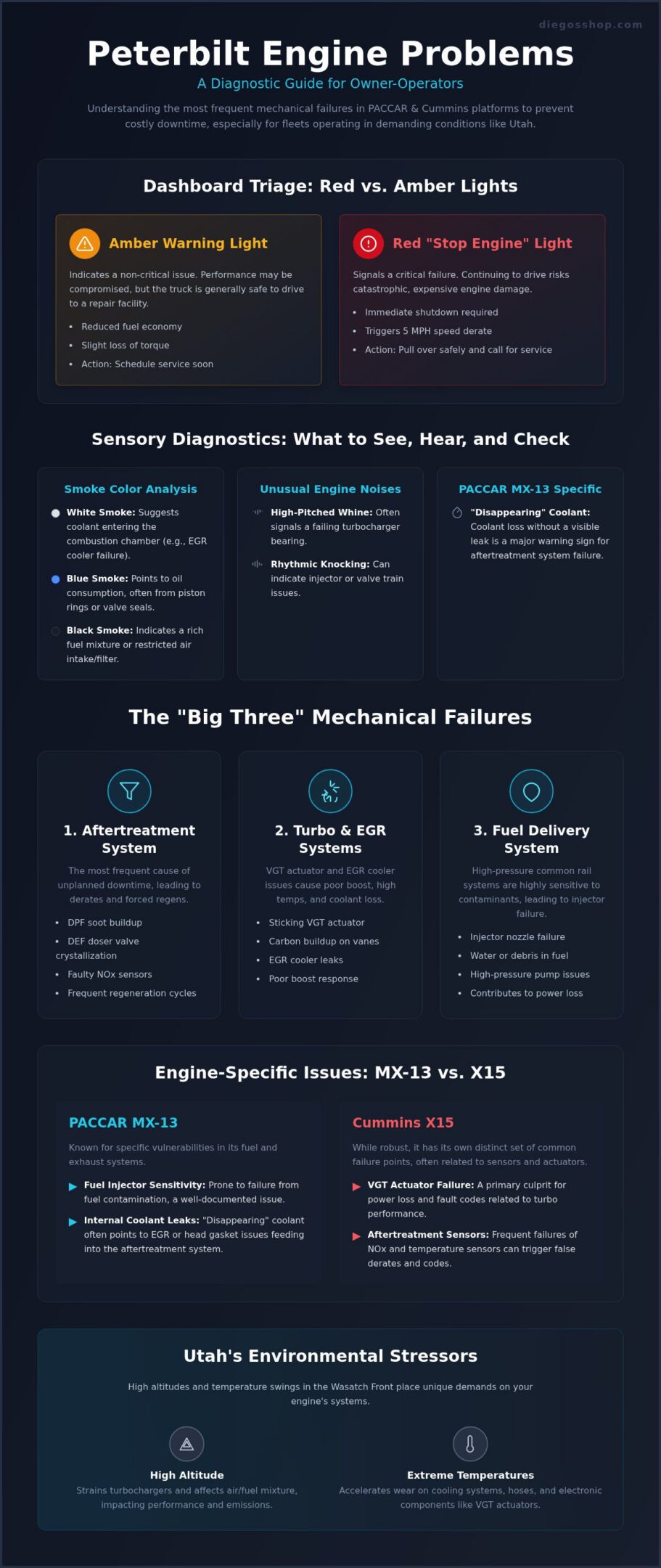
Understanding the severity of a dashboard alert is critical for fleet safety. An amber warning light typically indicates that performance is compromised, but the truck is still operational. You can usually reach a repair facility under these conditions, though you should expect reduced fuel economy or a slight loss in torque. A red “Stop Engine” light is a different story. This is an immediate command to pull over and shut down. Continuing to drive with a red light risks catastrophic internal damage, such as a melted piston or a thrown rod. If the ECM detects a critical failure in the aftertreatment system, it will trigger a derate, eventually capping your speed at a frustrating 5 MPH to protect the hardware.
Visual and Auditory Warning Signs
Your senses are often just as reliable as a scan tool for initial troubleshooting. Smoke color is a primary diagnostic indicator. White smoke usually suggests coolant is entering the combustion chamber, often due to an EGR cooler failure. Blue smoke points to oil consumption, while thick black smoke indicates a rich fuel mixture or a restricted air intake. Listen for unusual noises that deviate from the steady hum of a healthy engine. A high-pitched whining often signals a failing turbocharger bearing, while rhythmic knocking can indicate injector or valve train issues. In PACCAR MX-13 engines, keep a close eye on fluid levels. A “coolant disappearance” without a visible puddle on the ground often means the fluid is being pushed through the exhaust system, a common precursor to total aftertreatment failure.
The “Big Three” Mechanical Failures in Modern Peterbilt Rigs
Mastering the longevity of a modern rig requires a deep understanding of three specific systems: aftertreatment, turbocharging, and fuel delivery. These areas represent the most common Peterbilt engine problems encountered by fleet managers today. While the block and rotating assembly of a PACCAR or Cummins engine are remarkably durable, the bolt-on components are where the battle for uptime is won or lost. High-pressure common rail systems, for example, are incredibly sensitive to water and debris, which can lead to catastrophic injector failure. This sensitivity has even led to significant legal scrutiny, such as the PACCAR MX-13 fuel injector lawsuit. Addressing these vulnerabilities through specialized maintenance prevents minor glitches from snowballing into total engine failure.
DPF and SCR System Restrictions
The aftertreatment system is the single most frequent cause of unplanned downtime. Soot buildup within the Diesel Particulate Filter (DPF) eventually leads to frequent “regens” that consume fuel and reduce power. If the system cannot clear itself, the filter becomes restricted, forcing a manual cleaning or replacement. Simultaneously, the DEF doser valve often fails due to urea crystallization, which blocks the spray of fluid into the Selective Catalytic Reduction (SCR) catalyst. Often, the hardware is fine, but a faulty NOx sensor sends incorrect data to the ECM, triggering a false derate. Precise expert diagnostics are essential to avoid replacing expensive hardware when a simple sensor swap would suffice.
Turbocharger and EGR Cooler Issues
Turbocharger failures in Peterbilt trucks often center on the Variable Geometry Turbo (VGT) actuator. These electronic components control the vanes within the turbo to manage boost levels. When they stick due to carbon buildup or heat soak, you’ll experience poor boost response and dangerously high exhaust temperatures. This often works in tandem with EGR cooler leaks. A leaking cooler is the silent killer of head gaskets because it allows coolant to seep into the intake stream. Symptoms of a failing turbo wheel or bearing assembly include a metallic “dentist drill” whine or visible oil in the charge air cooler pipes. Keeping these components clean through preventive maintenance is the only way to ensure modern emission standards don’t ground your fleet.
PACCAR MX-13 vs. Cummins X15: Engine Specific Issues
Peterbilt trucks are symbols of durability, but the specific maintenance needs depend heavily on the engine platform you select. Most operators choose between the “in-house” PACCAR MX-13 and the “industry-standard” Cummins X15. While both deliver the torque required for heavy-duty hauling, they suffer from distinct mechanical vulnerabilities. Identifying common Peterbilt engine problems requires looking past the chassis and focusing on the specific engine architecture. Diagnostic tools must be calibrated for the specific platform, not just the truck brand, to ensure accurate fault code interpretation. A generic scan often misses the nuance of manufacturer-specific parameters.
Common PACCAR MX-13 Failures
The MX-13 is a favorite for regional haulers because of its superior fuel economy and integrated design. However, it’s prone to several persistent issues that can sideline a truck if ignored. These aren’t necessarily design flaws, but rather sensitive areas that require specialized attention during routine service intervals.
- Coolant Leaks: We frequently see leaks originating at the oil module and water pump seals. These often start as small “weeps” but can quickly escalate into significant fluid loss during high-altitude operation.
- Electrical Harness Chafing: The wiring harness on many MX-13 models is sensitive to engine vibration. Over time, this leads to chafing that creates intermittent “ghost codes,” causing frustration for drivers and technicians who can’t find a physical fault.
- Fuel Pressure Delivery: Issues within the high-pressure pump can lead to inconsistent fuel delivery. This results in rough idling or power surges that compromise the smooth operation of the rig.
Common Cummins X15 Failures
The Cummins X15 is the workhorse of the long-haul industry, prized for its robust power delivery and widespread parts availability. Even with its reputation for strength, it has specific “Achilles heels” that require a watchful eye. It’s an engine that rewards those who listen to its warning signs.
- Cam-Follower Wear: A distinct “ticking” sound from the top end often signals early-model cam-follower wear. If you don’t catch this early, it’ll damage the camshaft itself, leading to a much more expensive repair.
- Fuel Pump Plunger Failures: High-pressure fuel pump plungers can fail, often sending metal shards through the entire fuel system. This metal contamination is a nightmare for injectors and requires a complete system flush to resolve.
- EGR Valve Sticking: Excessive carbon loading can cause the EGR valve to stick. This disrupts the air-to-fuel ratio, leading to poor performance and increased emissions that trigger a derate.
Maintaining these engines requires a master craftsman’s touch and specialized diagnostic equipment. Whether you run the fuel-efficient PACCAR or the high-torque Cummins, staying ahead of these platform-specific failures is the only way to guarantee total control over your fleet’s uptime. Accurate diagnosis is the first step toward a permanent fix.
Troubleshooting and Preventive Maintenance for Utah Fleets
Utah’s geography is unforgiving on heavy-duty equipment. Operating a Peterbilt along the Wasatch Front or through the steep grades of the I-15 corridor introduces stressors that flatland fleets never encounter. High-altitude operation means thinner air, which directly affects how your turbocharger spools and how efficiently your cooling system dissipates heat. These environmental factors often exacerbate common Peterbilt engine problems, turning a small sensor drift into a full-blown roadside emergency. Proactive service is the only way to ensure fleet maintenance pays for itself rather than becoming a sunk cost of doing business.
Steep grades like Parley’s Canyon put immense thermal loads on your engine. When you’re pulling 80,000 pounds uphill in thin air, your cooling system is pushed to its absolute limit. This is where weak points in the PACCAR MX-13 water pump or the Cummins X15 EGR cooler become apparent. In the winter, the salt and magnesium chloride used on Utah roads can wreak havoc on exposed electrical connectors, leading to the intermittent “ghost codes” we discussed earlier. Addressing these regional challenges requires a technician who understands the local environment.
The Role of Diesel Diagnostics
For 2020 and newer Peterbilt models, a simple code reader is no longer sufficient. Modern troubleshooting requires advanced computer diagnostics that can interpret thousands of data points in real-time. We don’t just read the code; we analyze live data to find the root cause of the failure. If a NOx sensor is reading out of range, we determine if it’s a bad sensor or if the doser valve is failing to prime. Integrating diesel engine repair with data-driven inspections allows us to solve the problem permanently the first time.
Preventive Protocols for OTR Drivers
Winter in Utah demands a specific set of preventive protocols. Cold-soaked batteries and gelled fuel are frequent culprits for morning no-starts. We recommend regular testing of fuel heaters and checking battery load capacity before the first frost hits. Beyond the basics, oil analysis serves as a “blood test” for your engine. It catches microscopic metal wear that signals a failing bearing long before it spins and ruins the block. Similarly, regular coolant testing prevents liner cavitation and internal EGR corrosion. This is the core of diesel maintenance: building rugged reliability for the long haul.
Don’t wait for a dashboard warning to dictate your schedule. If you’ve noticed a drop in boost or higher-than-normal operating temperatures, it’s time for a professional evaluation. Schedule a comprehensive diagnostic session at Diego’s Shop to keep your Peterbilt running at peak performance.
Professional Peterbilt Engine Repair at Diego’s Shop
Diego’s Shop in Springville provides the technical mastery required to solve common Peterbilt engine problems once and for all. We don’t believe in the “guess-and-check” method that plagues many unspecialized shops. Instead, we use expert diagnostics to pinpoint the exact failure point, saving you from the “parts-cannon” approach that leads to unnecessary expenses. Our team handles everything from aftertreatment system overhauls to high-pressure fuel pump repairs with the precision of a seasoned master craftsman. We serve fleet managers and owner-operators throughout Utah County and the entire Wasatch Front with a focus on durability and total control over the repair process. Every job we take on is backed by our commitment to warrantied repair work, ensuring your investment is protected.
Why Specialized Expertise Matters
General repair shops often lack the proprietary software necessary for deep-dives into PACCAR and Cummins engine controllers. Without these tools, they’re essentially flying blind. This leads to the “guess-and-check” cycle where sensors are replaced one by one while the root cause remains. Our approach is built on integrity and personal accountability. We maintain total control over the diagnostic sequence to ensure every repair meets our high standards for performance and safety. We understand that every hour your truck sits in a bay is an hour it’s not earning revenue. Our specialized knowledge of the MX-13 and X15 platforms allows us to identify issues like harness chafing or actuator sticking much faster than a generalist. We get you back on the road safely and efficiently, with the confidence that the job was done right.
Schedule Your Peterbilt Service in Springville
Our facility is conveniently located in Springville, making it an ideal stop for long-haulers on the I-15 and local commercial fleets alike. We provide comprehensive diesel repair in Utah that drivers can rely on when the stakes are high. Whether you’re dealing with an intermittent ghost code or a full-blown engine derate, we have the specialized equipment and hands-on experience to fix it. Don’t let a minor symptom turn into a catastrophic failure that grounds your entire operation. Call or visit us today to schedule your service and keep your Peterbilt performing at its absolute best. We take pride in the durability of our work and the peace of mind we provide to our customers. Reliable expertise is just a phone call away.
Secure Your Fleet’s Uptime for the Long Haul
Mastering the complexities of modern diesel systems requires a shift from reactive repairs to proactive management. You now know how to distinguish between minor sensor drifts and critical mechanical failures in your PACCAR or Cummins powerplants. By prioritizing specialized diagnostics and regional maintenance protocols, you protect your rig from the expensive derates that sideline unprepared fleets. Managing common Peterbilt engine problems effectively is a matter of technical precision and consistent oversight.
You deserve a partner who understands the mechanical nuances of the Wasatch Front. Diego’s Shop brings the integrity of a master craftsman to every service bay, ensuring your truck receives the precise care it needs to stay on the road. We eliminate the uncertainty of fault codes and provide a clear path to durable performance. Don’t let unplanned downtime dictate your schedule or drain your revenue.
Get Expert Peterbilt Engine Repair at Diego’s Shop. As heavy-duty fleet specialists in Springville, UT, we provide the warrantied diesel repairs and local expertise you can depend on. Let’s keep your fleet moving forward with total control and confidence.
Frequently Asked Questions
Why is my Peterbilt losing power on hills?
Losing power on hills is often due to a combination of high-altitude air density and turbocharger inefficiencies. In Utah, thinner air requires your turbo to work harder to maintain boost levels. If your VGT actuator is sticking or your air filters are restricted, you’ll feel a significant drop in torque exactly when you need it most. We often find that boost leaks in the charge air cooler are the hidden culprit.
What does a “DEF System Derate” mean for my engine?
A DEF System Derate is a protective software command that limits your engine’s power output when emissions sensors detect a failure. It’s designed to ensure compliance with EPA standards by making the truck difficult to operate until it’s repaired. If the fault persists, the ECM will eventually cap your speed at 5 MPH. This ensures that operators address the emissions failure before it causes permanent damage to the SCR catalyst.
How often should I clean the DPF on a PACCAR MX-13?
Most PACCAR MX-13 engines require a professional DPF cleaning every 200,000 to 400,000 miles. However, this interval varies based on your idle time, fuel quality, and average load weights. If you notice your truck performing “parked regens” more than once a week, your filter is likely reaching its ash capacity. Neglecting this leads to high backpressure that can eventually crack the expensive DPF substrate.
Is it safe to drive my Peterbilt with an amber check engine light?
Driving with an amber light is generally acceptable for reaching a repair facility, but you should not continue your normal route. An amber light indicates a non-critical fault that still compromises engine efficiency and fuel economy. Ignoring this warning often results in a red “Stop Engine” light, which requires an immediate roadside shutdown. Taking care of it early prevents a minor sensor issue from becoming a major mechanical failure.
Why is my Cummins engine making a ticking noise?
A distinct ticking noise in a Cummins X15 often points to cam-follower wear or valve train issues. This is a critical warning sign that should never be ignored by owner-operators. If the followers fail completely, they can scar the camshaft, turning a relatively straightforward top-end repair into a complete engine teardown. Regular oil analysis is the best way to catch the metallic debris from this wear before it destroys the block.
What causes coolant to disappear without a visible leak in a Peterbilt?
Disappearing coolant without a visible puddle usually indicates an internal leak in the EGR cooler or a failing head gasket. This is one of the more common Peterbilt engine problems that leads to white smoke in the exhaust stream. The coolant is being pulled into the intake and burned during combustion. This process can eventually foul your DPF and SCR catalysts, leading to even more expensive aftertreatment repairs.
How much does a Peterbilt turbo replacement typically cost?
The cost of a turbocharger replacement depends on whether the failure is in the mechanical wheel or the electronic VGT actuator. Industry reports confirm that turbochargers are among the most expensive components to replace on a heavy-duty diesel engine. We recommend a professional diagnostic session to determine if the entire unit has failed. Sometimes, a thorough cleaning of the vanes or an actuator calibration can restore full performance.
Can cold Utah weather cause fuel gelling in my Peterbilt?
Cold Utah winters absolutely cause fuel gelling when temperatures drop below the cloud point of your diesel fuel. Paraffin wax in the fuel crystallizes and clogs your primary and secondary filters, leading to a no-start condition. We recommend using winter-blend fuel and ensuring your fuel heaters are fully functional before the first major cold snap hits the Wasatch Front. This prevents unplanned downtime during the peak hauling season.