
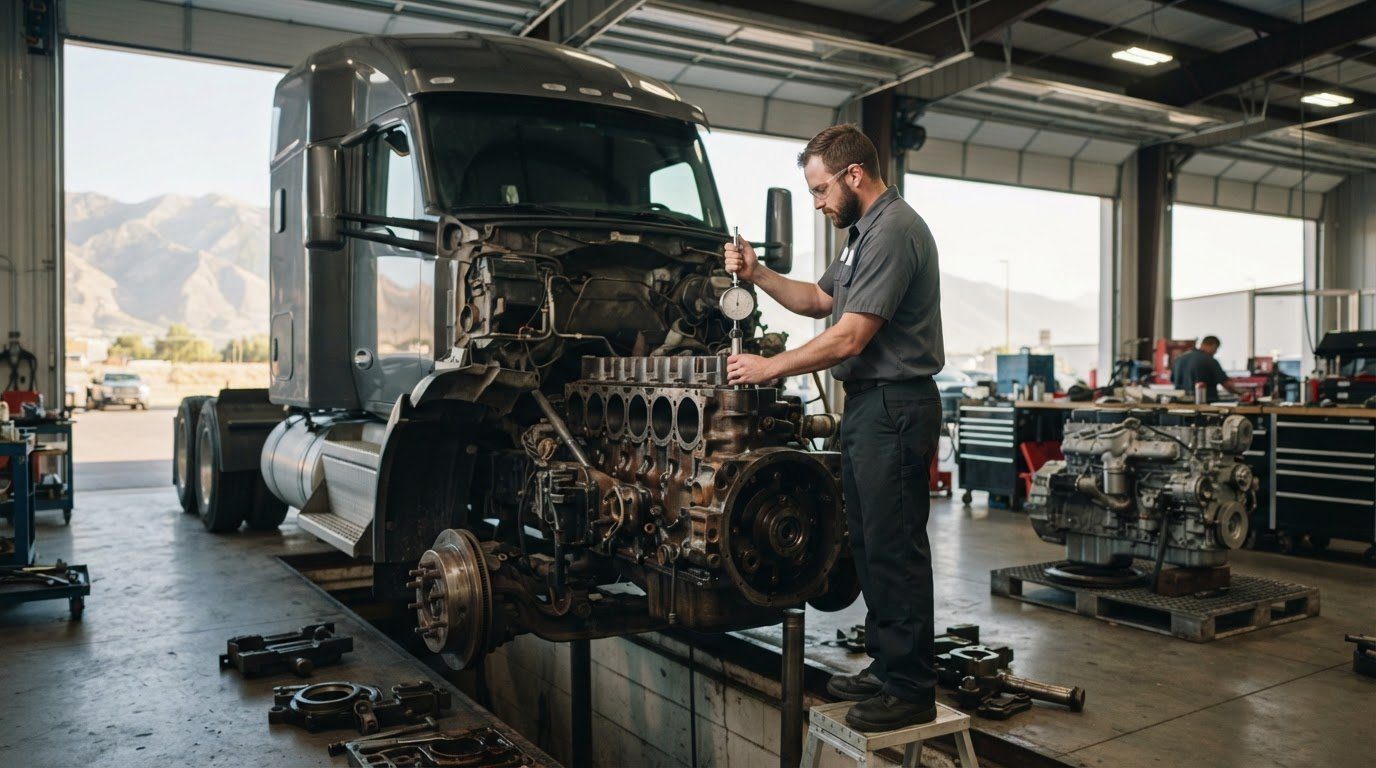
When to Choose an In-Frame Rebuild Over Replacement in 2026

Pulling a heavy-duty diesel engine out of the chassis is often an expensive mistake when the underlying block remains structurally sound. For fleet managers watching delivery schedules slip, knowing when is an in-frame rebuild a better option than replacement comes down to two critical factors: foundational metal integrity and bay turnaround time.
Every day your truck sits sidelined, revenue disappears. Worse yet is the fear of committing to an in-frame overhaul only to discover a condemned block or a scored crank after teardown. Balancing immediate shop turnaround against the remaining service life of your chassis is one of the toughest calls in fleet maintenance.
You don’t have to gamble your operating budget on guesswork. You will discover the exact mechanical benchmarks that prove when an in-frame overhaul outperforms a complete engine replacement. We will examine a diagnostic inspection checklist for block viability, analyze realistic shop downtime, and give you the data needed to protect your truck’s operational future.
Key Takeaways
- Understanding when is an in-frame rebuild a better option than replacement starts with verifying foundational block integrity and counterbore condition before committing to extensive repairs.
- Leaving the engine block mounted in the chassis cuts labor hours and turnaround time by bypassing transmission extraction, front axle drops, and long crate freight delays.
- Evaluating the remaining service life of your chassis, transmission, and suspension ensures you match your overhaul investment directly to the truck’s realistic operational lifespan.
- Precision assembly standards, from verified liner protrusion to strict torque-to-yield bolt sequences, are essential for securing reliable mileage and comprehensive warranty protection.
Understanding the Core Differences: In-Frame Rebuild vs. Engine Replacement
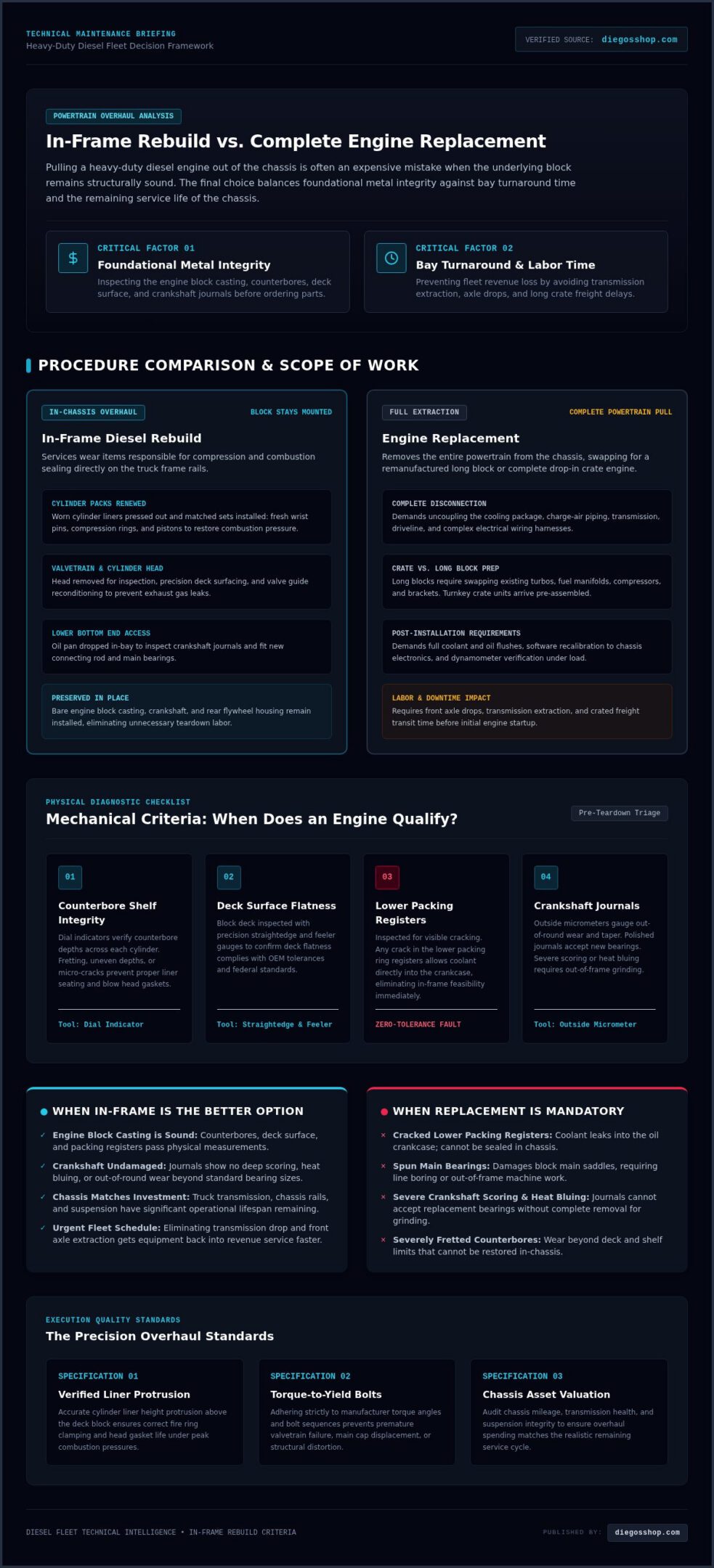
Deciding between an overhaul and a crate swap dictates how long your truck occupies a repair bay. Knowing when is an in-frame rebuild a better option than replacement requires understanding exactly what changes during both procedures. An in-frame rebuild services the core power-producing components while the engine block stays mounted to the truck frame rails. A complete replacement removes the entire powertrain from the chassis, swapping it for a remanufactured or new unit.
The Anatomy of an In-Frame Diesel Overhaul
During an in-frame overhaul, technicians strip the engine down to its base casting directly in the bay. The process renews the wear items responsible for compression and combustion sealing:
- Cylinder packs: Technicians press out worn cylinder liners and install fresh matched sets, including wrist pins, compression rings, and the engine’s pistons to restore proper combustion cylinder pressure.
- Valvetrain and head: The cylinder head is removed for inspection, surfacing, and valve guide reconditioning to prevent exhaust gas leaks.
- Lower bottom end: The oil pan drops, allowing access to inspect crankshaft journals and install new connecting rod and main bearings.
Crucially, an in-frame rebuild leaves the bare engine block, the crankshaft, and the rear flywheel housing in place. If these core metal foundations remain within strict manufacturer tolerances, rebuilding them in place eliminates unnecessary teardown labor.
What a Full Diesel Engine Replacement Entails
A full replacement takes a radically different route. Technicians must disconnect the cooling package, charge-air piping, transmission, driveline, and complex electrical harnesses. Once freed, the failed engine is hoisted entirely out of the frame.
Operators usually choose between a remanufactured long block or a turnkey crate engine. A long block requires swapping over existing turbos, fuel manifolds, compressors, and brackets. A complete turnkey drop-in includes these accessories pre-assembled. After installation, the truck requires complete coolant and oil flushes, software recalibration to match chassis electronics, and dynamometer verification to test under load. When asking yourself when is an in-frame rebuild a better option than replacement, remember that crate replacements demand extensive mechanical disassembly before the new engine fires a single stroke.
Critical Mechanical Criteria: When Your Diesel Engine Qualifies for an In-Frame
A successful overhaul relies entirely on the structural condition of the engine’s casting. Determining when is an in-frame rebuild a better option than replacement requires strict physical triage before ordering parts. If the block deck, counterbores, or crankshaft journals show extreme wear, an in-frame rebuild will fail prematurely. Scheduling professional diesel engine repair at the first sign of excessive blow-by or oil consumption prevents progressive damage that ruins an otherwise salvageable core.
Block and Counterbore Structural Integrity
Precision measurement determines whether the engine block can remain in the bay. Technicians mount dial indicators to check counterbore depths across each cylinder. Fretting, uneven depths, or micro-cracks along the counterbore shelf prevent proper liner seating and blow head gaskets. Precision straightedges and feeler gauges confirm deck surface flatness to comply with OEM tolerances and federal rebuilding standards. Most critically, any visible cracking in the lower packing ring registers allows coolant into the crankcase, eliminating in-frame feasibility immediately.
Crankshaft and Lower-End Journal Evaluation
Inspecting the bottom end confirms whether standard bearings can restore factory clearances. Technicians use outside micrometers to measure crank journals for out-of-round wear, taper, and deep scoring:
- Journal surface condition: Polished, undamaged journals accept standard or undersized replacement bearings without pulling the crank. Severe scoring or heat bluing requires out-of-frame crankshaft grinding.
- Main bearing saddle alignment: A spun main bearing damages the block’s parent bore. Restoring that bore requires line boring on an industrial machining table, which forces engine extraction.
- Lube system debris analysis: Inspecting the oil pump pickup screen separates routine copper and aluminum bearing wear from steel particulate. Heavy magnetic debris circulating through internal oil galleries contaminates fresh bearings within hours.
Recognizing when is an in-frame rebuild a better option than replacement preserves your operating capital. If your oil analysis remains free of shrapnel and the block casting measures true, keeping the block between the frame rails delivers unmatched value. Fleet managers across the region rely on thorough mechanical evaluations from Diego’s Shop to confirm core integrity before turning a single wrench.
Operational and Economic Trade-Offs: Labor, Turnaround Time, and Fleet Downtime
Revenue in commercial trucking depends on rolling wheels. When deciding when is an in-frame rebuild a better option than replacement, shop hours and scheduling logistics often outweigh the price of raw steel. Every day a Class 8 truck sits parked inside a repair bay, fixed insurance, driver wages, and missed delivery bonuses compound into serious fleet losses. Establishing consistent fleet maintenance programs allows operators to catch worn liners early, transforming emergency teardowns into controlled, scheduled overhauls.
Shop Labor Hours and Bay-Time Comparison
Labor allocation differs dramatically between keeping an engine in the chassis and extracting it entirely. An in-frame rebuild isolates technician labor directly to the failed components, whereas a replacement requires extensive powertrain disassembly:
- Chassis preservation: An in-frame rebuild leaves the transmission, clutch linkage, front steer axle, and cab mounts undisturbed. Technicians work through the oil pan opening and cylinder head deck.
- Extraction overhead: Swapping an engine requires draining hydraulic circuits, discharging air conditioning loops, disconnecting complex wiring harnesses, and uncoupling the driveline. Reconnecting these support systems adds dozens of billable technician hours before the replacement engine even turns over.
- Platform accessibility: Engine bay designs on Peterbilt, Kenworth, and Freightliner models heavily dictate labor speed. Conventional long-hood chassis offer ample clearance for in-chassis liner extraction, whereas severe-service cabovers multiply extraction complexity.
Minimizing Route Interruption and Fleet Scheduling
Supply chain timelines play a massive role in answering when is an in-frame rebuild a better option than replacement for active fleets. Sourcing a remanufactured crate engine frequently involves unpredictable freight transit, core return charges, and backorder delays that leave trucks stranded for weeks. In contrast, comprehensive in-frame overhaul kits for popular Cummins, Detroit, and Caterpillar platforms are readily stocked across regional distribution hubs.
For vocational haulers and freight fleets operating across the Wasatch Front and Utah County, lost operational days quickly devastate tight delivery contracts. Staging overhaul kits based on oil analysis trends lets fleet managers complete a full in-chassis rebuild in roughly half the bay time of an extraction swap. Following a disciplined in-chassis break-in protocol puts the truck back on the road earning revenue while out-of-frame candidates are still waiting for freight delivery.
Assessing Total Asset Value: Mileage, Chassis Condition, and Future Duty Cycles
An engine does not operate in a vacuum. Deciding when is an in-frame rebuild a better option than replacement requires matching your mechanical investment directly to the truck’s remaining operational lifespan. Installing an expensive crate powertrain into a chassis with fatigued rails or a worn transmission creates an unbalanced asset that drains maintenance budgets. Reviewing your logs against the 2026 diesel maintenance handbook helps establish realistic vehicle longevity benchmarks before approving major overhauls.
Evaluating the Remaining Useful Life of Supporting Systems
A comprehensive vehicle inspection must precede any internal engine work. Fleet owners must assess three major structural zones before committing capital:
- Structural frame and suspension: Severe-service hauling stresses crossmembers, spring hangers, and frame rails. Cracked web flanges or heavy corrosion around fifth-wheel mountings disqualify an aging chassis from receiving a costly crate engine.
- Emissions aftertreatment modules: Check the remaining service capacity of the Diesel Particulate Filter (DPF), Diesel Oxidation Catalyst (DOC), and Selective Catalytic Reduction (SCR) canisters. If the aftertreatment system requires imminent, full-scale replacement, an economical in-frame keeps overall expenditure manageable.
- Drivetrain components: Inspect transmission synchronizer health, clutch wear indicators, and differential ring-and-pinion gear lash. A truck needing both an engine swap and a transmission rebuild rarely justifies the expense unless the chassis is exceptionally young.
Owner-Operator vs. Fleet Management Strategies
Your operating model determines whether an in-frame overhaul provides adequate amortization. For cross-country, high-mileage line-haul carriers logging over 120,000 miles annually, a complete crate replacement might amortize cleanly across a five-year horizon. Vocational dump trucks, regional delivery units, and municipal haulers run far fewer annual miles. In those applications, an in-frame rebuild restores compression, eliminates blow-by, and delivers 300,000 to 500,000 additional miles without over-capitalizing on an aging asset.
Secondary resale value also depends on certified paperwork. A documented, warrantied in-chassis rebuild protects fleet trade-in values by showing future buyers that critical wear items were professionally renewed. When evaluating when is an in-frame rebuild a better option than replacement for your balance sheet, look at the full picture of depreciation and remaining chassis life. Schedule a commercial fleet diagnostic assessment with our master technicians to evaluate your complete powertrain and chassis before investing.
The Precision Overhaul Standard: Selecting the Right Repair Partner in Utah
An in-frame overhaul is only as dependable as the hands executing the assembly. Understanding when is an in-frame rebuild a better option than replacement requires trusting that your technician respects thousandth-of-an-inch tolerances. Cutting corners during in-chassis assembly turns a cost-effective rebuild into catastrophic premature failure. Objective diagnostics and precision craftsmanship ensure your powertrain delivers the extended service life you expect.
Critical Measurements That Determine In-Frame Longevity
Precision measurement separates a reliable build from a recurring headache. Technicians must verify several critical physical specifications before torquing down components:
- Liner protrusion verification: Dial indicators must measure liner protrusion across four perimeter points on every cylinder. If protrusion sits even 0.002 inches below specification, the head gasket fire ring fails to clamp properly, blowing the gasket within 50,000 miles. Excessive protrusion cracks cylinder flanges once the head bolts stretch under operating heat.
- Torque-turn fastener procedures: Technicians must follow strict multi-stage torque-turn sequences using fresh torque-to-yield hardware on connecting rod caps and cylinder head studs. Reusing stretched bolts or skipping rotational angle verification invites rod cap separation under load.
- Cylinder wall cross-hatch inspection: Verifying precision cross-hatch plateau honing on wet liners guarantees steady oil retention and rapid piston ring seating during break-in.
Local Expertise Across the Wasatch Front
Managing commercial fleets demands dedicated shop tooling that general garages simply do not possess. Rigid counterbore cutters, mechanical liner pullers, and advanced electronic diagnostic tooling for Cummins, Detroit, and Caterpillar platforms are essential for flawless execution. For fleet managers across Utah County and the Wasatch Front, working with an established regional facility eliminates the long freight delays and uncertain build quality of out-of-state crate suppliers.
The definitive safeguard for your balance sheet is warrantied repair work. A warrantied overhaul provides clear operational accountability, ensuring that every seal, bearing, and matched cylinder pack meets commercial durability standards. When evaluating when is an in-frame rebuild a better option than replacement, partner with seasoned technicians who back their work with integrity. You can secure precision commercial diagnostics and heavy-duty overhauls built for the long haul by scheduling service with Diego’s Shop in Springville.
Protect Your Powertrain Investment with Precision Diagnostics
Deciding when is an in-frame rebuild a better option than replacement comes down to verifying your engine’s physical block integrity, respecting bay turnaround schedules, and aligning repair costs with your remaining chassis life. When your cylinder block, counterbores, and crankshaft remain structurally sound, an in-frame overhaul delivers hundreds of thousands of dependable miles without the long supply-chain delays of an engine swap.
You don’t need to make this critical asset decision in the dark. At our dedicated fleet service center in Springville, Utah, our technicians apply master-level precision across Cummins, Detroit, CAT, and Isuzu platforms. We deliver warrantied commercial repair work designed to keep your trucks on the road earning revenue. Schedule a Diesel Engine Diagnostic with Diego’s Shop today and secure the right path forward for your fleet.
Frequently Asked Questions
How long does a heavy-duty in-frame diesel rebuild typically last?
A properly executed heavy-duty in-frame rebuild typically adds 300,000 to 500,000 miles of reliable operational service life. Overall longevity depends on disciplined preventive maintenance, correct liner protrusion during assembly, and routine oil analysis. When technicians install precision-matched pistons, liners, and bearings according to strict factory tolerances, the engine delivers durable power comparable to a remanufactured crate unit.
What is the main difference between an in-frame and an out-of-frame overhaul?
The main difference is whether the bare engine block remains mounted inside the truck chassis during the repair process. An in-frame overhaul renews cylinder packs, connecting rod bearings, and cylinder heads while the block stays bolted to the frame rails. An out-of-frame overhaul pulls the entire engine to machine crankshafts or line-bore the block. Recognizing these limits shows when is an in-frame rebuild a better option than replacement for reducing downtime.
Can an in-frame rebuild fix a diesel engine that has spun a main bearing?
No, a spun main bearing cannot be properly corrected with an in-frame rebuild. When a main bearing spins, intense frictional heat distorts the engine block’s parent bore and scores the crankshaft journal. Restoring proper saddle alignment requires extracting the engine block for precision line boring on an industrial machining table. Rolling a new bearing into a warped saddle causes an immediate secondary failure.
How do technicians verify whether a cylinder block is suitable for an in-frame?
Technicians use dial depth gauges, precision straightedges, and magnetic particle inspection to verify block structural integrity before assembly. They measure counterbore depth across multiple points to confirm uniform liner seating and inspect lower packing registers for stress fractures. If the counterbores show fretting or the crankshaft journals reveal deep scoring, the engine requires full removal rather than in-chassis rebuilding.
Does an in-frame overhaul address emissions components like the DPF and EGR?
An in-frame overhaul focuses strictly on internal mechanical components and does not automatically service exhaust aftertreatment systems. While restoring cylinder compression eliminates excessive oil blow-by that clogs filters, components like the Diesel Particulate Filter and EGR cooler require separate diagnostic testing and ultrasonic cleaning. Technicians inspect these assemblies during the rebuild to prevent backpressure from damaging fresh cylinder packs.
How much downtime should a commercial fleet anticipate for an in-frame rebuild?
Commercial fleets should plan for approximately 7 to 14 days of bay downtime for a standard heavy-duty in-frame rebuild. This turnaround is substantially faster than waiting weeks for freight delivery and harness retrofitting on a crate engine. For fleet operators across the Wasatch Front, knowing when is an in-frame rebuild a better option than replacement keeps delivery schedules intact and cuts idle revenue losses.
Can light and medium-duty diesel trucks receive an in-frame rebuild?
Most light and many medium-duty diesel engines cannot undergo an in-frame rebuild because they utilize parent-bore cylinder blocks without removable wet liners. Engines like the Ford Powerstroke require complete extraction for machine boring and oversized pistons. However, commercial medium-duty engines with wet cylinder sleeves, including select Isuzu platforms, can sometimes undergo in-chassis overhauls depending on chassis clearance and oil pan access.