

What to Do When Your Diesel Truck Overheats: A Driver’s Response Guide

Ignoring a climbing temperature gauge for even five minutes can turn a simple cooling issue into a catastrophic engine failure. When that needle hits the red zone, you aren’t just looking at a minor delay. You are facing a thermal management crisis that can warp high-compression components and lead to permanent damage. It’s a high-stakes situation that every fleet owner and independent driver dreads. You know that every second you spend wondering what to do when diesel truck overheats is a second that puts your cylinder heads and gaskets at risk.
We understand that downtime is the enemy of your bottom line. You need clear, authoritative steps to regain control of the situation and protect your investment. This guide provides the immediate professional response protocols you need to save your engine and avoid the stress of unexpected mechanical breakdowns. We’ll walk through the specific technical causes behind diesel overheating, the role of modern OAT coolants which now hold over 52% of the market, and the preventive maintenance habits that ensure your truck stays out of the shop and on the job.
Key Takeaways
- Learn the critical “First 60 Seconds” protocol to determine if your engine requires an immediate shutdown or a high-idle cool down.
- Understand exactly what to do when diesel truck overheats to prevent the catastrophic failure of high-compression cylinder heads.
- Identify the diesel-specific weak points, like EGR coolers, that often cause overheating symptoms without showing a visible external leak.
- Discover how to perform a safe visual inspection once the engine is touch-safe to rule out “false” overheats caused by faulty sensors.
- Recognize why specialized diagnostics and preventive maintenance are essential for maintaining fleet uptime and ensuring engine durability.
What to Do the Moment Your Diesel Truck Overheats
When the temperature gauge climbs toward the red zone, the next sixty seconds determine whether you face a routine repair or a complete engine replacement. Diesel engines operate under immense pressure and heat. Unlike gasoline engines, the heavy iron or aluminum blocks of a diesel powerplant retain thermal energy for much longer, making an overheat a high-stakes emergency. Knowing exactly what to do when diesel truck overheats allows you to stay calm and execute a professional response that protects your equipment and your safety.
The Immediate Response Sequence
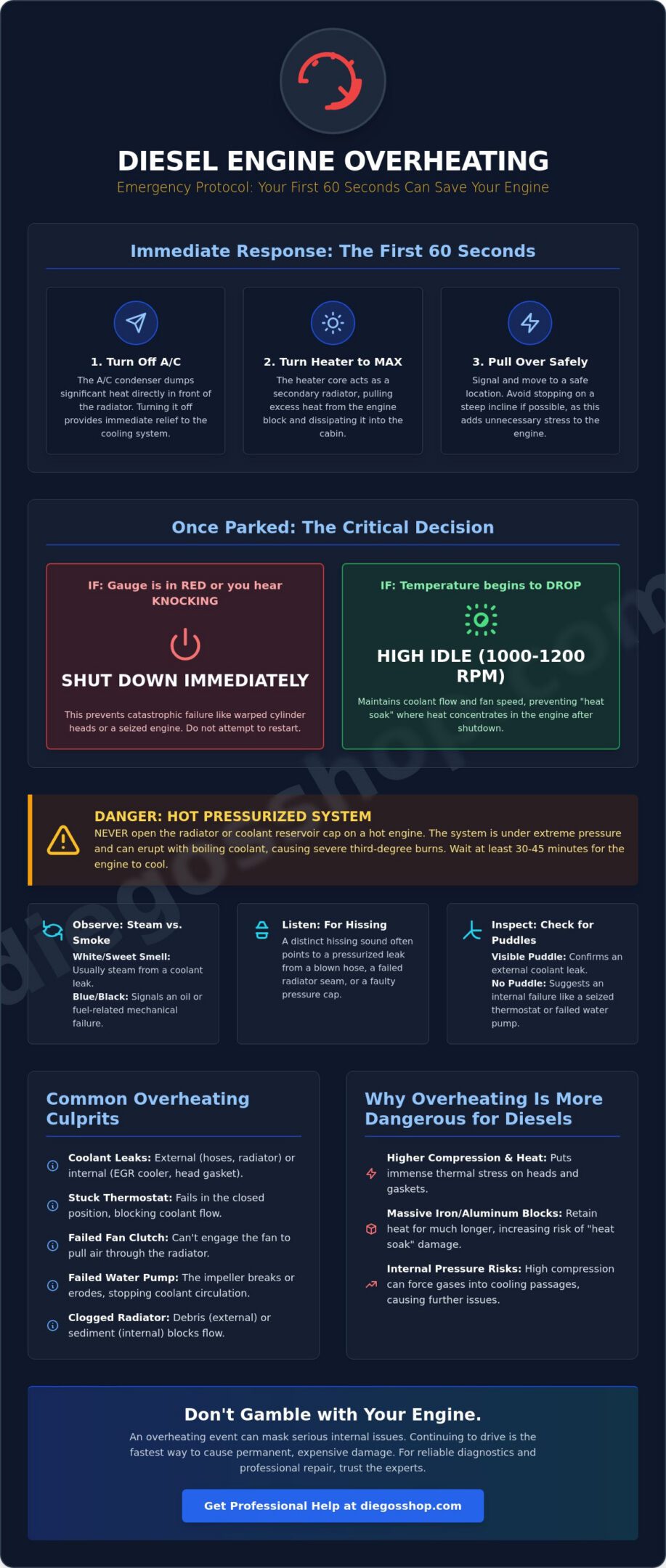
Your first priority is to reduce the load on the engine cooling system. Immediately turn off the air conditioning. The AC condenser sits right in front of your radiator, and its operation dumps significant heat directly into the cooling stack. Next, turn your cabin heater to its maximum setting and set the fan to high. This utilizes the heater core as a secondary radiator, pulling excess heat away from the engine block and into the cab. It’ll be uncomfortable, but it’s a proven method to buy yourself a few extra minutes of engine life.
Signal and move to a safe shoulder or an exit. Avoid stopping on a steep incline if possible, as idling an overheated engine while fighting gravity adds unnecessary stress. Once you’re stationary, monitor the gauge closely. If the needle is buried in the red or you hear a loud knocking sound, shut the engine down immediately. However, if the temperature begins to drop while parked, keeping the engine at a high idle (around 1,000 to 1,200 RPM) can sometimes be safer. This maintains coolant flow and airflow from the mechanical fan, preventing “heat soak” that occurs when a hot engine is suddenly silenced.
Safety Precautions for Roadside Inspection
Once you’ve stopped, your primary job is observation, not immediate repair. Never, under any circumstances, attempt to open a pressurized radiator cap or coolant reservoir on a hot diesel engine. The system is under extreme pressure; opening it can cause a geyser of boiling coolant that leads to severe third-degree burns. You must wait at least 30 minutes before you even think about checking fluid levels or touching cooling components.
- Identify Steam vs. Smoke: White, sweet-smelling clouds usually indicate steam from a coolant leak. Blue or black clouds typically signal an oil or fuel-related mechanical failure.
- Listen for Leaks: A hissing sound often points to a blown hose or a failed pressure cap.
- Check the Ground: Look for puddles forming under the front of the truck. If the ground is dry but the engine is overheating, you might be dealing with an internal failure like a seized thermostat or a failed water pump.
Your goal is to gather data for a technician while staying out of harm’s way. If the gauge doesn’t drop quickly or you see visible fluid loss, it’s time to call for a professional tow. Continuing to drive while wondering what to do when diesel truck overheats is the fastest way to warp a cylinder head beyond repair.
Identifying Common Causes of Diesel Engine Overheating
Once you’ve stabilized the vehicle, the focus shifts to root cause analysis. Diesel engines are built for durability, but they rely on a delicate balance of fluid dynamics and airflow. Identifying the culprit quickly can be the difference between a simple part swap and a total engine overhaul. When you are deciding what to do when diesel truck overheats, you must distinguish between external symptoms and internal failures that aren’t immediately visible to the naked eye.
External coolant leaks are the easiest to spot. You’ll often see puddles of bright green, red, or orange fluid under the chassis or notice a distinct sweet smell. Internal leaks are more deceptive. If your coolant levels are dropping but you see no puddles, the engine might be “consuming” the fluid through a cracked head or a failed EGR cooler. This often results in white smoke from the exhaust. Both scenarios require immediate attention to prevent the high compression of a diesel cycle from forcing combustion gases into the cooling passages.
Cooling System Mechanical Failures
The thermostat is a common point of failure. If it sticks in the closed position, it acts like a dam, preventing hot coolant from reaching the radiator. This causes temperatures to spike in seconds. Another critical component is the fan clutch. In heavy-duty applications, the fan should engage with a roar when the engine gets hot. If you can easily spin the fan by hand when the engine is warm (and off), the clutch has likely lost its fluid and can no longer pull sufficient air at low speeds. Finally, water pump impellers can occasionally erode or shear off. When this happens, the coolant stays stationary, and the block will overheat even if the radiator is cold to the touch.
Radiator and Airflow Issues
Airflow is just as vital as fluid. Road debris, insects, and even bent fins can significantly reduce the efficiency of your cooling stack. Regular diesel maintenance includes pressure washing these fins to ensure the engine can breathe. Internally, the radiator can develop scaling or “corrosion blankets” that insulate the metal and prevent heat transfer. This is why modern diesel engines have shifted toward Organic Acid Technology (OAT) coolants, which now hold over 52% of the market share. These specialized formulations provide superior corrosion protection, but mixing them with older green coolants can cause “gelation” that clogs the entire system.
Fuel system issues shouldn’t be overlooked either. A faulty fuel injector can cause a “lean” condition in a specific cylinder, leading to localized extreme temperatures that won’t always show up on a standard dashboard gauge until the damage is done. If you suspect your cooling system is failing despite having plenty of fluid, it’s time for a professional diesel engine repair diagnostic to pinpoint the exact failure point before your next haul. Accurate data is your best defense against unexpected downtime.
Why Overheating is More Dangerous for Diesel Engines
Diesel engines are built to handle extreme pressures, but that same structural strength becomes a liability during a thermal event. While a gasoline engine might survive a brief spike in temperature with only minor consequences, a diesel powerplant operates under high compression ratios that leave zero room for error. When you are deciding what to do when diesel truck overheats, you must respect the physics at play. The massive forces inside the combustion chamber can turn a small leak into a shattered engine block in seconds.
Thermal Stress and Cylinder Head Integrity
The primary danger in a diesel overheat is the rapid, uneven expansion of metal. Most heavy-duty heads are made of cast iron or aluminum alloys that expand at specific rates. When temperatures exceed the design limit, the cylinder head can warp or crack, instantly breaking the seal of the head gasket. Because diesel engines rely on compression to ignite fuel, even a microscopic gap leads to a total loss of power and potential “hydro-locking” if coolant enters the cylinder.
There is also the critical risk of a “dropped valve.” Heat causes the valve stems to expand and potentially seize in their guides. If a valve stays open when it should be closed, the piston will strike it, leading to a catastrophic mechanical failure. This is why a single significant overheating event often necessitates a full diesel engine repair. Once the internal tolerances are compromised, the engine’s durability is gone.
The EGR and Oil Cooler Connection
Modern emissions-controlled diesels have much narrower operating temperature windows than older models. The Exhaust Gas Recirculation (EGR) cooler is a frequent weak point. This component uses engine coolant to lower the temperature of exhaust gases before they re-enter the intake. If the engine overheats, the EGR cooler can rupture internally. This sends coolant directly into the intake manifold or exhaust stream, mimicking a blown head gasket and causing heavy white smoke.
Similarly, the oil cooler is vital for maintaining the integrity of your lubrication. Diesel oil handles significantly more heat and soot than gasoline oil. When the cooling system fails, oil temperatures skyrocket, causing the oil to thin out and lose its ability to protect bearings and journals. If you see “milky” oil or notice coolant in your oil pan, the internal seals have failed. Beyond the immediate repair, improper cooling chemistry can lead to wet sleeve cavitation. This occurs when tiny air bubbles implode against the cylinder liners, eventually pitting through the metal and allowing coolant to mix with oil. Maintaining total control over your thermal levels is the only way to ensure long-term reliability.
Safely Inspecting and Recovering Your Truck
After waiting at least thirty minutes for the block to become touch-safe, you can begin a systematic visual inspection. This phase is about gathering intelligence rather than performing immediate repairs. You are looking for physical evidence that explains the gauge’s behavior. Understanding what to do when diesel truck overheats involves distinguishing between a minor external leak and a terminal internal failure. If you rush this step, you risk misdiagnosing the problem and causing further damage by attempting to drive a compromised vehicle.
Sometimes, the overheat isn’t a thermal event at all. A faulty coolant temperature sensor or a short in the wiring harness can cause the dashboard gauge to spike or peg in the red zone instantly. If your engine feels relatively cool to the touch, you don’t smell the sweet scent of antifreeze, and your overflow tank is at the proper level, you might be dealing with an electrical failure. However, never assume it is a sensor until you’ve verified the mechanical integrity of the system. A professional diagnostic tool is the only way to confirm sensor accuracy against actual block temperatures.
The Roadside Diagnostic Checklist
Start your inspection at the coolant reservoir. Check the fluid level against the “cold” fill line; if the tank is empty, you have a significant breach. Look for a “white crust” or powdery residue around hose fittings and the water pump weep hole. This residue is dried coolant and is a clear sign of a slow leak that has finally reached a breaking point. Next, inspect the serpentine belt. A loose or glazed belt will slip on the water pump pulley, preventing the pump from circulating fluid. If the belt looks shiny or has deep cracks, it can’t provide the friction needed for heavy-duty cooling.
Knowing When to Tow
There is a specific point of no return where you must stop trying to recover the truck yourself. Pull the oil dipstick and examine the fluid. If the oil looks like a chocolate milkshake, do not restart the engine. This indicates that coolant has breached the oiling system, likely through a failed oil cooler or a cracked head gasket. Running the engine with contaminated oil will destroy the main bearings within minutes. Similarly, if you see persistent white steam billowing from the tailpipe, your engine is consuming its coolant through an internal breach.
A professional tow is a fraction of the cost of a seized engine block. Professional recovery ensures your truck reaches a facility equipped for high-precision diesel engine repair. Attempting to limp a truck to the next town with a compromised cooling system is a gamble where the stakes are your entire engine. When the evidence points to internal failure, choose the safety of a tow over the risk of a total loss.
Professional Diesel Diagnostics and Repair in Utah County
After you’ve managed the immediate crisis and secured your vehicle, the next step is a definitive resolution. Understanding what to do when diesel truck overheats includes knowing when to hand the keys to a specialist who can verify the integrity of your cooling stack. Modern diesel engines are far too complex for “parts cannon” guesswork. You need a diagnostic approach that identifies the root cause, whether it’s a micro-leak in a heater hose or a software calibration error in the electronic fan clutch.
At Diego’s Shop, we’ve built our reputation on technical precision and personal accountability. We don’t just clear codes; we perform deep-system analysis to ensure your truck is road-ready. Our facility is equipped to handle the specific needs of light, medium, and heavy-duty equipment. Whether you are running a Ford Powerstroke for local deliveries or a Peterbilt for long-haul freight, we have the specialized tools and experience to execute durable, warrantied repair work that keeps your fleet in motion.
Advanced Diagnostic Capabilities at Diego’s Shop
We utilize high-pressure testing equipment to simulate the extreme operating conditions your truck faces under load. This allows us to find hidden leaks that only appear when the engine is at full operating temperature. Our technicians also specialize in electronic fan clutch testing and sensor calibration. In many modern trucks, a gauge that reads incorrectly is just as dangerous as a physical leak. By verifying that your sensors provide accurate data to the ECM, we ensure your engine’s protective derate modes function exactly as intended. For commercial operators, our comprehensive fleet maintenance programs are designed to catch these cooling vulnerabilities before they cause an expensive roadside event.
Serving Springville and the Wasatch Front
Utah’s geography presents a unique set of challenges for diesel cooling systems. The high altitude of the Wasatch Front means the air is thinner, which reduces the efficiency of your radiator and cooling fans. When you combine this with the steep grades of our mountain passes and summer temperatures that frequently exceed 100 degrees, your truck’s thermal management system is pushed to its absolute limit. We understand these local variables and how they impact your engine’s longevity.
Our Springville location is perfectly positioned to serve drivers across Utah County. We take pride in being a no-nonsense shop where the work is honest and the results are dependable. If you’ve experienced a thermal spike or want to prevent one, contact us for diesel repair in Utah that you can trust. We provide the peace of mind that comes from knowing your equipment was serviced by a master craftsman. Performance and durability are our promises to you.
Secure Your Engine’s Future with Professional Oversight
Overheating in a diesel engine is a high-stakes event that demands a disciplined response. You’ve learned that the first sixty seconds are critical for engine preservation and that ignoring the warning signs of a failing EGR cooler or a stuck thermostat can lead to permanent head damage. Knowing exactly what to do when diesel truck overheats is your first line of defense against catastrophic failure and expensive downtime. Taking the right steps on the roadside can save you thousands in avoided damage.
At Diego’s Shop, we provide the technical expertise needed to restore your truck’s cooling system to factory standards. Our team specializes in diagnostics for light, medium, and heavy-duty trucks, ensuring your equipment can handle Utah’s demanding terrain. We perform warrantied repair work from our shop in Springville, serving the entire Wasatch Front with integrity and skill. Schedule an expert diesel cooling system inspection at Diego’s Shop today. We’re here to ensure your truck stays on the road and your business stays in motion.
Frequently Asked Questions
Can I drive my diesel truck if it is overheating but the light isn’t on yet?
No, you should pull over immediately if the needle moves significantly past its normal operating range. Dashboard warning lights are often programmed to trigger only after a critical threshold is reached. By the time the light illuminates, internal damage like head warping or gasket failure may already be occurring. Monitoring the gauge allows you to react before a minor cooling issue becomes a total engine replacement.
How long should I let a diesel engine cool down before adding coolant?
You must wait at least 30 to 45 minutes until the engine is touch-safe before opening the system or adding fluid. Adding cold coolant to a hot engine block can cause thermal shock, which leads to cracked heads or blocks. Always ensure the engine has reached a stable, lower temperature to prevent pressurized steam from causing severe burns when you access the reservoir or overflow tank.
Will an overheating diesel engine damage the turbocharger?
Yes, excessive heat is a primary cause of turbocharger failure. Turbos rely on engine oil for both lubrication and cooling of the internal bearings. When the engine overheats, the oil thins out and loses its protective properties. This can lead to coking, where oil bakes onto the turbine shaft, eventually seizing the unit and requiring expensive repairs. Maintaining proper thermal levels is vital for turbo longevity.
What is the normal operating temperature for a medium-duty diesel truck?
Most modern medium-duty diesel engines operate between 190°F and 210°F. While the temperature fluctuates during steep climbs, it should remain within this window. If you notice your gauge consistently reading above 215°F, your cooling system is struggling to manage the load. Understanding these baselines helps you decide what to do when diesel truck overheats before the situation becomes an emergency. Professional diagnostics can confirm if your sensors are reading accurately.
Can a bad diesel injector cause the engine to overheat?
A faulty injector can definitely cause localized overheating within a specific cylinder. If an injector is leaning out or has a poor spray pattern, it creates an intensely hot combustion event. This heat can melt a piston or crack a cylinder head even if the overall coolant temperature seems manageable. Regular fuel system inspections are a key part of a professional preventive maintenance strategy to protect your block.
Why is my truck overheating only when pulling a heavy trailer uphill?
Overheating under load usually points to a reduction in cooling system efficiency. When you pull a heavy trailer uphill, the engine generates maximum heat while airflow may be limited by lower road speeds. This often reveals a partially clogged radiator, a slipping fan clutch, or a water pump with eroded impellers. These components might work fine on flat ground but fail when the engine’s thermal output increases significantly.
Is it safe to use tap water in my diesel cooling system during an emergency?
Use tap water only as a last resort to reach a safe location. Tap water contains minerals like calcium and magnesium that cause scaling and corrosion inside the engine’s cooling passages. If you must use it, the entire system requires a professional flush and a refill with the correct OAT coolant as soon as possible. Driving long-term with tap water will eventually lead to permanent radiator blockages and reduced efficiency.
How often should I flush my diesel cooling system to prevent overheating?
Most industry experts recommend a full cooling system flush every two to three years or every 50,000 miles. This interval depends on the type of coolant used and your specific duty cycle. Modern Organic Acid Technology (OAT) coolants, which hold over 52% of the market, provide longer protection but still require regular testing for pH balance. Consistent preventive maintenance is the best way to avoid ever needing to wonder what to do when diesel truck overheats.