
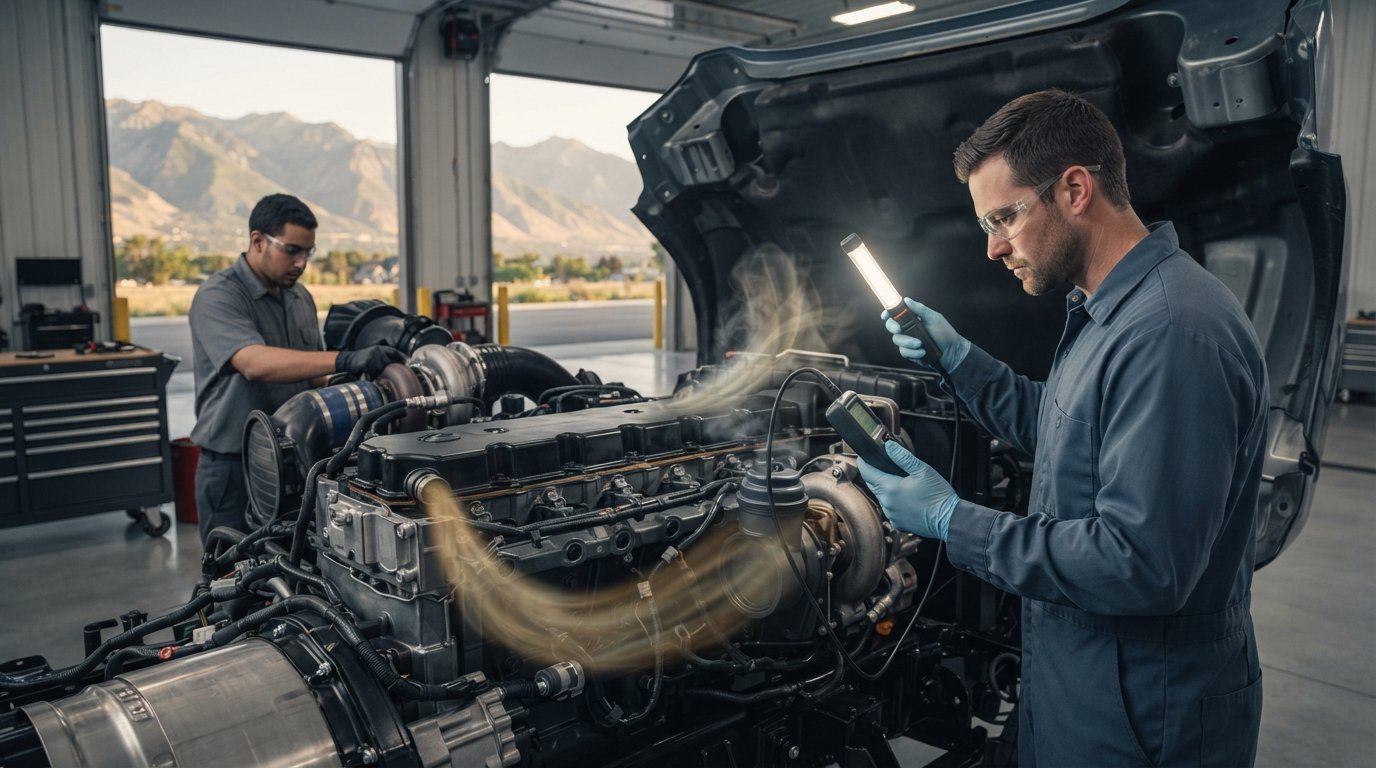
What Causes Excessive Crankcase Pressure in a Diesel Engine? Expert Diagnostic Guide

Seeing engine oil push past your crankshaft seals doesn’t automatically mean your diesel is ready for the scrap heap. When you spot fresh oil sweating around valve cover gaskets or watch the oil cap rattle off the filler neck, it’s natural to brace for catastrophic failure. Fleet operators and truck owners constantly ask what causes excessive crankcase pressure in a diesel, dreading the thought that cracked piston rings or scored liners will sideline their equipment.
That panic is understandable, but high crankcase pressure doesn’t always signal an internal disaster. The actual culprit is frequently a restricted ventilation component or external accessory leak rather than a ruined power assembly. In this diagnostic guide, you’ll discover the mechanical causes of crankcase pressure buildup, how to spot warning signs early, and proven diagnostic steps to isolate the true issue. We’ll provide a systematic testing sequence that eliminates guesswork, safeguards fleet uptime, and prevents unnecessary engine teardowns.
Key Takeaways
- Understand the mechanical difference between normal diesel combustion blow-by and hazardous pressure spikes that threaten engine integrity.
- Uncover what causes excessive crankcase pressure in a diesel, distinguishing between saturated CCV filters, turbocharger seal bypass, and worn piston rings.
- Spot early physical warning signs like ejected dipsticks, weeping valve cover gaskets, and sensor fault codes before severe seal failure occurs.
- Follow a systematic isolation and manometer diagnostic workflow to pinpoint the root problem without rushing into an unneeded engine teardown.
- Apply proactive maintenance practices and targeted repair strategies to maintain reliable fleet uptime and avoid costly shop visits.
Understanding Diesel Crankcase Pressure: Normal Blow-By vs. Harmful Pressure
Crankcase pressure is the positive pneumatic force that accumulates inside an engine’s lower block cavity. In diesel engines, generating some baseline pressure is completely normal. Diesel cylinders generate massive combustion forces, frequently exceeding 500 psi of peak cylinder pressure. Even on factory-fresh engines, a tiny fraction of that compressed combustion air slips past the piston ring end gaps into the crankcase. Technicians call this combustion blow-by.
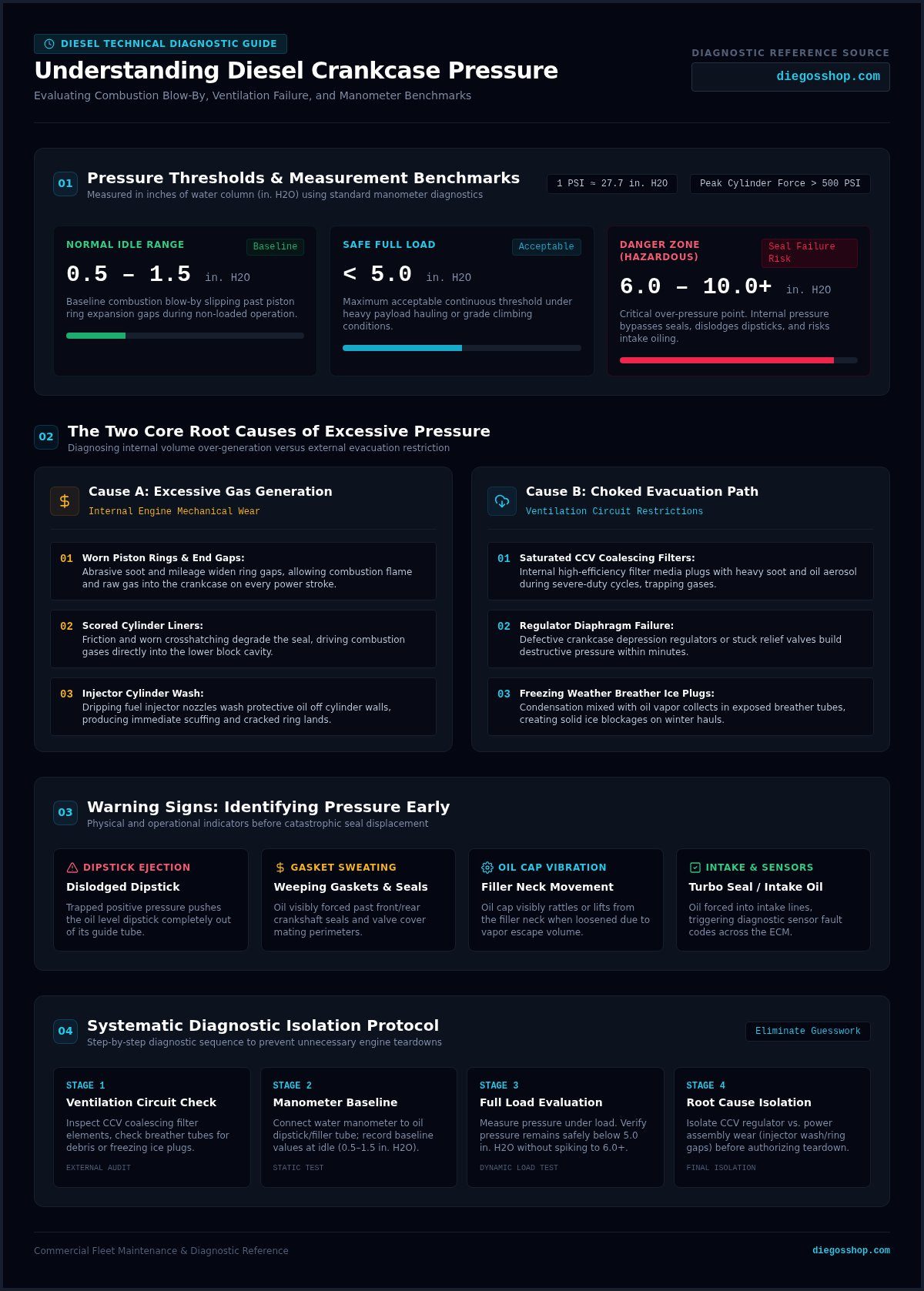
The difference between a healthy engine and a compromised one comes down to volume and evacuation capability. Under normal conditions, a healthy diesel measures between 0.5 and 1.5 inches of water (in. H2O) at idle, remaining safely below 5.0 in. H2O under full load. The danger point begins when internal pressure spikes past 6.0 to 10.0 in. H2O. Because one pound per square inch equals roughly 27.7 in. H2O, just a fraction of a psi of trapped pressure will push past front and rear crankshaft seals, push oil into intake lines, and force the oil dipstick out of its tube. Understanding what causes excessive crankcase pressure in a diesel begins by isolating whether the engine generates too much blow-by or simply cannot vent it.
The Mechanics of Combustion Blow-By in Compression-Ignition Engines
Compression-ignition engines depend on high compression ratios to ignite diesel fuel without spark plugs. Turbochargers cram dense, pressurized air into the combustion chambers, doubling or tripling working cylinder pressures compared to gasoline engines. When a truck pulls a heavy grade or hauls a maximum payload, cylinder pressure peaks, naturally increasing the volume of hot blow-by entering the sump. Quality piston rings seal against the cylinder walls under this load, but normal thermal expansion gaps always allow a small volume of exhaust gas to bypass the piston skirts.
The Critical Function of the Crankcase Ventilation System
Older engines routed raw crankcase vapors directly to the pavement through open road-draft tubes. Modern commercial trucks use a sealed crankcase ventilation system that captures these fumes, filters out aerosolized oil droplets using high-efficiency coalescing filters, and returns cleaned gases back to the turbocharger compressor inlet.
Crankcase depression regulators and internal pressure-relief valves maintain neutral crankcase pressure during rapid throttle changes. When analyzing what causes excessive crankcase pressure in a diesel, technicians inspect these ventilation circuits first. If a coalescing filter clogs or a regulator diaphragm fails shut, the engine can build destructive internal pressure in minutes, even with mechanically pristine piston rings.
Primary Mechanical Causes of Excessive Crankcase Pressure in a Diesel
Every crankcase pressure issue traces back to one of two mechanical realities: the engine is generating excessive blow-by gas, or the ventilation path is choked. Pinpointing what causes excessive crankcase pressure in a diesel requires isolating the engine’s internal assemblies from its external support equipment. Rushing to conclusions often leads operators to authorize costly rebuilds when the actual failure sits outside the engine block.
Worn Piston Rings, Scored Liners, and Cylinder Wash
Piston rings maintain the critical boundary between burning fuel and crankcase motor oil. Over hundreds of thousands of miles, abrasive soot and normal friction widen piston ring end gaps and wear down cylinder crosshatching. As documented in technical studies on diesel engine blow-by causes and diagnostics, severe ring wear allows combustion flame and raw gas to rush downward into the crankcase on every power stroke.
Leaking fuel injectors accelerate this destruction. A dripping nozzle washes protective motor oil off the cylinder wall, creating immediate metal-on-metal scuffing. Scored cylinder liners and cracked piston ring lands quickly follow, generating catastrophic volumes of continuous blow-by.
Clogged CCV Filters and Crankcase Breather Tubes
A closed crankcase ventilation system cannot function when its internal media is blocked. High-efficiency coalescing filters trap heavy soot and oil aerosol, but severe-duty cycles saturate these elements rapidly. Once plugged, crankcase vapors cannot escape back into the intake tract.
Freezing weather creates an equally sudden failure point. Condensation mixed with oil vapor collects in exposed breather tubes, forming ice plugs during freezing winter hauls. With the vent sealed shut, internal pressure builds rapidly behind the engine’s oil seals.
Auxiliary Culprits: Turbocharger Seals and Air Brake Compressors
Not all crankcase pressure comes from the engine’s combustion chambers. Auxiliary equipment connected to the engine lubrication circuit can force outside pressure directly into the oil pan:
- Turbocharger Seal Bypass: Worn turbine or compressor dynamic seals allow charged boost air to leak straight past the center housing into the oil drain tube.
- Air Brake Compressor Wear: On Class 7 and Class 8 commercial trucks, the air brake compressor shares the engine’s oil sump. Worn compressor piston rings or bad unloader valves pump high-pressure reservoir air directly through the front timing gear cover into the crankcase.
Diagnosing these external systems before ordering an in-frame overhaul saves thousands in downtime. Partnering with a skilled technician at Diego’s Shop for accurate diesel engine repair ensures every auxiliary component is systematically isolated and tested first.
Warning Signs: How to Identify Excessive Crankcase Pressure Early
Trapped crankcase pressure acts relentlessly against the weakest mechanical seals in an engine. Left uncorrected, minor vapor accumulation turns into severe structural oil leaks. Catching physical indicators early allows operators to determine what causes excessive crankcase pressure in a diesel before oil starvation or secondary turbocharger damage takes a truck out of service.
Physical and Visual Warning Signs in the Engine Compartment
Pressure always seeks the easiest path of escape. The oil dipstick tube provides that relief path. When internal pressure spikes under load, it pushes the dipstick upward, venting oil mist across the firewall and exhaust manifold. Weeping valve cover gaskets, oil puddles on top of the bellhousing, and wet front crankshaft seals follow quickly. If you notice an oily coating covering the transmission case and undercarriage, excessive crankcase pressure is blowing oil through primary seals.
Performance Changes and Breather Tube Smoke Colors
A healthy ventilation line emits faint, translucent vapor. Troubled engines produce dense, rhythmic pulses of blue-gray or whitish smoke that chuff out of the breather in time with engine firing pulses. As detailed in this technical analysis of diesel blow-by and crankcase ventilation, excessive flow rates carry liquid oil directly into turbocharger compressor inlets. This oil saturation cuts boost efficiency, clogs intake manifolds, fouls aftertreatment sensors, and creates severe runaway hazards if the engine begins burning its own sump oil.
The Shop-Floor Oil Fill Cap Check and Its Practical Limits
A simple field check helps spot excessive vapor velocity. With the engine warm and idling, remove the oil filler cap, flip it upside down, and rest it loosely over the opening. Normal mechanical vibration makes the cap dance or drift slowly across the neck. If the cap is blown clear off the neck by escaping air, blow-by is dangerously high.
Remember that this cap test is strictly qualitative. It shows that volume is elevated, but it cannot reveal what causes excessive crankcase pressure in a diesel. Isolating bad piston rings from an auxiliary air compressor leak requires instrumented pressure testing.
Step-by-Step Diagnostic Procedures to Pinpoint the Pressure Source
Guesswork has no place in diesel troubleshooting. When an engine shows high crankcase volume, jumping straight into an in-frame rebuild risks wasting substantial resources on a misdiagnosed external component. Isolating what causes excessive crankcase pressure in a diesel requires an orderly diagnostic sequence starting with non-invasive baseline checks before opening mechanical assemblies.
Water Manometer Testing and Water Column Standards
Standard dial-style pressure gauges reading in pounds per square inch lack the sensitivity needed to evaluate engine sump conditions. Because 1 psi equals roughly 27.7 inches of water column (in. H2O), a hazardous rise in crankcase pressure often reads as a fraction of a psi on common shop gauges. Technicians rely on a calibrated water manometer, a Magnehelic differential pressure gauge, or high-precision electronic transducers connected to the dipstick tube.
Testing begins with the engine brought up to full operating temperature. While idle numbers between 0.5 and 1.5 in. H2O confirm baseline breathing, definitive testing requires running the engine under full rated stall speed or dyno load. Pressures consistently exceeding 5.0 to 6.0 in. H2O under heavy boost indicate restricted venting or severe combustion blow-by.
Isolating Turbochargers and Pneumatic Air Compressors
Before condemning pistons or liners, technicians isolate auxiliary equipment that connects to the crankcase sump:
- Breather and CCV Verification: Inspect the closed crankcase ventilation coalescing filter element and check flexible vent lines for internal sludge accumulation or kinked bends.
- Air Brake Compressor Isolation: Class 7 and 8 trucks use engine-lubricated compressors. Disconnect and cap the air compressor discharge line; if crankcase pressure instantly normalizes on the manometer, the compressor unloader valve or piston rings have failed.
- Turbocharger Drain Inspection: Check the turbocharger oil drain tube. High compressor boost sneaking past dynamic shaft seals pushes direct pressure back down the oil drain line into the crankcase.
Cylinder Leak-Down, Borescope Inspection, and Relative Compression
If auxiliary equipment tests cleanly and ventilation circuits breathe freely, internal combustion blow-by is the primary factor. Diagnostic software performs an automated relative compression sweep across all cylinders by measuring starter motor amperage draw. Any cylinder showing low cranking resistance gets flagged for focused mechanical testing.
Technicians then insert shop air into suspected cylinders using injector adapters at top dead center. Listening for rushing air at the oil fill neck confirms whether compression rings, cracked ring lands, or scored liners are leaking into the pan. If your fleet trucks display these warning signs, schedule advanced diagnostics with Diego’s Shop to pinpoint the exact failure before costly damage spreads.
Solutions, Preventive Maintenance, and Professional Diesel Repair
Resolving pressure issues depends on treating the mechanical cause rather than masking symptoms. Bypassing breathers or venting lines to the atmosphere violates emissions laws and leaves core mechanical flaws unaddressed. When you verify what causes excessive crankcase pressure in a diesel, targeted repairs protect your investment and keep equipment generating revenue.
Scheduled CCV Servicing and Oil Quality Management
Replace coalescing filters according to operational duty rather than waiting for warning lights. Heavy hauling, extended idling, and severe vocational work saturate filter media long before standard highway intervals. Review the 2026 diesel maintenance handbook for interval schedules suited to working engines. Combining timely filter changes with shear-stable, high-detergent engine oil prevents piston ring sticking and keeps carbon from plugging crankcase ventilation channels.
In-Frame Overhauls vs. Targeted Component Repairs
Not every pressure spike requires an engine overhaul. If testing pinpoints a blown air compressor unloader or turbocharger seal bypass, replacing that auxiliary component restores proper pressure immediately. When cylinder leak-down tests confirm scored liners or broken compression rings, an in-frame overhaul is the proper mechanical fix. Trusting seasoned technicians for expert diesel engine repair ensures new cylinder packs, bearings, and heads are fitted to exact factory tolerances with warrantied workmanship.
Dedicated Commercial Fleet Diagnostics in Utah County
Unplanned downtime destroys operating margins. Implementing structured fleet maintenance stops minor blow-by accumulation before it blows crankshaft seals on the highway. For operators seeking reliable diesel repair in Utah, Diego’s Shop delivers comprehensive Class 3 through Class 8 mechanical support. Our shop in Springville serves Utah County and Wasatch Front fleets with honest, rigorous diagnostics that isolate crankcase issues before catastrophic failure occurs.
Protect Your Engine With Systematic Diagnostics
High crankcase pressure isn’t an automatic death sentence for your engine. Accurately determining what causes excessive crankcase pressure in a diesel requires isolating clogged CCV filters and auxiliary compressor leaks before pulling cylinder packs. Quantitative manometer testing cuts through the guesswork, protecting your bottom line from premature teardowns and unexpected highway failures.
Suspect severe blow-by or escalating crankcase pressure issues? Contact Diego’s Shop in Springville, UT for precision diesel diagnostics. Our technicians provide comprehensive diagnostics and warrantied repair work for Class 3 through Class 8 commercial diesel engines. Fleets and owner-operators across Utah County and the Wasatch Front trust our thorough, honest testing to protect uptime. Get the verified answers you need to keep your equipment running strong mile after mile.
Frequently Asked Questions
Can a clogged CCV filter cause an engine to blow out its dipstick?
Yes, a clogged CCV filter will routinely force the dipstick out of its tube. When the coalescing filter media saturates with oil sludge and soot, blow-by gases have no clear escape route to the intake tract. Pressure builds rapidly behind the engine’s mechanical seals. Because the dipstick tube offers the path of least physical resistance, the trapped crankcase air pushes the dipstick upward and vents oil mist across the engine bay.
Is some blow-by normal on a heavy-duty diesel engine?
Yes, every heavy-duty diesel engine produces a measurable volume of blow-by during normal operation. Diesel engines rely on high compression ratios and high boost levels to generate torque. Even with precision-machined piston rings and factory cylinder crosshatching, microscopic amounts of combustion gas bypass the ring end gaps into the crankcase. The crankcase ventilation system is engineered specifically to manage and evacuate this normal gas volume continuously without building pressure.
How much crankcase pressure is considered normal in inches of water?
A healthy diesel engine typically measures between 0.5 and 1.5 inches of water column at idle. Under full load, acceptable readings generally stay below 5.0 to 6.0 inches of water column. When readings climb past 10 inches of water, the engine has entered a severe caution zone. Technicians use calibrated manometers to evaluate these precise thresholds, helping determine what causes excessive crankcase pressure in a diesel before catastrophic seal damage occurs.
Can a faulty turbocharger cause high crankcase pressure in a diesel?
Yes, a worn or damaged turbocharger can introduce high pressure directly into the crankcase. The turbocharger center housing relies on dynamic shaft seals to contain extreme compressor boost and hot exhaust gas. If these seals degrade or develop excessive bearing play, charged boost air forces its way past the journal bearings and down the oil drain tube. This pressurizes the oil pan without any mechanical failure inside the engine cylinders.
How does an air brake compressor increase engine crankcase pressure?
Heavy-duty commercial trucks use engine-driven air compressors that share the engine’s oil supply for lubrication. The compressor utilizes its own internal pistons, rings, and unloader valves. When compressor piston rings wear out or an unloader valve sticks open, compressed air leaks straight past the compressor cylinder into the engine’s front gear housing. This auxiliary air artificially inflates crankcase pressure, mimicking the symptoms of worn engine rings or damaged cylinder liners.
What happens if you ignore excessive diesel crankcase pressure?
Ignoring elevated pressure leads to catastrophic engine failure. High internal pressure blows out front and rear crankshaft seals, sprays oil onto hot exhaust manifolds, and causes rapid oil loss. It also restricts turbocharger oil drainage, forcing motor oil into the compressor housing and charge air cooler. This oil carryover clogs diesel particulate filters, fouls intake sensors, and creates severe engine runaway hazards. Identifying what causes excessive crankcase pressure in a diesel protects your equipment and fleet uptime.