
Utah Fleet Preventive Maintenance: Maximize Uptime 2026

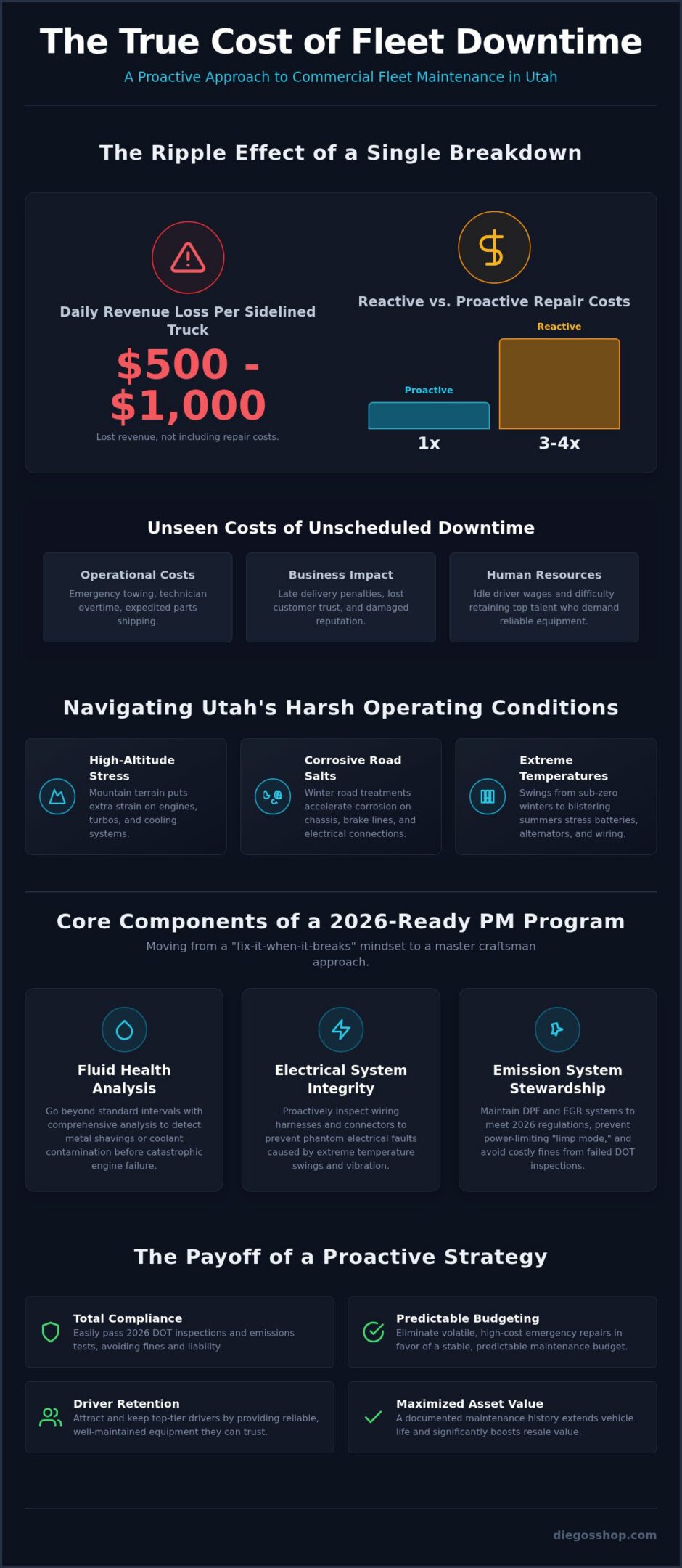
It’s 3:00 PM on a Tuesday, and your lead driver is sidelined on the shoulder of I-15 with a blown turbo, watching revenue evaporate while waiting for a tow. Industry data confirms that a single sidelined semi-truck can cost your business between $500 and $1,000 every day in lost revenue, a cost that’s often avoidable with proper preventive maintenance for commercial fleets in Utah. You’ve likely felt the frustration of reactive repairs and the difficulty of finding reliable diesel technicians in Utah County who truly understand the demands of our mountain terrain.
We agree that keeping a fleet profitable shouldn’t feel like a constant gamble against mechanical failure. This guide explains how a structured service program keeps your equipment moving and your maintenance budget predictable. You’ll discover how tailored service protocols help you navigate the 2026 emissions regulations, eliminate failed DOT inspections, and maximize the eventual resale value of your heavy-duty assets. We’ll look at the specific technical requirements for Isuzu, Ford, and Peterbilt engines operating along the Wasatch Front to ensure your fleet stays out of the shop and on the road.
Key Takeaways
- Understand the financial impact of reactive repairs and how to prevent the $1,000 daily revenue loss associated with unexpected roadside breakdowns.
- Learn how a structured program for preventive maintenance for commercial fleets in Utah protects your diesel engines from high-altitude stress and corrosive road salts.
- Prepare for 2026 DOT inspections and emissions regulations with proactive diagnostic protocols that ensure total compliance and avoid costly fines.
- Discover how to categorize your equipment by duty cycle to build a maintenance rhythm that extends vehicle life and boosts resale value.
- Gain peace of mind by prioritizing warrantied repair work performed by specialized diesel technicians who understand the specific needs of your fleet.
The Real Cost of Fleet Downtime in the Wasatch Front
When a tractor-trailer stalls on I-15 during the morning rush, the financial damage starts instantly. For many operators, preventive maintenance for commercial fleets in Utah is viewed as an expense, but the lack of it creates a massive ripple effect across your entire operation. A single breakdown doesn’t just halt one delivery; it triggers a chain of events that can cost three to four times more than a scheduled service visit. From emergency towing fees to expedited parts shipping and technician overtime, reactive repairs drain your capital without warning. Industry estimates show that a sidelined truck costs between $500 and $1,000 per day in lost revenue alone.
Beyond the balance sheet, there’s a human cost. Top-tier drivers want to work for companies that provide dependable, well-maintained equipment. If your trucks are constantly in the shop, your best talent will look for seats at firms that prioritize reliability. Moving from a “fix-it-when-it-breaks” mindset to a master craftsman approach isn’t just about engines; it’s about building a stable business foundation. You’re not just fixing machines; you’re protecting your promises to your customers.
Calculating Your Fleet’s True Hourly Downtime Rate
Understanding your actual loss requires looking beyond the repair bill. You’re paying driver wages even when the wheels aren’t turning. You’re losing the opportunity cost of the next load. You might even face penalties for late deliveries or missed windows. Within the broader scope of Fleet management, maintenance is the most controllable variable in your profit margin. Downtive is the silent killer of Utah small businesses. Settling for “cheap” fixes usually results in recurring failures that compound these costs over the life of the vehicle. Proactive care ensures that your budget remains predictable rather than volatile.
Why Utah County Businesses Can’t Afford Roadside Failures
Utah’s geography adds a layer of risk that national averages don’t capture. A breakdown in a remote canyon or on a steep grade during a winter storm isn’t just a delay; it’s a safety hazard and a logistical nightmare. Towing a heavy-duty asset out of Spanish Fork Canyon is significantly more expensive than a scheduled drive to a shop in Springville. Effective fleet maintenance acts as an insurance policy for your schedule. In a competitive market, your reputation is built on reliability. When your trucks are known for being out of service, you lose the trust of your customers. A master craftsman approach to maintenance ensures your fleet reflects the integrity of your brand.
Core Components of a 2026 Commercial PM Program
Modern fleet management requires more than just kicking the tires and checking the oil. In 2026, preventive maintenance for commercial fleets in Utah must address the sophisticated computers and sensitive emission controls found in brands like Peterbilt, Kenworth, and Isuzu. A robust program ensures total compliance with Federal vehicle maintenance requirements, protecting your operation from liability and the high cost of failed DOT inspections. This level of technical oversight transforms your maintenance schedule from a chore into a strategic asset.
Routine service begins with fluid health. While following a standard diesel oil change interval is a baseline, we use comprehensive fluid analysis to detect metal shavings or coolant contamination before they destroy an engine block. Electrical systems also demand specialized attention. Utah’s extreme temperature swings, from blistering summer heat to sub-zero winters, put immense stress on batteries and alternators. We proactively inspect wiring harnesses and connectors to prevent the phantom electrical faults that often plague modern diesel rigs.
Emission System Stewardship: DPF and EGR Health
Modern diesel engines depend on complex Diesel Particulate Filters (DPF) and Exhaust Gas Recirculation (EGR) systems to meet 2026 air quality standards. Neglecting these components leads to “limp mode,” where the engine’s power is electronically capped to prevent damage, effectively stranding your load. Proactive sensor cleaning and valve inspections are essential to keep these systems functioning. High-quality filters act as the first line of defense, ensuring that soot and particulates don’t compromise your engine’s technical mastery. If you want to ensure your emission controls are handled with expert care, a visit to Diego’s Shop can provide the diagnostic clarity you need.
Chassis and Drivetrain Fortification
Heavy-duty hauling across the Wasatch Front puts immense torque on every component of your drivetrain. We look for early signs of wear in leaf springs and U-joints, as a failure under load on a steep grade can be catastrophic. Many veteran technicians realize that complex diesel engine repair often starts with a drivetrain inspection to ensure power is being transferred efficiently. Our lubrication protocols use high-grade synthetics designed to withstand high-mileage demands and the corrosive “Salt Lake Effect” found on our winter roads. This master craftsman approach ensures that every part of the vehicle, from the turbocharger to the rear axle, is prepared for the long haul.
Navigating Utah’s Unique Operational Challenges
Utah’s terrain demands more than standard service intervals. High-altitude operation in the Wasatch Range means your turbochargers spin faster to compensate for thin air. This increases internal temperatures and puts additional strain on cooling systems. Effective preventive maintenance for commercial fleets in Utah must account for these environmental stressors. We also battle the “Salt Lake Effect,” where aggressive road treatments on the I-15 corridor accelerate corrosion on every exposed chassis component and electrical connector.
Temperature swings are equally brutal for diesel equipment. Your fleet must transition from 100°F summer heat to -10°F winter freezes. This cycle causes seals and hoses to expand and contract, leading to premature leaks if they aren’t monitored closely. Managing steep grades in the mountains requires a specific focus on transmission health and brake integrity. Without specialized oversight, these unique factors will shorten the lifespan of your heavy-duty assets and lead to expensive roadside failures.
Winterization Strategies for the Wasatch Front
Winter on the Wasatch Front is unforgiving for diesel engines. We focus on fuel gelling prevention and rigorous heater block testing to ensure your trucks start when the mercury drops. Air dryer maintenance is critical because moisture in the system leads to frozen brake lines, which can paralyze a vehicle on the road. We perform battery load testing before the first Utah County freeze to identify weak cells that would otherwise fail under the increased cranking demand of a cold diesel engine. These proactive steps keep your drivers moving when others are stuck in the yard.
Mountain-Ready Cooling and Braking Systems
Climbing Parley’s Canyon or Provo Canyon forces engines to run at peak capacity for extended periods. We prioritize coolant pH testing to prevent liner pitting, a common issue in high-stress mountain climbs where cavitation is more likely. Brake fade prevention is equally vital for the descent, requiring meticulous inspection of drums, pads, and slack adjusters. Because of these localized pressures, diesel maintenance must occur more frequently than national fleet guides suggest. A master craftsman understands that Utah miles are harder on a truck than flatland miles and adjusts the service rhythm accordingly.
Developing a Sustainable Fleet Maintenance Schedule
A successful strategy for preventive maintenance for commercial fleets in Utah moves away from generic charts and toward a data-driven calendar. You can’t maintain a local delivery truck in Provo the same way you manage an OTR rig crossing state lines. A master craftsman understands that every vehicle has a unique signature of wear based on its specific route and load. By establishing a structured rhythm, you replace the chaos of emergency repairs with the calm of scheduled service. This transition is essential for keeping your maintenance budget predictable and your fleet reliable.
- Classify by Duty Cycle: Group your vehicles into OTR, Local, or Severe duty categories. Local stop-and-go traffic in Salt Lake County puts different stresses on a drivetrain than long-distance hauling.
- Integrate Regulatory Checks: Build dot truck inspections near me directly into your PM rhythm. This ensures that compliance is a natural byproduct of your maintenance, not a separate logistical headache.
- Leverage Telematics: Use real-time engine data to trigger service alerts. Waiting for a round number on the odometer often means you’ve already missed the optimal window for fluid changes.
- Create a Feedback Loop: Establish a formal process for drivers to report minor issues to the shop. A small oil dampness reported today prevents a seized engine next month.
- Review Annually: Analyze your repair logs every twelve months. If you see recurring failures in a specific model year or route, adjust your intervals to counter the pattern.
Mileage vs. Engine Hours: Which Metric Matters Most?
Mileage is often a deceptive metric for Utah fleets. Idling in Wasatch Front traffic or running auxiliary equipment can lead to significant engine wear that doesn’t show up on the odometer. For Kenworth and Peterbilt heavy-duty rigs, or Isuzu medium-duty trucks, engine hours provide a much more accurate picture of component fatigue. Tracking Power Take-Off (PTO) hours is vital for vocational fleets where the engine works hard even when the vehicle is stationary. Focusing on hours ensures that your lubricants and filters are replaced before their chemical properties break down from thermal stress.
Pre-Trip and Post-Trip Inspection Mastery
Empowering your drivers to perform thorough inspections is your first line of defense against downtime. A disciplined 5-minute walk-around can save 5 hours of shop time by catching a frayed belt or a leaking wheel seal before the truck leaves the yard. These inspections don’t just prevent breakdowns; they create a paper trail that proves your commitment to safety. Proper documentation is a powerful asset during DOT audits and significantly boosts the resale value of your equipment when it’s time to cycle out older units. Consistency in these small checks builds a culture of accountability across your entire team.
If you’re ready to move from reactive fixes to a professional service schedule, contact Diego’s Shop to build your customized fleet maintenance plan.
Partnering with Diego’s Shop for Long-Term Reliability
Diego’s Shop operates on a simple principle: technical mastery combined with personal accountability. While corporate service centers often treat your trucks as numbers on a spreadsheet, we approach every engine with the precision of a seasoned master craftsman. Choosing preventive maintenance for commercial fleets in Utah means finding a partner who understands the specific stresses of the I-15 corridor and the steep grades of the Wasatch Range. We don’t just follow a checklist; we analyze the unique wear patterns of your specific operation to provide no-nonsense solutions that keep your business moving.
Located in Springville, we serve the entire Wasatch Front with a focus on durability and reliability. Our team specializes in the complex engine management systems of modern Peterbilt, Kenworth, Isuzu, and Ford diesel platforms. We bridge the gap between old-world mechanical skill and 2026 diagnostic technology, ensuring that your fleet remains compliant with all local emissions and safety regulations. We take pride in the durability of our work and the integrity of our service guarantees.
Warrantied Peace of Mind for Utah Fleets
Trust is built on results, not just promises. This is why warrantied repair work is at the heart of our service model. When we perform a repair or a scheduled maintenance task, we stand behind the work with a commitment to quality that corporate shops struggle to match. Our technical mastery significantly reduces the frequency of “comebacks,” those frustrating return trips for the same issue that bleed your uptime. We treat your equipment with the respect it deserves, ensuring every bolt is torqued and every sensor is calibrated to factory specifications. This hands-on approach provides the peace of mind you need to focus on your core business operations.
Getting Started: Your First Fleet Health Assessment
Transitioning to a structured maintenance rhythm begins with a comprehensive fleet health assessment. During this initial diagnostic phase, we evaluate everything from your light-duty Ford pickups to your heavy-duty Peterbilt tractors. We look for the hidden issues mentioned earlier, such as DPF soot loading or U-joint wear, to establish a baseline for your customized PM plan. Our goal is to create a predictable schedule that aligns with your specific duty cycles and budget requirements. You can Schedule your fleet’s preventive maintenance assessment at Diego’s Shop today to secure the long-term reliability of your assets. We are ready to help you eliminate the uncertainty of roadside breakdowns and replace it with a promise of quality.
Secure Your Fleet’s Future on the Wasatch Front
A successful 2026 operation requires a shift from emergency repairs to a disciplined, proactive strategy. By addressing the high-altitude stress and corrosive road salts unique to our region, you ensure your heavy-duty assets remain reliable and compliant. Implementing a structured program for preventive maintenance for commercial fleets in Utah transforms your shop time from a burden into a strategic advantage that boosts resale value and driver retention.
Diego’s Shop brings over a decade of specialized experience in Peterbilt, Kenworth, and Isuzu platforms to every service bay in Springville. We provide the technical mastery needed to navigate modern emission systems and complex engine management with total confidence. Every service we perform is backed by warrantied repair work; this gives you the peace of mind that comes from true accountability and master craftsmanship.
Keep your fleet moving. Contact Diego’s Shop for a custom PM plan today. Your trucks are the backbone of your business, and we’re here to ensure they stay on the road where they belong.
Frequently Asked Questions
What is the standard interval for commercial diesel preventive maintenance in Utah?
Standard intervals usually fall between 15,000 and 25,000 miles for long-haulers, but preventive maintenance for commercial fleets in Utah often requires more frequent service. Because our drivers face steep mountain grades and extreme temperature swings, we recommend shortening those windows. For local delivery trucks or severe-duty equipment, tracking engine hours is often more reliable than mileage. We help you establish a custom schedule that accounts for the specific stresses of the Wasatch Front.
How does Utah’s altitude affect my fleet’s maintenance needs?
High-altitude operation means your diesel engine has to work harder to pull in oxygen. This forces turbochargers to spin at higher RPMs to maintain boost levels, which generates more internal heat. Your cooling system must be in top condition to handle this increased thermal load. We prioritize coolant pH testing and turbocharger inspections to ensure your fleet doesn’t suffer from premature component failure while climbing our mountain passes.
Can a well-maintained PM program help my trucks pass DOT inspections?
A structured PM program is the most effective way to ensure your vehicles pass annual DOT inspections without issues. By catching worn brake pads, leaking wheel seals, or cracked leaf springs during scheduled service, you eliminate the risk of out-of-service orders. Our comprehensive inspection protocols mirror the standards used by enforcement officers, allowing you to operate with total confidence and avoid the high costs of failed roadside checks.
What is included in a typical commercial fleet PM service at Diego’s Shop?
Our PM service includes complete diesel diagnostics, full fluid analysis, and a detailed check of the electrical system. We go beyond basic oil changes by inspecting the chassis, drivetrain, and emission control components like the DPF and EGR valves. We specialize in technical mastery of Peterbilt, Kenworth, Isuzu, and Ford systems. This thorough approach identifies small issues before they escalate into expensive, warrantied repairs or unexpected downtime.
Is it better to follow mileage or engine hours for diesel maintenance?
Engine hours provide a far more accurate metric for diesel maintenance, especially for fleets operating in Utah County. Idling in traffic or using Power Take-Off (PTO) systems causes engine wear that isn’t reflected on the odometer. We recommend following engine hour intervals for oil and filter changes to protect your engine’s internal components. This precision timing ensures your lubricants are replaced before they lose their protective properties from thermal breakdown.
How do I prevent DPF and EGR issues in my commercial fleet?
Preventing emission system failures requires proactive sensor cleaning and regular inspection of the EGR valves. Excessive idling is a primary cause of soot buildup, so we help you monitor engine data to reduce unnecessary run time. Using high-quality filters and performing forced regenerations when necessary keeps these sensitive systems running efficiently. Specialized diagnostics at our Springville shop can detect early signs of restriction before your truck enters a costly “limp mode.”
Why should I choose a specialized diesel shop over a general fleet service?
General shops often lack the specialized diagnostic tools and deep technical knowledge required for modern diesel engine management. We focus exclusively on diesel technology, which allows us to provide more accurate troubleshooting for complex brands like Peterbilt and Isuzu. A specialized shop understands the nuances of heavy-duty drivetrains and high-pressure fuel systems. This expertise ensures your preventive maintenance for commercial fleets in Utah is performed by master craftsmen who speak your equipment’s language.
Does Diego’s Shop offer warranties on preventive maintenance and repairs?
Yes, Diego’s Shop stands behind every service with warrantied repair work. We believe that accountability is the foundation of a trust-based partnership with our fleet clients. Whether we are performing a routine inspection or a complex engine overhaul, our work is designed for durability and long-term reliability. This commitment to quality gives you peace of mind, knowing that your equipment is handled by experts who take pride in their technical skill.