
Utah Diesel Emissions Testing & Repair: Your 2026 Compliance Guide

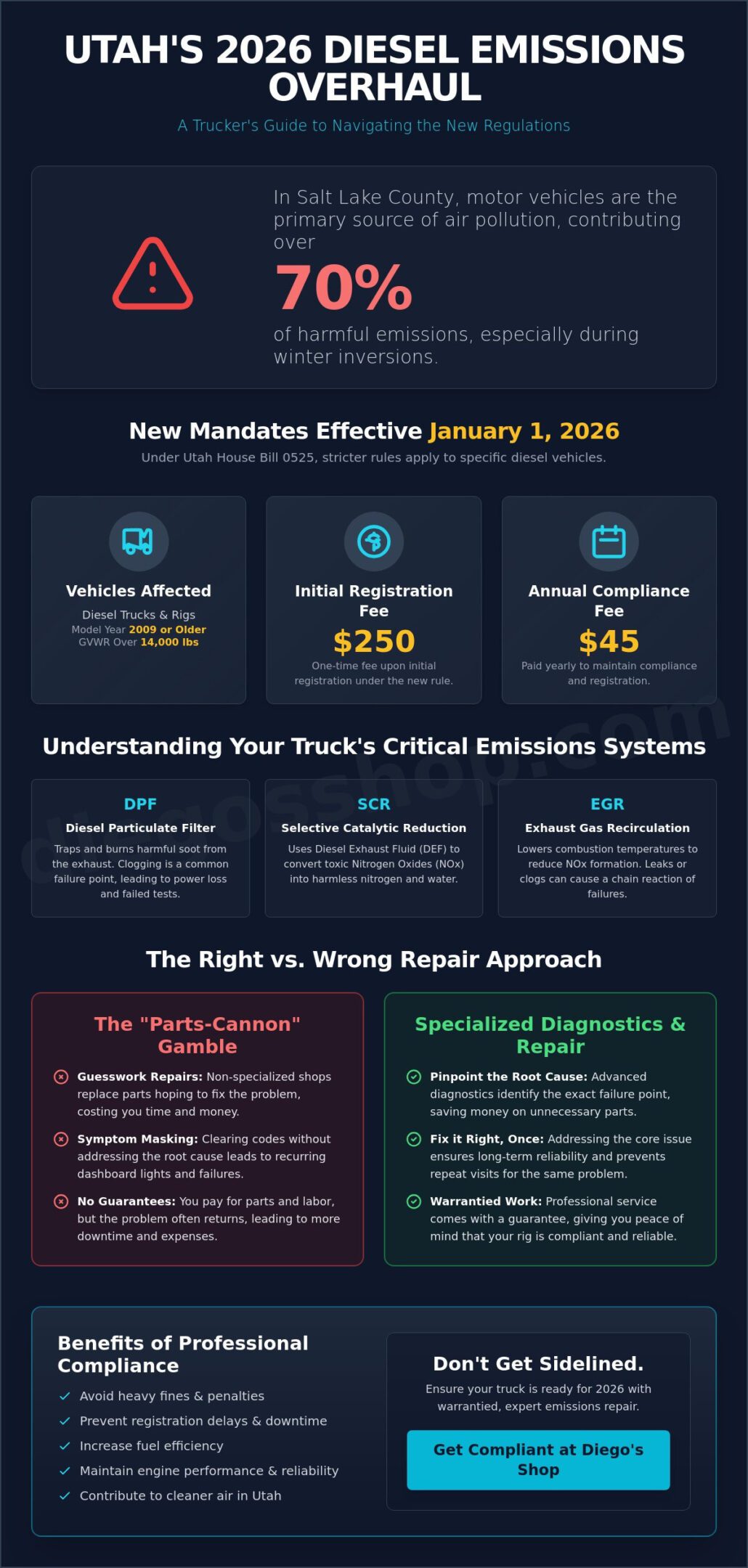
Did you know that motor vehicles are responsible for more than 70% of the air pollution in Salt Lake County? This reality is why the state implemented stricter standards as of January 1, 2026, including a $250 initial registration fee for diesel trucks with a 2009 or older model year and a GVWR over 14,000 lbs. If you operate a rig in the Wasatch Front, securing professional utah diesel emissions testing repair is the only way to ensure your vehicle stays on the road without facing heavy fines or registration delays.
We understand the stress of staring at a dashboard warning light and worrying that a failed inspection will sideline your business. Modern DPF, SCR, and EGR systems are technically complex; you shouldn’t have to pay for the “parts-cannon” approach where non-specialized shops guess at your expense. You need a trusted partner who provides honest, warrantied work that addresses the root cause of emissions failures rather than just masking the symptoms.
This guide will help you master the 2026 compliance landscape, including county-specific rules for Salt Lake, Davis, Utah, Weber, and Cache counties. You’ll learn exactly how specialized diagnostic protocols keep your engine performing at its peak while ensuring your maintenance is done right.
Key Takeaways
- Learn about the 2026 registration fees and county-specific compliance rules to avoid unnecessary fines and registration delays.
- Identify the critical roles of DPF, SCR, and EGR systems and how their health impacts both your emissions status and engine performance.
- Discover why specialized utah diesel emissions testing repair is the most reliable way to clear fault codes and pass mandatory visual inspections.
- Understand the advantage of technical mastery over “parts-cannon” repairs to save money by pinpointing the root cause of exhaust failures.
- See how warrantied repair work and professional fleet maintenance ensure your truck maintains rugged reliability while meeting all state standards.
Navigating Utah Diesel Emissions Requirements in 2026
Utah diesel emissions testing is a mandatory inspection to verify that your vehicle’s exhaust systems meet state air quality standards. For 2026 registration renewals, the process is particularly relevant for owners in Utah County. Because 2026 is an even-numbered year, the biennial testing schedule generally requires inspections for vehicles with even-numbered model years. This isn’t just a bureaucratic hurdle; it’s a professional diagnostic check that ensures your engine is operating at peak efficiency. Our technicians see two primary testing methods: On-Board Diagnostics (OBDII) for newer trucks and opacity testing for older models. OBDII tests communicate directly with your engine’s computer to identify hidden faults, while opacity tests measure the physical density of exhaust smoke to ensure older engines aren’t over-polluting.
Who Needs Testing in Utah County?
The requirements for utah diesel emissions testing repair vary based on your vehicle’s weight and age. Light-duty pickups under 14,000 lbs Gross Vehicle Weight Rating (GVWR) follow the standard biennial schedule. However, heavy-duty rigs face stricter scrutiny. As of January 1, 2026, Utah House Bill 0525 mandates that diesel vehicles from model year 2009 or older with a GVWR over 14,000 lbs must pay a $250 initial registration fee and a $45 annual compliance fee. While vehicles are typically exempt for their first few years, most trucks over six years old must prove they meet state standards. For commercial fleets, staying ahead of these dates is the only way to avoid costly downtime and registration blocks. Residential owners should also track these windows closely, as a failed test can prevent you from legally driving your primary vehicle.
The Impact of Utah’s Winter Inversions
Utah’s geography creates a unique challenge for air quality, especially along the Wasatch Front. During winter inversions, cold air traps pollutants in the valleys, leading to hazardous conditions. Motor vehicles are responsible for over 70% of the air pollution in Salt Lake County, and diesel particulates are a significant contributor. Understanding How Diesel Particulate Filters work is vital for every modern truck owner; these components are designed to trap and burn off soot before it reaches the atmosphere. The Utah County Health Department prioritizes diesel compliance because these programs collectively prevent the release of approximately 4 tons of nitrogen oxide daily. Beyond the environmental benefits, a successful emissions test is a sign of engine health. When your exhaust system is clean and your sensors are functional, your fuel efficiency increases and your truck maintains the rugged reliability you depend on for heavy hauls.
Why Diesel Emissions Systems Fail: Technical Mastery of Modern Engines
Modern diesel engines are technical marvels, but their emissions systems are incredibly sensitive. The “Big Three” components; the Diesel Particulate Filter (DPF), Selective Catalytic Reduction (SCR), and Exhaust Gas Recirculation (EGR); work in a delicate balance to scrub pollutants. If one component starts to drift out of spec, it often creates a chain reaction. For example, a leaking EGR cooler can cause excessive soot that quickly overwhelms the DPF. This complexity is why specialized diesel engine repair is vital. General mechanics often lack the high-level diagnostic tools needed to see how these systems interact in real-time, leading to expensive and unnecessary parts replacements.
Engine management systems now monitor emissions output every second your truck is running. One of the most critical players is the SCR system, which uses Diesel Exhaust Fluid (DEF) to convert nitrogen oxide into harmless nitrogen and water. While many local shops focus on light-duty passenger trucks, heavy-duty long-haul giants like Peterbilt and Kenworth require a deeper level of expertise to meet Utah’s official diesel emissions testing requirements. When your truck’s computer detects a fault in these systems, it won’t just turn on a light; it can actively limit your speed or torque to protect the environment and the engine.
DPF Clogging and Regeneration Issues
A Diesel Particulate Filter clogs when soot builds up faster than it can be burned off. Passive regeneration happens naturally during highway driving when exhaust temperatures are high enough to clear the filter. Active regeneration occurs when the engine’s computer injects extra fuel to artificially raise temperatures. If your truck spends most of its time idling or in stop-and-go Utah County traffic, it may never complete a full cycle. You’ll notice a sharp drop in fuel economy or a “DPF Full” warning on your dash. Ignoring these signs can lead to a completely plugged filter that requires professional cleaning or replacement to pass utah diesel emissions testing repair inspections.
SCR and DEF System Failures
Utah’s harsh winters create specific problems for DEF systems. Since DEF is roughly 67% deionized water, it can freeze at 12 degrees Fahrenheit. While modern trucks have tank heaters, a failed heating element or a cracked line will immediately trigger a fault code. We also see frequent failures in the NOx sensors that monitor SCR efficiency. If these sensors provide inaccurate data, your truck might enter “limp mode,” capping your speed at 5 mph until the issue is resolved. If your system is struggling, having a master technician perform a comprehensive diagnostic can save you from being stranded on the side of I-15.
The Testing Process and Common Failure Points for Trucks
Passing a certified diesel emissions test involves more than just plugging in a scanner. It’s a comprehensive evaluation designed to ensure every component of your exhaust system is functioning as the manufacturer intended. The process begins with a rigorous visual inspection. Technicians look for signs of tampering, such as missing catalytic converters or illegal “delete” kits that bypass emissions controls. If any factory-installed equipment is missing or altered, the vehicle fails immediately, regardless of how clean the exhaust might seem. This strict adherence to Utah’s official diesel emissions requirements helps maintain the air quality standards that protect our communities.
For trucks manufactured after 1998, the core of the test is the On-Board Diagnostics (OBDII) check. This system monitors your engine’s performance in real-time. If the computer detects a fault, it triggers a Diagnostic Trouble Code (DTC). Even if you’ve recently cleared a check engine light, the system will likely show “not ready” monitors. These monitors are internal self-tests that require specific driving conditions to complete. If they haven’t finished their cycles, the testing equipment cannot verify your truck’s compliance. For older diesel models, we perform an opacity test. This involves measuring the density of the smoke emitted under a load, ensuring that older engines still operate within acceptable environmental limits for utah diesel emissions testing repair standards.
Top 5 Reasons Diesels Fail Emissions in Utah
- Active Check Engine Lights: Any stored code related to the fuel or exhaust system is an automatic failure.
- Faulty EGR Components: Leaking EGR coolers or stuck valves are common culprits that increase nitrogen oxide output.
- Incomplete Monitor Cycles: Replacing a battery or clearing codes right before a test often leaves the system in a “not ready” state.
- Illegal Exhaust Modifications: Delete kits are easily spotted during visual inspections and carry heavy penalties.
- Excessive Smoke: For older trucks, high opacity readings usually point to fuel injector issues or turbocharger wear.
How to Prepare Your Truck for the Test
Preparation is the key to a stress-free inspection. The most important step is ensuring your truck has completed a proper drive cycle. This typically involves 20 to 30 miles of mixed highway and city driving to allow the OBDII monitors to reset. You should also verify that your Diesel Exhaust Fluid (DEF) tank is at least half full to avoid sensor errors during the test. Finally, keeping your preventive maintenance up to date ensures that small issues don’t turn into expensive emissions failures. When your truck is maintained with technical mastery, passing the test becomes a routine part of your schedule rather than a source of anxiety.
Specialized Diesel Emissions Repair: Fixing the Root Cause
General auto repair shops often lack the specialized tooling required to handle heavy-duty diesel exhaust systems. When you seek utah diesel emissions testing repair, you need a technician who understands that an emissions code is often just a symptom of a deeper engine problem. Many non-specialized shops resort to the “parts-cannon” approach, replacing expensive sensors or filters without identifying why they failed in the first place. At Diego’s Shop, we use advanced diagnostic scanners to pinpoint whether a failure is electronic, such as a faulty NOx sensor, or mechanical, like a degraded injector spray pattern that’s causing excessive soot. This level of technical mastery is what separates a temporary fix from a permanent solution.
Technical mastery means knowing when a component can be saved. Instead of immediately recommending a multi-thousand-dollar DPF replacement, we evaluate if professional cleaning or a forced regeneration cycle can restore the system to factory specs. This “Done Right” philosophy ensures you aren’t paying for hardware you don’t need while guaranteeing your truck meets the 2026 compliance standards. By choosing a shop that focuses exclusively on diesel repair in Utah, you ensure your light-duty pickup or heavy-duty long-haul giant receives the expert attention it deserves.
EGR and Turbocharger Services
Carbon buildup is the silent killer of diesel efficiency. Over time, soot accumulates in the EGR valve, restricting flow and forcing the engine to work harder. This directly impacts exhaust opacity and shortens the life of your DPF. We also specialize in Variable Geometry Turbo (VGT) diagnostics. If the vanes in your turbocharger stick, it can lead to improper boost levels and a failed emissions test. Our comprehensive inspection protocols ensure these high-wear components are cleaned and calibrated to maintain rugged reliability and peak performance under load.
Warrantied Emissions Repairs
Trust is built on accountability. Emissions components are some of the most expensive parts on a modern truck, which is why we provide honest, transparent recommendations. We don’t just clear codes; we fix the root cause to ensure long-term compliance with utah diesel emissions testing repair standards. Every repair we perform is backed by our commitment to 100% warrantied work. This gives fleet managers and owner-operators peace of mind knowing their investment is protected against recurring failures. If your truck is struggling to stay out of limp mode, it’s time to schedule a specialized diesel diagnostic to get your rig back to work.
Rugged Reliability: Getting Your Diesel Emissions Done Right at Diego’s Shop
In Springville and throughout Utah County, diesel owners need a partner who understands the high stakes of 2026 compliance. We’ve spent years honing our craft to ensure every truck that leaves our bay is built on technical mastery and rugged reliability. Our team doesn’t just look at a screen; we look at the whole vehicle. From the complex systems of a Ford Powerstroke to the heavy-duty long-haul giants like Peterbilt and Kenworth, we provide the specialized care required for utah diesel emissions testing repair. You won’t find generic fixes or “parts-cannon” guesswork here. We deliver precision results that ensure your vehicle performs at its peak while meeting every state standard. Our reputation is built on personal accountability and the pride we take in being your trusted partner for all diesel vehicle needs.
Fleet Emissions Management
Commercial operations depend on every rig in the fleet being legally registered and ready for the haul. We offer customized plans that integrate emissions monitoring into your regular diesel maintenance schedule. By tracking the health of your DPF and SCR systems over time, we catch minor sensor drifts before they turn into forced downtime. This proactive approach significantly reduces the risk of roadside DOT inspection failures, which can be devastating to your bottom line. We understand that for a fleet manager, time is money. That’s why our comprehensive inspection protocols are designed to be efficient without sacrificing the technical depth needed to guarantee compliance. We keep your fleet moving by focusing on accountability and integrity in every inspection.
Schedule Your Service in Springville
Getting your truck ready for the 2026 registration cycle shouldn’t be a headache. We’ve streamlined our process to offer easy appointment booking for both standard testing and comprehensive diagnostics. When you arrive at our shop, please bring your current registration papers and any recent vehicle history. This information helps our master technicians understand the baseline of your engine’s performance and identify any recurring patterns that might affect your emissions status. We’ll perform a thorough evaluation and provide clear, honest recommendations if repairs are necessary. Our work is 100% warrantied, so you can drive away with total peace of mind. Don’t leave your compliance to chance or settle for a shop that doesn’t speak the language of diesel. Trust Diego’s Shop for Diesel Emissions Done Right.
Secure Your Registration and Engine Health
Utah’s 2026 emissions standards demand more than just a passing grade; they require a commitment to technical excellence. You’ve seen how the biennial schedule and the new High Emissions Heavy Duty Vehicle fee impact your registration. Success in this landscape isn’t about luck. It’s about ensuring your DPF, SCR, and EGR systems are maintained with technical mastery. Expert utah diesel emissions testing repair is the difference between a temporary registration fix and a high-performing engine that stands the test of time.
As Springville’s trusted local diesel experts, we specialize in light, medium, and heavy-duty diesel platforms. We don’t just clear fault codes; we provide 100% warrantied repair work that addresses the root cause of every failure. Our team is ready to help you navigate these complex laws while maximizing your truck’s performance. Don’t let a failed inspection sideline your business or your daily drive.
Schedule Your Diesel Emissions Testing or Repair at Diego’s Shop Today. We’re here to take the stress out of compliance so you can focus on the road ahead with confidence.
Frequently Asked Questions
Can I pass Utah emissions if my check engine light is on?
No, you cannot pass a Utah emissions test if your check engine light is illuminated. Any active Diagnostic Trouble Code (DTC) in the engine management system results in an immediate failure during the OBDII scan. We recommend a professional diagnostic to identify the specific fault before attempting your test. Clearing the light right before the inspection won’t work, as it resets the system monitors to an incomplete status.
What is the ‘Not Ready’ status on an emissions test, and how do I fix it?
A ‘Not Ready’ status means your vehicle’s computer hasn’t finished its internal self-tests for systems like the EGR or DPF. This often happens after a battery replacement or code clearing. To fix this, you must complete a specific drive cycle. This usually involves 20 to 30 miles of varied city and highway driving to allow the sensors to gather enough data to verify system health.
Do heavy-duty diesel trucks over 14,000 GVWR need emissions testing in Utah County?
Yes, heavy-duty diesel trucks with a GVWR over 14,000 lbs require emissions testing in Utah County. As of January 1, 2026, vehicles from model year 2009 or older in this weight class face a $250 initial registration fee. These regulations target the modernization of older fleets. Staying compliant ensures you avoid these higher costs and keeps your commercial operations running without legal interruptions.
How much does a diesel emissions repair typically cost?
Repair costs vary significantly based on whether the issue is a simple sensor or a major component like a DPF. While a standard diesel emissions test in Utah County typically costs between $30 and $55, repairs depend on the diagnostic findings. Specialized utah diesel emissions testing repair shops focus on fixing the root cause to prevent the high costs of the ‘parts-cannon’ approach where unnecessary components are replaced.
Is it illegal to have a ‘deleted’ diesel truck in Utah?
It is illegal to operate a ‘deleted’ diesel truck on Utah public roads. Removing or bypassing factory emissions equipment like the DPF or SCR system violates both state and federal laws. During the mandatory visual inspection, technicians look for tampered exhaust systems. If your truck is found to be deleted, it will fail the inspection immediately and cannot be registered until the factory emissions equipment is professionally reinstalled.
How often do I need to get my diesel truck tested in Utah?
Most diesel vehicles in the five participating Utah counties require testing biennially. For 2026, which is an even-numbered year, vehicles with even-numbered model years generally need an inspection. Trucks less than six years old are usually exempt, though specific rules vary slightly by county. Checking your registration renewal notice is the most reliable way to confirm if your specific vehicle is due for its next test.
What happens if my truck fails the opacity test but the computer says it’s fine?
Your truck will fail the inspection if it fails the opacity test, even if the computer reports no fault codes. The opacity test measures physical smoke density, which the OBDII system might not always detect as a critical failure. Heavy smoke usually indicates an issue with fuel injectors, the turbocharger, or air intake restrictions. Our technicians use technical mastery to diagnose these mechanical issues that electronic scanners might miss.
Can Diego’s Shop handle emissions repairs for large commercial fleets?
Diego’s Shop is fully equipped to handle emissions repairs for large commercial fleets. We understand that downtime costs money, so we prioritize efficient diagnostics and warrantied repair work to keep your business moving. Our team services everything from light-duty pickups to heavy-duty giants like Volvo and Kenworth. We provide the comprehensive maintenance plans needed to ensure your entire fleet remains compliant with Utah’s 2026 air quality standards.