
Utah Commercial Vehicle Emissions Testing Requirements 2026: The Fleet Owner’s Guide

In 2026, a single missed emissions deadline or a failed inspection does more than just trigger a fine; it grounds your revenue and disrupts your entire logistics chain. Staying ahead of the curve is the only way to protect your bottom line. We know that managing a diesel fleet involves a constant struggle with changing regulations and the persistent fear that a mechanical failure will lead to a costly registration lapse.
This guide provides the expert clarity you need to master the utah commercial vehicle emissions testing requirements 2026. You’ll gain a clear roadmap for compliance that accounts for the specific needs of both light-duty and heavy-duty diesel engines. We provide the technical insight to help you pass the first time, every time. Our goal is to replace the stress of technical services with the peace of mind that comes from professional oversight.
We’ll break down the 2026 testing schedule, clarify the distinction between state emissions and federal DOT safety standards, and explain how specialized preventive maintenance prevents expensive downtime. By the end of this article, you’ll have a reliable plan to keep your fleet operational and fully compliant with Utah County laws.
Key Takeaways
- Identify which trucks in your fleet are due for inspection by mastering the utah commercial vehicle emissions testing requirements 2026 for even-model-year vehicles.
- Determine whether your medium or heavy-duty diesel truck requires an OBDII check or an opacity test based on its specific weight rating.
- Understand why a clean tailpipe doesn’t guarantee a passed federal safety inspection and how to coordinate both requirements effectively.
- Use preventive maintenance strategies like DPF cleaning to ensure your fleet passes the emissions test on the first attempt and avoids registration delays.
- Partner with a specialized diesel repair expert in Springville to handle complex emissions control systems and warrantied engine work.
Utah Commercial Vehicle Emissions Testing Requirements for 2026
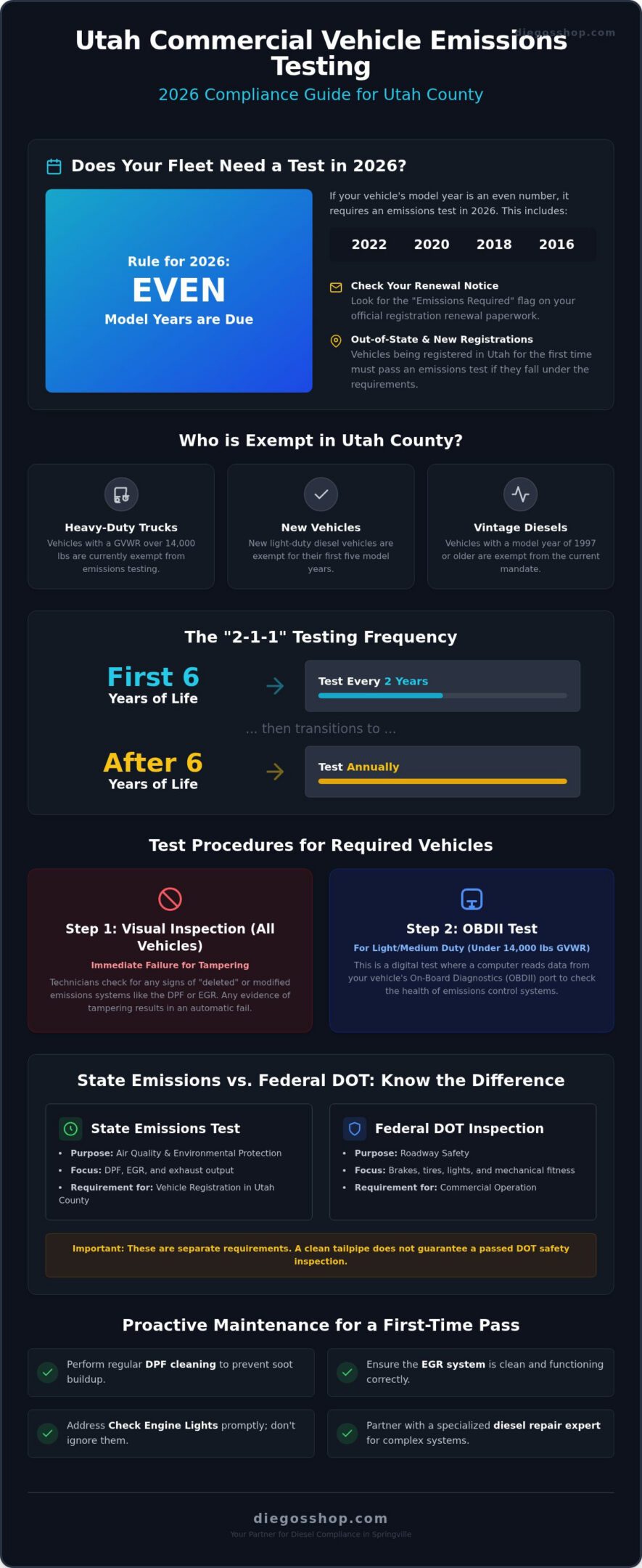
The Utah County Health Department enforces strict diesel standards to protect air quality along the Wasatch Front. For fleet owners, staying compliant means more than just avoiding a ticket; it’s about ensuring your trucks stay on the road without registration interruptions. The utah commercial vehicle emissions testing requirements 2026 focus heavily on even-numbered model years. Because 2026 is an even year, the state requires inspections for vehicles with model years like 2020, 2018, and 2016. This biennial cycle helps identify aging emissions components before they lead to significant engine damage or environmental violations.
These local mandates are part of the broader landscape of Vehicle inspection in the United States, but Utah County has specific nuances. For example, while some counties have broader requirements, Utah County focuses on diesel vehicles within the 1998 to 2021 model year range. If your fleet operates heavy-duty trucks with a Gross Vehicle Weight Rating (GVWR) over 14,000 lbs, those specific vehicles are currently exempt from emissions testing in Utah County. This distinction is vital for fleet managers who need to allocate maintenance budgets effectively across different weight classes.
Exemptions also apply to the newest additions to your fleet. New light-duty diesel vehicles don’t require testing for their first five years of operation. Similarly, vintage diesel trucks from 1997 or older are exempt from the current mandate. Understanding these boundaries prevents you from wasting time on unnecessary inspections for vehicles that don’t yet require them.
Who Needs a Test in Utah County This Year?
Determining which trucks need a test starts with your registration renewal notice. Look for the ‘Emissions Required’ flag, which serves as the definitive signal for compliance. If you’ve recently added out-of-state diesel trucks to your fleet or moved your business to Springville, those vehicles must meet the utah commercial vehicle emissions testing requirements 2026 before you can complete their Utah registration. We often see fleet owners caught off guard by these requirements during the onboarding of used equipment, so checking the model year against the even-year rule is a critical step in your procurement process.
The 2-1-1 Testing Frequency for Newer Fleets
Newer diesel trucks follow a specific frequency often referred to as the 2-1-1 pattern. For the first six years of a vehicle’s life, the county requires an emissions test every two years. Once a truck surpasses the six-year mark, it typically transitions to an annual testing requirement. Commercial use doesn’t grant any leeway here; the high mileage seen in fleet operations actually makes these regular checks more important. A 2020 model year truck hits that six-year milestone in 2026, making it a primary candidate for inspection this cycle. Keeping a rigorous schedule ensures your fleet remains profitable and legally cleared for work.
Diesel-Specific Requirements: Weight Classes and Testing Methods
Understanding your vehicle’s Gross Vehicle Weight Rating (GVWR) is the first step in mastering the utah commercial vehicle emissions testing requirements 2026. This number determines whether your truck undergoes a digital handshake with a computer or a physical measurement of its exhaust smoke. In Utah County, diesel vehicles from 1998 to 2021 are the primary focus for local mandates. If your truck is older than 1998, it currently falls outside the testing mandate, but newer models must face rigorous scrutiny to ensure they meet modern air quality standards.
Every test begins with a comprehensive visual inspection. Technicians look for evidence of tampering with the Diesel Particulate Filter (DPF) or Exhaust Gas Recirculation (EGR) systems. Any signs of “deletes” or bypassed components result in an immediate failure. Maintaining these complex systems through professional diesel engine repair ensures your hardware stays compliant and your engine remains efficient. Our team focuses on technical integrity so your fleet stays on the road without legal interruptions.
Light-Duty Diesel Rules (Under 14,000 lbs GVWR)
Light-duty diesel trucks, including popular platforms like the Ford Powerstroke or Ram Cummins, utilize On-Board Diagnostics (OBDII) testing. The technician plugs into the vehicle’s computer to check for stored fault codes and monitor sensor performance. A common hurdle is the “Not Ready” status. This occurs if the computer hasn’t completed its self-checks after a battery disconnect or code clearing. Most importantly, a lit Check Engine Light is an automatic fail. You can find more details on Utah’s official vehicle inspection requirements to see how these digital standards apply to your specific model year and weight class.
Heavy-Duty Diesel Protocols (Over 14,000 lbs GVWR)
Heavy-duty trucks over 14,000 lbs GVWR often require opacity testing in surrounding counties, which measures the density of the smoke emitted during a snap-acceleration test. While newer heavy-duty rigs are increasingly equipped with advanced onboard diagnostics that mirror light-duty protocols, the smoke density remains a standard for older commercial rigs. Heavy-duty diesel vehicles over 14,000 GVWR are currently exempt from emissions testing in Utah County, though they must still comply with federal safety standards. This exemption provides some relief for large-scale logistics, but it requires diligent preventive maintenance to avoid future regulatory shifts. Staying informed on the utah commercial vehicle emissions testing requirements 2026 helps you manage these discrepancies across your entire fleet.
The Intersection of State Emissions and Federal DOT Inspections
Compliance isn’t a one-and-done task. For fleet owners, the challenge lies in managing two distinct sets of regulations: county-level emissions and federal safety standards. While the utah commercial vehicle emissions testing requirements 2026 focus on your engine’s environmental impact, the Department of Transportation (DOT) focuses on the physical safety of your rig. A truck can have a perfectly clean tailpipe and still fail a DOT truck inspection due to a worn brake pad or a flickering marker light.
The Official Utah DMV Inspection Requirements outline the emissions side, but federal law mandates that all commercial vehicles over 10,001 lbs undergo a safety inspection every year. Coordinating these dates saves you time. We recommend aligning your emissions testing with your annual safety check to minimize your fleet’s time off the road. Technical mastery of diesel systems allows us to identify issues that affect both categories during a single service visit.
Annual DOT Inspection Requirements for 2026
Federal safety inspections are rigorous. Technicians must verify the integrity of steering, braking, and lighting systems to ensure the vehicle is safe for public highways. Implementing a consistent fleet maintenance program is the most effective way to avoid surprises during these checks. A failed DOT inspection doesn’t just delay your registration; it negatively impacts your company’s CSA (Compliance, Safety, Accountability) score. This score is a public record of your safety performance, and a poor rating can lead to increased insurance premiums and frequent roadside interventions.
Common Failure Points for Commercial Diesel Trucks
Exhaust leaks are a frequent culprit for double failures. A leak before the treatment system ruins your emissions data, while a leak near the cab is a major DOT safety violation. We also see many heavy-duty models fail due to worn suspension components or steering binding that goes unnoticed during daily operations. At Diego’s Shop, we use advanced diagnostic protocols to catch these issues early. We check for:
- Cracked or leaking exhaust manifolds and bellows.
- Worn kingpins and tie rod ends.
- Brake chamber leaks and slack adjuster issues.
Catching these problems during routine maintenance keeps your fleet compliant and your drivers safe. Our technicians understand the specific demands of modern diesel technology and the durability required for long-haul work. This proactive approach ensures your equipment remains a reliable asset rather than a regulatory liability.
Preventive Maintenance: Ensuring Your Fleet Passes the First Time
Compliance is a direct reflection of your engine’s internal health and operational efficiency. If you wait until the registration deadline to address the utah commercial vehicle emissions testing requirements 2026, you risk facing expensive re-testing fees, fines, and registration delays that keep your trucks off the road. A clogged Diesel Particulate Filter (DPF) does more than just trigger an emissions failure; it restricts exhaust flow, which forces the engine to work harder and significantly increases soot production. We recommend EGR system cleaning as a standard diesel maintenance practice for every commercial rig. Clean fuel injectors are equally important. They ensure precise fuel atomization, which leads to lower emissions and better MPG for your entire fleet.
Addressing the ‘Check Engine’ Light Early
Many fleet owners believe they can simply clear a fault code right before a test to bypass the system. This strategy always fails. Clearing codes resets the onboard monitors to a “Not Ready” status, which results in an immediate rejection at the testing station. To reset these monitors, the vehicle must complete a specific series of maneuvers known as a drive cycle. The diesel drive cycle is a technical necessity that allows the onboard computer to run self-diagnostic routines under various load and speed conditions to verify that all emissions components are functioning correctly. Proactive repairs save you from the stress of last-minute registration hurdles and keep your fleet moving.
Modern Diesel Engine Management Mastery
Staying ahead of the utah commercial vehicle emissions testing requirements 2026 requires a deep understanding of digital engine management. The 2026 emissions landscape relies on a sophisticated network of sensors to maintain compliance. NOx sensors, O2 sensors, and Exhaust Gas Temperature (EGT) probes must all communicate perfectly with the engine control module. Even a minor sensor malfunction can lead to a failed test or, worse, an unexpected engine derate in the middle of a haul. Software updates also play a critical role in how modern diesel engines manage their emissions output. Our preventive inspections at Diego’s Shop are designed to identify these failing components before they ever trigger a dashboard code. We use our technical expertise to ensure your fleet remains a durable asset. You can trust our team for reliable preventive maintenance that keeps your business profitable.
Diego’s Shop: Your Partner for Diesel Compliance in Springville
Diego’s Shop provides the specialized diesel engine repair necessary to meet the utah commercial vehicle emissions testing requirements 2026. We understand that for commercial operators in Springville and across the Wasatch Front, a truck in the shop is a truck that isn’t making money. Our team focuses on technical integrity and warrantied repair work to ensure your fleet stays on the road. We use efficient diagnostic tools to pinpoint issues quickly, reducing your downtime and preventing the frustration of failed inspections. Our custom fleet service plans are built to handle the demanding conditions of Utah’s roads, ensuring every vehicle in your care remains a durable asset.
Why Choose a Specialized Diesel Shop?
General mechanics often lack the specific diagnostic equipment and deep technical knowledge required for modern diesel platforms. At Diego’s Shop, you work with master craftsmen who specialize in Peterbilt, Kenworth, and various medium-duty platforms. We understand the specific nuances of comprehensive engine management and emission control systems. Choosing a local specialist offers a level of personalized accountability that large dealerships can’t match. We take pride in the durability of our work and the direct relationships we build with fleet owners. This no-nonsense approach ensures your technical problems are solved correctly the first time.
Next Steps for Your 2026 Fleet Compliance
Staying ahead of the utah commercial vehicle emissions testing requirements 2026 starts with a proactive approach. We recommend scheduling a pre-emissions inspection in Springville to catch potential failure points before they lead to registration lapses. Our team will help you develop a long-term preventive maintenance plan tailored to your specific fleet size and usage. This strategy ensures you remain compliant with all state and federal regulations year-round. Don’t wait for a registration deadline to discover a mechanical problem. Contact us to get a quote for commercial fleet services today and experience the peace of mind that comes from professional diesel oversight.
Secure Your Fleet’s Future for 2026
Mastering the utah commercial vehicle emissions testing requirements 2026 is about more than registration; it’s about the technical integrity of your operation. Remember that even-model-year vehicles face the spotlight this cycle. You must also account for the critical difference between county emissions mandates and federal DOT safety standards to avoid unexpected downtime. Proactive maintenance on your DPF and EGR systems ensures your trucks remain efficient and legally cleared for work across the Wasatch Front.
At Diego’s Shop, we provide the specialized diesel diagnostics and warrantied repair work you need for total peace of mind. Our master craftsmen in Springville understand the specific demands of major commercial brands and the local regulations that govern them. We handle the complex engine management systems so you can focus on your business. Keep your fleet compliant and on the road; schedule your diesel service at Diego’s Shop today.
Your fleet is the backbone of your success. With the right technical partner, you can turn regulatory hurdles into a routine part of a high-performing maintenance strategy. We’re ready to help you stay ahead of the curve and keep your business moving forward.
Frequently Asked Questions
Which Utah counties require emissions testing for commercial vehicles in 2026?
Commercial vehicles registered in Salt Lake, Davis, Utah, Weber, and Cache counties must undergo emissions testing. In Utah County, this applies specifically to diesel vehicles within the 1998 to 2021 model year range. These requirements help manage air quality along the Wasatch Front. If your fleet operates across multiple counties, you must comply with the specific mandates of the county where each vehicle is registered to ensure legal operation and avoid registration fines.
Does a diesel truck over 14,000 lbs need the same emissions test as a car?
No, the testing protocols differ significantly based on the vehicle’s Gross Vehicle Weight Rating (GVWR). In Utah County, heavy-duty diesel trucks over 14,000 lbs GVWR are currently exempt from emissions testing, whereas light-duty diesel trucks must pass an OBDII computer check. It’s vital to verify your truck’s weight class against the utah commercial vehicle emissions testing requirements 2026 to determine if a physical opacity test or a digital diagnostic is necessary for your specific registration cycle.
What happens if my commercial diesel truck fails its emissions test?
A failed emissions test results in an automatic registration block, meaning your vehicle cannot legally operate on public roads. You’ll receive a report detailing the reasons for failure, such as stored fault codes or excessive exhaust opacity. After performing the necessary diesel engine repair, you must have the vehicle re-tested to clear the flag. We recommend addressing these mechanical issues immediately to avoid costly fleet downtime and the potential legal penalties associated with registration lapses.
Can I register my truck in a non-emissions county if I operate in Utah County?
Vehicle registration must occur in the county where the vehicle is primarily garaged or where the business is physically located. Attempting to register a truck in a non-emissions county to bypass local requirements is considered registration fraud and can lead to severe legal penalties. The state uses various enforcement methods to ensure that commercial fleets operating within the Wasatch Front comply with the specific environmental standards of their home county to maintain air quality.
How often do diesel trucks need a DOT inspection vs. an emissions test?
Federal law mandates that all commercial vehicles over 10,001 lbs GVWR undergo a DOT safety inspection every 12 months. In contrast, the frequency for emissions testing depends on the vehicle’s age; newer trucks follow a biennial schedule while those older than six years require annual checks. Aligning these two separate requirements through a comprehensive fleet maintenance program is the most efficient way to keep your equipment compliant, maintain technical integrity, and minimize your time off the road.
Is a safety inspection still required for commercial trucks in Utah in 2026?
Yes, commercial trucks with a GVWR over 10,001 lbs must still pass an annual federal DOT safety inspection to operate legally in Utah. While the state eliminated safety inspections for most passenger vehicles years ago, commercial standards remain strict to ensure highway safety. This inspection covers critical systems like brakes, steering, and lighting. It’s a separate requirement from the utah commercial vehicle emissions testing requirements 2026, and both must be satisfied to ensure your fleet remains operational.
What are the most common reasons for a diesel emissions failure?
The most frequent causes for failure include a lit “Check Engine” light, clogged Diesel Particulate Filters (DPF), and malfunctioning Exhaust Gas Recirculation (EGR) valves. Sensors like NOx or O2 probes often fail, triggering fault codes that prevent a passing status. Additionally, any visual evidence of tampering with emission control hardware leads to an immediate rejection. Regular preventive maintenance is the best defense against these common technical issues, ensuring your exhaust system functions exactly as the manufacturer designed.
Do vintage or older commercial diesel trucks have different testing rules?
Yes, Utah County currently exempts diesel vehicles with model years of 1997 or older from emissions testing mandates. However, older heavy-duty trucks that do require testing in other jurisdictions often face opacity standards, which measure the density of exhaust smoke rather than using computer diagnostics. Even if your vintage truck is exempt from emissions, it must still meet all federal DOT safety requirements to remain operational. Technical mastery of these older platforms ensures they continue to perform reliably for years.