

The Ultimate Diesel Fleet Maintenance Schedule for 2026

Every missed delivery starts somewhere, and more often than not, it starts with a diesel engine that wasn’t supposed to fail today. You had a schedule. You had routes. And now you’ve got a truck on the side of the highway and a customer waiting for a call you don’t want to make.
If that scenario feels familiar, you already know the real cost of reactive maintenance. It’s not just the repair bill; it’s the ripple effect across your entire operation. A solid diesel fleet maintenance schedule is the difference between a fleet that runs on your terms and one that runs on its own, unpredictable timeline. Most fleet managers understand this in theory. The challenge is building a schedule that actually holds up against real-world duty cycles, inconsistent service records, and the pressure of keeping every truck moving.
That’s exactly what this guide addresses. You’ll learn how to build a data-driven maintenance calendar tailored to how your commercial diesel assets actually work, so you can lower your total cost of ownership, pass DOT inspections without surprises, and put unscheduled downtime behind you for good. Here’s where to start.
Key Takeaways
- A structured diesel fleet maintenance schedule built around the 1-10-100 Rule can dramatically reduce your total cost of ownership by turning costly repairs and downtime into predictable, manageable service intervals.
- The four pillars of lubrication, filtration, cooling, and emissions form the foundation of any professional diesel checklist — and modern oil sampling techniques let you catch internal wear before it becomes a breakdown.
- A one-size-fits-all maintenance interval fails commercial fleets; long-haul, regional, and severe-duty trucks each require a customized approach based on mileage, engine hours, and real-world duty cycles.
- Operating on the Wasatch Front introduces unique stressors — including high-altitude turbocharger strain and I-15 winter brine damage — that demand region-specific adjustments to your maintenance strategy.
- Partnering with a dedicated diesel specialist who provides warrantied repair work gives fleet managers the accountability and reliability that general shops simply cannot match.
The ROI of a Proactive Diesel Fleet Maintenance Schedule
At its core, a diesel fleet maintenance schedule is a structured plan that defines exactly when each vehicle receives inspections, fluid changes, filter replacements, and system checks, based on mileage thresholds, engine hours, or calendar intervals. It sounds straightforward. In practice, most fleets either don’t have one or don’t follow it consistently, and that gap is where profitability quietly disappears.
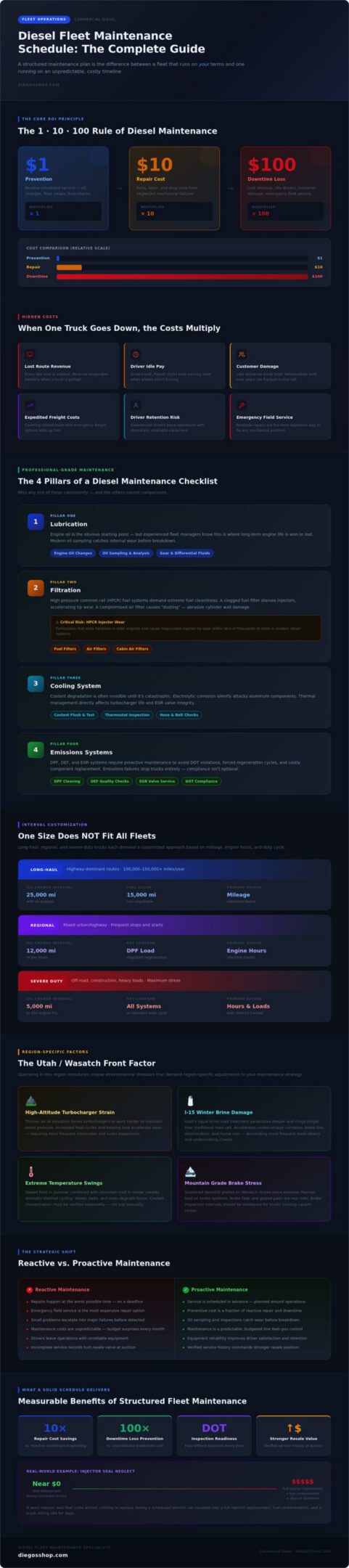
The industry principle that captures this best is the 1-10-100 Rule: every dollar spent on prevention saves roughly ten dollars in repair costs and one hundred dollars in downtime-related losses. That’s not a theoretical ratio. It reflects the compounding nature of mechanical neglect, where a worn injector seal that costs almost nothing to replace during a scheduled service can escalate into a full injector replacement, fuel contamination, and a truck sitting idle for days. The math isn’t complicated. The discipline to act on it is.
A well-executed schedule also directly affects resale value. Commercial diesel assets depreciate faster when service records are incomplete or inconsistent. Buyers and fleet remarketing platforms scrutinize maintenance documentation, and a truck with a verifiable, structured service history commands a meaningfully stronger position at auction or private sale. For fleets managing asset lifecycles over three to five years, that difference adds up across every unit in the rotation.
The broader shift this requires is moving from reactive firefighting to predictable operational costs. When maintenance is scheduled, budgeted, and tracked, it stops being a surprise and starts being a line item you control.
Eliminating the Hidden Costs of Downtime
A single truck out of service for a day carries costs that go well beyond the repair invoice. You’re absorbing lost revenue on that route, potential driver overtime or idle pay, customer relationship damage, and in some cases, expedited freight costs to cover the gap. Whether it’s a heavy hauler or a local service van providing carpet cleaning Lake Geneva WI, vehicle reliability is the foundation of service delivery. Driver retention is also a factor that’s easy to overlook: experienced drivers don’t stay with operations where equipment reliability is inconsistent. And if a breakdown reaches the roadside stage, emergency field service is consistently the most expensive way to address a mechanical problem, both in direct cost and in the hours lost waiting for a technician to arrive.
Extending Engine Longevity in Modern Diesels
Understanding diesel engine fundamentals makes clear why modern systems demand stricter scheduling than older mechanical engines. High-pressure common rail (HPCR) fuel systems operate at injection pressures that older systems never approached, and those tolerances leave almost no margin for contaminated fuel or degraded lubricants. Injector life expectancy is directly tied to fuel cleanliness; particulates that would have been inconsequential in a previous generation of engines now cause measurable wear at the injector tip within tens of thousands of miles. In 2026, preventive maintenance isn’t just a best practice for diesel fleets; it’s the primary driver of long-term engine ROI.
Core Components of a Professional Diesel Checklist
A diesel fleet maintenance schedule is only as strong as the systems it covers. Most generic checklists stop at oil changes and tire pressure, which is exactly why most fleets still get blindsided by failures that a more thorough protocol would have caught weeks earlier. Professional-grade maintenance is built on four pillars: lubrication, filtration, cooling, and emissions. Miss any one of them consistently, and the others can’t compensate.
Lubrication and Filtration Systems
Engine oil is the obvious starting point, but experienced fleet managers know the fuel filter is where real risk hides. Modern high-pressure common rail systems require fuel cleanliness that older mechanical engines never demanded. A clogged or degraded fuel filter doesn’t just reduce performance; it starves injectors of clean fuel under pressure, accelerating tip wear at a rate that compounds with every mile. Fuel filter replacement intervals should be treated as non-negotiable, not adjusted based on how the truck “seems” to be running.
Air filtration carries equal weight. A compromised air filter allows fine particulates into the intake stream, a condition technicians call a “dusted” engine. The abrasive wear this causes on cylinder walls and piston rings is irreversible. In high-dust operating environments, inspection intervals should be shortened accordingly. The 2026 Diesel Maintenance Handbook outlines specific interval adjustments based on operating conditions, and it’s a practical reference for fleets running mixed duty cycles.
One area where modern fleets are gaining a real edge is oil sampling. Sending used oil to a lab for analysis gives you a chemical fingerprint of what’s happening inside the engine: elevated iron indicates cylinder or ring wear, copper points to bearing degradation, and coolant contamination shows up as sodium or potassium. You’re not guessing at internal condition; you’re reading it directly. For fleets managing multiple assets, oil sampling turns an invisible problem into a scheduled intervention.
Brake, Suspension, and Electrical Health
Brake and suspension inspections aren’t optional maintenance items; they’re compliance requirements. FMCSA vehicle maintenance regulations set clear standards for commercial vehicle inspection, and brake system defects remain among the most cited violations during roadside inspections. S-cam adjustment, slack adjuster condition, and brake lining thickness all need documented checks at defined intervals, not just when a driver reports pulling or noise.
Electrical systems deserve more attention than most fleets give them. Telematics units, ELD devices, and advanced driver assistance systems all draw continuous power, and that load accelerates battery degradation faster than older electrical architectures experienced. Alternator output should be load-tested regularly, not just visually inspected. A battery that passes a static voltage check can still fail under real operating load.
Emission Control Management (DPF/SCR)
This is where most generic maintenance checklists fall completely short, and where modern diesel fleets face their highest risk of unscheduled downtime. Diesel Particulate Filter (DPF) and Selective Catalytic Reduction (SCR) systems require active management, not passive monitoring.
The DPF traps soot from exhaust gases and periodically burns it off through regeneration. The problem arises when trucks run too many short routes or idle heavily, preventing passive regen from completing. Soot accumulates, the system triggers an active regen, and if that’s interrupted repeatedly, you’re looking at a forced regen or, worse, a DPF that needs physical cleaning or replacement. Scheduling proactive DPF cleanings before ash loading reaches critical thresholds is far less disruptive than managing a truck in limp mode on a deadline.
SCR systems add another layer of complexity. DEF (Diesel Exhaust Fluid) quality degrades if stored improperly or contaminated, and SCR sensors that monitor NOx conversion efficiency will trigger fault codes that cascade into derate events. Monitoring DEF concentration and keeping SCR sensors on a defined inspection schedule prevents the majority of emission-related limp mode events that ground trucks mid-route.
Emission failures are now the leading cause of modern diesel derate events, yet they’re almost entirely preventable with a structured approach. If your current checklist doesn’t include DPF and SCR intervals, it’s worth connecting with a diesel fleet maintenance specialist who understands how these systems behave under real commercial duty cycles.
Customizing Intervals: Mileage vs. Engine Hours
A flat mileage-based schedule looks clean on paper. In practice, it fails the moment your fleet includes more than one type of truck doing more than one type of work. A long-haul Peterbilt logging 120,000 highway miles a year and a medium-duty Isuzu running municipal stop-and-go routes accumulate wear in completely different ways, and treating them identically guarantees that one of them will be over-serviced while the other quietly degrades between intervals.
The more accurate trigger for diesel service isn’t always mileage. It’s engine hours. A truck that idles heavily at a job site can accumulate the equivalent of hundreds of highway miles worth of oil degradation without moving an inch. Generic recommendations like “change oil every 10,000 to 15,000 miles” completely miss this reality, which is why fleets relying on mileage alone keep getting surprised by wear patterns that don’t match their service records.
Categorizing your assets is the first step toward a diesel fleet maintenance schedule that actually reflects how your trucks operate:
- Long-haul: High mileage, sustained highway loads, relatively stable thermal cycles. Mileage-based intervals work reasonably well here, with oil analysis used to validate extension opportunities.
- Regional: Mixed highway and urban routes, moderate idle time, variable loads. A hybrid mileage-plus-calendar approach typically fits best.
- Severe duty: Construction, vocational, municipal, or distribution work involving heavy idling, frequent starts, PTO operation, or consistent maximum load. Engine hours should be the primary trigger, not odometer readings.
Telematics platforms have made this categorization far more precise. Modern systems track idle time, engine load percentage, PTO engagement hours, and geographic operating conditions in real time. That data can be configured to trigger maintenance alerts based on actual wear inputs rather than estimated mileage thresholds, giving fleet managers a much tighter grip on where each asset sits in its service cycle. Federal diesel fleet maintenance regulations require that commercial carriers maintain systematic inspection and maintenance records, and telematics-generated service logs satisfy that requirement far more reliably than manual tracking.
Normal vs. Severe Duty Cycles
Severe duty isn’t just about heavy loads. Constant idling, high PTO hours, and repetitive short trips that prevent engines from reaching full operating temperature all qualify. Trucks operating under these conditions should have oil change intervals shortened to reflect engine hours rather than miles, and filter inspections moved to every service event without exception. A solid fleet preventive maintenance plan accounts for these variables at the individual asset level, not just across the fleet as a whole.
Developing Your Fleet’s ‘Service A, B, and C’ Rhythm
Structuring maintenance into three defined tiers gives your operation a repeatable rhythm that’s easy to track and communicate to drivers:
- Service A (Safety and Lube), every 5,000 to 7,500 miles: Oil and filter change, fluid level checks, brake inspection, tire pressure and condition, lights, and driver-reported defects.
- Service B (Intermediate), every 15,000 to 25,000 miles: Fuel filter replacement, air filter inspection, DPF system check, belt and hose inspection, battery load test, and suspension component review.
- Service C (Major and Annual), aligned with DOT inspection cycles: Comprehensive drivetrain inspection, full brake system measurement and documentation, cooling system service, injector performance assessment, and emission control system cleaning or recalibration.
This tiered structure keeps every truck on a defined path and prevents the most common failure mode in fleet maintenance: the truck that “just had an oil change” but hasn’t had a meaningful inspection in 60,000 miles.
The Utah Factor: Maintaining Fleets on the Wasatch Front
Generic maintenance schedules are written for generic conditions. The Wasatch Front isn’t generic. Fleets operating between Ogden and Springville contend with a specific combination of stressors that most national maintenance guides never account for: sustained mountain grades, elevation-driven engine strain, winter brine saturation on I-15, and temperature swings that can push 60 degrees Fahrenheit within a single day. A diesel fleet maintenance schedule built without these variables baked in is already behind.
Start with altitude. At 4,500 feet and above, air density drops measurably, and that thinner air directly affects the air-to-fuel ratio your engine is calibrated to run on. Turbochargers compensate by working harder, spinning at higher boost pressures to force adequate air volume into the combustion chamber. That increased workload accelerates turbo bearing wear and raises exhaust gas temperatures (EGT) on any haul with meaningful grade. Fleets running loads up Provo Canyon or across the Point of the Mountain should have EGT monitoring as a standard operating practice, not an afterthought. Sustained high EGT without intervention shortens turbo life and stresses the DPF regeneration cycle, compounding two problems at once.
Cooling system health is equally critical in this geography. Mountain grades force engines to sustain high load output for extended periods, which generates heat at a rate that flat-highway driving never approaches. For those managing temperature-sensitive cargo, you can learn more about specialized commercial refrigeration through E.R.S. Heating & Cooling to ensure your reefers are as reliable as your engines. Coolant condition, thermostat function, and radiator core cleanliness all matter more here than they would for the same truck running routes across Nevada. A cooling system that’s technically functional at sea level can run marginal on a Wasatch grade, and marginal becomes a problem when temperatures climb in July.
Winterization and Corrosion Prevention
UDOT’s use of liquid brine on I-15 and canyon roads is effective for road safety and brutal for undercarriage components. Brake hardware, leaf springs, and suspension mounting points absorb brine saturation through an entire winter season. Pre-winter inspections should include block heater and fuel heater verification, air dryer cartridge replacement, and a documented undercarriage inspection. Scheduled undercarriage washes during winter months aren’t optional maintenance for Wasatch Front fleets; they’re corrosion control. Leaf spring condition and U-bolt torque deserve specific attention given the combination of road salt exposure and the rough surface quality on secondary Utah routes.
High-Altitude Engine Performance
Monitoring EGT on heavy mountain hauls gives you early warning of turbocharger stress before it becomes a failure event. If EGT is consistently running high under normal load conditions, that’s a signal worth investigating, not logging and ignoring. Air filter inspection intervals should also be shortened for trucks running construction or agricultural corridors where dust loading is higher than typical highway operation.
These aren’t adjustments a general shop unfamiliar with regional conditions will think to recommend. For fleets based on the Wasatch Front, working with a specialist who understands how Utah’s elevation, winters, and road conditions interact with modern diesel systems is a practical advantage. Diesel repair in Utah requires that regional context, and Diego’s Shop in Springville is positioned specifically to provide it for light, medium, and heavy-duty commercial fleets operating in this environment.
If your current maintenance plan doesn’t account for the Wasatch Front’s specific demands, connect with a local diesel fleet maintenance specialist who can build those variables into your service intervals from the ground up.
Implementing Your 2026 Strategy with Diego’s Shop
A well-built diesel fleet maintenance schedule only delivers results when the shop executing it actually understands what’s under the hood. That distinction matters more than most fleet managers realize until they’ve spent time chasing misdiagnoses from a general repair shop that handles everything from lawn equipment to light-duty pickups. Specialization isn’t a marketing claim; it’s the difference between a technician who recognizes a subtle DPF ash loading pattern and one who replaces parts until the fault code clears.
Diego’s Shop in Springville is built specifically around commercial diesel work. That focus shapes everything: the diagnostic tools on hand, the familiarity with Peterbilt, Kenworth, Ford, and Isuzu platforms, and the understanding of how modern emission control systems behave under real commercial duty cycles. Generalist shops don’t carry that depth. They can’t, because their attention is spread across too many vehicle types to develop it.
The other differentiator is warrantied repair work. For fleet operators, that’s not a minor detail. When a repair carries a warranty, accountability comes with it. You’re not absorbing the cost of a comeback because a component was installed incorrectly or a root cause was missed. That protection directly supports the reliability your diesel fleet maintenance schedule is designed to create.
Partnering for DOT Compliance
Roadside inspections don’t announce themselves, and an Out of Service violation doesn’t just ground one truck; it disrupts the entire day’s operation. Diego’s Shop provides DOT truck inspections that pre-screen your vehicles against the same criteria inspectors use, so deficiencies get corrected in a controlled environment rather than discovered on the side of I-15. Digital service records maintained through the shop give you audit-ready documentation at any point, satisfying FMCSA record-keeping requirements without manual tracking overhead.
Expert Diagnostics for Modern Fleets
Sensor faults in modern diesel systems don’t always announce themselves with obvious symptoms. A degrading NOx sensor or a marginal fuel rail pressure reading can run under the threshold for active fault codes while quietly accelerating wear. Advanced diagnostic software gives Diego’s technicians visibility into live data streams across supported platforms, catching developing issues before they become breakdown events.
That capability extends across the commercial diesel brands most common on the Wasatch Front: Peterbilt, Kenworth, Ford, and Isuzu. Whether you’re managing a regional LTL fleet or a mixed vocational lineup, the diagnostic approach is the same: read the data, identify the pattern, and fix it before it costs you a route.
Apps manage schedules. Technicians fix trucks. If you’re ready to put a real specialist behind your 2026 maintenance strategy, schedule a fleet consultation at Diego’s Shop and build a plan that holds up under actual operating conditions.
Build a Fleet That Runs on Your Terms in 2026
A strong diesel fleet maintenance schedule isn’t just about keeping trucks out of the shop. It’s about controlling costs, protecting your assets, and running an operation that doesn’t get derailed every time a warning light comes on. The core principles are clear: maintain your lubrication, filtration, cooling, and emission systems on defined intervals, calibrate those intervals to how your trucks actually work, and account for the specific demands your regional environment places on every drivetrain.
That last point matters especially for fleets on the Wasatch Front. Altitude, winter brine, and mountain grades don’t show up in a national maintenance template. They show up in your repair bills if you ignore them.
Diego’s Shop in Springville brings specialized diesel mastery, warrantied repair work, and deep familiarity with Utah County’s operating conditions to every fleet relationship. That combination of accountability and regional expertise is what makes the difference between a maintenance plan that looks good on paper and one that actually holds up on I-15.
Keep your fleet on the road with a custom maintenance plan from Diego’s Shop. Your trucks are built to work hard. Make sure your maintenance strategy is too.
Frequently Asked Questions About Diesel Fleet Maintenance Schedules
What is the most important part of a diesel fleet maintenance schedule?
Emission control management is the single most consequential element in a modern diesel fleet maintenance schedule. DPF and SCR systems are the leading cause of derate events that ground trucks mid-route, yet they’re almost entirely preventable with structured intervals. Most fleets focus on oil changes and miss this entirely. Get your emission systems on a defined cleaning and inspection cycle, and you’ve addressed the failure mode that causes the most unscheduled downtime in 2026.
How often should I change the oil in my commercial diesel truck in 2026?
There’s no single correct answer because duty cycle determines the interval more than any manufacturer default. Highway trucks running consistent long-haul routes can often extend to 15,000 miles with oil analysis confirming condition. Severe-duty trucks operating under heavy idle, PTO use, or frequent short trips should be on engine-hour triggers rather than odometer readings. Oil sampling removes the guesswork entirely by showing you actual lubricant degradation rather than relying on estimated mileage thresholds.
What is the difference between Service A, Service B, and Service C?
Service A covers safety and lubrication basics: oil and filter changes, fluid checks, brake inspection, tire condition, and lights. It runs every 5,000 to 7,500 miles and keeps your truck legally compliant between deeper inspections. Service B adds fuel filter replacement, air filter inspection, DPF checks, and battery load testing at roughly 15,000 to 25,000 mile intervals. Service C is a comprehensive annual event aligned with DOT inspection cycles, covering drivetrain, cooling system service, injector assessment, and full emission control cleaning.
How do engine hours compare to mileage for maintenance intervals?
Engine hours measure actual mechanical wear regardless of distance traveled. A truck idling at a job site for eight hours accumulates oil degradation, bearing wear, and combustion byproducts without adding a single mile to the odometer. Mileage-based intervals miss this entirely, which is why fleets with heavy idle time consistently see premature wear that doesn’t match their service records. For vocational, construction, or municipal trucks, engine hours are the more accurate trigger for service decisions.
Why do diesel engines require more frequent maintenance than gasoline engines?
Modern commercial diesels operate at significantly higher compression ratios, injection pressures, and sustained load outputs than gasoline engines. High-pressure common rail fuel systems demand fuel cleanliness that leaves almost no tolerance for degraded filters or contaminated supply. Diesels also carry emission control systems, including DPF and SCR components, that require active management rather than passive monitoring. The mechanical tolerances are tighter, the operating stresses are greater, and the consequences of neglect compound faster.
Can a well-maintained schedule help my fleet pass DOT inspections?
Yes, directly. Brake system defects and lighting violations are among the most cited findings during roadside inspections, and both are addressed in a properly structured maintenance schedule. Pre-screening your vehicles against DOT inspection criteria in a controlled shop environment catches deficiencies before an inspector does. Documented service records also satisfy FMCSA record-keeping requirements, so you’re not scrambling to reconstruct maintenance history when compliance questions arise.
How does the Utah climate affect my diesel maintenance needs?
Fleets on the Wasatch Front face stressors that generic national schedules don’t account for. Elevation above 4,500 feet pushes turbochargers harder on every loaded grade, accelerating bearing wear and raising exhaust gas temperatures beyond what flat-highway operation produces. Winter brine saturation on I-15 and canyon roads attacks brake hardware, leaf springs, and suspension mounting points throughout the season. Both issues require specific interval adjustments, not just the standard manufacturer recommendations written for average operating conditions.
What are the early warning signs that my fleet maintenance schedule is failing?
The clearest indicator is unscheduled downtime becoming routine rather than rare. If trucks are regularly breaking down between scheduled services, your intervals don’t match your actual duty cycles. Other signals include recurring fault codes that keep returning after repairs, DPF regeneration events happening more frequently than expected, and drivers reporting performance complaints that weren’t flagged during the last service. A pattern of reactive repairs replacing planned interventions means the schedule exists on paper but isn’t calibrated to how your trucks actually operate.