
Reducing Fleet Maintenance Costs in Utah: A Strategic Guide for 2026

In Utah, the real cost of your fleet isn’t found on the sticker price. It is hidden in the corrosive salt of a Wasatch winter and the brutal grades of Parley’s Canyon. You already know that reactive repairs and emergency roadside calls are more than just an inconvenience; they are profit killers that make predictable budgeting nearly impossible. Achieving success in reducing fleet maintenance costs Utah operators face means fighting against the “Utah tax” of mountain driving and harsh weather. Staying ahead of the curve is the only way to keep your trucks moving and your margins intact.
We understand the pressure of maintaining heavy-duty diesel assets while managing new 2026 regulations like the $250 heavy-duty emissions compliance fee. With diesel prices averaging $4.568 per gallon, every minute of downtime or inefficient engine performance directly impacts your bottom line. This guide provides a clear roadmap to slash your operating expenses and minimize downtime through specialized maintenance strategies and expert mechanical oversight. You will learn how to transition from expensive emergency fixes to a disciplined preventive maintenance schedule that extends vehicle lifespan and ensures your fleet remains a reliable asset rather than a liability.
Key Takeaways
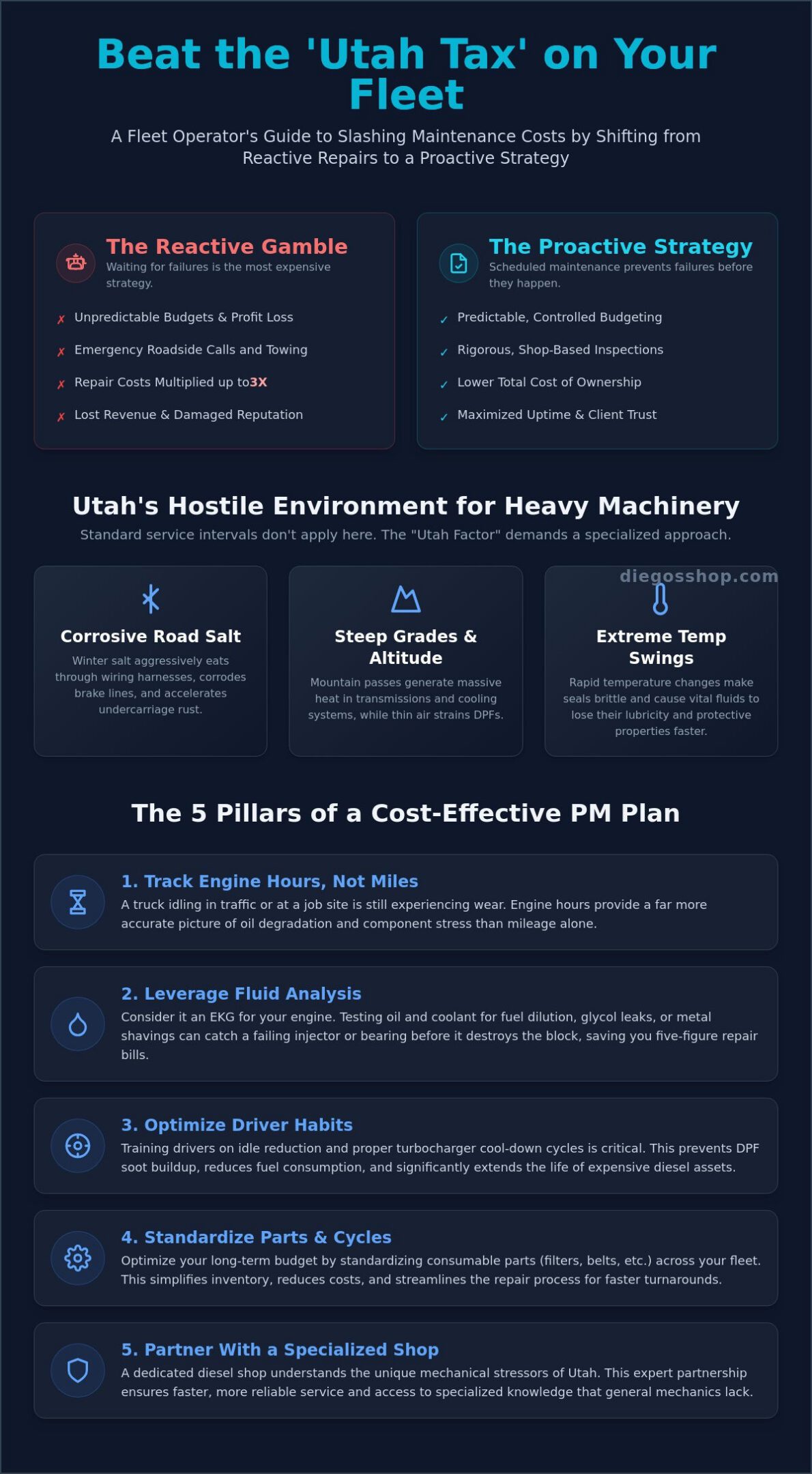
- Shift from reactive repairs to a proactive strategy to mitigate the unique mechanical stressors of Utah’s steep mountain grades and corrosive road salt.
- Implement a rigorous preventive maintenance plan focused on engine hours and fluid analysis to succeed in reducing fleet maintenance costs utah operators encounter.
- Train drivers on idle reduction and proper turbocharger cycles to prevent DPF soot buildup and significantly extend the life of your diesel assets.
- Optimize your long-term budget by standardizing parts across your fleet and partnering with a specialized diesel shop for faster, more reliable turnaround.
The High Cost of Reactive Maintenance in the Utah Climate
Reactive maintenance is a gamble where the house always wins. In the commercial diesel world, this means waiting for a component to fail before addressing it. It’s the most expensive way to run a business. Proactive maintenance, or preventive maintenance, involves scheduled inspections and component replacements to stop failures before they happen. For those focused on reducing fleet maintenance costs utah presents a specific set of challenges that make the reactive approach unsustainable. If you wait for a warning light, you’ve already lost the battle against your budget.
Utah’s environment is hostile to heavy machinery. Winter road salt is a silent killer. It eats through wiring harnesses and corrodes brake lines with aggressive speed. Then there are the grades. Pulling 80,000 pounds up a 6% grade generates massive heat in the transmission and cooling systems. When you combine this with Utah County’s temperature swings, seals become brittle and fluids lose their lubricity faster than the manufacturer’s manual predicts. A truck that runs fine in the Midwest will struggle under the “Utah Factor” without a specialized oversight strategy.
An emergency breakdown on the I-15 corridor is a logistical nightmare. You aren’t just paying for a tow; you’re paying for the premium emergency labor rate and the lost driver hours. These hidden costs often triple the price of the actual repair. Reducing fleet maintenance costs utah operations require means eliminating these roadside surprises through rigorous shop-based inspections.
Why Utah’s Geography Demands Superior Maintenance
Mountain passes like Parley’s Canyon or the climb through Spanish Fork Canyon put extreme stress on braking systems and cooling loops. High-altitude operation also changes how diesel engines breathe. Thinner air can lead to incomplete combustion, which forces your diesel particulate filter (DPF) to work harder and regenerate more frequently. Standard service intervals designed for flat, sea-level states simply don’t work here. If you follow a “one-size-fits-all” schedule, you’re likely overextending your equipment and inviting a major failure.
The True Price of Downtime for Local Fleets
Lost revenue is the most visible part of downtime. When a medium-duty truck sits in a bay for an unplanned repair, it isn’t earning. While exact figures vary by industry, the loss of a single power unit can cost a fleet hundreds or even thousands of dollars per day in missed opportunities. Beyond the numbers, your reputation is at stake. Missed delivery windows lead to lost contracts and diminished trust with your clients. Downtime is the most expensive variable in fleet management.
The 5 Pillars of a Cost-Effective Preventive Maintenance Plan
Telematics and GPS software provide valuable data, but they cannot replace the hands-on mechanical oversight required for heavy-duty assets. True success in reducing fleet maintenance costs utah managers strive for comes from a disciplined, five-pillar approach to shop-floor reality. While digital alerts tell you where a truck is, a physical inspection tells you if it will finish the route. A robust plan focuses on measurable mechanical health indicators rather than just reacting to dashboard lights.
The first pillar is transitioning from mileage-based intervals to engine-hour tracking. In Utah, a truck idling at a job site or crawling through I-15 traffic in Salt Lake County is still wearing down its internal components. Engine hours provide a more accurate picture of oil degradation and bearing wear. Second, you must maintain meticulous service records. This data allows you to identify “lemon” vehicles that consume a disproportionate amount of your budget. For benchmarking, the Utah Division of Fleet Operations offers excellent examples of how rigorous documentation leads to better asset management. The final pillars include aggressive tire management and cooling system prioritization, which are both critical for maintaining fuel efficiency on steep mountain grades.
Fluid Analysis: The EKG of Your Diesel Engine
Oil and coolant analysis is the most affordable insurance policy a fleet can buy. By testing for fuel dilution, glycol leaks, or metal shavings, you can catch a failing injector or a spun bearing before it destroys the block. Consistent diesel maintenance backed by lab results prevents five-figure engine rebuilds. It turns guesswork into a science. If you aren’t testing your fluids, you’re flying blind through the most expensive part of your vehicle.
Cooling System and Emission Control Oversight
Modern diesel engines live and die by their cooling and emission systems. High-altitude operations in the Wasatch Front place extra strain on the Exhaust Gas Recirculation (EGR) cooler. When these systems fail, they trigger “limp mode” scenarios that leave your drivers stranded. For Springville fleets, winter-grade additives are non-negotiable to prevent fuel gelling and system clogs during sub-zero cold snaps. Keeping these systems clean reduces the frequency of DPF regenerations and saves thousands in fuel and cleaning costs over the vehicle’s life. If you want to see how these pillars can stabilize your budget, it’s time to consult with a specialized fleet partner who understands Utah’s unique demands.
Optimizing Fleet Operations: Driver Habits and Route Efficiency
The person behind the wheel is your most critical maintenance tool. Their daily habits determine whether a truck reaches its full service life or ends up in the shop for premature overhauls. Strategic driver management is a cornerstone of reducing fleet maintenance costs utah businesses face daily. While telematics can track location, teaching your team to understand the mechanical limits of their equipment creates a culture of accountability that saves thousands in avoidable repairs.
One of the most overlooked aspects of diesel health is the turbocharger cycle. After a heavy pull up a grade like the Point of the Mountain, a diesel engine needs a proper cool-down period. Shutting down a hot engine immediately causes the oil to “coke” or bake inside the turbocharger bearings. Over time, this leads to catastrophic turbo failure. Training drivers to allow for a three-to-five minute idle period after high-load operations is a zero-cost strategy that prevents a four-figure repair bill. Similarly, avoiding unnecessary steep grades when a truck is fully loaded preserves both the transmission and the braking system.
Harsh driving isn’t just a safety risk; it’s a financial drain. Rapid acceleration and aggressive braking accelerate tire cupping and brake pad wear. By using data to identify drivers who consistently trigger high-G events, you can provide targeted coaching. While many organizations focus on safety through state-required driver training, adding a module on “mechanical sympathy” ensures your team understands how their foot on the pedal impacts the fleet’s bottom line.
The Impact of Idling on Diesel Life Cycles
Idling is a silent budget killer. Industry data shows that one hour of idling is equivalent to approximately 30 miles of engine wear. For long-haul fleets, auxiliary power units (APUs) are a smart investment that pays for itself by keeping the cab comfortable without running the main engine. Reducing idle time doesn’t just save fuel; it directly lowers the frequency of your diesel particulate filter (DPF) cleanings. Excessive idling leads to rapid soot buildup, which eventually forces the truck into frequent, fuel-heavy regenerations or expensive shop-forced “parked” regens.
Driver Education as a Cost-Saving Tool
Education is the best defense against mechanical neglect. We recommend implementing pre-trip inspection checklists that drivers actually use, rather than just “pencil whipping” the form. When a driver catches a small coolant leak or a fraying belt in the morning, it stays a minor fix. If they ignore it, it becomes a roadside emergency. Incentivizing fuel-efficient driving and equipment care lowers the fleet’s overall total cost of ownership (TCO) and rewards the employees who treat your assets with respect. Good drivers don’t just move freight; they protect your investment.
Strategic Parts Management and Replacement Cycles
Strategic parts management is the backbone of a lean operation. It involves more than just finding the lowest price on a fuel filter. You need to evaluate the Return on Investment (ROI) for every component that goes onto your trucks. In many cases, high-quality aftermarket parts offer the same durability as Original Equipment Manufacturer (OEM) components at a lower cost. However, for critical engine internals or sensitive electronic sensors, OEM parts often provide the precision needed to avoid expensive secondary failures. Standardizing these parts across your entire fleet simplifies your inventory and reduces the time your technicians spend searching for the right SKU. This level of organization is essential for reducing fleet maintenance costs utah businesses must manage to stay competitive in 2026.
Inventory control isn’t just about storage; it’s about speed. When you standardize your fleet to specific models or engines, you can stock the most common failure points. This reduces the time a truck spends waiting for a delivery. It also allows your mechanical team to become specialists in a specific platform, which leads to faster diagnostic times and more accurate repairs. Every minute saved in the shop is a minute that truck can be out on the road earning revenue. We focus on these efficiencies to ensure your fleet remains a productive asset rather than a drain on your cash flow.
When to Repair vs. When to Replace
The Case for Quality Components
Quality matters. A cheap oil filter that bypasses contaminants or a low-grade seal that leaks prematurely can lead to an engine seizure. These secondary failures are always more expensive than the initial savings. Using a diesel parts center allows you to source reliable components that meet or exceed factory specifications. We believe in the long-term savings of installing professional-grade parts that come with a guarantee. Leveraging warrantied repair work adds a layer of financial protection, ensuring that if a part does fail, your business isn’t on the hook for the labor to fix it again. If you want to protect your assets with the highest quality components, partner with our expert fleet maintenance team.
Partnering with a Specialized Utah Diesel Shop
Software platforms can track your fuel use and location, but they can’t diagnose a spun bearing or a leaking air brake line. For real results in reducing fleet maintenance costs utah managers need a mechanical partner who understands the iron. General auto shops often lack the heavy-duty lifts, specialized computer diagnostics, and overhead clearance required for professional fleet maintenance. When you partner with a specialist, you’re investing in the technical infrastructure and specific expertise that keeps commercial assets on the road. A local Springville partner provides the rapid response and turnaround time that national franchises simply can’t match.
Compliance is a major part of your operating budget. Failing a roadside inspection leads to fines and immediate downtime that ruins your delivery schedule. We ensure your vehicles are 100% ready for dot truck inspections near me by performing rigorous pre-checks before the inspector ever sees your truck. Our team knows exactly what Utah inspectors are looking for, from brake stroke measurements to lighting and load securement. This local knowledge prevents the expensive “out of service” tickets that plague fleets crossing the Wasatch Front. We take the guesswork out of compliance so you can focus on your core operations.
Expertise That Keeps You Moving
There is no substitute for a technician who understands modern engine management. At Diego’s Shop, we pride ourselves on the personal accountability that comes with being a local master craftsman. You aren’t just another account number in a database; you’re a neighbor whose business depends on our technical skill. Our team handles everything from light-duty Ford pickups to heavy-duty Peterbilts with the same level of precision. We use advanced diagnostics to find the root cause of an issue, preventing the “parts cannon” approach that inflates your repair bills. Reducing fleet maintenance costs utah fleets deal with starts with getting the repair right the first time.
Getting Started with a Custom Fleet Plan
Every fleet has a different duty cycle and different mechanical needs. The first step toward a predictable budget is a comprehensive fleet health audit at Diego’s Shop. We’ll inspect every asset, review your current logs, and identify the immediate risks to your uptime. From there, we build a custom maintenance schedule that aligns with your operational flow. This creates predictable billing and a service rhythm that prevents major component failures. Don’t wait for a roadside emergency to find a mechanic you can trust. Contact Diego’s Shop today to request your custom fleet maintenance plan and take total control of your operating expenses. Quality work is our signature promise.
Taking Control of Your Fleet’s Operational Budget
Success in reducing fleet maintenance costs utah operators face depends on moving beyond simple oil changes. You must integrate rigorous fluid analysis, enforce mechanical sympathy among drivers, and manage parts with a focus on long-term ROI. By treating maintenance as a strategic investment rather than an unavoidable expense, you protect your assets from the Wasatch Front’s unique stressors. This ensures your trucks remain on the road during peak demand when it matters most. A disciplined approach today prevents the catastrophic failures of tomorrow.
Diego’s Shop provides the specialized diesel expertise in Springville needed to execute these strategies. We deliver comprehensive warrantied repair work across light, medium, and heavy-duty diesel platforms. Our team ensures your equipment meets the highest standards of durability and performance. Whether you manage a local delivery route or a long-haul operation, we’re ready to help you stabilize your spending and eliminate the uncertainty of roadside failures. You can build a more resilient, profitable fleet by starting with the right mechanical partner.
Request a Custom Fleet Maintenance Consultation at Diego’s Shop and secure your uptime. Your fleet is built for the long haul, and we’re here to keep it that way. Quality work is our signature promise.
Frequently Asked Questions
What is the most effective way to reduce fleet maintenance costs in Utah?
The most effective method is transitioning from a reactive repair model to a disciplined preventive maintenance schedule. This approach addresses the specific mechanical stressors found in the Intermountain West, such as steep mountain grades and corrosive winter road salt. By prioritizing engine health and conducting regular fluid analysis, you can achieve consistent results in reducing fleet maintenance costs utah operators face while extending the total lifespan of your diesel assets.
How often should my diesel fleet undergo preventive maintenance?
We recommend scheduling service intervals based on engine hours rather than odometer readings alone. In Utah, heavy idling during winter and high-load climbs through mountain passes mean engines work harder even at low speeds. A standard baseline is usually every 250 to 500 engine hours. However, your specific duty cycle and results from oil analysis should ultimately dictate the frequency to ensure you aren’t over-servicing or under-protecting your equipment.
Does cold weather in Utah affect diesel engine maintenance costs?
Cold weather significantly drives up costs through increased battery strain, fuel gelling risks, and salt-related corrosion. Sub-zero temperatures in Utah County require the use of high-quality winter-grade additives and frequent inspections of air systems to prevent freezing. Additionally, road salt aggressively attacks electrical harnesses and brake components. Addressing these seasonal factors early prevents expensive emergency repairs and keeps your fleet compliant with safety standards during the harshest months.
Should I use OEM or aftermarket parts for my fleet trucks?
The best strategy is to use a mix based on the component’s criticality to the engine’s operation. High-quality aftermarket parts often provide excellent ROI for non-critical items like body components or certain suspension parts. For sensitive engine sensors, injectors, or internal seals, OEM parts are often superior because they prevent expensive secondary failures. We focus on sourcing reliable components that carry a professional guarantee to protect your business from the cost of repeated labor.
How can I track and manage my fleet’s maintenance history?
The most reliable way to manage history is through a centralized digital logging system or by partnering with a specialized shop that provides detailed electronic service records. Accurate tracking allows you to monitor the total cost of ownership for each unit and identify “lemon” vehicles before they drain your budget. These records are also essential for maintaining resale value and proving compliance during state or federal inspections.
What are the most common maintenance issues for diesel trucks in Utah County?
The most frequent issues involve emission control systems, specifically Diesel Particulate Filters (DPF) and EGR coolers, which struggle with high-altitude combustion. We also see frequent cooling system leaks and accelerated brake wear caused by the extreme thermal cycling of mountain driving. Addressing these regional stressors through targeted inspections prevents the most common causes of roadside downtime on the I-15 corridor and surrounding canyons.
Is it cheaper to outsource fleet maintenance or do it in-house?
For most fleets, outsourcing to a specialized shop is more cost-effective than maintaining an in-house facility. In-house shops require massive investments in heavy-duty lifts, specialized diagnostic software, and ongoing technician training. By outsourcing, you only pay for the expertise and infrastructure when you need it. This allows your business to leverage master-level diesel technicians without the burden of fixed overhead and administrative management of a mechanical staff.
How do I know when it’s time to retire a truck from my fleet?
Retire a truck when the annual cost of unplanned repairs and the value of lost revenue from downtime exceed the cost of a new vehicle payment. This point of diminishing returns usually appears when major components like the transmission or turbocharger begin to fail consecutively. Using your maintenance logs to track these cost spikes ensures you sell the asset while it still holds significant resale value, rather than waiting for a total mechanical failure.