

Mastering Your Fleet Vehicle Uptime Strategy in 2026

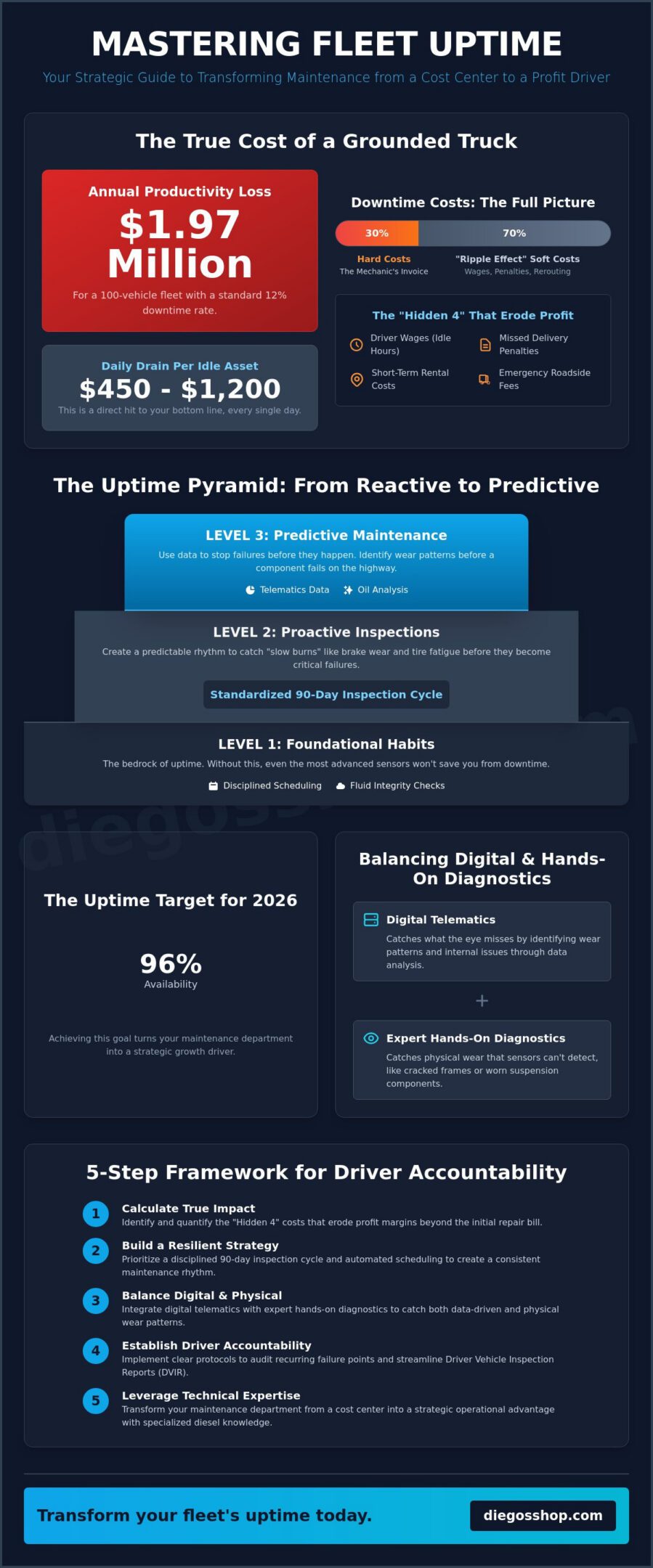
An idle asset doesn’t just sit; it drains between $450 and $1,200 from your bottom line every single day. For a 100-vehicle fleet, maintaining a standard 12% downtime rate can evaporate nearly $1.97 million in annual productivity. These numbers prove that a reactive approach to repairs is no longer sustainable. You need a disciplined fleet vehicle uptime strategy that moves beyond putting out fires and focuses on a consistent, professional mechanical rhythm.
You likely feel the pressure of rising operational costs and the constant anxiety of FMCSA compliance. It’s frustrating when unpredictable DPF failures or a shortage of reliable technicians keep your trucks off the road. We believe that maintenance should provide peace of mind, not more stress. This guide will show you how to transform diesel engine repair and preventive maintenance into a strategic advantage that lowers your total cost of ownership. We’ll examine the impact of automated scheduling, the shift toward predictive diagnostics, and the specific steps required to reach a 96% availability target in 2026.
Key Takeaways
- Calculate the true impact of idle assets by identifying the “Hidden 4” costs that erode your profit margins.
- Build a resilient fleet vehicle uptime strategy that prioritizes a 90-day inspection cycle and disciplined scheduling.
- Balance digital telematics with expert hands-on diagnostics to catch physical wear that sensors can’t detect.
- Establish clear driver accountability using a 5-step framework designed to audit recurring failure points and streamline DVIR protocols.
- Leverage technical diesel expertise to transform your maintenance department from a cost center into a strategic operational advantage.
The True Cost of Downtime: Why Uptime is Your Best 2026 Investment
Operating a diesel fleet in 2026 is an exercise in precision. When a truck pulls off the shoulder, the clock starts ticking on more than just a repair bill. A reactive “fix-it-when-it-breaks” mindset is the most expensive mistake a manager can make in the current economy. To remain profitable, your fleet vehicle uptime strategy must account for the “Hidden 4” costs that never appear on a mechanic’s invoice. These include driver wages for idle hours, penalties for missed delivery windows, the high cost of short-term rentals, and the steep premiums associated with emergency roadside assistance.
The 2026 regulatory landscape adds another layer of financial risk. FMCSA fine increases mean that an equipment failure during an inspection is no longer just a minor setback; it’s a direct hit to your bottom line. Beyond the money, there’s a psychological toll. Unreliable equipment is a leading cause of driver turnover. Your best diesel drivers want to spend their hours behind the wheel, not waiting in a parking lot for a service truck. Providing dependable machinery is a key part of keeping your seats filled with experienced professionals.
Hard Costs vs. Soft Costs in Modern Trucking
Many managers focus solely on the shop bill, but that figure usually represents only 30% of the total loss. The “Ripple Effect” of a single truck down can be devastating for tight-margin fleets. One missed pickup often leads to a chain reaction of delayed loads and frustrated logistics partners. Effective fleet management requires recognizing that these soft costs, like administrative time spent rerouting freight, often outweigh the physical repair. Uptime is a direct measure of your fleet’s mechanical health and its ability to generate consistent revenue.
Opportunity Costs and Brand Reputation
In 2026, shippers are prioritizing reliability over the lowest price. A missed contract due to repeated equipment failure is a permanent loss of income. Consistent uptime builds the long-term trust required to secure stable, high-paying contracts. Transitioning from “survival mode” to a strategic uptime model ensures that your trucks are ready when the phone rings. This shift isn’t just about avoiding engine failure; it’s about positioning your business as a dependable partner in a competitive market. A robust fleet vehicle uptime strategy turns your maintenance department into a driver of growth rather than a drain on resources.
The Uptime Pyramid: From Reactive to Predictive Maintenance
Moving from a reactive stance to a proactive one isn’t just about software; it’s about structure. Think of your fleet vehicle uptime strategy as a pyramid. At the base, you have the foundational habits that keep the wheels turning. As you move up, you integrate more data to stop failures before they happen. This progression allows you to manage costs without overwhelming your shop staff or your budget. Transitioning to this model is the final step in a mature fleet vehicle uptime strategy.
A reliable fleet maintenance schedule is the bedrock. Without a disciplined calendar, even the most advanced sensors won’t save you. You need a system that tracks every asset and ensures no truck misses its window. The middle tier involves the 90-day inspection cycle. This is where you catch the “slow burns” like brake wear and tire fatigue. By standardizing these intervals, you create a predictable rhythm for your shop and your drivers.
The peak of the pyramid is predictive maintenance. This level uses telematics and oil analysis to see what the human eye misses. This data-driven approach is essential for streamlining uptime by identifying wear patterns before a component fails on the highway.
The Mechanics of Preventive Maintenance
Fluid integrity is the lifeblood of a diesel engine. The 2026 diesel maintenance handbook emphasizes that contaminated oil or coolant leads to catastrophic failure. Don’t just follow mileage. If your trucks idle in heavy traffic or haul heavy loads, your duty cycle demands more frequent service. Regular dot truck inspections near me help identify structural weaknesses, like cracked frames or worn suspension components, before they become safety hazards.
Transitioning to Predictive Models
Predictive models rely on history. By monitoring fault code patterns, you can anticipate EGR and DPF issues before the engine enters derate mode. Trend analysis in coolant and oil samples reveals internal wear, such as bearing degradation or head gasket leaks. This approach reduces shop time because you can order parts in advance. You aren’t waiting for a breakdown; you’re scheduling the fix during planned downtime. If your current schedule feels more like a suggestion than a rule, it’s time to tighten your protocols. Professional Fleet Maintenance keeps your equipment in peak condition and your business moving forward.
Telematics vs. Hands-On Diagnostics: Finding the Balance
Digital tools are changing the industry, but they don’t replace mechanical intuition. Your fleet vehicle uptime strategy depends on how well you merge data with dirt-under-the-fingernails expertise. Telematics provides a window into the engine’s brain, yet it remains blind to the physical realities of a hard-working truck. A successful operation uses data to flag potential issues while relying on a master craftsman to verify the actual condition of the iron.
The Role of Telematics in Uptime
Modern software offers real-time monitoring of engine load, fuel trim, and exhaust temperatures. These metrics are vital for identifying inefficiencies before they become failures. By using telematics for efficient fleet management, you can automate service alerts and ensure no vehicle overshoots its maintenance window. This data also highlights driver behavior, such as excessive idling or harsh braking, which helps pinpoint mechanical stress points. When used correctly, software acts as an early warning system that keeps your shop one step ahead of the next repair bill.
Why Hands-On Inspections Remain Essential
Despite the rise of AI, a sensor cannot see a dry-rotted belt or a loose fastener. These physical defects often cause the most sudden and costly roadside failures. At Diego’s Shop, we combine technical mastery with modern diagnostic tools to provide a complete picture of vehicle health. A visual inspection catches leaks, cracks, and frayed wires that an electronic scan simply misses. This “Master Craftsman” approach ensures that diesel engine repair is based on total vehicle reality, not just a list of fault codes.
Consider a case where a vehicle passed every electronic scan without a single fault code. During a routine physical inspection, a technician noticed a slight metallic shimmer in the transmission fluid. This manual check saved a transmission that the onboard computer insisted was perfect. Creating a tight feedback loop between driver reports and shop diagnostics ensures these small signs don’t turn into major expenses. Technology serves as a helpful guide, but a seasoned technician remains the final authority on roadworthiness. Our standard involves a rigorous multi-point check that verifies the integrity of every hose, clamp, and connection. We don’t just clear codes; we find the root cause of the vibration or the leak. This level of detail is what keeps a fleet vehicle uptime strategy profitable over the long haul. Integrity in maintenance means looking beyond the screen to ensure every component is truly secure.
A 5-Step Strategic Framework for Maximizing Fleet Uptime
Implementing a successful fleet vehicle uptime strategy requires moving from vague goals to a disciplined framework. Theory alone doesn’t keep trucks on the road; repeatable processes do. By following a structured approach, you can identify hidden weaknesses and address them before they impact your delivery schedule. This framework focuses on data, driver accountability, and regional expertise to ensure your equipment remains profitable and reliable.
Step 1 & 2: Data Auditing and Driver Involvement
Start by auditing your current downtime to identify the “Top 3” recurring failure points in your specific fleet. Your past repair invoices are more than just financial records. They are diagnostic tools that help you predict future failures. If you see a pattern of EGR issues or cooling system leaks, you can adjust your inspection focus to catch these problems earlier. Drivers are your first line of defense. They must be trained to recognize early warning signs like unusual vibrations, smells, or sounds before a sensor ever triggers a fault code. Incentivizing “clean” Driver Vehicle Inspection Reports (DVIRs) and proactive reporting turns your drivers into active participants in your maintenance goals. When drivers feel responsible for their equipment, retention rates often improve alongside vehicle reliability.
Step 3 & 4: Regional Maintenance and Parts Strategy
Utah presents unique challenges that generic schedules often ignore. The Wasatch Front environment involves heavy salt corrosion, steep mountain grades, and extreme temperature swings. Your diesel maintenance intervals must reflect these harsh realities. Brake systems and cooling components face significantly higher stress on local mountain passes than they do in flatter regions. To bypass ongoing supply chain delays, build a “Critical Parts” inventory on-site. This “Uptime Kit” should include high-wear items like belts, filters, and common sensors. Utilizing a reputable diesel parts center ensures you are using OEM quality components that stand up to the rigors of heavy-duty hauling. This proactive stocking prevents a simple $50 part from causing a $1,500 day of lost revenue.
The final step is establishing a relationship with a specialized diesel repair utah center. Having a partner who understands modern diesel engine management and offers warrantied work provides total peace of mind. A robust fleet vehicle uptime strategy is only as strong as the technicians executing it. Our team provides the technical mastery required to keep your light, medium, or heavy-duty trucks in peak condition. If your current maintenance plan doesn’t account for Utah’s unique terrain, it’s time to upgrade. Contact us today for professional Fleet Maintenance that puts you back in control of your operational rhythm.
Why Diego’s Shop is Your Strategic Uptime Partner in Springville
Many providers treat downtime as a simple financial metric. We view it differently. To us, downtime is a mechanical failure of discipline that can be avoided with the right expertise. A successful fleet vehicle uptime strategy requires a partner who understands that every hour your truck sits in a bay is an hour of lost revenue. We provide the technical mastery and grounded expertise needed to keep your diesel fleet moving through the toughest conditions the Wasatch Front can offer. Our team focuses on the durable, hardworking nature of your machinery to ensure it performs when you need it most.
Specialized Expertise for Complex Systems
Modern diesel engines require more than general repair knowledge. We provide deep expertise in Peterbilt, Kenworth, Isuzu, and Ford diesel platforms. This specialization ensures your specific equipment receives the precise care it needs. Our diagnostic protocols go beyond reading fault codes. We identify internal wear patterns in engine management and emission systems before they lead to costly roadside failures or engine derates. You need a partner who speaks your language and understands your operational goals. We don’t just fix parts; we maintain the mechanical integrity of your entire fleet. This specialized approach allows us to catch the small leaks or loose connections that automated sensors often miss.
The Diego’s Shop Promise: Quality and Reliability
We believe in no-nonsense communication and total accountability. When you bring your fleet to us, you receive honest assessments and clear timelines. This allows you to manage your logistics with confidence rather than guessing when a truck will return to service. Our commitment to warrantied repair work provides the peace of mind that comes from knowing the job was done right the first time. We take pride in supporting Utah County businesses with reliable, hardworking diesel service that stands up to heavy loads and mountain grades. Integrity is the foundation of every service we perform, from routine preventive maintenance to complex diesel engine repair. Contact Diego’s Shop today for a custom fleet maintenance plan and experience the difference that master-craftsman skill makes for your bottom line. We are ready to help you transform your maintenance from a reactive expense into a strategic operational advantage.
Take Control of Your Fleet’s Mechanical Destiny
Transitioning from reactive repairs to a proactive fleet vehicle uptime strategy is the most significant investment you can make this year. You’ve seen how identifying hidden costs and implementing a rigorous five-step framework can stabilize your operations. By balancing modern telematics with the visual intuition of a master craftsman, you eliminate the blind spots that lead to expensive roadside failures. Your trucks face unique stresses on the Wasatch Front, and they require a maintenance rhythm that respects those conditions.
We provide warrantied diesel repairs and specialized expertise for medium and heavy-duty fleets across Springville and the surrounding areas. We take pride in the durability of our work and the clarity of our communication. It’s time to move beyond survival mode and start building a more resilient operation that keeps your drivers safe and your deliveries on time.
Secure Your Fleet’s Future with a Custom Maintenance Plan at Diego’s Shop
Let’s turn your maintenance schedule into a predictable, profitable engine for growth. Your fleet deserves equipment that works as hard as you do.
Frequently Asked Questions
What is the most common cause of fleet vehicle downtime in 2026?
Emission system failures, specifically DPF and EGR issues, remain the leading cause of unplanned downtime for diesel fleets. These complex systems require precise management to avoid engine derates. Regular cleaning and sensor calibration are essential to keep your trucks on the road. Ignoring these components often leads to expensive roadside emergencies that could’ve been prevented with a disciplined inspection routine.
How can I calculate the true financial impact of an idle truck?
To find the true cost, you must add the “Hidden 4” to your repair bill: driver wages for idle time, missed delivery penalties, rental vehicle fees, and emergency service premiums. Industry data shows that an idle asset can cost between $450 and $1,200 per day. Tracking these figures helps you justify a more robust fleet vehicle uptime strategy and move maintenance from an expense to a strategic advantage.
Is preventive maintenance really cheaper than reactive repairs?
Preventive maintenance is significantly more cost-effective because it allows you to address wear before it causes a catastrophic failure. Fleets that automate their scheduling report a 35% reduction in unplanned breakdowns. By catching a worn belt or a small coolant leak in the shop, you avoid the high costs of towing and the operational chaos of a truck breaking down mid-route.
How do Utah weather conditions affect my fleet vehicle uptime strategy?
Utah’s environment is exceptionally harsh on diesel engines due to heavy road salt, steep mountain grades, and rapid temperature changes. These factors accelerate corrosion and put extreme stress on cooling and braking systems. A successful fleet vehicle uptime strategy in the Wasatch Front must include more frequent fluid checks and underside inspections to combat the unique wear patterns caused by our regional terrain.
What role does driver training play in reducing mechanical failures?
Drivers are your most valuable diagnostic tool because they spend the most time with the equipment. Training them to recognize subtle changes in engine vibration, exhaust smell, or air system sounds can stop a minor issue from becoming a total engine failure. Rigorous Pre-Trip and Post-Trip inspections ensure that small defects are reported and repaired before the truck leaves the yard.
Can telematics alone prevent major engine breakdowns?
Telematics provide vital data on engine load and fault codes, but they can’t detect physical defects like frayed wires or dry-rotted hoses. Software is an excellent early warning system, but it requires a technician’s eye to verify the mechanical reality. Relying solely on sensors leaves you vulnerable to simple physical failures that an algorithm isn’t designed to see.
How often should I schedule professional shop inspections for my fleet?
Most top-performing fleets follow a 90-day professional inspection cycle to maintain a high level of availability. This frequency allows technicians to catch wear patterns in brakes, tires, and suspension components that might not trigger an electronic alert. Standardizing these intervals ensures your fleet stays compliant with FMCSA regulations while providing a predictable rhythm for your maintenance budget and operational planning.
What are the benefits of partnering with a local diesel specialist vs. a national chain?
Partnering with a local diesel specialist provides a level of personal accountability and regional expertise that national chains often lack. We understand the specific demands of Utah’s mountain passes and extreme weather. You get direct communication with master craftsmen who prioritize the long-term durability of your equipment. This relationship builds trust and ensures your warrantied repair work is handled with integrity.