

Loss of Power in Diesel Engine: Causes and Expert Solutions for 2026

Imagine you are hauling a heavy load up the steep 6 percent grade of Spanish Fork Canyon on a Tuesday afternoon when your RPMs suddenly drop and the accelerator goes soft. That sinking feeling in your chest isn’t just about the mechanical failure; it’s about the thousands of dollars in revenue lost for every day your truck sits in a bay. You need your equipment to perform with rugged reliability, yet identifying the specific loss of power in diesel engine causes often feels like a guessing game when dealing with general repair shops that lack specialized mastery.
We understand that unplanned downtime is the enemy of your bottom line. You deserve a partner who provides honest, warrantied work rather than inconsistent results that leave you stranded. In this guide, we’ll help you identify the root causes of power failure and show you how professional diagnostics keep your fleet on the road. We are going to examine the most common fuel and air system failures and provide a clear, technical plan to restore your vehicle’s strength, ensuring the job is done right the first time.
Key Takeaways
- Identify the critical differences between general performance drops and torque loss to prioritize the right repairs for your heavy-duty hauling needs.
- Uncover why fuel delivery systems and air intake imbalances are the leading loss of power in diesel engine causes in 2026.
- Learn how to manage modern emissions components like EGR valves and DPFs to prevent them from “choking” your engine’s output.
- Recognize the warning signs of “Limp Mode” and how electronic sensors act as a protective shield for your vehicle’s most vital components.
- Discover the value of professional diagnostic protocols that target the root cause of power failure to ensure every repair is done right.
Understanding Diesel Power Loss: Symptoms and Regional Factors
Diesel power loss is more than a minor annoyance. It is a measurable decline in your engine’s ability to perform work over time. When your truck fails to maintain highway speeds or struggles to crest a hill it once handled easily, you are facing a performance gap. Identifying the specific loss of power in diesel engine causes is the first step toward restoring your vehicle’s rugged reliability. We approach these issues with technical mastery to ensure your repair is done right the first time.
Power vs. Torque: What Are You Actually Losing?
Torque and power are related but distinct. Torque is the rotational force that gets a heavy load moving from a dead stop. Power is the engine’s ability to maintain that momentum at higher speeds. Horsepower is the rate of doing work. If your truck starts the load fine but loses speed on flat ground, the engine is failing to produce power. If you cannot get the load moving at all, you have a torque problem. Understanding Diesel engine operation helps clarify that torque relies on cylinder pressure while power depends on how quickly that pressure can be applied repeatedly. A gear-related struggle usually involves high RPMs with no movement, while an engine-related struggle is characterized by a sluggish, dead pedal feel.
Warning Signs You Shouldn’t Ignore
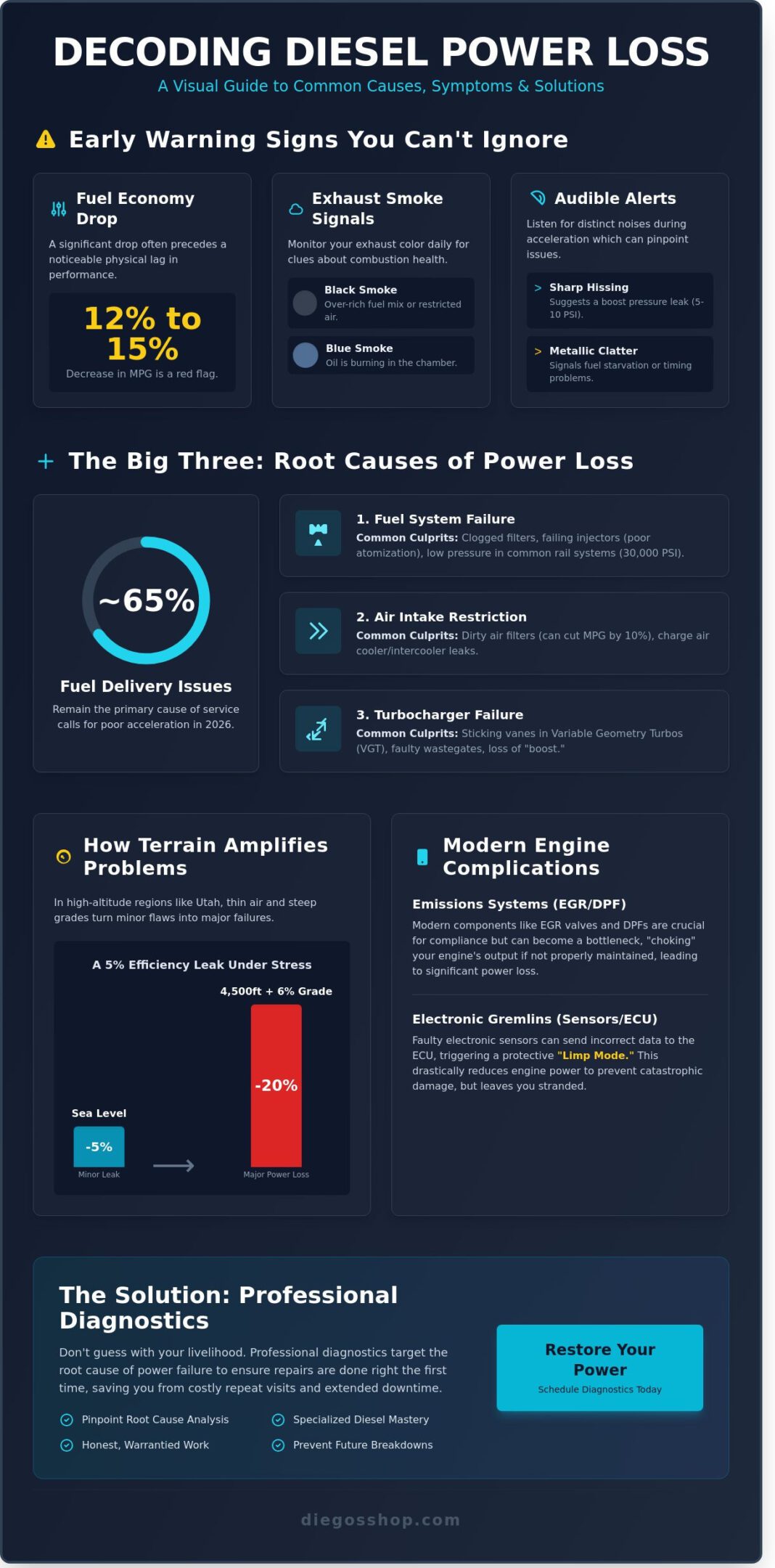
A 12% to 15% drop in fuel economy often happens before you feel a physical lag. You should monitor your exhaust color daily. Black smoke indicates an over-rich fuel mixture or restricted airflow. Blue smoke suggests oil is burning in the combustion chamber. Listen for specific sounds during acceleration. A sharp hissing sound often points to a 5 psi to 10 psi drop in boost pressure from a cracked charge air cooler hose. A metallic clatter usually signals fuel starvation or timing issues. These symptoms are early warnings of the primary loss of power in diesel engine causes that lead to expensive downtime if ignored.
In Utah, the environment tests even the best equipment. At altitudes above 4,500 feet, the air is significantly thinner. This reduces the oxygen available for combustion. When you hit a 6% grade, a minor 5% efficiency leak becomes a major 20% power loss. Heat and elevation exacerbate every small mechanical flaw. We see many trucks that run fine at sea level but fail completely when crossing the mountain passes of the West. Addressing these issues requires a specialist who understands how regional factors impact diesel performance. We provide the honest, warrantied work needed to keep your engine running strong regardless of the terrain.
The Big Three: Fuel, Air, and Turbocharger Failures
Diesel engines function on a delicate balance. They require a specific ratio of compressed air and atomized fuel to generate the torque required for heavy-duty work. If this balance shifts by even a small margin, performance drops instantly. In 2026, fuel delivery issues remain the primary loss of power in diesel engine causes, accounting for approximately 65% of all service calls related to poor acceleration. High-pressure common rail systems demand absolute precision; a minor obstruction can lead to a significant drop in output. Turbochargers handle the heavy lifting by forcing air into the cylinders, which is vital for maintaining power at high altitudes or during heavy hauls. For complex issues involving forced induction, professional diesel engine repair ensures your boost levels remain consistent and your engine stays protected.
Fuel System Blockages and Injector Failure
Fuel filters are your first line of defense, yet they’re the most overlooked component. A filter clogged with particulates can restrict flow enough to starve the engine under load. Failing fuel injectors are another common culprit. When an injector fails to atomize fuel into a fine mist, the resulting poor spray pattern leads to incomplete combustion and visible soot. In modern common rail systems operating at 30,000 PSI, low fuel pressure often triggers a “limp mode.” This safety feature limits RPM to prevent catastrophic component damage, leaving you with a fraction of your usual power.
Air Intake Restrictions and Turbocharger Lag
Air intake restrictions act like a chokehold on your engine. For medium-duty commercial trucks, a dirty air filter can reduce fuel economy by 10% and significantly cut horsepower. Turbocharger failures often stem from sticking vanes in Variable Geometry Turbos (VGT) or a faulty wastegate. If the “boost” disappears, the engine cannot process enough fuel to maintain speed. Intercooler leaks are equally problematic. When compressed air escapes through a cracked boot or core before reaching the cylinders, the engine loses the oxygen density required for a strong combustion stroke. Identifying these loss of power in diesel engine causes early prevents long-term wear on internal components.
If your truck feels sluggish or fails to hold speed on an incline, it’s time for a professional diagnostic. You can schedule a comprehensive inspection to get your vehicle back to peak performance.
Modern Emissions Systems: EGR and DPF Complications
Modern diesel engines rely on complex filtration and recirculation to meet EPA Tier 4 standards. While these systems reduce nitrogen oxide and particulate matter, they create high-stress environments for engine components. If you don’t maintain these parts, they eventually choke the engine. This restriction is one of the most common loss of power in diesel engine causes that leaves drivers stranded. It’s a trade-off where cleaner air comes at the cost of increased maintenance requirements.
EGR Valve Carbon Buildup
The Exhaust Gas Recirculation (EGR) valve lowers combustion temperatures by reintroducing cooled exhaust into the intake manifold. Over time, soot and oil vapor create a thick, tar-like carbon paste that causes the valve to stick. When the valve sticks open, it floods the intake with oxygen-poor gas when the engine needs fresh air most. You’ll feel a massive power loss under load and notice a rough, unstable idle. While some shops suggest a quick spray cleaning, this is usually a 30-day fix. Professional component service or replacement is the only way to ensure the valve and cooler are clear of 100% of the restrictive buildup, restoring the engine’s technical mastery.
DPF Clogging and Failed Regenerations
The Diesel Particulate Filter (DPF) is a ceramic honeycomb designed to trap soot before it exits the tailpipe. Think of a clogged DPF like a potato shoved into your exhaust system; it creates massive backpressure that fights against the turbo’s efforts. For the DPF to “regenerate” or burn off that soot, exhaust temperatures must reach 1,000 to 1,200 degrees Fahrenheit. Drivers in Utah County often face issues because short trips between Provo and American Fork don’t allow the system to reach these temperatures.
When regenerations fail repeatedly, the soot packs tightly into the filter, a condition known as face plugging. If you ignore the dashboard alerts, the vehicle’s computer will trigger “limp mode,” severely restricting your RPMs to protect the engine from a melted DPF core. Replacing a destroyed DPF is a major expense that far outweighs the cost of proactive cleaning and monitoring.
Consistent fleet maintenance is the most effective way to monitor these systems before they fail. Industry data suggests that 60% of modern diesel engine issues stem from emissions system neglect. We use advanced diagnostic tools to track soot levels and EGR flow rates, ensuring your vehicle maintains its rugged reliability on every haul. Getting these systems serviced regularly ensures the job is Done Right the first time.
Electronic Gremlins: Sensors, ECU, and Limp Mode Logic
Many owners face a frustrating scenario where their truck suddenly loses all throttle response, only to have it return after a quick restart. This behavior is a classic symptom of the loss of power in diesel engine causes tied to electronic management. Your truck isn’t fixing itself. It’s simply resetting a software state that will inevitably return until the hardware fault is addressed. At Diego’s Shop, we see this often in light-duty pickups and heavy-duty haulers alike.
The “Restart Fix” and Limp Mode Explained
Limp mode is a protective software state programmed into the Engine Control Unit (ECU). It triggers when sensors detect parameters that could cause an engine to melt down or a turbo to overspeed. By limiting fuel injection and turbo boost, the ECU ensures you can reach a repair facility without a total engine replacement. Restarting the vehicle clears the active status of the code, but the fault remains stored in the permanent memory. You shouldn’t ignore this warning. Driving in limp mode for more than 40 or 50 miles puts immense strain on the transmission because the ECU cannot properly coordinate shift points with the reduced engine torque.
Critical Sensor Failures: MAP, MAF, and EBP
The ECU relies on a constant stream of high-speed data to maintain technical mastery over combustion. When these sensors fail, performance drops instantly. Three specific sensors cause the most trouble in modern diesel systems:
- Manifold Absolute Pressure (MAP): This sensor tracks turbo boost levels. If the sensor port is clogged with carbon or the sensor fails, the ECU won’t know how much air is entering the cylinders, leading to a significant loss of power in diesel engine causes.
- Mass Air Flow (MAF): These sensors are incredibly sensitive. A poor-quality air filter can allow debris or oil to coat the sensor wire. This leads to inaccurate air-density readings and poor fuel trim.
- Exhaust Back Pressure (EBP): This is a hidden cause of many mystery power losses. The EBP sensor monitors the pressure before the turbo. If the small metal tube leading to this sensor becomes packed with soot, the ECU assumes the engine is choking and will aggressively de-rate the power output to prevent damage.
It is vital to understand that pulling a trouble code at a local parts store isn’t a true diagnosis. A code like P0299 tells you there is an underboost condition, but it doesn’t explain if the cause is a cracked intercooler, a stuck turbo vane, or a faulty MAP sensor. Our certified technicians use comprehensive inspection protocols to test the sensors and the wiring harnesses to ensure the repair is done right the first time.
Don’t let electronic glitches leave you stranded on the shoulder. Schedule a professional diesel diagnostic service at Diego’s Shop to get your power back today.
Professional Diagnostics and Prevention at Diego’s Shop
Identifying the primary loss of power in diesel engine causes is only the first step toward restoring your vehicle’s performance. At Diego’s Shop, our philosophy is simple: Diesel Service and Repair Done Right. We don’t rely solely on what a computer screen tells us. While digital scans provide a starting point, our master technicians understand that sensors often report the symptom rather than the source. We apply technical mastery to every truck that enters our bays, ensuring your equipment returns to the road with rugged reliability.
The “Done Right” Diagnostic Process
Our diagnostic approach goes deep into the mechanical heart of your engine. We use physical pressure tests to identify boost leaks that scanners might miss and perform detailed injector flow analysis to ensure precise fuel delivery. Our technicians view your vehicle as a complete, integrated system. A drop in power might look like a fuel issue, but it could actually stem from a restricted exhaust or a failing turbocharger component.
We provide 100% warrantied repair work because we believe in the quality of our craftsmanship. This commitment offers peace of mind for drivers on long hauls through the Intermountain West. Whether you’re driving a light-duty Ford-F250 or a heavy-duty Kenworth, our comprehensive inspection protocols ensure we fix the problem correctly the first time. We eliminate the guesswork that leads to repeat shop visits and unnecessary downtime.
Preventive Maintenance: The Cure for Power Loss
The most effective way to address the various loss of power in diesel engine causes is to stop them before they start. We develop customized maintenance schedules tailored to the specific demands of light, medium, and heavy-duty trucks. For commercial fleets, this proactive strategy is essential to eliminate expensive roadside power loss events. Our team focuses on the critical systems that modern diesels rely on for efficiency.
- Detailed inspections of EGR coolers and valves to prevent carbon buildup.
- Proactive DPF monitoring to avoid “limp mode” scenarios.
- Fuel system cleaning and filter rotations to protect high-pressure rails.
- Turbocharger health checks to ensure consistent boost levels.
By following our diesel maintenance guidelines, owners can catch EGR and DPF issues early. Industry data shows that regular maintenance can reduce the Total Cost of Ownership (TCO) by up to 15% over the life of a vehicle by avoiding catastrophic failures. We prioritize honest communication and dependable service to keep your fleet operational and profitable.
Don’t let a sluggish engine impact your bottom line. Visit Diego’s Shop for expert diagnostics and warrantied repairs that you can trust. We are your partner in maintaining the power and performance your work demands.
Restore Your Performance with Technical Mastery
Ignoring the early signs of a sluggish engine often leads to expensive downtime and complex mechanical failures. Understanding the most common loss of power in diesel engine causes, from clogged fuel filters to restricted DPF systems, is the first step toward maintaining a dependable fleet. Modern 2026 diesel technology requires more than just a quick fix; it demands precise electronic diagnostics and a deep understanding of ECU logic to keep your vehicle out of limp mode. Whether you’re operating a heavy-duty Peterbilt or a light-duty Ford, proactive maintenance ensures your engine meets rigorous performance and emission standards.
Diego’s Shop provides the rugged reliability you need to stay on the road. We specialize in Isuzu, Kenworth, and other major diesel brands, delivering 100% warrantied repair work for every customer. Our team serves Springville and the entire Wasatch Front with honest, expert service that gets the job done right the first time. Don’t let a minor sensor issue turn into a major overhaul. You can count on our certified technicians to diagnose your power loss with absolute precision.
Schedule Your Expert Diesel Diagnostic at Diego’s Shop Today
We’re ready to help you get your truck back to peak operating condition with the professional care it deserves.
Frequently Asked Questions
Why does my diesel truck lose power when I accelerate uphill?
Losing power on an incline usually stems from fuel starvation or a failing turbocharger. When you hit a 10% grade, your engine requires maximum fuel volume and boost pressure to maintain momentum. If your fuel lift pump provides less than the required 55 PSI, the engine enters a derated state to prevent internal damage. We use advanced diagnostics to ensure your fuel system meets factory specifications for rugged reliability.
Can a bad fuel filter really cause a total loss of engine power?
A restricted fuel filter is one of the most common loss of power in diesel engine causes because it blocks essential flow to the high pressure pump. Modern diesel systems rely on filters that catch particles as small as 2 microns. When these pores clog, fuel pressure drops below 10 PSI and the engine may stall completely. Replacing your filters every 15,000 miles prevents these sudden failures and keeps your truck running right.
What is “Limp Mode” and is it safe to keep driving?
Limp mode is a security feature in your truck’s computer that restricts engine performance to prevent catastrophic mechanical failure. It typically limits your speed to 40 miles per hour and caps engine speed at 2,000 RPM to protect the drivetrain. While it’s designed to let you reach a safe location, you shouldn’t drive long distances in this state. Continuing to push a vehicle in limp mode can turn a minor sensor issue into a $5,000 repair bill.
How much does it cost to diagnose a diesel power loss issue?
Diagnostic costs for power loss depend on the time required for a certified technician to perform a comprehensive system scan and physical inspection. Most professional shops charge based on a standard labor rate for 1 to 2 hours of expert troubleshooting. This process involves checking fuel rail pressure, turbocharger output, and exhaust backpressure. At Diego’s Shop, we focus on technical mastery to find the root cause quickly, ensuring an honest and warrantied repair.
Why does my engine power return after I turn the truck off and back on?
Power often returns after a restart because the Engine Control Unit resets its temporary error logs and clears the “soft” fault state. If a sensor like the Manifold Absolute Pressure sends a single reading outside of the 0 to 40 PSI range, the computer may cut power as a precaution. Turning the key off cycles the electronics, but the underlying mechanical loss of power in diesel engine causes remain. Ignoring these intermittent symptoms leads to more expensive repairs later.
Will a clogged DPF cause my diesel engine to stall or lose power?
A clogged Diesel Particulate Filter creates excessive backpressure that will definitely cause power loss and eventual stalling. When soot levels reach 80% capacity, the exhaust gas can’t exit the engine efficiently. This creates a bottleneck that forces the engine to work 20% harder just to move air through the system. Regular regeneration cycles are critical, as a fully blocked DPF requires professional cleaning or total replacement to restore performance.
How often should I have my EGR system inspected to prevent power loss?
You should have your Exhaust Gas Recirculation system inspected every 25,000 miles to prevent carbon buildup. In many heavy duty engines, soot can reduce the diameter of intake passages by 30% over two years of driving. This restriction chokes the engine and causes a noticeable drop in torque. Our technicians use specialized tools to verify EGR valve movement and cooler efficiency, keeping your system clean and reliable.
Does high altitude in Utah affect diesel engine performance and power?
High altitude in Utah significantly impacts performance because the air contains roughly 20% less oxygen at 6,000 feet compared to sea level. Diesel engines lose approximately 3% of their rated horsepower for every 1,000 feet of elevation gain. This means a truck rated for 400 horsepower might only produce 328 horsepower at the top of a mountain pass. We calibrate fuel maps and turbo settings to handle these specific regional conditions and ensure your truck stays dependable.