

Justifying Preventative Maintenance to Your Boss: A Data-Driven Guide

A single missed oil analysis costing less than $100 often leads to a $30,000 engine overhaul that sidelines your best driver for weeks. You already understand that reactive repairs are the most expensive way to run a fleet. However, justifying preventative maintenance to my boss can feel like an uphill battle when they only focus on this month’s line items. It’s exhausting to manage emergency breakdowns while facing constant pressure to cut “unnecessary” spending on trucks that appear to be running fine. You need a way to bridge the gap between technical mastery and fiscal reality.
We’re going to change that conversation. You’ll learn how to transform maintenance from a perceived cost center into a rugged competitive advantage that protects your bottom line. This guide provides a clear ROI framework and a persuasive pitch that speaks the language of business, not just diesel. We’ll show you exactly how to prove that “Done Right” today means thousands of dollars saved tomorrow, ensuring your fleet stays on the road where it belongs.
Key Takeaways
- Break the cycle of reactive maintenance by uncovering the hidden costs of breakdowns that jeopardize your fleet’s rugged reliability.
- Transform maintenance into a profit center by using a data-driven framework to compare scheduled plans against catastrophic engine failures and fuel loss.
- Strengthen your business case with DOT compliance data that links proactive shop visits to lower CSA scores and reduced legal liability.
- Follow a step-by-step guide for justifying preventative maintenance to my boss by aligning hard repair data with key company goals like maximum uptime.
- Learn how a “Done Right” service strategy with warrantied repairs ensures your fleet stays on the road with total peace of mind.
The High Cost of the “Wait and See” Trap: Why Reactive Maintenance Fails
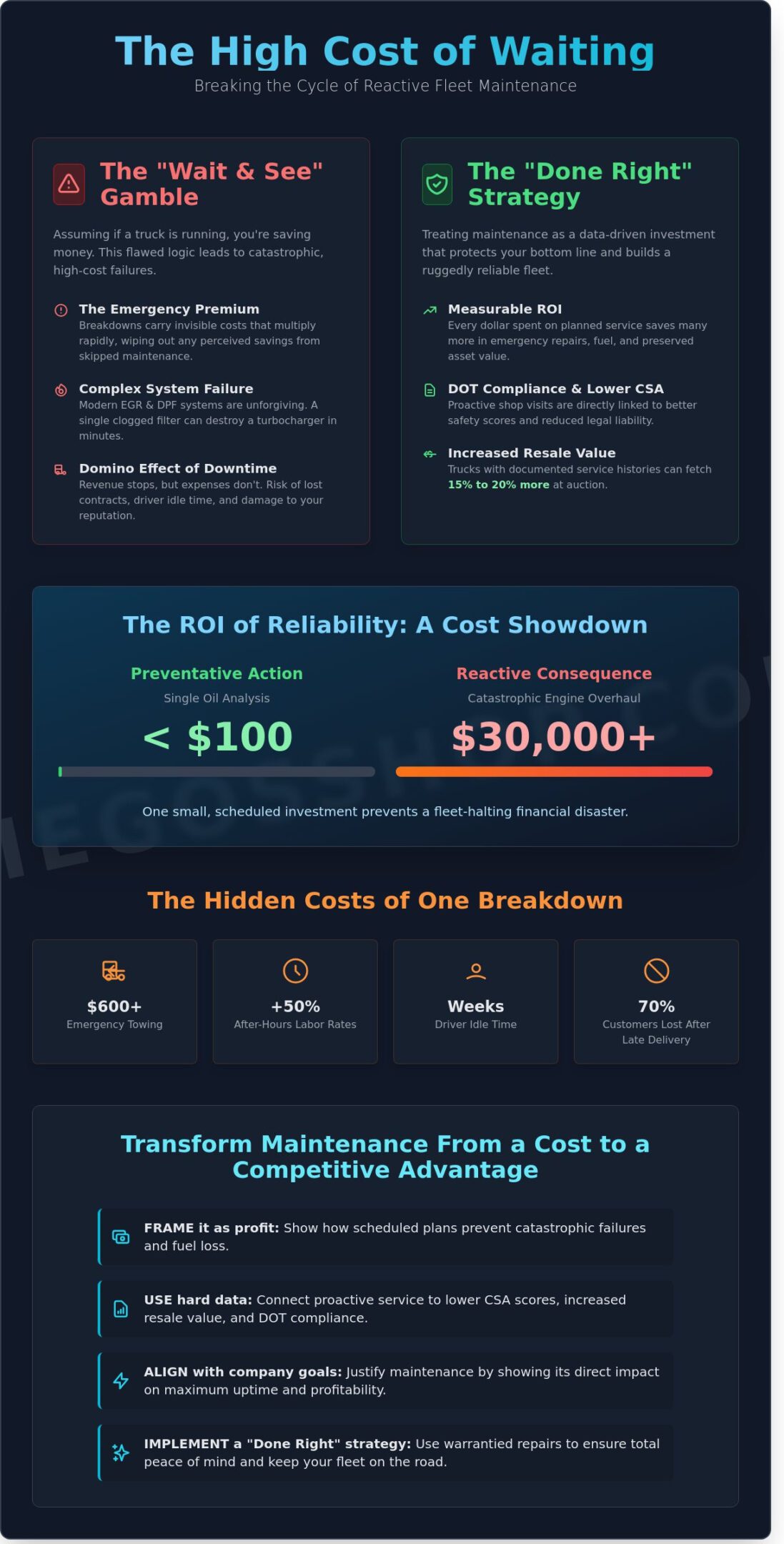
Reactive maintenance is a high-risk gamble with your fleet assets. It assumes that if a truck is moving, you’re saving money. This logic is dangerous and fundamentally flawed. While a preventative maintenance (PM) service has a visible, predictable cost, a breakdown carries invisible costs that multiply rapidly. When justifying preventative maintenance to my boss, I focus on the reality that waiting for a failure is the most expensive way to run a diesel fleet. It transforms a simple service into a multi-thousand dollar emergency.
Modern diesel technology, specifically EGR and DPF systems, is less forgiving of neglect than older, purely mechanical engines. These complex emission systems require technical mastery to manage. A single clogged DPF can lead to backpressure that destroys a turbocharger in minutes. You aren’t just changing oil; you’re protecting sophisticated hardware that’s designed to fail if it isn’t monitored. Rugged reliability isn’t an accident. It’s the result of comprehensive inspection protocols that catch small carbon buildups before they choke the engine.
The Emergency Repair Premium
Emergency repairs carry a heavy financial premium that wipes out any perceived savings from skipping maintenance. A standard tow for a Class 8 truck often starts at $600 and increases based on mileage and location. After-hours labor rates frequently jump 50% or more above standard shop rates. Parts availability is another hurdle that drives up costs. During a crisis, you’re forced to pay for expedited shipping or source whatever is available, regardless of the price. This volatility disrupts shop schedules and pulls technicians away from planned work, creating a backlog that hurts the entire fleet’s uptime. Successfully justifying preventative maintenance to my boss requires showing that downtime is a choice between a scheduled pause and a forced, expensive stop.
The Ripple Effect of Unplanned Downtime
Unplanned downtime creates a domino effect that reaches far beyond the repair shop. When a truck stops, your revenue stops, but your expenses don’t. Research indicates that 70% of customers are less likely to renew a contract after a single late delivery caused by equipment failure. You also have to calculate the driver idle time cost. If a truck sits in a shop for three days, you’re paying a driver’s base salary while that asset generates zero revenue. This is how small issues turn into major engine overhauls. For a deeper look at these transitions, refer to this Expert Diesel Engine Repair guide. It shows how technical oversight keeps your fleet on the road and your reputation intact.
Calculating the ROI: Turning Maintenance into a Profit Center
Your boss likely views the maintenance budget as a series of costs to be minimized. To change that mindset, you must present maintenance as an investment with a measurable return. Justifying preventative maintenance to my boss becomes easier when you compare the fixed, predictable cost of a 12-month plan against the catastrophic price of a single engine failure. A typical heavy-duty diesel overhaul can exceed $20,000 in parts and labor. In contrast, a comprehensive preventative maintenance schedule costs a small fraction of that amount annually. This is not just about fixing trucks; it is about protecting the company’s bottom line.
We define this approach as “Rugged Reliability.” It is a financial asset that pays dividends every day a vehicle is on the road. Consistent records do more than just keep you compliant; they increase the resale value of the fleet. Data from industry auctions shows that trucks with documented service histories often fetch 15% to 20% more than those with spotty records. When you prove that every dollar spent on a filter or an oil analysis saves five dollars in emergency repairs, the conversation shifts from “spending” to “saving.”
Extending Asset Lifespan in the Wasatch Front
Utah presents unique challenges that demand rigorous service intervals. Temperature swings from -10°F in January to 100°F in July cause seals to become brittle and fluids to break down faster than in milder climates. Road salt used by UDOT during winter months accelerates chassis corrosion and electrical failures. Regular lubrication and detailed inspections prevent premature chassis and engine death by catching small leaks before they turn into seized components. For technical longevity tips, read The 2026 Diesel Maintenance Handbook.
Fuel Savings and Emission Compliance
Fuel is the largest variable expense for any fleet. A well-maintained engine with clean filters and precise fuel injection timing can improve fuel economy by 1% to 2%. For a fleet of 10 trucks averaging 100,000 miles a year, even a 1% gain saves thousands of gallons of diesel. Neglect leads to expensive Diesel Particulate Filter (DPF) replacements, which can cost $5,000 or more, whereas professional cleaning is a manageable operational expense. Regular EGR service prevents total system soot-up that causes catastrophic engine failure and unplanned downtime.
If you’re ready to build a data-backed plan for your vehicles, schedule a service with our certified technicians to get an honest assessment of your fleet’s needs. Justifying preventative maintenance to my boss starts with showing them that “Done Right” means more money in the bank.
Strengthening Your Case with Data and DOT Compliance
Data doesn’t lie, and it’s the most powerful tool you have when justifying preventative maintenance to my boss. Leaders prioritize two things above all else: profitability and the reduction of legal liability. A proactive maintenance schedule directly impacts both. When a fleet operates with a “fix it when it breaks” mentality, it carries a high risk of poor CSA scores, which leads to increased roadside interventions and higher insurance premiums. By presenting a strategy focused on rugged reliability, you show that you aren’t just spending money; you’re protecting the company’s reputation and bottom line.
Documentation is your best defense. In the event of a highway accident, investigators look for a “paper trail of neglect.” If you can produce digital records showing that every safety system was inspected and serviced on schedule, you provide the company with essential legal protection. This “Done Right” approach provides the peace of mind that comes from knowing every vehicle is as safe as possible before it hits the road.
Avoiding the “Failed DOT Inspection” Nightmare
Nothing stalls a budget like a surprise fine or an out-of-service (OOS) order. During the 2023 CVSA International Roadcheck, nearly 19% of vehicles inspected were placed out of service due to maintenance violations. These aren’t just minor inconveniences; they represent thousands of dollars in lost revenue, towing fees, and emergency repair premiums. A structured PM program acts as a permanent “pre-inspection” process. By scheduling reliable DOT truck inspections in Utah County, you identify worn brake pads, chafed air lines, or lighting issues before a state trooper does. This guarantees compliance and keeps your trucks moving without the threat of heavy fines.
Leveraging Historical Repair Data
To succeed at justifying preventative maintenance to my boss, you must look backward to move forward. Gather invoices from the last 12 months and highlight every “emergency” repair. Compare the cost of that emergency tow and roadside fix to what a scheduled shop visit would have cost. The numbers usually tell a stark story: emergency repairs often cost 3 to 4 times more than planned maintenance.
- Track MTBF: Use a simple spreadsheet to track the Mean Time Between Failures for each unit. If a specific Peterbilt or Kenworth is failing every 15,000 miles, you have data-backed proof that the current interval is too long.
- Visualize Trends: Create a basic chart showing the decline in “unplanned downtime” hours as PM compliance increases.
- Identify Lemons: Data helps you spot vehicles that are costing more to maintain than they are worth, allowing the boss to make informed replacement decisions.
Using these metrics transforms the shop from a “cost center” into a “value center.” It proves that technical mastery and consistent scheduling aren’t just about mechanics; they’re about business survival.
The Pitch: How to Present the Business Case to Your Boss
Moving from reactive repairs to a proactive schedule requires more than just a request; it requires a professional business case. When justifying preventative maintenance to my boss, I focus on the bottom line. You need to transform technical needs into financial assets. Follow these four steps to build your case.
- Step 1: Gather your data. Pull the invoices from the last 12 months. Compare the cost of a $450 scheduled service against a $6,000 emergency engine repair. Numbers don’t lie.
- Step 2: Align with company goals. If the company is pushing for 98% on-time delivery, explain how PM reduces roadside failures that cause delays.
- Step 3: Present a Pilot Program. Don’t ask to change the whole fleet at once. Propose a 180-day trial on 10% of your trucks to track the reduction in “unscheduled shop time.”
- Step 4: Focus on the Cost of Inaction. Explain that skipping a $300 valve adjustment today leads to a $15,000 engine failure later. The price of doing nothing is always higher.
Framing the Conversation Around Revenue
In the trucking industry, if the wheels aren’t turning, we aren’t earning. Shift the language away from “oil changes” and toward “Operational Readiness” and “Risk Mitigation.” This language appeals to leadership because it protects the company’s ability to generate cash. Use this 30-second elevator pitch: “By investing $500 in Rugged Reliability now through scheduled service, we ensure $20,000 in projected revenue for this truck next month remains secure.” This framing turns a shop expense into an insurance policy for your income.
Handling Common Objections
Expect pushback and meet it with facts. When the boss says, “we don’t have the money,” show them the “emergency tax.” Data from 2023 indicates that unscheduled repairs cost 4 times more than planned maintenance. If they claim “the trucks are new,” remind them that 2024 diesel models have sensitive after-treatment systems. These systems require precise care to avoid “limp mode” errors that can ground a new rig for weeks. Finally, if they suggest doing it “ourselves later,” explain the value of a warrantied diesel specialist. At Diego’s Shop, we provide work that is Done Right and backed by a guarantee. This eliminates the risk of a DIY mistake costing the company even more in the long run. Justifying preventative maintenance to my boss becomes easy when you prove that professional oversight reduces total liability.
Ready to protect your fleet with technical mastery? Schedule a professional fleet assessment to get the data you need for your pitch.
Implementing a “Done Right” Strategy with Diego’s Shop
Diego’s Shop serves as the professional partner you need when justifying preventative maintenance to my boss. We understand that fleet managers in Utah County need more than just oil changes; they need a strategy built on rugged reliability and technical mastery. Our Springville-based service center provides a local advantage for fleets operating along the I-15 corridor, offering a level of accountability that national chains can’t match. We treat every vehicle with a focus on diesel service and repair done right, ensuring your equipment stays on the road and out of the graveyard.
Our comprehensive inspection protocols are designed for light, medium, and heavy-duty diesel vehicles. We don’t just look for obvious leaks. Our certified mechanics perform deep-dive diagnostics into cooling systems, exhaust aftertreatment, and drivetrain integrity. By catching a $200 sensor failure today, we prevent a $5,000 roadside breakdown tomorrow. This proactive approach provides the data-backed peace of mind that keeps your operations running without the stress of unexpected failures.
Customized Fleet Service Plans
We recognize that a Ford F-350 used for local deliveries has different service requirements than a Kenworth or Peterbilt hauling 80,000 pounds across the country. Diego’s Shop tailors PM schedules to your specific vehicle types and duty cycles. Whether you manage a fleet of local dump trucks or OTR long-haulers, we align our service intervals with manufacturer recommendations and real-world Utah driving conditions. For a deeper look at how we structure these programs, explore our Fleet Maintenance guide. We help you present a clear, organized plan to leadership that accounts for every asset in the yard.
Warrantied Work as Risk Mitigation
One of the most effective tools for justifying preventative maintenance to my boss is our 100% warrantied work. In an industry where unplanned downtime can cost a fleet upwards of $760 per day per vehicle according to industry benchmarks, the risk of a faulty repair is unacceptable. Our warranty acts as a financial safeguard for your company’s investment. It proves that we stand behind our technical mastery and the parts we install.
Our honest, reliable approach ensures that when a truck leaves our shop, it’s ready for the rigors of the job. We eliminate the “paying twice” scenario that often plagues cut-rate maintenance shops. By partnering with us, you’re not just buying a service; you’re securing a guarantee of performance. This level of accountability is exactly what bosses look for when approving maintenance budgets.
Stop the Breakdown Cycle and Secure Your Fleet’s Future
Transitioning from reactive repairs to a proactive strategy isn’t just about saving time; it’s about protecting your bottom line. Data from the American Transportation Research Institute shows that unexpected breakdowns cost fleets an average of $450 per hour in lost productivity. When you factor in DOT out-of-service fines that often exceed $4,000 per violation, the financial risk of waiting for a failure becomes impossible to ignore. By justifying preventative maintenance to my boss using these hard numbers, you move the conversation from “spending money” to “protecting revenue.”
At Diego’s Shop, we specialize in keeping Peterbilt, Kenworth, and Ford diesel engines on the road across Utah County and the Wasatch Front. Our team delivers rugged reliability through 100% warrantied repair work, ensuring your fleet meets every compliance standard without the guesswork. We provide the technical mastery and honest service your business needs to stay competitive and keep your drivers safe. It’s time to trade the stress of emergency repairs for the peace of mind that comes with a plan that’s done right.
Get a Custom Fleet Maintenance Quote for Your Boss
Frequently Asked Questions
How can I connect fleet maintenance to our company’s professional image?
How do I calculate the ROI of preventive maintenance for a diesel fleet?
You calculate ROI by subtracting the total cost of the maintenance program from the savings gained through reduced emergency repairs and downtime. According to the American Transportation Research Institute, maintenance costs average $0.20 per mile. If a PM program reduces your breakdown frequency by 20%, you save thousands per vehicle annually. This clear financial data is essential for justifying preventative maintenance to my boss.
What is the most common objection bosses have to PM programs?
The most common objection is the immediate upfront cost and perceived vehicle downtime. Managers often focus on the $300 to $600 spent on a service today rather than the $10,000 engine failure it prevents later. You’ll need to explain that a scheduled 4 hour service is much easier to manage than a 3 day unscheduled breakdown that halts your entire delivery schedule.
How often should a commercial diesel truck have a full preventive maintenance inspection?
A commercial diesel truck should undergo a full inspection every 10,000 to 15,000 miles or every 90 days. This schedule follows Federal Motor Carrier Safety Administration guidelines to ensure safety and legal compliance. Regular intervals prevent 85% of common roadside failures. We use comprehensive inspection protocols to catch small leaks before they become catastrophic failures that take your truck off the road.
Can preventive maintenance actually reduce my insurance premiums?
Yes, consistent maintenance records can lead to lower insurance premiums through improved Safety Measurement System scores. Carriers with lower crash rates and fewer maintenance violations often see 5% to 15% reductions in annual premiums. Showing a history of “Done Right” maintenance proves to insurers that your fleet is a lower risk. This documentation provides tangible proof of your commitment to safety and rugged reliability.
What happens if we skip a PM cycle because the fleet is too busy?
Skipping a single PM cycle increases the risk of a major component failure by 25% during the next 5,000 miles. While it keeps the truck moving today, it leads to compounding neglect where minor issues like worn belts cause engine overheating. This neglect is a primary reason for justifying preventative maintenance to my boss, as emergency repairs typically cost 4 times more than scheduled service.
How does Diego’s Shop help me document maintenance for my boss?
Diego’s Shop provides detailed digital reports and service histories for every vehicle in your fleet. We document every diagnostic result and repair performed with technical mastery. These records give you a clear paper trail to prove compliance and ROI. Having honest, warrantied proof of work makes it easy to show your boss exactly where the maintenance budget is going and how it protects the company assets.
Is it cheaper to do maintenance in-house or outsource to a specialist like Diego’s?
Outsourcing to a specialist is often cheaper because it eliminates the $100,000 plus annual overhead of specialized tooling, software, and technician benefits. Diego’s Shop offers the rugged reliability of master technicians without the fixed costs of running a private shop. You pay only for the expert work we deliver, ensuring every dollar is spent on keeping your heavy duty long haul giants on the road.