

How to Improve Diesel Fuel Economy: A Master Technician’s Guide for 2026

With West Coast diesel prices hitting $6.524 per gallon in May 2026, every fleet owner is searching for exactly how to improve diesel fuel economy to protect their bottom line. When your trucks lose power during heavy mountain hauls in Utah or get stuck in frequent DPF regeneration cycles, you aren’t just losing time; you’re losing profit. You already know that fuel is your largest overhead, and watching your MPG drop while prices rise creates a level of uncertainty that no business should have to manage.
You can take control of your engine’s efficiency again. This master technician’s guide provides the professional maintenance strategies and technical adjustments needed to restore lost performance and maximize your fuel range. We will examine the essential preventive maintenance steps, fuel system calibrations, and emission system checks that reduce your fueling stops and lower your long-term operating costs. From understanding the impact of 2026 emissions standards to optimizing fuel lubricity, we provide the technical roadmap to keep your fleet running strong and lean.
Key Takeaways
- Understand why diesel engines naturally lose up to 10% of their efficiency over time and how to identify this “Efficiency Drift” early.
- Discover how to improve diesel fuel economy by maintaining the precision of fuel injection systems and optimizing turbocharger performance.
- Learn why professional diagnostics provide a permanent solution for fuel loss while aftermarket additives often only mask underlying mechanical symptoms.
- Identify the specific preventive maintenance steps, such as managing tire rolling resistance, that maximize your miles per gallon in 2026.
- Explore how structured fleet maintenance plans help Utah businesses maintain power and reduce fueling stops during heavy mountain hauls.
Understanding Diesel Fuel Economy and Why It Declines
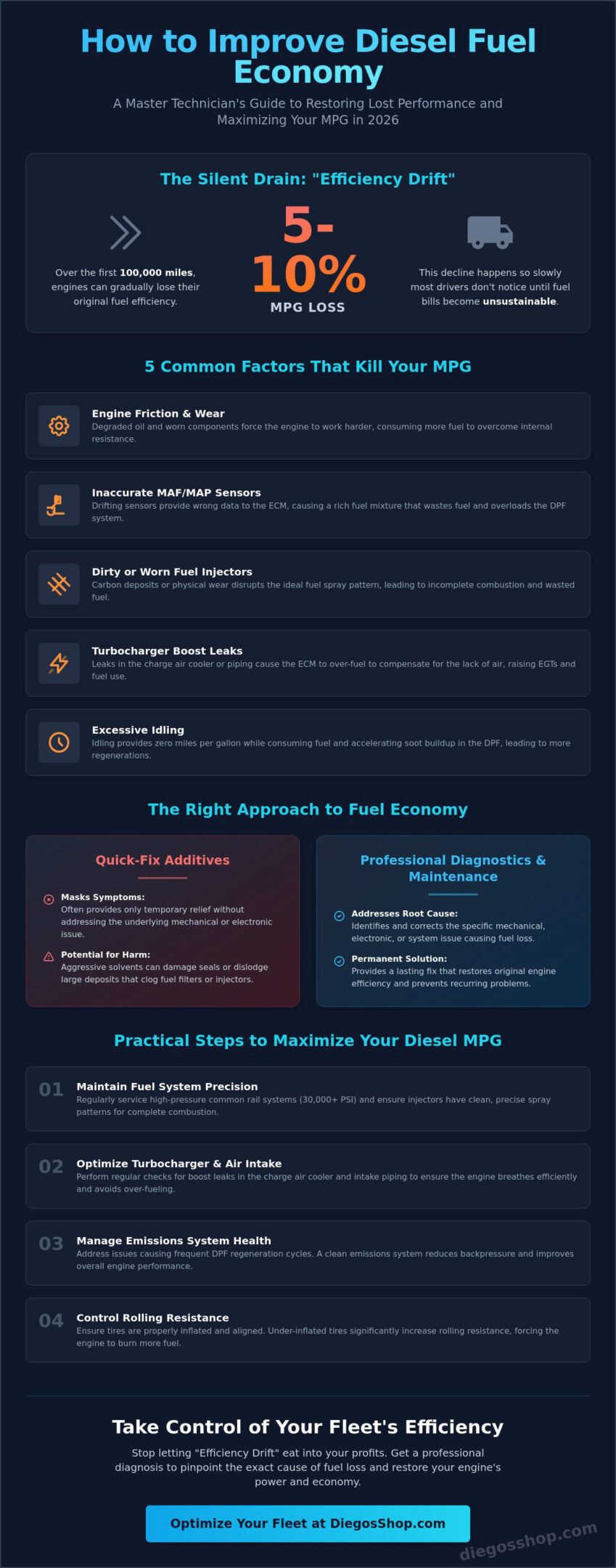
Diesel fuel economy isn’t just a number on your dashboard. It’s a precise measure of thermal efficiency and mechanical health. When your engine converts fuel to energy effectively, your overhead stays low and your equipment lasts longer. However, many operators notice a gradual decline in performance over time. This is often called “Efficiency Drift.” Over the first 100,000 miles of an engine’s life, it’s common for engines to lose 5% to 10% of their original MPG. This happens so slowly that most drivers don’t notice the change until the fuel bills become unsustainable.
Modern emission standards, specifically those implemented from EPA 2010 onwards, fundamentally changed Understanding Diesel Fuel Economy for commercial fleets. While these systems significantly reduce NOx and particulate matter, they also introduce backpressure and complex management requirements. Finding the “sweet spot” where torque and RPM align for maximum efficiency is more technical than it used to be. If you want to know how to improve diesel fuel economy, you have to look at the engine as a complete, interconnected system rather than a simple mechanical pump.
The Science of Diesel Combustion Efficiency
Diesel engines rely on a compression-ignition cycle. Unlike gasoline engines that use spark plugs, diesels compress air until it reaches a temperature high enough to ignite the fuel spontaneously. This high compression ratio is why diesel inherently outperforms gasoline in heavy-duty applications. The energy density of the fuel, combined with the cetane rating, dictates the ignition delay. A higher cetane rating ensures a shorter ignition delay and a more complete fuel burn. This directly translates to better mileage and smoother operation under heavy loads.
Common Factors That Kill Your MPG
Several mechanical issues can quietly destroy your efficiency. Friction is a primary culprit. As engine oil degrades or internal components wear, the engine must work harder to overcome its own internal resistance. Sensor inaccuracies are another frequent issue. If your Mass Air Flow (MAF) or Manifold Absolute Pressure (MAP) sensors drift, the engine computer may command a fuel mixture that’s too rich. This wastes fuel and increases the load on your exhaust aftertreatment system, leading to more frequent regenerations.
Commercial operations often overlook the hidden cost of excessive idling. Idling provides zero miles per gallon while still consuming fuel and accelerating soot buildup in the DPF. Learning how to improve diesel fuel economy starts with identifying these small, cumulative losses. Addressing them through precise diagnostics and scheduled maintenance is the only way to keep your operating costs under control.
Critical Engine Systems That Dictate Your Fuel Mileage
Modern diesel engines are marvels of high-pressure engineering. To achieve the power and efficiency expected in 2026, these engines rely on common rail injection systems that operate at 30,000+ PSI. This extreme pressure allows for precise fuel atomization, but it also means that even the smallest mechanical deviation can cause your MPG to plummet. If you are evaluating how to improve diesel fuel economy, you must understand that your engine is a balanced ecosystem of air, fuel, and exhaust management. When one system struggles, the Electronic Control Module (ECM) compensates by adjusting the fuel-to-air ratio, often at the expense of your wallet.
Fuel Injector Health and Spray Patterns
Fuel injectors are the heart of your engine’s efficiency. Over time, carbon deposits build up on the injector tips, disrupting the fine mist required for a complete burn. There’s a significant difference between “dirty” injectors, which can sometimes be cleaned, and “worn” injectors, where the internal needle and seat have physically eroded. In HEUI systems, stiction occurs when burnt oil creates a sticky residue inside the injector’s spool valve, causing delayed firing and significant fuel waste. Maintaining clean, precise injectors is an essential part of Professional Maintenance for Fuel Mileage.
Turbochargers and Charge Air Coolers
Your engine needs to breathe to perform. The turbocharger forces dense, oxygen-rich air into the cylinders, but any leak in the charge air cooler or intake piping creates a “boost leak.” When this happens, the ECM detects a lack of air and commands the injectors to stay open longer to maintain power, leading to over-fueling and high exhaust gas temperatures. In many modern trucks, Variable Geometry Turbo (VGT) vanes can stick due to soot accumulation. This prevents the turbo from providing the correct amount of boost at the right RPM, forcing the engine out of its peak efficiency range.
The Impact of DPF and EGR Systems
The exhaust system effectively acts as a tax on your engine’s performance. A clogged Diesel Particulate Filter (DPF) creates backpressure that forces the engine to work harder just to push exhaust gases out. This “backpressure tax” directly reduces your thermal efficiency. Furthermore, the “Regen” cycle uses an auxiliary injector to spray raw fuel into the exhaust to burn off soot, which can consume several gallons of fuel per cycle if your system is struggling. Soot build-up in the EGR valve also disrupts combustion temperatures, further degrading your mileage. If your commercial trucks are hitting regen cycles too frequently, it’s time to look at a professional fleet maintenance plan to identify the root cause before it leads to a breakdown.
Professional Maintenance vs. Quick-Fix Additives
Many drivers reach for a bottle of additive the moment they notice their MPG starting to slip. It’s a tempting shortcut. The shelves are full of products promising to “restore like-new performance” or “clean injectors instantly.” While certain treatments serve a specific purpose, they cannot repair physical metal wear or fix a failing sensor. If you’re searching for how to improve diesel fuel economy, you have to distinguish between temporary chemical cleaning and genuine mechanical health. A “miracle in a bottle” won’t recalibrate a drifting fuel trim or seal a leaking charge air cooler.
The U.S. Department of Energy on diesel efficiency confirms that while diesel engines are inherently more efficient than gasoline counterparts, maintaining that lead requires consistent technical oversight. Relying solely on additives to manage your engine’s health is a reactive strategy that often costs more in the long run. True efficiency comes from a proactive approach that combines high-quality fuel with professional-grade diagnostics.
Do Fuel Additives Actually Save Money?
Additives generally fall into two categories: detergents and lubricity enhancers. Detergents help prevent carbon buildup on injector tips, while lubricity enhancers protect high-pressure pumps from the low-sulfur fuels common in the U.S. Products like Stanadyne or Opti-Lube can be beneficial for maintaining a healthy system. However, they have limits. Chemicals cannot dissolve hardened carbon deposits that have baked onto components over thousands of miles. Using “snake oil” products with high concentrations of alcohol can actually damage sensitive O-rings and sensors. This creates new problems instead of solving your fuel consumption issues.
The Value of Specialized Diesel Diagnostics
Professional diagnostics go far beyond reading a trouble code. We use live data logging to monitor fuel trim imbalances while the engine is under load. This allows us to see exactly how the computer is compensating for mechanical inefficiencies. A cylinder contribution test is another vital tool; it identifies which specific cylinder is underperforming before it causes a total failure. Generic OBD-II scanners often miss up to 70% of these nuanced efficiency problems because they lack access to manufacturer-specific data streams.
Investing in a technical “tune-up” for a modern common-rail diesel involves verifying the health of the entire air and fuel path. This level of expert diesel engine repair identifies the root causes of poor mileage rather than just treating the symptoms. When you address the core mechanical issues, you see a measurable increase in MPG that no additive can match. Real efficiency is built on a foundation of precision and accountability.
Practical Steps to Maximize Your Diesel MPG in 2026
Maximizing efficiency requires a combination of technical precision and disciplined operational habits. While mechanical health is the foundation, your daily choices on the road and in the shop determine your final fuel overhead. If you want to know how to improve diesel fuel economy, you must look beyond the engine bay and address the external factors that create parasitic drag on your performance. Small adjustments in maintenance timing and driving technique often yield the most significant returns for commercial operations.
Maintenance Intervals That Actually Matter
A strict diesel maintenance schedule is your first line of defense against rising fuel costs. Many operators focus on oil changes, but for MPG, your fuel filters are actually more critical. A partially restricted filter forces the lift pump to work harder and can cause drop-offs in rail pressure that the ECM struggles to manage. On older diesel models, regular valve lash adjustments ensure that the intake and exhaust cycles remain perfectly timed. Neglecting your cooling system is another common mistake. A failing fan clutch that stays engaged longer than necessary creates a constant “fan-on” fuel drain that can steal up to 20 horsepower from your engine.
Driving Habits for the Wasatch Front
Utah’s geography presents unique challenges for diesel efficiency. Navigating steep grades on I-15 and I-80 requires a focus on momentum management rather than raw power. Aggressive acceleration can reduce your fuel economy by 10% to 40% in stop-and-go conditions. At the high altitudes found along the Wasatch Front, the thinner air makes your turbocharger work harder to maintain oxygen density. Plus, during the colder months, you must account for winter diesel blends. These blends are necessary to prevent gelling, but they typically cause a 2% to 5% drop in MPG due to lower energy content. Adjusting your expectations and driving style during these periods is essential.
Aerodynamics and Weight Management
The cost of speed is exponential. Increasing your cruising speed from 65 mph to 75 mph can significantly increase your fuel consumption because of the increased wind resistance. For commercial fleets, removing unnecessary dead weight from service trucks is a simple way to reduce the load on the drivetrain. Simple aerodynamic fixes, such as installing side skirts on trailers or ensuring flatbeds are properly loaded to minimize drag, provide measurable results over long hauls. Tracking these trends through telematics allows you to see exactly how to improve diesel fuel economy across your entire operation. For a comprehensive evaluation of your fleet’s efficiency, schedule your next preventive maintenance service with our master technicians today.
Optimizing Fleet and Personal Diesel Performance at Diego’s Shop
Technical knowledge only delivers value when it is applied with precision. At Diego’s Shop, we don’t guess about your engine’s health; we verify it. Our Springville technicians use advanced diagnostic tools to identify the exact mechanical and electronic bottlenecks stealing your mileage. For many commercial operators, the search for how to improve diesel fuel economy ends when they see the real-world ROI of a well-maintained engine. A modest improvement of just 1 MPG can save a high-mileage truck thousands of dollars in fuel costs annually. We focus on providing the technical accountability that turns those potential savings into a reality for your business.
Our approach is rooted in the “Diego’s Standard.” This means every service we perform, from a simple sensor calibration to complex engine overhauls, is backed by our commitment to durability. We provide warrantied repair work because we take pride in the longevity of our craftsmanship. We understand that for Utah businesses, a truck sitting in a bay is a truck losing money. By focusing on root-cause repairs rather than temporary fixes, we ensure your equipment stays on the road longer and runs more efficiently between service intervals.
Expert Fleet Maintenance in Springville
Managing a diverse fleet requires a specialized touch. We develop custom fleet maintenance plans designed specifically for the rigorous demands of Utah’s terrain. Whether you operate Peterbilt, Isuzu, or Kenworth trucks, our proactive inspection protocols catch efficiency leaks before they trigger a breakdown. We monitor data trends across your entire fleet to identify underperforming units, allowing for scheduled, data-driven service that minimizes unexpected downtime. This systematic oversight is the most reliable way to maintain peak performance across your entire operation.
Get a Professional Efficiency Audit
If your truck is struggling with frequent DPF regenerations or has recently entered limp mode due to emission system faults, a specialized efficiency audit is necessary. During this check, we examine the entire air-fuel path, test injector contribution levels, and verify that your ECM is communicating correctly with all exhaust sensors. We identify the specific mechanical drag factors that generic scanners often overlook. Taking a proactive stance on your engine’s health is the only proven way to protect your bottom line against rising overhead. Schedule your diesel efficiency service at Diego’s Shop today and let our master technicians restore the power and economy your engine was built to deliver. Reliable service. Proven results.
Protect Your Bottom Line with Technical Precision
Restoring your engine’s efficiency requires more than just high-quality fuel; it demands a comprehensive understanding of the systems that manage air, fuel, and exhaust. We have covered how mechanical wear, sensor drift, and Utah’s unique geography contribute to the slow decline in your performance. By focusing on the health of your fuel injection and turbocharger systems while maintaining a disciplined maintenance schedule, you can effectively counteract these losses. Learning how to improve diesel fuel economy isn’t a one-time fix. It’s a commitment to professional oversight and data-driven adjustments that keep your operating costs predictable.
At Diego’s Shop, we specialize in the medium and heavy-duty diagnostics that identify root-cause inefficiencies before they lead to costly repairs. We provide warrantied repair work to fleet owners across Utah County and the Wasatch Front, ensuring that every truck in your operation performs at its peak. Don’t let rising fuel overhead drain your profits through neglected maintenance. Maximize your diesel’s efficiency with Diego’s Shop today. Your fleet is built to work hard, and we’re here to make sure it works smart. Let’s get your MPG back where it belongs.
Frequently Asked Questions
Does a dirty air filter really affect diesel fuel economy?
A dirty air filter forces your turbocharger to work harder to maintain the required boost levels. While modern engine computers can compensate for some restriction, the increased intake temperature and turbo strain eventually lead to higher fuel consumption. Keeping your air intake clear ensures the engine doesn’t waste energy fighting for every cubic foot of oxygen. It is a simple but vital part of any maintenance routine.
How much MPG can I expect to gain from a professional fuel system cleaning?
A professional cleaning can restore the 5% to 10% of fuel economy lost to carbon buildup on injector tips. By returning your fuel spray to its original fine mist, you ensure a more complete combustion cycle. This process is one of the most effective ways to understand how to improve diesel fuel economy once your engine has surpassed the 100,000-mile mark and started to experience efficiency drift.
Is it better to keep a diesel engine running or turn it off when idling?
Turn the engine off if you expect to be stationary for more than three minutes. Idling provides zero miles per gallon and accelerates soot accumulation in your Diesel Particulate Filter. Modern heavy-duty engines are built for frequent starts. The fuel saved by shutting down far outweighs the minimal wear on the starter motor, especially in commercial fleet applications where idling costs add up quickly.
Can a bad EGR valve cause a significant drop in fuel mileage?
Yes, a failing EGR valve disrupts the precise balance of exhaust gases recirculated into the combustion chamber. If the valve sticks, it causes improper combustion temperatures and leads to more frequent, fuel-heavy DPF regeneration cycles. Addressing EGR faults is a critical step in maintaining your engine’s thermal efficiency and preventing the backpressure that kills your miles per gallon.
Do larger tires decrease diesel fuel economy?
Larger, heavier tires increase rolling resistance and alter your effective gear ratio, which typically decreases mileage. The engine must produce more torque just to rotate the increased mass of the wheels. If you switch to a larger tire size without recalibrating the ECM, your speedometer and fuel economy calculations will also be inaccurate. This often leads to a noticeable drop in overall range.
How often should I change my fuel filters to maintain peak efficiency?
Change your fuel filters every 10,000 to 15,000 miles or according to your specific manufacturer’s interval. Clean filters are vital for maintaining the high rail pressures required by modern common-rail systems. Restricted filters cause the lift pump to work harder. This can lead to pressure drops that the computer tries to manage by adjusting fuel timing, which ultimately wastes fuel.
Does cold weather in Utah affect diesel fuel consumption?
Cold weather impacts efficiency through the use of winter-blend diesel, which contains less energy per gallon than summer fuel. You may notice a 2% to 5% drop in MPG during Utah winters. Additionally, the engine takes longer to reach its optimal operating temperature. During this warm-up period, the ECM commands a richer fuel mixture to maintain engine stability and performance.
What is the best speed for maximum fuel economy in a diesel truck?
Most diesel trucks achieve their best fuel economy between 55 and 65 mph. Aerodynamic drag increases exponentially as you exceed 65 mph, forcing the engine to burn significantly more fuel just to overcome wind resistance. Staying within this “sweet spot” is a simple, no-cost method for how to improve diesel fuel economy on long hauls across the Wasatch Front.