
DOT Inspection Failure Repair in Utah: A Guide to Compliance Recovery

Did you know that nearly one in four out-of-service orders in 2026 stems from a single brake system violation? When the Utah Highway Patrol pulls your truck off the I-15 corridor, the immediate impact is more than just a citation; it’s a complete halt to your operations. You’re likely feeling the weight of mounting downtime and the stress of managing complex FMCSA regulations. Securing professional DOT inspection failure repair Utah is the only way to stop the bleeding and avoid fines that can now exceed $16,000 per violation.
You shouldn’t have to guess if your truck will pass a re-inspection or worry about your CSA score dropping further. This guide provides a clear roadmap to clearing Out-of-Service orders quickly and ensuring your equipment meets the highest standards of diesel mastery. We’ll break down the latest 2026 safety inspection fee changes and the specific repair protocols required to get you back on the road. You’ll learn how to handle the recovery process with confidence, turning a roadside failure into a foundation for long term fleet reliability.
Key Takeaways
- Distinguish between standard “fix-it” tickets and critical Out-of-Service (OOS) orders that legally ground your vehicle.
- Identify critical mechanical failure points in brake and steering systems that frequently trigger roadside enforcement.
- Understand why a controlled shop environment is essential for maintaining the high standards required for warrantied diesel repair work.
- Discover the precise documentation steps needed for DOT inspection failure repair Utah to clear violation codes and protect your CSA score.
- Adopt a preventive maintenance mindset to catch potential failures early and keep your fleet moving across the Wasatch Front.
Understanding Utah DOT Failures and Out-of-Service (OOS) Orders
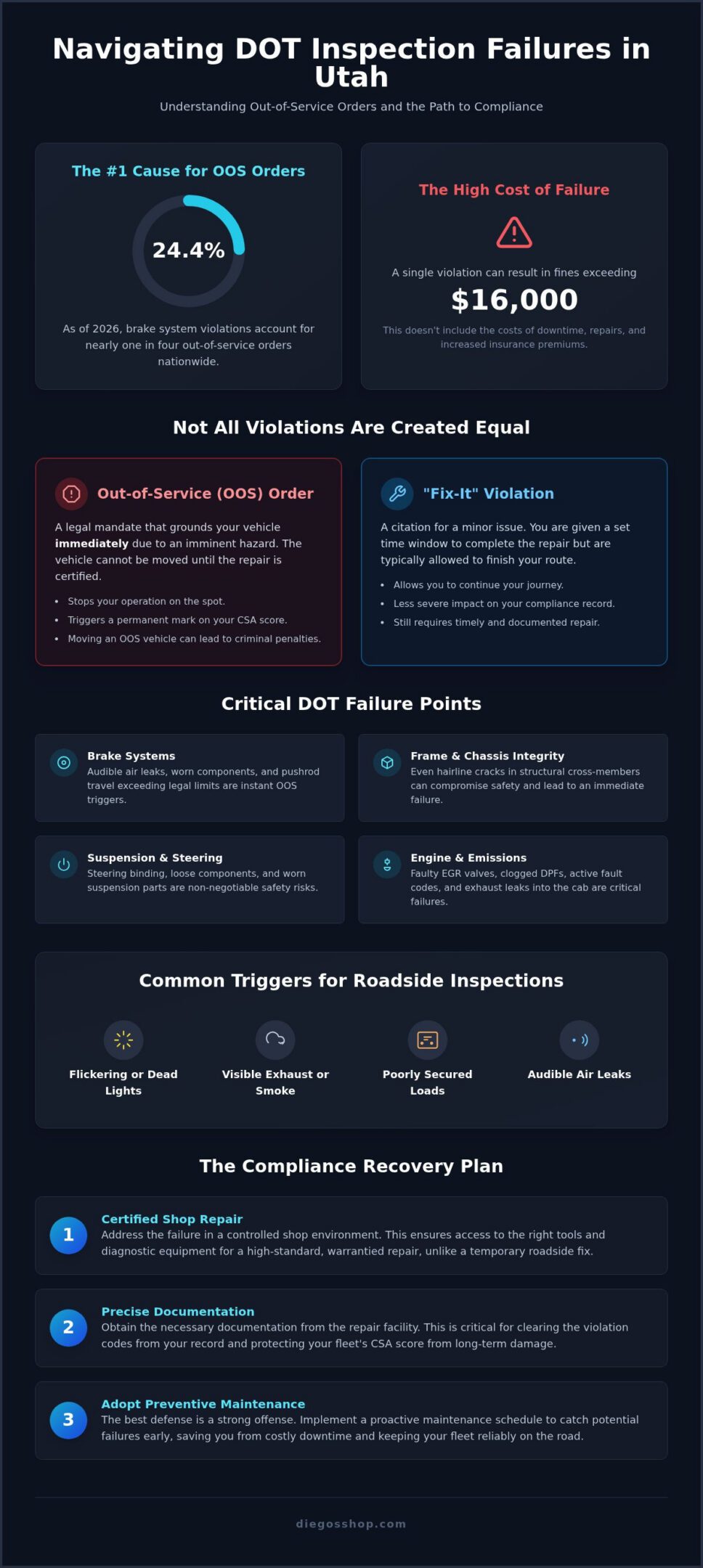
Not all citations are equal in the eyes of the law. A “fix-it” violation usually means you have a set window to repair a minor issue, but you’re allowed to finish your route. In contrast, an Out-of-Service (OOS) order is a legal mandate that grounds the vehicle immediately. The Utah Highway Patrol (UHP) and Utah Department of Transportation (UDOT) enforce these rules with zero tolerance for safety-critical defects. If an inspector finds a condition that poses an imminent hazard, your truck stays where it is until the problem is resolved.
Most enforcement activity occurs along the I-15 and I-80 corridors. These are high-intensity zones where weigh stations and roadside inspections are a daily reality for Utah carriers. A failure in these areas doesn’t just stop your delivery; it leaves a permanent mark on your Compliance, Safety, Accountability (CSA) score. High scores signal to federal regulators that your fleet is a risk, leading to more frequent roadside stops and higher insurance premiums. Professional DOT inspection failure repair Utah is the only way to clear these orders and restore your fleet’s standing.
The Immediate Consequences of an OOS Order
When a vehicle is sidelined at a Utah port of entry, the financial impact is immediate. You cannot legally move that truck until a qualified technician certifies the repair. Attempting to bypass this rule is a massive legal risk. Moving a vehicle under an OOS order can lead to the suspension of your operating authority and heavy criminal penalties. Beyond the legalities, your insurance provider monitors these incidents closely. Frequent OOS orders suggest a lack of oversight, which often results in policy cancellations or significant rate hikes.
Common Triggers for Utah Roadside Inspections
Utah weigh stations utilize the Pre-Selection Screening System to flag trucks for inspection before they even reach the scale. If your DOT number is linked to a history of violations, you’ll likely see the “pull in” light. However, many inspections are triggered by simple, visible defects that catch an officer’s eye. Common triggers include:
- Flickering or non-functional lighting systems.
- Visible exhaust leaks or excessive smoke.
- Loose cargo straps or poorly secured loads.
- Audible air leaks from the brake system.
Preventive maintenance serves as your primary defense against these unannounced checks. Catching a worn component during a routine fleet check is far more cost-effective than an emergency DOT inspection failure repair Utah. It protects your driver’s time and ensures your equipment remains compliant while crossing the Wasatch Front.
Technical Breakdown: Common DOT Repair Failure Points
Brake violations are the most frequent cause for grounding a truck. Statistics from early 2026 show they account for 24.4% of all out-of-service orders. Inspectors look past simple brake pad wear. They check for audible air leaks and measure slack adjuster travel with precision. If your pushrod stroke exceeds the legal limit, your vehicle is sidelined immediately. Frame integrity is just as vital. A single hairline crack in a structural cross-member can lead to a failure. These repairs require master craftsman skills and deep knowledge of heavy-duty chassis requirements.
Diesel engines must meet strict emission standards to stay compliant. Faulty EGR valves or clogged DPF filters trigger red flags during Utah roadside checks. Investing in a professional truck egr service ensures your system functions within legal limits during a Level 1 inspection. Specialized diagnostics catch failing sensors or exhaust leaks before they become expensive citations. Exhaust leaks into the cab are particularly dangerous and result in immediate grounding. We specialize in maintaining these complex systems for Peterbilt, Kenworth, and Isuzu fleets.
Diesel Engine and Emission System Repairs
Modern diesel technology relies on a web of sensors to maintain compliance. When a sensor fails, it often triggers a derate mode or an active fault code that an inspector will see. Our shop uses advanced diagnostic tools to pinpoint these issues before they lead to an OOS order. We don’t just clear codes; we fix the underlying mechanical cause. This level of technical mastery is what keeps your fleet on the road rather than stuck at a port of entry.
Suspension and Steering Mastery
Steering and suspension failures are non-negotiable safety risks. We frequently address steering binding in International ProStar models, a technical issue that demands expert diagnosis. Kingpin wear and loose tie rod ends can cause unpredictable handling and uneven tire wear. A broken or shifted leaf spring is a major violation that affects load distribution. Quality leaf spring repair restores the structural balance of your vehicle.
Under 49 CFR 396.9, you must secure a federal out-of-service repair certification before returning to duty. This documentation proves the work was completed by a qualified technician and that the vehicle is safe for operation. Managing a DOT inspection failure repair Utah requires more than just a quick fix. You need a shop that understands the technical nuances of FMCSA compliance. At Diego’s Shop, we focus on preventive maintenance that prevents these technical failures from ever reaching the weigh station. Our warrantied repair work gives you the peace of mind that your truck is safe, legal, and ready for the long haul.
Roadside vs. Shop Repairs: Choosing the Right Solution
Roadside service might seem like the quickest path back to the highway. However, the environment of a shoulder or a parking lot is rarely suitable for high-integrity mechanical work. When you’re facing a DOT inspection failure repair Utah, the quality of the fix determines if you’ll pass the follow-up inspection. A temporary patch on a brake line or a quick sensor reset often fails under the scrutiny of a UHP inspector. You need a solution that addresses the root cause rather than just the symptom.
The difference between a “parking lot fix” and a shop-based repair is technical depth. Mobile technicians are often limited by the tools they can carry and the weather conditions they face. In contrast, a specialized shop provides a stable, clean environment where precision is the priority. This is especially true for modern diesel systems that require advanced diagnostic software and specialized heavy-duty lifts. Choosing a shop ensures the repair is done right the first time, preventing the costly cycle of re-inspection failures.
When Roadside Assistance is Insufficient
Modern diesel engines are intricate machines. They require clean environments and heavy-duty diagnostic equipment that mobile units simply cannot carry. If your failure involves internal engine components, complex emission systems, or structural frame issues, a tow to a specialized diesel center is a necessity. Roadside technicians often lack the specific software required to recalibrate control modules after a repair. This leads to secondary failures during re-inspection, which further damages your CSA score and extends your downtime.
The Advantage of a Specialized Diesel Shop
Choosing a controlled shop environment in Springville ensures every repair meets master craftsman standards. Our facility provides access to OEM-quality parts and specialized components, such as heavy-duty leaf springs, that aren’t typically stocked on service trucks. While your truck is in the bay, we can perform comprehensive fleet maintenance. This proactive approach identifies secondary issues, like worn kingpins or leaking wheel seals, before they trigger your next roadside stop.
Integrity is the foundation of our work. We provide warrantied repair work that gives commercial fleets peace of mind. A roadside fix rarely comes with a guarantee, but a shop-based repair is backed by personal accountability. Building a relationship with a local master craftsman in Utah County means you have a dependable partner who knows your equipment’s history. When you choose a shop over a shoulder, you’re choosing durability and long-term compliance for your DOT inspection failure repair Utah.
The Compliance Recovery Plan: Steps to Get Back on the Road
Clearing a roadside failure requires more than turning a wrench. You must bridge the gap between the mechanical fix and the legal record. When you complete a DOT inspection failure repair Utah, your documentation must be flawless. Every line item on your repair invoice should correspond directly to the violation codes listed on your inspection report. If an officer cited a specific air leak on the primary reservoir, the invoice should explicitly state the repair of that component. Discrepancies here can lead to re-inspection delays or the refusal of a certification. Precision in the shop must be matched by precision on paper.
Certification of Repairs
The FMCSA requires a formal sign-off before a vehicle returns to service. In Utah, this certification is typically signed by the motor carrier official or the technician who performed the work. You must complete the “Certification of Repairs” section on the roadside inspection form and return it to the issuing agency within 15 days. Never make the mistake of self-certifying a repair if you don’t have the technical documentation to back it up. Record-keeping violations in 2026 carry heavy penalties; fines can reach as high as $15,846 per incident. Keeping these records for at least 12 months is a mandatory requirement for compliance.
Leveraging Professional Documentation for DataQs
Sometimes, a roadside inspector gets it wrong. If you believe a violation was cited in error, the DataQs system is your only recourse to fix your CSA score. This is where master craftsman precision becomes a legal asset. Detailed shop diagnostics and high-resolution photos of the “failed” part can prove your case. If our diagnostics show a sensor was within operating parameters at the time of the stop, that data is vital evidence.
Consistent preventive maintenance records further strengthen your position by demonstrating a history of proactive care. Technical expertise isn’t just for repairs. It’s for protecting your reputation and your operating authority. If you’re struggling with a complex violation or need a partner who understands the high stakes of compliance, contact Diego’s Shop for professional repair and documentation support. We ensure your recovery plan is built on technical mastery and honest accountability.
Why Utah County Trusts Diego’s Shop for DOT Failure Repairs
When a roadside inspector grounds your vehicle, you don’t need a corporate franchise with a rotating staff. You need a master craftsman who understands the specific mechanical standards required to clear an out-of-service order. At Diego’s Shop, we specialize in high-stakes DOT inspection failure repair Utah for carriers operating across the Wasatch Front. Our facility in Springville is strategically located near the I-15 corridor to provide rapid, high-integrity service for light, medium, and heavy-duty diesel platforms.
Modern trucks are rolling data centers. Passing a Level 1 inspection in 2026 requires more than basic mechanical skills; it demands deep expertise in engine management and emission control systems. Our technicians utilize advanced diagnostic protocols to ensure every sensor and valve functions perfectly. This technical precision is why we are the preferred choice for diesel engine repair in Utah County. We stay ahead of evolving technology standards to ensure your equipment remains compliant, efficient, and ready for re-inspection.
A Personal Commitment to Fleet Reliability
We view every repair as a partnership in your business’s success. Unlike impersonal national chains, Diego’s Shop offers personal accountability. We know your drivers, your routes, and the specific history of your equipment. This familiarity allows us to implement proactive fleet maintenance that catches potential OOS incidents before they happen. Our goal is to keep your trucks on the road, not sidelined at a port of entry due to avoidable mechanical failures.
A failed inspection is a temporary setback, not a permanent liability. By choosing a shop that prioritizes technical mastery and honest communication, you ensure your fleet recovers quickly and stays reliable for the long haul. If you’re facing a compliance crisis or want to prevent the next one, get your DOT inspection failure repair Utah fixed right at Diego’s Shop. We turn technical challenges into dependable solutions.
Secure Your Compliance and Get Back on the Road
Navigating an out-of-service order requires a shift from emergency reaction to strategic recovery. You’ve learned that distinguishing between a simple fix-it ticket and a critical grounding is the first step toward protecting your operating authority. Professional DOT inspection failure repair Utah ensures that your vehicle doesn’t just pass a re-inspection; it returns to the highway with higher integrity than before. By prioritizing shop-based diagnostics and precise documentation, you safeguard your CSA score and minimize the risk of future enforcement actions.
At Diego’s Shop, we provide warrantied repair work on all diesel engines, including specialized expertise in Peterbilt, Kenworth, and other major commercial brands. Our dedicated fleet maintenance protocols are designed to catch failures before they reach the weigh station. We take pride in our master craftsmanship and personal accountability for every truck that enters our bay. Get Your DOT Failure Repaired by Experts in Springville today to restore your peace of mind. Your fleet is the backbone of your business, and we’re here to keep it moving safely across the Wasatch Front.
Frequently Asked Questions
What are the most common reasons for failing a DOT inspection in Utah?
Brake system violations and tire issues are the primary causes for failure. According to 2026 data, brake defects account for 24.4% of out-of-service orders, while tire problems make up 21.4%. Other frequent triggers include non-functional lighting, improper cargo securement, and audible air leaks. Routine inspections often catch these issues before they lead to a costly roadside grounding at a Utah weigh station.
How much time do I have to fix a DOT violation?
You must return the signed inspection report to the issuing agency within 15 days of the stop. For minor “fix-it” violations, you can typically complete your current trip but must perform repairs before the next dispatch. However, if you receive an Out-of-Service order, you cannot move the vehicle at all until the safety-critical defects are fully resolved and certified by a technician.
Can I drive my truck to a repair shop if I have an Out-of-Service order?
No, you cannot legally operate a vehicle under an OOS order on any public roadway. You must either have a mobile technician perform the repairs at the roadside or have the vehicle towed to a specialized facility. Driving a grounded truck is a serious violation that leads to heavy criminal penalties, significant fines, and the potential suspension of your operating authority.
Does Diego’s Shop provide warrantied repairs for DOT failures?
Yes, we provide warrantied repair work for all diesel engine, chassis, and emission system repairs. This guarantee ensures that your fix is durable and meets the high standards required for federal compliance. We specialize in Peterbilt, Kenworth, Isuzu, and Ford diesel platforms. Our master craftsman approach focuses on high-integrity solutions that give fleet owners total peace of mind after a failure.
What is a DataQs challenge, and how does a repair shop help with it?
A DataQs challenge is a formal administrative process used to contest inaccurate roadside inspection data on your carrier record. A professional repair shop helps by providing the technical evidence needed to prove a violation was cited in error. This includes detailed diagnostic logs, high-resolution photos of components, and master technician statements. Accurate documentation is the only way to successfully overturn a citation and protect your CSA score.
How do I clear a DOT violation from my carrier record?
You cannot remove a valid violation from your record, but you can mitigate its impact through the DataQs system if the citation was factually incorrect. For valid citations, the only path to recovery is completing a high-quality DOT inspection failure repair Utah and maintaining a clean record moving forward. Over time, consistent clean inspections will dilute the negative impact of a past failure on your safety score.
Are annual DOT inspections the same as roadside inspections in Utah?
No, annual inspections are scheduled safety checks required by federal law, whereas roadside inspections are unannounced enforcement stops by the UHP. While both use the same safety criteria, a roadside failure results in immediate legal consequences and CSA points. An annual inspection is a proactive tool that allows you to identify and fix mechanical issues in a controlled environment before they trigger a roadside citation.
What documentation do I need to show that a DOT violation has been repaired?
You need a detailed repair invoice that explicitly matches the violation codes listed on your inspection report. This invoice must show the parts used and the labor performed to address each specific defect. Additionally, you must complete the “Certification of Repairs” section on the original roadside inspection form. Motor carriers are required to keep these repair records for at least 12 months to remain compliant.