
Diesel Repair Warranty vs. Third-Party Insurance: A 2026 Fleet Owner’s Guide

A $35,000 engine rebuild can ground your fleet and erase a year of profit in a single afternoon. You already know that keeping your trucks on the road requires more than just skilled mechanics; it requires a financial safety net that actually catches you when components fail. Deciding between a diesel repair warranty vs third-party insurance is a strategic choice that determines how fast you return to service and how much of that repair bill stays in your bank account. The wrong choice often leads to complicated claims processes and unexpected downtime that costs thousands in lost revenue.
We’ll help you find the best ROI for your fleet by providing a clear framework for choosing the right protection. This guide breaks down the critical differences between shop-backed warranties and mechanical breakdown insurance, highlighting the hidden exclusions often found in the fine print. You’ll learn how to minimize out-of-pocket costs for major engine failures and ensure your trucks receive fast, reliable repairs that remain warrantied. Whether you’re an owner-operator or managing a regional fleet, the goal is total control over your maintenance budget and peace of mind.
Key Takeaways
- Distinguish between a quality-focused shop warranty and the broader financial protection of Mechanical Breakdown Insurance (MBI).
- Evaluate the ROI of a diesel repair warranty vs third-party insurance to see which best protects your fleet from sudden five-figure repair bills.
- Uncover the “wear and tear” clauses in third-party policies that often lead to denied claims for major engine and emissions failures.
- Learn how to leverage specialized shop expertise to navigate the complex claims process and secure the highest quality parts for your repairs.
- Build a durable maintenance strategy that balances upfront premiums against the accountability of locally warrantied repair work.
Defining the Terms: Diesel Warranty vs. Mechanical Breakdown Insurance
Understanding the difference between a diesel repair warranty vs third-party insurance is the first step toward securing your fleet’s financial future. These two products serve different purposes; one guarantees the quality of a specific repair, while the other acts as a broader financial shield against mechanical failure. In 2026, the lines often blur, but the mechanics of how they operate remain distinct. One focuses on the integrity of the work performed, while the other manages the overall risk of equipment ownership.
What is a Diesel Repair Warranty?
A diesel repair warranty is a direct promise of accountability from the shop to the owner. When specialized shops like Diego’s Shop perform “Warrantied Repair Work,” they stand behind the specific parts and labor involved in that job. Typically, this covers defects in materials or workmanship for a set period, such as 12 months or 12,000 miles. It’s a localized guarantee. If a fuel injector we installed fails within that window, we fix it. There is no deductible, and there is no middleman. It ensures that the technical service you paid for meets a professional standard of durability. This type of protection is tied to the quality of the craftsman’s hands rather than a corporate policy document.
What is Third-Party Diesel Insurance?
Third-party insurance, often marketed as Mechanical Breakdown Insurance (MBI) or a Vehicle Service Contract (VSC), operates on a different model. It functions like health insurance for your truck. You pay a monthly premium, which typically ranges from $100 to $200 for diesel trucks in 2026, to cover future mechanical failures. An Extended warranty or service contract is technically an insurance product governed by different regulations than a shop guarantee. These policies cover a wide range of components regardless of who serviced them last. However, they usually require an outside adjuster to inspect the vehicle and approve the repair before any work begins. In 2026, insurance carriers are using stricter underwriting, placing more weight on clean roadside inspection histories and documented safety practices.
To choose the right path, you must look at the operational mechanics:
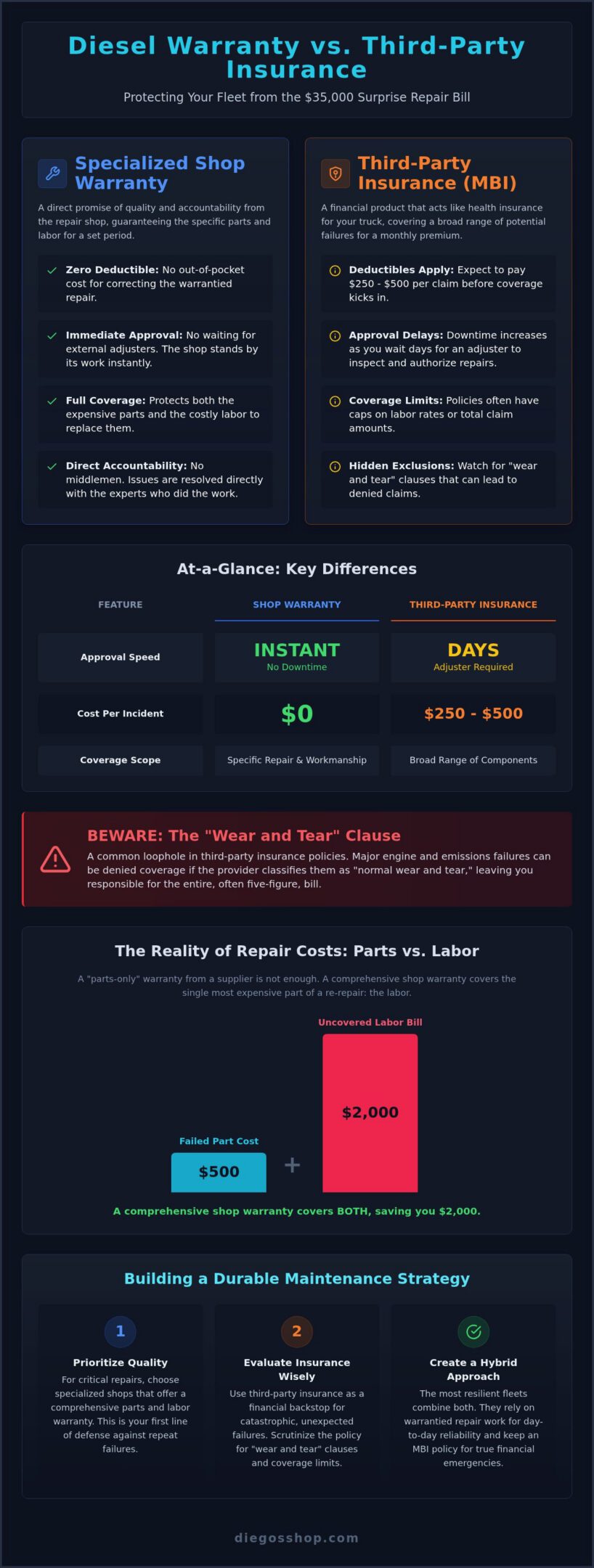
- Deductibles: Shop warranties usually have zero deductible for the specific part replaced. MBI policies often require a $250 to $500 deductible per visit.
- Payment: Shops typically bill insurance companies directly, but some policies require the owner to pay upfront and seek reimbursement.
- Coverage Limits: Insurance policies often have caps on labor rates or total claim amounts. A shop warranty covers the full cost of correcting the original repair.
- Approval Speed: Shop warranties are immediate. Third-party insurance can take days for an adjuster to arrive and authorize the work.
Warranties protect the work. Insurance protects the bank account. The most resilient fleets use a strategic combination of both to keep their trucks moving.
The Power of a Specialized Diesel Shop Warranty
Local shop warranties provide the immediate accountability that fleet managers in Utah County rely on. When debating the merits of a diesel repair warranty vs third-party insurance, the speed of resolution is often the deciding factor. A manufacturer (OEM) warranty typically only applies to new vehicles and specific factory defects. In contrast, a local shop guarantee covers the actual work performed on your Peterbilt or Kenworth regardless of its mileage or age. This “Warrantied Repair Work” ensures that if a fix doesn’t stick, the shop makes it right at no cost to you. Preventive maintenance serves as the foundation of this protection. Keeping accurate service records ensures that your warranty eligibility remains undisputed if a component fails prematurely.
Under federal emissions warranty regulations, certain components have mandated coverage periods, but for the vast majority of mechanical failures, the shop’s personal guarantee is your strongest asset.
Parts vs. Labor: The Crucial Distinction
Many owners are surprised to find that a standard “parts warranty” from a retail supplier covers only the physical component, not the time spent under the hood. If a $500 part fails, you might still face a $2,000 labor bill for the teardown and reassembly required to replace it. Diego’s Shop eliminates this risk by offering comprehensive coverage. A comprehensive diesel warranty covers both the failed component and the expert labor hours required for a complete, professional installation. This approach removes the financial sting of a “comeback” and places the responsibility for quality squarely on the technician.
Accountability and Proximity
Dealing with a national insurance provider often involves a corporate runaround that keeps your truck stationary for weeks while you wait for an approval. Choosing expert diesel repair Utah means you have a seasoned, no-nonsense master craftsman in Springville standing behind every bolt turned. We serve the entire Wasatch Front with a focus on durability and honest communication.
- Direct Communication: You speak with the technician, not a claims adjuster.
- Faster Turnaround: No waiting for third-party inspections or part approvals.
- Local Support: We understand the specific demands of Utah’s terrain and climate.
For fleets that value integrity, partnering with a dependable maintenance provider is the most effective way to manage long-term costs and minimize downtime.
Evaluating Third-Party Insurance for Diesel Fleets
Third-party insurance offers a different financial strategy compared to a shop-backed guarantee. While a warranty ensures the quality of a specific fix, insurance acts as a shield against the high costs of catastrophic mechanical failure. For many fleet owners, the primary appeal is the ability to turn a $35,000 engine overhaul into a manageable $500 deductible. This predictability helps stabilize commercial budgets, especially as repair costs for modern diesel engines continue to rise. When comparing a diesel repair warranty vs third-party insurance, it’s vital to remember that insurance is a financial product, not a service standard.
The Federal Acquisition Regulation on warranties highlights how the government views commercial protection as a way to ensure long-term performance and value. Fleet owners should apply a similar logic when evaluating third-party plans. These policies are designed to mitigate risk across the entire vehicle, but they come with administrative hurdles that a local shop warranty doesn’t have.
When Insurance Makes Financial Sense
Insurance is most effective for high-mileage over-the-road trucks where the probability of a major component failing is high. It serves as a stop-loss measure. If a transmission or high-pressure fuel pump fails, the policy absorbs the bulk of the financial blow. However, insurance should never replace a proactive fleet maintenance plan. In fact, most insurance carriers require proof of regular service before they’ll honor a claim. Combining a rigorous maintenance schedule with a robust insurance policy creates a dual layer of protection for your business capital.
The Hidden Pitfalls of Third-Party Plans
The most dangerous phrase in any third-party policy is “normal wear and tear.” Insurance companies often use this clause to deny claims on components like Diesel Particulate Filters (DPF) or Exhaust Gas Recirculation (EGR) systems. These parts are frequently excluded or severely limited in basic plans. Another common issue is the “Adjuster Delay.” Unlike a shop warranty, which allows work to begin immediately, third-party insurance typically requires an outside adjuster to inspect the damage. This process can add several days to your downtime, costing you more in lost revenue than the repair itself.
Owners must also watch for limits on labor rates. If your policy only pays $100 per hour and the actual shop rate is higher, you’re responsible for the difference. Additionally, if you can’t produce perfect maintenance records, carriers may cite a “pre-existing condition” or “lack of maintenance” to void the coverage entirely. A seasoned mechanic can help you document failures accurately to navigate these hurdles, but the owner must remain vigilant about the fine print. Protecting your fleet requires a clear understanding of what’s truly covered before the truck breaks down.
Direct Comparison: ROI and Reliability for Utah Owners
ROI is the bottom line for every fleet owner in Springville. Comparing a diesel repair warranty vs third-party insurance requires looking at more than just the price tag. Upfront premiums for third-party insurance can feel like a necessary safeguard, but the “built-in” cost of a high-quality shop warranty often provides better immediate value. When a turbocharger or a set of fuel injectors fails, the depth of coverage and the speed of the response determine your actual profit. Shop warranties offer the flexibility to work with your own trusted mechanic, while many insurance plans restrict you to a specific, often distant, network. This loss of choice can lead to lower quality parts and technicians who don’t understand your specific equipment needs.
To evaluate these options effectively, consider these four metrics:
- Direct Costs: Insurance requires monthly premiums and deductibles. Shop warranties are included in the price of the repair.
- Approval Logic: Insurance adjusters look for reasons to deny claims. Shop owners look for ways to stand behind their work.
- Component Specifics: Shop warranties often cover the entire assembly. Insurance may only cover “lubricated internal parts.”
- Geographic Freedom: Local warranties provide immediate support on the Wasatch Front. Insurance often requires towing to a “preferred” facility.
Calculating the Real Cost of Downtime
A three-day wait for an insurance adjuster often costs more in lost revenue than the actual repair bill. Every hour your truck sits in a lot is an hour it isn’t earning. Direct-to-shop warranties eliminate this administrative burden. You get a diagnosis and a fix without waiting for a corporate middleman to approve the parts. This streamlined approach is especially critical when managing reliable DOT truck inspections and keeping your fleet compliant. In 2026, the most successful fleets prioritize speed over complex policy structures.
The Decision Matrix for 2026
Choosing the right protection depends on your asset’s age and usage. If your truck is under three years old, rely on the OEM coverage. For older, high-value assets, a combination of third-party insurance for catastrophic failure and a shop warranty for specific repairs is the gold standard. Specialized diesel engine repair remains the foundation of any protection plan. Diesel ROI is the balance between protection premiums and actual road-time. When you need a partner who understands the stakes of your business, contact Diego’s Shop to discuss warrantied repair work that keeps you moving. Durability you can bank on.
How Diego’s Shop Navigates Warranty and Insurance for You
Diego’s Shop stands as a strategic bridge between technical necessity and financial protection. When navigating the choice between a diesel repair warranty vs third-party insurance, you need a partner who understands both the internal mechanics of a high-pressure fuel pump and the complex language of a service contract. Our Springville facility provides honest, no-nonsense diagnostics that insurance companies respect and trust. We’ve built a reputation across the Wasatch Front for total accountability. Every light, medium, and heavy-duty job we handle is defined by our commitment to “Warrantied Repair Work.” This local presence ensures that your truck isn’t just a claim number in a national database; it’s a vital business asset that we personally guarantee.
Advocating for the Fleet Owner
Insurance adjusters often push for remanufactured or used parts to minimize their payout. We speak “adjuster” to protect your asset. We translate complex diesel failures; from EGR cooler leaks to turbocharger bearing failures; into the specific terminology required for insurance approval. A “cheap fix” that fails in six months isn’t a solution; it’s a liability for your business. By providing detailed photographic evidence and technical diagnostics, we advocate for the labor hours and high-quality components your truck needs. Our history of serving Utah’s trucking community with technical mastery means we know how to secure the best possible outcome for your fleet.
Choosing local accountability over a national call center provides three distinct advantages:
- Technical Authority: We explain the “why” behind a failure, making it harder for adjusters to cite “wear and tear.”
- Specialized Knowledge: Expertise in Peterbilt, Isuzu, Kenworth, and Ford systems allows for more accurate repair estimates.
- Direct Access: You can walk into our shop and speak with the master craftsman responsible for your vehicle.
Getting Started with a Protection Strategy
Building a resilient fleet starts long before the breakdown occurs. The first step is a comprehensive diesel maintenance review. We analyze your service history to identify gaps that might lead to future claim denials. Because we work with various third-party providers daily, we can offer insights into which plans actually pay out and which ones bury their exclusions in the fine print. We help you balance the immediate security of our shop warranty with the long-term protection of insurance. Ready for a shop that stands behind its work? Contact Diego’s Shop in Springville today to discuss a maintenance plan that keeps your fleet moving. Durability is our promise.
Secure Your Fleet’s Future with Proven Protection
Choosing the right path between a diesel repair warranty vs third-party insurance isn’t about finding a one-size-fits-all product; it’s about building a defense that keeps your trucks moving. A specialized shop warranty provides immediate accountability and zero-deductible repairs on workmanship, while third-party insurance acts as a vital financial shield against catastrophic engine failures. By combining these strategies, you minimize out-of-pocket costs and avoid the administrative delays that often lead to lost revenue. Success in 2026 requires a partner who understands the fine print as well as the mechanical intricacies of your equipment; for expert guidance on these decisions, check out Repair Integrity.
Diego’s Shop provides expert service for Peterbilt, Kenworth, and diverse commercial fleets throughout Springville and the Wasatch Front. We deliver master-craftsman quality backed by transparent diagnostics and dedicated advocacy for your insurance claims. Don’t let unexpected downtime dictate your profit margins. Get Warrantied Diesel Repairs You Can Trust at Diego’s Shop. Let’s keep your fleet on the road with durability you can bank on.
Frequently Asked Questions
Does third-party insurance cover diesel engine overhauls?
Yes, most third-party policies cover engine overhauls if the failure is mechanical and not caused by normal wear. These plans typically pay for major components like crankshafts and pistons. You must confirm that your policy includes coverage for progressive damage. This ensures that if one part fails and destroys others, the entire repair bill is covered rather than just the initial component.
What is the standard warranty for diesel repair at an independent shop?
A standard warranty at a professional independent shop typically covers parts and labor for 12 months or 12,000 miles. This guarantee ensures that the technician stands behind the durability of the work performed. Specialized facilities handling Peterbilt or Kenworth systems may offer longer terms for specific heavy duty engine rebuilds. Always confirm whether the warranty is comprehensive, covering both the physical component and the expert labor.
Can I use my third-party insurance at any diesel repair shop in Utah?
You can usually choose any licensed facility in Utah, but you must obtain authorization from the insurance company before the shop starts the teardown. While carriers cannot legally force you to a specific network, they may limit the labor rate they are willing to pay. If the shop’s professional rate exceeds the insurance cap, the truck owner is responsible for paying the difference out of pocket.
Is a diesel warranty transferable if I sell my truck or fleet vehicle?
Most shop warranties remain with the vehicle, but third-party insurance usually requires a formal transfer process and a small fee. Providing documented proof of warrantied repairs can significantly increase the resale value of your fleet assets. It demonstrates to the buyer that the truck has been maintained by experts and that the components are currently protected by a professional guarantee of quality.
Why was my diesel insurance claim denied for “lack of maintenance”?
Insurance claims are frequently denied because the owner cannot produce specific, dated maintenance records that match the manufacturer’s requirements. If you miss a scheduled oil change or fuel filter replacement, the adjuster may cite lack of maintenance as the cause of failure. Maintaining a rigorous service log is essential when navigating the complexities of diesel repair warranty vs third-party insurance coverage.
How long does a typical diesel repair warranty last?
Most diesel repair warranties last for one year, though heavy duty engine rebuilds can carry coverage for up to 24 months. The specific duration often depends on the parts used during the service. OEM components generally allow for longer warranty terms than budget aftermarket alternatives. Always ask for a written document that clearly defines the expiration date and any mileage limitations on the work performed.
Do I have to pay a deductible for warrantied repair work?
You typically do not pay a deductible for repairs covered under a shop’s own warranty. This is a primary benefit of localized warrantied repair work. If a component fails due to a defect in materials or workmanship, the shop handles the entire cost. In contrast, when comparing a diesel repair warranty vs third-party insurance, remember that insurance policies almost always require a deductible per visit.
What happens if a warrantied diesel part fails while I am out of state?
You should contact the original repair shop before authorizing any new work if a warrantied part fails while you are out of state. Many independent shops are part of national networks that allow for warrantied service at affiliated facilities. If no affiliate is available, the original shop may authorize a one-time reimbursement for emergency repairs, provided you can document the failure and the necessary fix.