
Diesel Repair Parts Warranty: A Guide to Protecting Your Investment

A diesel repair parts warranty is often only half of the protection you actually need to keep your fleet on the road. While a manufacturer might replace a defective injector or turbocharger, they rarely cover the specialized labor required to swap it out. You already know that diesel components cost significantly more than gasoline parts, sometimes up to 100% more. It’s a heavy investment, and the last thing you need is the stress of paying twice for a repair that should have been done right the first time.
We understand that unexpected downtime is the enemy of your bottom line. This guide will show you how to navigate the differences between manufacturer coverage and local shop guarantees to ensure total protection. You’ll learn how federal laws like the Magnuson-Moss Warranty Act work in your favor and why preventive maintenance is your best defense against claims denials. We will also provide a clear strategy for choosing a Springville master craftsman who takes personal accountability for the durability of their work, ensuring your investment stays protected and your trucks stay moving.
Key Takeaways
- Learn why 2026 standards have shifted toward longer coverage for emission-control components and how to leverage these federal protections for your fleet.
- Understand how a standard diesel repair parts warranty often excludes the cost of labor, leaving you responsible for the most expensive part of the fix.
- Evaluate whether mileage-based or time-based warranty terms provide the best protection for your specific heavy-duty routes and operational needs.
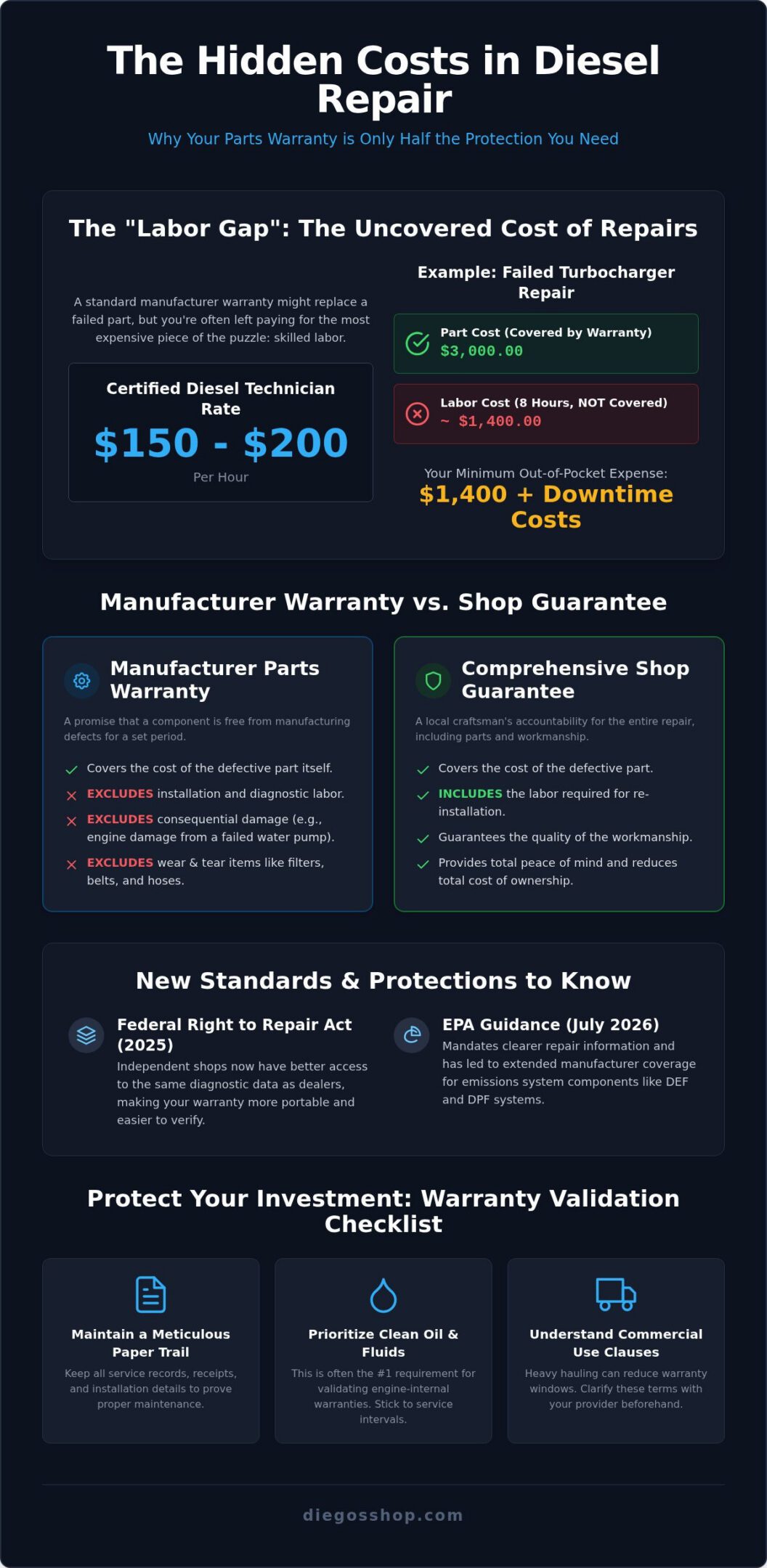
- Protect your coverage by maintaining a meticulous paper trail and prioritizing clean oil as the primary requirement for validating engine-internal warranties.
- Discover the advantage of working with a local Springville master craftsman who provides personal accountability and specialized expertise for Peterbilt, Kenworth, and Ford engines.
Understanding Diesel Repair Parts Warranties in 2026
A diesel repair parts warranty is a manufacturer’s promise that a component is free from defects in materials and workmanship. In 2026, these protections have evolved significantly. Following the Federal Motor Vehicle Right to Repair Act passed in late 2025, independent shops now have better access to the same diagnostic data as dealers. This means your warranty is more portable and easier to verify than ever. Additionally, July 2026 EPA guidance mandates that manufacturers provide clear repair information for emissions systems. Consequently, many brands have extended coverage for Diesel Exhaust Fluid (DEF) and Diesel Particulate Filter (DPF) components to meet these stricter federal standards.
Understanding warranties and their specific limitations helps you avoid paying for the same repair twice. It’s critical to distinguish between new OEM parts and remanufactured options. OEM parts are built to original specifications and typically offer the most stable protection. Remanufactured parts can save money, but their warranties vary based on the rebuilder’s standards. You must also account for commercial use. Most manufacturers reduce warranty windows if a vehicle is used for hire or heavy hauling. A part that lasts three years in a light-duty truck might only be covered for one year in a fleet environment.
OEM vs. Aftermarket Parts: The Warranty Battle
OEM warranties provide peace of mind for heavy-duty trucks like Peterbilt and Kenworth. They offer a direct line to the manufacturer if a component fails. However, aftermarket manufacturers like FP Diesel often compete by offering longer protection windows or better terms for fleet operators to gain market share. While aftermarket parts can be high quality, beware of budget options. The cheapest part on the market usually carries the shortest protection window. This often leaves you exposed just a few months after installation when the part fails under heavy load.
What Is Usually Covered (And What Isn’t)
Most warranties cover high-value components like high-pressure fuel pumps, injectors, and turbochargers. These are the parts most likely to suffer from manufacturing defects. You will rarely find coverage for wear and tear items. Filters, belts, and hoses are considered consumables and are almost never warrantied. A major point of contention is progressive damage. If a warrantied water pump fails and causes the engine to overheat, many standard warranties only cover the pump. They won’t pay for the warped head or blown gasket caused by that failure. Always check if your diesel repair parts warranty includes consequential damage before signing off on a major repair.
The Labor Gap: Parts Warranties vs. Shop Guarantees
A standard diesel repair parts warranty covers the component, but it leaves a massive financial hole: the labor. In 2026, diesel-certified technicians typically charge between $150 and $200 per hour. If a $3,000 turbocharger fails, the manufacturer might send you a new one, but they won’t pay for the six or eight hours of labor required to install it. This is the “Labor Gap.” For many fleet owners, it is the difference between a minor setback and a financial crisis. Most parts manufacturers refuse to pay for shop labor because they cannot control the quality of the installation once the part leaves their warehouse.
While some regulations, such as California’s diesel warranty requirements, provide strict frameworks for emissions components, general mechanical parts remain a major risk. This is why choosing a shop that offers comprehensive warrantied repair work is essential for total peace of mind. A local Springville shop can offer better protection than a national parts catalog because they take responsibility for the entire repair cycle, from the torque on the bolts to the final diagnostic check.
Why Labor Guarantees Matter for Commercial Fleets
The real cost of a “free” warrantied part that takes 10 hours to install is still thousands of dollars in shop time and lost revenue. Labor warranties drastically reduce the total cost of ownership (TCO) for fleet owners by shifting that risk back to the service provider. For a diesel repair parts warranty to remain valid and for labor coverage to apply, professional installation is usually a non-negotiable requirement. Expert installation ensures that the part was not compromised during the build, which is often the first thing a manufacturer investigates during a claim. Without a labor guarantee, you are essentially gambling on the component’s perfection.
Diego’s Shop: Accountability in Every Bolt
Our “Master Craftsman” approach means we stand behind every repair we perform in Utah County. Personal accountability beats a generic corporate warranty every time. We understand that your livelihood depends on the durability of our work. By pairing high-quality components with technical mastery, we effectively eliminate the Labor Gap for our clients. If a part we installed fails within the warranty period, we handle the logistics and the labor. This level of integrity ensures you never pay for the same repair twice. If you want to lower your risk, consider booking your next fleet maintenance with a team that values your uptime as much as you do.
Evaluating Warranty Terms for Commercial Fleet Maintenance
Protecting your fleet requires a deep understanding of the fine print. An over-the-road (OTR) long-hauler has vastly different needs than a local dump truck operating in the gravel pits of Utah County. For high-mileage operators, a time-based diesel repair parts warranty might look attractive on paper, but it often carries a mileage cap that expires long before the year is up. Conversely, a local vocational truck might never hit the mileage limit but could exceed the time limit due to high engine hours. You must choose parts and coverage that align with your specific duty cycle to avoid being left unprotected.
The “Severe Service” clause is a common hurdle for fleet owners. Manufacturers often classify frequent idling, heavy towing, or operation in dusty environments as severe service. This classification can cut warranty periods in half or void them entirely if you don’t follow a stricter maintenance schedule. Comprehensive fleet maintenance contracts often include warranty management. This ensures your shop documents every service to prove you’ve met these higher standards, effectively shielding you from claim denials based on usage patterns.
Short-Haul vs. Long-Haul Warranty Needs
High idle time is the hidden enemy of diesel components. While the odometer isn’t turning, the engine is still working, which leads to carbon buildup in DPF systems and EGR valves. If your truck spends half its life idling on a job site, a standard diesel repair parts warranty might not provide the depth of coverage you need for emissions-heavy components. For interstate fleets, the value of a nationwide warranty network cannot be overstated. Breaking down in a neighboring state with a part warrantied only at a single local shop creates a logistical nightmare that wipes out any initial savings.
The Role of Preventive Maintenance in Warranty Claims
Preventive maintenance is your primary insurance policy for parts. Manufacturers are quick to deny a claim if they find evidence of neglected service. For instance, skipping a single oil change can easily void a turbocharger warranty, as dirty oil is the leading cause of bearing failure. Our approach to diesel maintenance focuses on rugged reliability and meticulous record-keeping. At Diego’s Shop, we use a strict protocol to catch early signs of component fatigue. By identifying a weeping water pump or a noisy injector early, we help you file a claim before a catastrophic failure makes the damage “unwarrantable” due to neglect.
How to Ensure Your Diesel Warranty Remains Valid
Securing a diesel repair parts warranty is only the first step in protecting your investment. Maintaining that protection requires strict adherence to manufacturer protocols. The most common reason for a denied claim is a lack of evidence. If you cannot prove the part was installed correctly or maintained properly, the manufacturer has every right to refuse a replacement. Clean oil is the most frequent requirement for any engine-internal warranty. Contaminated oil acts like liquid sandpaper, destroying bearings and seals. If a manufacturer finds sludge or high silicon levels during a forensic analysis of a failed part, they will almost certainly void your coverage.
When a component fails, your first instinct might be to scrap it and move on. Never throw away the old component. Manufacturers often require the failed part for inspection or as a “core” return to verify the defect. Professional diesel engine repair is often a mandatory condition for warranty compliance. Many brands explicitly state that their warranties are void if the part was installed by an uncertified individual or in a non-commercial setting. Technical mastery during the installation phase ensures the part operates within its designed parameters from day one.
Documentation: Your Shield Against Denied Claims
A valid repair order is your primary defense in a dispute. It must include the specific VIN, accurate mileage at the time of repair, and the exact part numbers used. Digital maintenance logs offer a significant advantage here, as they provide an unalterable timeline of service that can save you thousands in disputed claims. In the context of a diesel warranty claim, the burden of proof rests on the vehicle owner to demonstrate that all required maintenance was performed according to the manufacturer’s specifications. Without these records, your diesel repair parts warranty is essentially a piece of paper with no legal weight.
Common Mistakes That Void Warranties
Modern Tier 4 engines are incredibly sensitive to fluid types. Using the wrong Diesel Exhaust Fluid (DEF), coolant, or oil grade can lead to immediate system failures that manufacturers will not cover. While DIY repairs might seem like a way to save on labor, they often cost you the parts warranty entirely. Manufacturers view non-professional installation as a high-risk variable. Finally, always respect your truck’s rated capacities. Exceeding the manufacturer’s recommended towing or payload limits puts undue stress on the powertrain, and evidence of overloading is a fast track to a denied claim. If you need reliable service that keeps your coverage intact, schedule your warrantied repair work with a master craftsman who understands the stakes.
Why Utah County Trusts Diego’s Warrantied Repair Work
Serving the Wasatch Front requires more than just a toolbox and a bay. It demands a commitment to technical mastery and the personal accountability of a master craftsman. At Diego’s Shop, we understand that a diesel repair parts warranty is only as reliable as the technician who stands behind it. We specialize in heavy-duty and medium-duty vehicles, providing expert service for Peterbilt, Kenworth, Isuzu, and Ford engines. Our team doesn’t just swap parts; we ensure every component is integrated into your system with the precision required for long-term durability. We take pride in keeping Utah moving by delivering repairs that last well beyond the warranty period.
Fleet managers often find themselves buried in paperwork when a component fails. We eliminate that burden by managing the warranty process from start to finish. Our deep understanding of manufacturer requirements allows us to document failures accurately, increasing the likelihood of a successful claim. We handle the logistics and the technical justifications so you can focus on your operations. This comprehensive support is the Springville advantage. We offer a level of specialized diesel knowledge that general auto shops simply cannot provide, ensuring your fleet remains compliant and protected against unexpected costs.
Specialized Expertise for Modern Diesel Technology
Specialized diesel knowledge is no longer optional for 2026 engines. With the recent shifts in federal emissions standards and the increasing complexity of DEF and DPF systems, generic diagnostic tools are often insufficient. Our shop utilizes advanced diagnostic protocols to ensure that every diesel repair parts warranty claim is backed by precise data. We identify the root cause of a failure rather than just treating the symptoms. This “no-nonsense” approach provides peace of mind, knowing that your truck won’t be back in the shop for the same issue next week. We verify every torque spec and fluid level to guarantee that your new parts operate in a perfect environment.
Ready for Service in Springville
Our location in Springville, Utah, is strategically positioned to serve fleets operating throughout Utah County. We invite owner-operators to schedule a preventive maintenance check, which serves as a professional audit of your current warranties. We’ll review your service history and identify any components nearing their coverage limits, helping you address potential issues before they become out-of-pocket disasters. Integrity and technical skill are the cornerstones of our business. Don’t leave your uptime to chance with a shop that doesn’t understand the nuances of commercial coverage. Schedule your warrantied diesel repair at Diego’s Shop today.
Secure Your Fleet’s Future with Technical Mastery
Protecting your heavy-duty equipment requires more than just purchasing a quality component. It requires a strategic approach to maintenance and a deep understanding of how a diesel repair parts warranty actually functions in the real world. You’ve learned that meticulous documentation is your primary shield against denied claims and that the labor gap is a financial risk you simply can’t afford to ignore. By prioritizing preventive maintenance and professional installation, you effectively shift the burden of risk away from your bottom line and ensure your trucks stay where they belong: on the road.
As Springville-based diesel specialists, we bring years of experience with Kenworth and Peterbilt fleets to every bay. We’re committed to minimizing your downtime through technical mastery and personal accountability. Don’t let a failed part become a double-payment disaster. Partner with a master craftsman who stands behind every bolt and every diagnosis. Get Reliable, Warrantied Diesel Repair in Springville. Your fleet is a significant investment; we’re here to help you protect it and keep your business moving forward with total confidence.
Frequently Asked Questions
Does a diesel parts warranty cover the cost of labor?
Standard manufacturer coverage rarely includes the cost of installation labor. While the replacement component is provided at no charge, the vehicle owner is typically responsible for the shop’s hourly rate to perform the swap. In 2026, these labor costs can be substantial. To avoid this out-of-pocket expense, look for service centers that provide a labor guarantee alongside the standard parts coverage.
How long is the typical warranty on a remanufactured diesel engine?
Most remanufactured diesel engines come with a warranty lasting between 12 and 24 months. These plans often include a mileage cap, such as 100,000 miles, whichever comes first. Commercial applications might see shorter terms due to the high-stress nature of the work. Always verify if the warranty is nationwide or limited to the specific rebuilder’s facility. Proper documentation of oil changes is essential to keep these long-term engine warranties valid.
Will using aftermarket parts void my manufacturer warranty?
No, the Magnuson-Moss Warranty Act protects your right to use aftermarket parts without voiding your original manufacturer warranty. A manufacturer can only deny a claim if they prove the aftermarket part specifically caused the failure. However, the aftermarket part itself is not covered by the OEM warranty. It carries its own separate protection from the producer. Using high-quality components ensures you maintain compliance while potentially lowering your overall repair costs.
What documentation do I need to file a diesel warranty claim?
You need a comprehensive paper trail to successfully file a claim. This includes the original repair order showing the VIN, accurate mileage at the time of repair, and the specific part numbers installed. You must also provide maintenance logs proving the vehicle was serviced according to manufacturer intervals. Digital logs are preferred because they provide a clear, chronological history. Without these records, manufacturers often cite lack of maintenance as a reason to deny your diesel repair parts warranty claim.
Does Diego’s Shop offer a warranty on its repair labor?
Yes, Diego’s Shop stands behind every repair with a labor guarantee that complements the manufacturer’s diesel repair parts warranty. We believe in personal accountability for every bolt we torque and every system we calibrate. Our master craftsmen ensure that if a warrantied part fails due to a manufacturing defect, you aren’t left paying for the same labor twice. This commitment to durability is why fleet managers throughout Springville trust us.
What happens if a warrantied part fails while I am out of state?
If the part carries a nationwide manufacturer warranty, you can typically have it serviced at any authorized dealer or participating independent shop in that network. If the warranty is specific to a local shop, you may have to return to that location for a free repair. For interstate fleets, we recommend choosing parts with broad network support. Always keep a digital copy of your repair orders to show technicians when you are far from home.
Can a failed DOT inspection affect my warranty status?
A failed DOT inspection doesn’t automatically void a warranty, but it can provide evidence of neglect that manufacturers use to deny claims. If an inspection identifies leaks or worn components that you ignore, any subsequent failure may be classified as preventable damage. Maintaining a clean inspection record demonstrates that you are proactive with your fleet maintenance. Manufacturers are far more likely to honor a claim when the vehicle shows a history of professional care.
Is progressive damage covered under a standard parts warranty?
Standard parts warranties rarely cover progressive damage. If a failed water pump causes your engine to overheat and warp the cylinder head, the manufacturer will likely only provide a new water pump. They won’t pay for the engine rebuild. This is why our preventive maintenance protocols focus on catching small leaks or noises before they escalate. Catching a failure early is the only way to prevent a minor part defect from becoming a total engine loss.