
Diesel Engine Vibration Diagnosis: A Fleet Owner’s Guide to Troubleshooting Shakes

Vibration is the language of a diesel engine. Decoding how it shakes reveals specific component failures before they become catastrophic. You have likely felt that knot in your stomach when a driver reports a new shudder in a heavy duty rig. It is the uncertainty that hurts most. You are stuck deciding between pulling the truck for expensive inspections or risking a total engine seizure on the highway. A precise diesel engine vibration diagnosis is the only way to move from guesswork to a guaranteed fix.
We understand that every hour a truck sits in the shop is an hour of lost revenue. Trial and error repairs are not an option for a professional fleet manager. This guide explains how to identify the root causes of engine shaking, from worn mounts to internal imbalances. You will learn to spot the signs of trouble early. This allows you to schedule warrantied repair work before a minor tremor turns into a major breakdown. We will show you how modern diagnostic techniques can reduce unplanned downtime by as much as 70 percent. This article provides the technical clarity you need to keep your trucks safe and your operations profitable.
Key Takeaways
- Learn to distinguish between static idle shakes and dynamic load vibrations to accurately isolate the source of mechanical stress.
- Discover how a precise diesel engine vibration diagnosis using modern scan tools can pinpoint a specific misfiring cylinder to avoid trial-and-error repairs.
- Understand the critical role of engine mounts in dampening vibration and how their failure impacts driver safety and vehicle longevity.
- Identify the warning signs of energy loss and mechanical imbalance before they escalate into catastrophic engine failure.
- Gain confidence in your fleet’s reliability by implementing professional diagnostic standards that minimize downtime and ensure long-haul performance.
Decoding Diesel Engine Vibration: Why Ignoring the Shake Costs You
Vibration in a heavy duty engine is more than a nuisance; it is a direct symptom of energy loss and mechanical stress. Every shake you feel in the cab represents energy that should be moving the truck forward but is instead being wasted as heat and friction. Diesel engines inherently produce more vibration than gasoline engines because of their high compression ratios. These engines rely on extreme pressure to ignite fuel, which creates a more violent combustion event. Achieving perfect engine balance is a constant challenge for engineers because of the massive inertial forces generated by heavy pistons and connecting rods.
When these forces aren’t managed, they trigger a destructive domino effect. A small, rhythmic shake might seem harmless at first, but it quickly begins to destroy critical components. Excessive vibration hardens rubber seals, causes gaskets to weep, and prematurely wears down main bearings. If left unaddressed, the engine can experience harmonic resonance. This occurs when the frequency of the vibration matches the natural frequency of the crankshaft, potentially leading to a catastrophic snap. This is why a professional diesel engine vibration diagnosis is a critical part of fleet maintenance.
The Financial Impact of Undiagnosed Vibrations
The cost of a vibration is rarely limited to a single part. Secondary failures often include cracked radiator supports, loose electrical connectors, and failed exhaust hangers. For over the road haulers, constant shaking leads to rapid driver fatigue, which increases the risk of road accidents and reduces driver retention. Torsional vibration is the twisting of the crankshaft under combustion pressure. If these torsional forces aren’t dampened by a functional balancer, the crankshaft will eventually fail under the strain, leading to an engine replacement that costs thousands more than a simple repair.
Vibration vs. Normal Diesel Operation
Fleet owners must establish a baseline for what is considered normal operation. Older mechanical engines often have a distinct, heavy pulse at idle that is entirely normal. In contrast, modern common-rail diesel engines are designed for much smoother operation. If a late model truck begins to mimic the rough idle of an older rig, it is a clear warning sign that the “standard shake” has crossed into a diagnostic requirement. For those looking for foundational knowledge on keeping these systems in peak condition, understanding expert diesel engine repair is the first step toward long term reliability. Don’t wait for a warning light; if the rhythm of the engine changes, the health of the engine is already at risk.
Identifying Vibration Patterns: Idle, Load, and RPM-Specific Issues
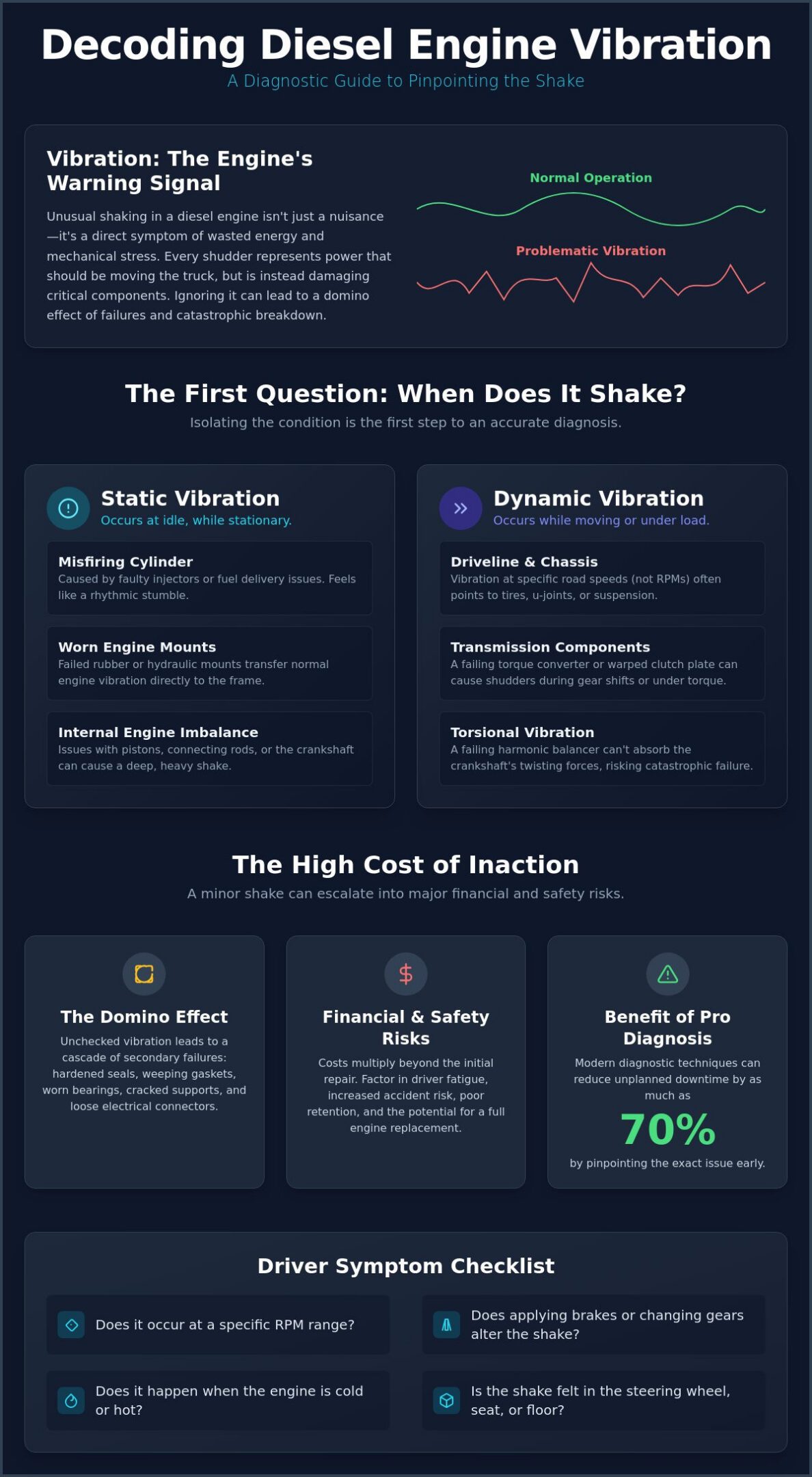
A successful diesel engine vibration diagnosis begins with one specific question: When does the truck shake? Not all vibrations are created equal. Technicians categorize these issues into static and dynamic states to narrow the field of possible failures. A static vibration occurs while the vehicle is stationary at idle. A dynamic vibration only appears when the truck is moving or under load. Determining the state of the engine when the symptom occurs is the fastest way to stop wasting money on parts that aren’t broken.
Distinguishing between engine vibration and chassis vibration is the next critical step. If the shake persists while the truck is in neutral and the engine is revved, the problem is likely internal to the engine. If the vibration only happens at specific road speeds regardless of engine RPM, the issue usually lies in the tires, driveline, or suspension. Transmission components, such as a failing torque converter or a warped clutch plate, can also mimic engine shakes. These components often create a shudder that feels like a misfire but only occurs during gear transitions or under heavy torque. If you’re seeing these signs, it may be time to consult the experts at Diego’s Shop for a comprehensive inspection.
To help your technician, ensure your drivers use this checklist when reporting symptoms:
- Does the vibration occur at a specific RPM range?
- Does it happen only when the engine is cold or at operating temperature?
- Is the shake felt in the steering wheel, the seat, or the floorboards?
- Does applying the brakes or changing gears alter the frequency of the shake?
Vibrations at Idle: The Fuel and Air Connection
Roughness at idle is frequently tied to combustion imbalance. A single faulty fuel injector can disrupt the rhythm of the entire block. When one cylinder fails to contribute its fair share of power, the crankshaft experiences a momentary slowdown, followed by a surge from the next healthy cylinder. This creates a rhythmic rocking motion. Air entering the fuel system or a clogged filter can also cause erratic idling. Staying ahead of these issues requires consistent diesel maintenance to ensure fuel delivery remains precise across all injectors.
Vibrations Under Load: Torque and Mechanical Stress
Some vibrations only reveal themselves when the engine is working hardest. During steep hill climbs or heavy acceleration, the increased cylinder pressure puts maximum stress on mechanical components. A failing turbocharger with unbalanced wheels can create a high frequency buzz that intensifies as boost builds. Professional Vibration Analysis often highlights how the harmonic balancer struggles to manage these increased forces if its internal dampening material has degraded. When the balancer fails, the crankshaft is left unprotected against the violent twisting forces of high torque operation.
The Most Common Culprits in Diesel Engine Vibration Diagnosis
Identifying the timing of a shake is only half the battle. To perform an accurate diesel engine vibration diagnosis, you must inspect the specific mechanical and fuel related components that fail most frequently in medium and heavy duty trucks. While academic theories often discuss generic balance, fleet owners need to know which physical parts are actually breaking on the road. From fuel delivery issues to failed isolation mounts, the cause of a vibration is usually found in a handful of high wear areas.
A cylinder misfire remains the most common cause of rhythmic engine shaking. When one cylinder fails to fire correctly, the engine loses its rotational symmetry. This creates a violent, repeating tug on the crankshaft that travels through the entire drivetrain. While some misfires are caused by mechanical failures like bent rods or damaged pistons, most originate in the fuel system. These internal failures represent a worst case scenario, but catching them early through vibration analysis can often save the engine block from total destruction.
Fuel System Imbalances and Injector Health
Modern diesel engines rely on incredibly precise fuel timing and volume. Over time, carbon buildup can clog injector nozzles, which distorts the spray pattern and leads to incomplete combustion. If an injector becomes “stuck” or fails to deliver the commanded fuel quantity, the resulting power imbalance causes the engine to rock on its mounts. This is particularly noticeable at idle, where the lack of momentum makes every uneven stroke feel more pronounced. Utilizing professional diesel diagnostics services is the only way to accurately test injector flow rates and identify which specific “hole” is causing the disturbance.
Mechanical Isolation: Mounts and Dampers
Even a perfectly tuned engine produces some level of vibration. Engine mounts are designed to isolate this energy from the cab and chassis. Over hundreds of thousands of miles, the rubber in these mounts can dry rot or develop fluid leaks, losing its ability to dampen movement. You can often spot a failed mount by looking for sagging rubber or metal on metal contact.
Another critical component is the harmonic balancer. This heavy disc sits on the front of the crankshaft and is designed to absorb torsional vibrations. It’s the silent killer of diesel engines. When the rubber bond inside the balancer separates, the disc can begin to wobble or stop dampening altogether. This allows destructive frequencies to vibrate through the crankshaft. Testing for balancer health includes:
- Inspecting the rubber ring for cracks or “walking” out of position.
- Checking for a visible wobble while the engine is running.
- Looking for shiny metal shavings near the front crank seal.
Keeping these isolation parts in peak condition is essential for the longevity of medium duty trucks. It’s a small investment that prevents the crankshaft from snapping under the stress of unmanaged harmonic frequencies.
Professional Vibration Analysis vs. Traditional Troubleshooting
In the past, a seasoned mechanic might “listen” to an engine with a screwdriver pressed against the block to find a shake. While experience is valuable, modern high-pressure common rail systems operate with tolerances too tight for the human ear to judge. Today, a professional diesel engine vibration diagnosis relies on data rather than intuition. Using digital diagnostic equipment allows technicians to see exactly what is happening inside the combustion chamber in real time. This precision eliminates the high cost of trial and error repairs that often plague fleet owners who rely on guesswork.
Electronic Vibration Analyzers (EVAs) have changed the way we approach troubleshooting. These tools use strategically placed sensors to measure the frequency and amplitude of a shake. By converting a physical vibration into a digital signature, we can determine if the frequency matches the rotation of the engine, the transmission, or the driveline. This scientific approach ensures that we aren’t just treating the symptom, but actually fixing the source of the mechanical stress.
Digital Diagnostics and Cylinder Contribution
Modern scan tools perform a critical test known as cylinder contribution. During this procedure, the engine’s computer measures the precise speed of the crankshaft after each individual firing event. If one cylinder is weak, the crankshaft slows down slightly during that specific stroke. Even a 5 percent drop in power from a single cylinder can cause a massive, bone-jarring vibration in the cab. Digital diagnostics can identify a failing injector before it throws a check engine light. This early detection is the key to preventing the “domino effect” of component failure mentioned earlier in this guide.
The Importance of a Specialized Diesel Shop
Heavy duty trucks from brands like Peterbilt or Kenworth require manufacturer-specific software to access deep-level engine data. General repair shops often lack the proprietary heavy duty software needed to communicate with complex diesel ECMs. Without these tools, a technician is essentially working blind, which leads to longer downtime and higher labor costs.
For fleet owners along the Wasatch Front, settling for “good enough” diagnostics leads to recurring issues and lost revenue. You need a master craftsman who understands the specific needs of commercial machinery. Choosing a shop that provides warrantied repair work ensures that the job is done right the first time. If your truck is suffering from an unidentified shake, contact Diego’s Shop today to schedule a professional diagnostic session and get your fleet back on the road with confidence.
Comprehensive Diesel Diagnostics at Diego’s Shop in Springville
A shake in the cab is a call for action. It’s a signal that your equipment is working against itself, wasting fuel and grinding down expensive internal components. At Diego’s Shop, we take total control of these complex situations. We specialize in light, medium, and heavy-duty diesel repair, providing the technical mastery needed to keep commercial vehicles on the road. Every diesel engine vibration diagnosis we perform is grounded in data and years of hands-on experience. We don’t guess; we identify the root cause and provide a clear path to a permanent fix.
Our shop is built on the values of a master craftsman. We take immense pride in the durability of our work and the integrity of our diagnostics. The “Diego’s Promise” means you receive honest, no-nonsense communication about the health of your engine. We understand the stress of vehicle downtime and the high cost of trial and error repairs. Our goal is to provide peace of mind through accurate service and dependable results. We treat your fleet with the personal accountability you expect from a local specialist.
Serving Springville and the Wasatch Front
We are proud to support the hardworking fleets of Utah County. From our home base in Springville, we serve the specific needs of operators in Spanish Fork, Provo, and across the entire Wasatch Front. Our technicians possess the specialized software and tools required to service a wide variety of diesel platforms. Whether you are managing Isuzu delivery trucks, Ford Powerstroke pickups, or heavy-duty Kenworth rigs, we have the capability to handle your most difficult vibration issues. Don’t let a minor tremor turn into a catastrophic failure. Schedule your professional vibration analysis today and protect your bottom line.
Fleet Maintenance Programs to Prevent Future Shakes
The most effective way to manage engine vibration is to catch it before it starts. Our comprehensive fleet maintenance plans include detailed vibration inspections as a standard protocol. By monitoring the condition of engine mounts, harmonic balancers, and fuel trim levels during routine service, we identify wear patterns early. This preventive approach minimizes unplanned downtime and prevents the “domino effect” of mechanical failure.
Every repair performed at Diego’s Shop is backed by our commitment to quality. We provide warrantied repair work that gives long-haul drivers the confidence they need for heavy-duty use. You deserve a partner who speaks your language and understands the hardworking nature of your machinery. We are here to ensure your trucks remain safe, efficient, and profitable for the long haul. Trust the experts who maintain total control over every repair.
Protect Your Fleet with Professional Diagnostics
Ignoring a persistent shake is an expensive gamble that compromises the safety and efficiency of your commercial vehicles. You now understand that vibration is more than a nuisance; it is a clear warning of internal mechanical stress or fuel delivery imbalances. By moving away from traditional troubleshooting and utilizing data-driven methods like cylinder contribution analysis, you can pinpoint failures with surgical precision. A proactive diesel engine vibration diagnosis ensures your trucks stay out of the shop and on the road where they belong.
At Diego’s Shop, we provide the technical mastery your fleet requires. We specialize in the complex systems found in Peterbilt, Kenworth, and Isuzu rigs, serving fleet owners throughout Springville and Utah County. Our team delivers warrantied repair work that stands up to the demands of heavy-duty hauling. We maintain total control over every repair to give you absolute peace of mind. Get Expert Diesel Vibration Diagnosis at Diego’s Shop and secure the long-term reliability of your equipment. Your fleet is the backbone of your business; we are here to keep it running strong.
Frequently Asked Questions
What are the most common causes of diesel engine vibration?
Fuel system imbalances, worn engine mounts, and failing harmonic balancers are the primary culprits. These issues disrupt the rotational symmetry of the engine and prevent smooth operation. Cylinder misfires are the leading cause of rhythmic shaking, often triggered by clogged fuel injectors or air entering the fuel lines. Identifying these specific failures early prevents the destructive domino effect on other engine components.
Can I drive my truck if the engine is vibrating at idle?
You should avoid operating the vehicle if the vibration is severe or accompanied by knocking sounds. While a minor idle shake might not cause immediate engine seizure, it is a clear sign of an underlying mechanical issue. Continuing to drive can lead to secondary damage in the drivetrain and cause the engine mounts to fail completely. It is always safer to perform a professional diagnostic check before a minor tremor becomes a major breakdown.
How much does a diesel engine vibration diagnosis cost?
The price of a professional diesel engine vibration diagnosis depends on the complexity of the engine and the digital tools required for testing. Specialized shops use advanced electronic vibration analyzers and manufacturer-specific scan tools to provide an accurate assessment. To get a precise understanding of the diagnostic requirements for your specific light, medium, or heavy-duty rig, contact a local specialist for a consultation.
Why does my diesel engine shake more when it is cold?
Diesel engines often shake more when cold because fuel is harder to atomize and ignite at lower temperatures. This results in incomplete combustion and uneven cylinder pressure during the initial warm-up phase. While some roughness is normal for older mechanical engines, an excessive cold shake in a modern common-rail system often points to failing glow plugs, worn injectors, or low compression in specific cylinders.
Is an engine vibration always a sign of a major mechanical failure?
No, many vibrations originate from simple isolation components like degraded rubber engine mounts or failed harmonic dampers. These parts are designed to absorb energy and can be replaced without rebuilding the engine. However, you should never ignore a new vibration. A professional technician can confirm whether the issue is a simple isolation problem or a warning sign of internal damage like a bent connecting rod.
How do I know if the vibration is coming from the engine or the transmission?
You can narrow the source by shifting the truck into neutral while stationary. If the vibration persists as you increase the engine RPM in neutral, the problem is likely internal to the engine. If the shake only reveals itself while the vehicle is in motion or under a specific torque load, the issue usually stems from the transmission, torque converter, or driveline components like the U-joints.
Can a bad fuel injector cause the whole truck to shake?
Yes, a single failing fuel injector can cause the entire vehicle to shudder by creating a massive power imbalance. When one cylinder fails to fire correctly, the crankshaft experiences a violent slowdown followed by a surge from the next healthy cylinder. This rhythmic imbalance travels through the engine mounts and into the chassis, which makes the cab vibrate noticeably even at low speeds.
What is a harmonic balancer and why does it cause vibrations?
A harmonic balancer is a heavy disc mounted to the front of the crankshaft that absorbs torsional twisting forces. It utilizes a rubber dampening ring to neutralize destructive frequencies generated during combustion. If the rubber bond fails or the disc walks out of position, it can no longer protect the crankshaft. This leads to severe vibrations that can eventually cause the crankshaft to snap under the stress.