
Diesel Engine Repair for Landscapers: Maximizing Uptime in Utah County

A single truck stuck in limp mode doesn’t just stall a crew; it burns through your profit margins during the peak of the Utah landscaping season. When your fleet is sidelined by a clogged DPF or a complex EGR failure, you aren’t just paying for parts. You’re losing the trust of your clients and the productivity of your team. Specialized diesel engine repair for landscapers is more than a mechanical fix. It is a strategic tool for revenue protection.
We know that a reliable fleet is the backbone of your operations. With Utah diesel prices averaging $4.866 per gallon this June, you can’t afford the fuel waste or inefficiency of a poorly maintained engine. This article explains how proactive maintenance protocols protect your fleet from costly downtime throughout the 2026 season. We will cover common emissions system pitfalls and the specific Utah County compliance schedules for even-numbered model years. You’ll discover how a partnership with a dependable local expert reduces long-term costs and provides the peace of mind you need to focus on your growth.
Key Takeaways
- Understand how specialized diesel engine repair for landscapers serves as a revenue-protection strategy to prevent thousands in lost daily crew income.
- Identify why excessive job-site idling is a leading cause of DPF and EGR failures and how to mitigate its impact on your trucks.
- Compare the long-term financial benefits of small, planned maintenance investments versus the high cost of emergency engine overhauls.
- Access a pre-season checklist designed to prepare your fleet’s cooling systems and fluid levels for the intense Utah summer heat.
- Discover the advantage of partnering with a local shop that provides warrantied repair work specifically tailored to the needs of commercial fleets.
The High Cost of Downtime: Why Landscapers Need Specialized Diesel Repair
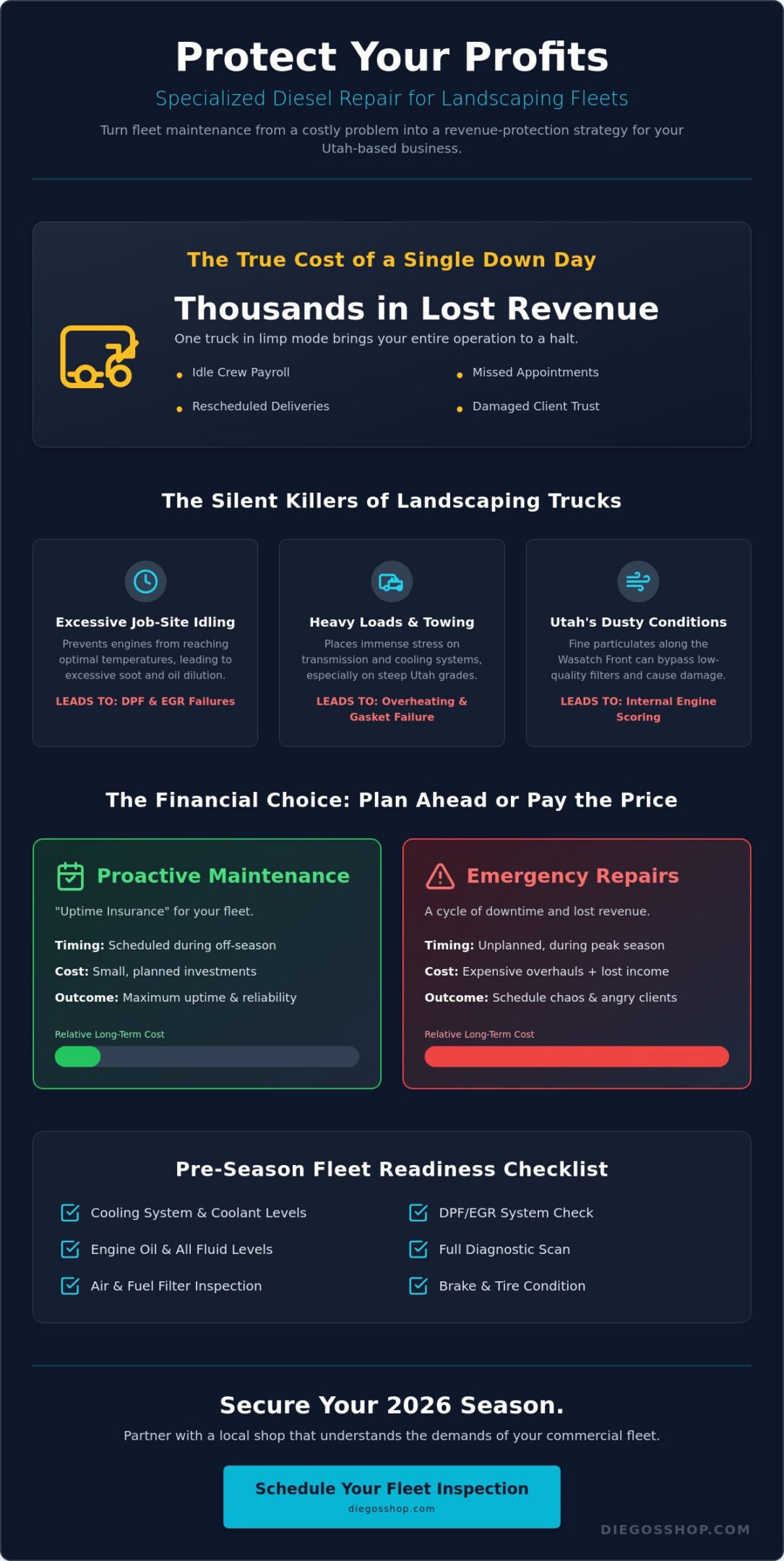
A single day of downtime can easily cost a landscaping crew thousands in lost revenue. It isn’t just the repair bill that hurts; it’s the missed appointments, the rescheduled sod deliveries, and the payroll you’re still paying for a crew that can’t work. When your truck is in the shop, your reputation is on the line. Clients expect their lawns mowed and their projects completed on schedule, regardless of your mechanical issues.
Effective diesel engine repair for landscapers functions as a critical business support service rather than a simple mechanical task. The Diesel engine is the heart of your operation. When it fails, your business stops. We view specialized technical mastery as “uptime insurance” for your fleet. By treating your trucks as precision tools rather than just transportation, we help you maintain total control over your seasonal schedule.
Commercial vs. Residential Diesel Service Needs
General repair shops often miss the nuances of medium-duty commercial systems because they treat them like passenger vehicles. Your landscaping trucks face much harsher conditions than a standard commuter diesel. Constant heavy loads and trailer towing put immense stress on the transmission and cooling systems. These components require more frequent, detailed inspections to catch wear before it leads to a catastrophic failure on the road.
Utah’s environment adds another layer of complexity. The dusty conditions along the Wasatch Front and throughout Utah County are brutal on diesel air filtration systems. Fine particulates can bypass low-quality filters, leading to internal engine scoring. A specialist understands that diesel engine repair for landscapers must include a robust strategy for managing these environmental factors. We focus on high-durability components that can withstand the grit and heat of a typical Utah summer.
Protecting Your 2026 Seasonal Revenue
Timing is everything in the landscaping industry. You don’t want to be dealing with a major engine overhaul in the middle of the spring rush. Strategic business owners schedule major repairs and inspections during the off-season or shoulder months. This proactive approach ensures your trucks are ready to perform when the demand is highest. Establishing a relationship with a local specialist now ensures you aren’t just another number in a long line during a mid-summer emergency.
Investing in proactive fleet maintenance is the most effective way to prevent mid-season breakdowns. Regular diagnostic checks can identify early signs of DPF soot buildup or failing injectors before they trigger a limp-mode event. Our goal is to keep your crews on the job site, not the shoulder of the I-15. Consistent care results in a reliable fleet that lasts through the 2026 season and beyond, reducing your long-term operational costs and protecting your bottom line.
Common Diesel Engine Failures in Hardworking Landscaping Fleets
Modern diesel engines are designed for the long haul, but the specific duty cycle of a landscaping truck is anything but standard. Your vehicles don’t spend their lives cruising at highway speeds where they can operate at peak efficiency. Instead, they face a grueling schedule of short trips, stop-and-go traffic, and long periods of idling at job sites. This low-load operation is actually high-stress for the engine, leading to specific mechanical issues that a generic repair shop might overlook. Reliable diesel engine repair for landscapers requires an understanding of these unique commercial challenges.
Constant idling is the silent killer of modern diesel power plants. While your crew is unloading equipment or using the truck as a mobile office, the engine isn’t reaching the optimal temperatures required for complete combustion. This leads to excessive soot production and oil dilution. Additionally, hauling heavy trailers loaded with skid steers or pallets of sod up steep Utah County grades puts massive strain on the cooling system. If your radiator or water pump isn’t performing at 100 percent, those uphill climbs can quickly lead to overheating and head gasket failure. Managing these complex electronic management systems requires expert diesel engine repair to ensure every sensor and module is communicating correctly.
The DPF and EGR Challenge
The emissions system is often the first point of failure for landscaping fleets. Low-speed operation prevents the Diesel Particulate Filter (DPF) from performing a “passive regeneration,” which naturally burns off soot. When the filter clogs, the truck enters limp mode, effectively ending your workday. Similarly, the Exhaust Gas Recirculation (EGR) cooler can become restricted with carbon deposits, leading to reduced fuel economy and internal engine wear. It is important to remember that Utah County requires OBD inspections for 2007 and newer diesel vehicles. “Deleting” these systems is not a legal or viable solution for a legitimate business. If you notice your truck frequently requiring manual regenerations, a consultation with Diego’s Shop can help identify the root cause before a total blockage occurs.
Fuel System Integrity and Contamination
Landscaping crews often rely on job-site fuel cans to keep equipment running, which significantly increases the risk of contamination. Even a small amount of water or fine grit can ruin a set of injectors. Modern fuel systems operate at incredibly high tolerances, and worn injectors can cause improper spray patterns that lead to catastrophic piston damage. High-pressure common rail systems are the heart of modern diesel performance. Maintaining fuel system integrity through high-quality filtration and regular water-in-fuel sensor checks is essential for preventing expensive, unannounced shop visits.
Preventive Maintenance vs. Emergency Repairs: Protecting Your Bottom Line
A $500 planned service is a manageable business expense. A $5,000 emergency engine overhaul is a financial shock that can derail your entire month. For landscaping business owners, the choice is clear. Proactive diesel engine repair for landscapers ensures you control the shop schedule, rather than the truck controlling yours. Our master craftsman approach involves a meticulous inspection process. We look for the small signs, such as weeping gaskets or cracked serpentine belts, before they escalate into a roadside breakdown. This level of attention to detail is what separates a reliable fleet from one that constantly surprises you with expensive failures.
We view every maintenance visit as an opportunity to reinforce the durability of your equipment. Catching a small coolant leak today prevents a warped cylinder head tomorrow. By choosing a shop that prioritizes technical mastery and thoroughness, you’re investing in the longevity of your most expensive assets. We stand behind our expertise with warrantied repair work, providing the accountability you need to run your business with confidence. It’s about building a relationship with a partner who understands that your trucks are your livelihood.
The ROI of Proactive Fleet Care
Consistent oil analysis serves as a predictive window into your engine’s health. By analyzing metal particulates and soot levels in used oil, we can identify internal wear before it causes a failure. This disciplined level of diesel maintenance keeps your trucks on the road for more seasons. Beyond reliability, a documented service history significantly increases vehicle resale value. When you eventually trade in a truck, a complete maintenance log proves the asset’s integrity to the next owner.
Efficiency is another major factor in your return on investment. Optimized engine tuning and clean induction systems help combat rising operational costs. With Utah diesel prices sitting at $4.866 per gallon this June, every percentage point gained in fuel efficiency directly impacts your bottom line. A well-maintained diesel engine doesn’t just last longer; it runs cleaner and consumes less fuel under heavy loads.
Avoiding the ‘Limp Mode’ Trap
Limp mode is a software-driven safety state that restricts engine power to prevent terminal damage. It is a massive logistical problem when your truck is loaded with a full trailer of sod or heavy equipment. You simply cannot navigate Utah County traffic or climb steep grades safely with a restricted engine. Most sensor-related limp mode traps are avoidable through routine sensor cleaning and software calibrations during regular service intervals.
If a fault light appears, specialized diagnostics are essential to pinpoint the exact failure. Guessing at sensors or valves only wastes time and money. We use advanced diagnostic tools to accurately reset and repair sensor-related issues, ensuring the problem is solved at the source. This precision prevents the recurring “check engine” lights that frustrate your drivers and stall your productivity.
Pre-Season Checklist: Getting Your Diesel Trucks Ready for the Spring Rush
The transition from winter dormancy to the spring rush is the most vulnerable time for your fleet. After months of cold starts or reduced activity, seals can dry out and batteries can lose their cranking capacity. A systematic approach to diesel engine repair for landscapers ensures your equipment is ready for the first day of the season. We recommend a five-step audit to safeguard your uptime before the schedule gets full.
- Step 1: Fluid and Filter Audit. Change your engine oil and fuel filters. Check your Diesel Exhaust Fluid (DEF) quality, as older fluid can crystalize and damage injectors.
- Step 2: Cooling System Inspection. Utah summers are unforgiving. Inspect every hose for soft spots and verify the water pump is circulating coolant efficiently to prevent overheating under heavy loads.
- Step 3: Electrical System Test. Test your batteries and alternator output. A weak charging system will fail the moment you add the electrical load of a dump trailer or auxiliary lighting.
- Step 4: Brake and Suspension Check. Towing heavy trailers places extreme stress on your chassis. Check for pad wear and ensure your leaf springs and shocks aren’t showing signs of fatigue.
- Step 5: Emissions System Review. Verify the DPF is clear. If you’ve been idling the truck to keep warm during winter prep, you likely have soot accumulation that needs attention.
Wasatch Front Specific Considerations
Winter in Utah County leaves behind a legacy of salt and magnesium chloride. These chemicals are highly corrosive to your chassis and brake lines. A thorough undercarriage wash and inspection can reveal rusted lines before they cause a loss of braking power. Additionally, your cooling system needs to be in top condition for the steep climbs of Traverse Mountain or Parley’s Canyon. Hauling a full crew and equipment up these grades requires maximum thermal efficiency. Ensure your reliable DOT truck inspections in Utah County are current. Staying compliant prevents costly roadside fines and keeps your drivers focused on the job site.
Diagnostic Health Check
We use professional-grade scanners to look beyond the dashboard. Many commercial trucks store “pending” codes that haven’t triggered a warning light yet. These often indicate a sensor that is beginning to drift out of calibration or a turbocharger vane that is sticking. Catching these issues during a diesel engine repair for landscapers pre-season visit prevents a mid-summer breakdown. A clear dashboard doesn’t always mean a healthy commercial diesel engine. We calibrate your sensors for optimal power delivery, ensuring you have the torque needed for heavy hauling. Schedule your pre-season inspection at Diego’s Shop today to secure your fleet’s reliability for the 2026 season.
Diego’s Shop: Your Partner for Reliable Landscape Fleet Maintenance in Springville
Choosing the right partner for diesel engine repair for landscapers is a decision that directly impacts your seasonal profitability. While generic dealerships often suffer from long lead times and general repair shops might lack specialized diagnostic equipment, Diego’s Shop offers a focused, commercial alternative. We understand that your trucks are precision tools, not just transportation. Our team prioritizes technical mastery and provides warrantied repair work that gives you the peace of mind to focus on your clients. We serve the entire Wasatch Front with a commitment to integrity and personal accountability.
A partnership with a dedicated specialist means your fleet receives consistent, high-level care from a master craftsman who knows your vehicles’ history. We don’t just fix symptoms; we address the root causes of mechanical issues to ensure your crew stays on the job site. By maintaining total control over complex engine management and emissions systems, we help you avoid the unexpected downtime that can derail a busy week. Our goal is to build a reliable fleet that lasts through the 2026 season, protecting your business from the stress of sudden, expensive failures.
Expertise You Can Trust
We possess deep experience across light, medium, and heavy-duty diesel platforms, including the specific systems found in Peterbilt, Isuzu, and Ford trucks. Our no-nonsense approach to diagnostics means we fix what is actually broken and proactively identify components nearing the end of their service life. We don’t use guesswork or unnecessary filler repairs. Instead, we provide clear, declarative assessments of your engine’s health. Local Springville business owners choose us because we provide grounded, hardworking service that matches the durable, hardworking nature of the machinery we service.
Get Your Fleet Season-Ready
Preparation is the foundation of a successful spring rush. Scheduling a comprehensive fleet-wide inspection before the first blades of grass are cut is the most effective way to protect your uptime. We make the process straightforward and efficient, respecting your time and your operational requirements. Our commitment to keeping Utah’s landscapers on the road and profitable is the foundation of everything we do. Contact us today for a professional consultation on your fleet’s diesel engine repair for landscapers and preventive maintenance requirements. Let’s ensure your equipment is as dependable and hardworking as the team that operates it.
Secure Your Fleet’s Performance for the 2026 Season
Proactive maintenance is the only way to ensure your landscaping business thrives during the high-demand months in Utah County. By addressing emissions systems, cooling components, and fuel integrity before the spring rush, you protect your revenue from the high cost of seasonal downtime. Specialized diesel engine repair for landscapers isn’t just about fixing a truck. It’s about maintaining a dependable foundation for your entire operation.
We provide expert service for Peterbilt, Kenworth, Isuzu, and Ford diesel platforms with a focus on technical mastery. Our warrantied repair work offers the accountability and peace of mind you need to lead your crews with confidence. We are proud to serve Springville and the entire Wasatch Front with honest, hardworking results. Each service protocol is designed to maximize the durability of your hardworking machinery and ensure total control over your fleet’s health.
Keep your fleet moving. Schedule your diesel service at Diego’s Shop today. Your trucks are the backbone of your success, and we are here to ensure they remain as reliable as your reputation.
Frequently Asked Questions
How often should a landscaping diesel truck be serviced compared to a regular truck?
Landscaping diesel trucks require more frequent service intervals than standard passenger vehicles due to their severe duty cycles. While a commuter truck might follow a standard mileage schedule, landscaping fleets often need oil and filter changes based on engine hours or every 5,000 miles. This accounts for the heavy towing and constant idling that standard vehicles don’t face. Regular diesel engine repair for landscapers ensures these shorter intervals are managed correctly to prevent premature wear.
Why does my diesel truck keep going into ‘limp mode’ during job site idling?
Excessive idling at job sites prevents the exhaust system from reaching the high temperatures needed for a Diesel Particulate Filter (DPF) regeneration. When soot accumulates beyond a certain threshold, the engine computer triggers limp mode to protect the turbocharger and engine from backpressure damage. This is a common issue for crews that leave trucks running while unloading equipment or during breaks. Avoiding long idle periods is the best way to prevent this specific power restriction.
Is it worth repairing an older diesel landscaping truck or should I replace it in 2026?
Deciding whether to repair or replace depends on the condition of the chassis and the 2026 regulatory environment. In Utah, 2009 and older heavy-duty vehicles now face a $250 initial registration fee and a $45 annual compliance fee. However, a major engine repair is still significantly less expensive than the high monthly payments of a new commercial vehicle. If the frame and transmission are solid, investing in professional diesel engine repair for landscapers is often the smarter financial move.
What are the most common diesel engine problems caused by Utah’s climate?
Utah’s climate creates unique challenges such as salt corrosion from winter roads and extreme heat during the summer months. Winter road treatments can eat through brake lines and electrical connectors if they aren’t washed regularly. In the summer, the steep grades of the Wasatch Front place immense strain on cooling systems, often leading to water pump or radiator failures. Fine dust from local job sites also clogs air filters faster than in other regions, requiring more frequent replacements.
Can a general mechanic handle the emissions system repairs on my commercial diesel?
General mechanics often lack the specialized diagnostic software and heavy-duty equipment required to properly service commercial emissions systems. Modern DPF and EGR systems are integrated into complex engine management modules that require specific technical mastery to reset and calibrate. Using a generalist can lead to parts swapping rather than a precise fix. A specialist ensures the repair is performed according to commercial standards, keeping your trucks compliant with Utah County emissions requirements.
How much does a typical preventive maintenance plan for a landscaping fleet cost?
The cost of a preventive maintenance plan depends on the size of your fleet and the specific service intervals required for your equipment. Rather than a one-size-fits-all price, we develop custom plans that reflect the actual workload and engine hours of your trucks. This approach ensures you aren’t overpaying for unnecessary service while still protecting your engines from failure. Investing in a structured maintenance agreement helps you predict operational expenses and avoid the financial shock of emergency repairs.
What is the benefit of warrantied repair work for my business trucks?
Warrantied repair work provides your business with essential financial protection and professional accountability. If a repaired component fails within the warranty period, the cost of the follow-up fix is covered, which eliminates the risk of paying for the same job twice. This is a critical component of fleet management because it ensures your maintenance budget is used effectively. It builds a partnership based on trust and the long-term durability of the work performed on your engines.
Do you provide DOT inspections for landscaping trailers and medium-duty trucks?
We provide comprehensive DOT inspections for both landscaping trailers and medium-duty trucks to ensure your entire setup is road-legal. These inspections cover critical safety components like lighting, braking systems, and coupling devices. Keeping your trailers and trucks compliant is necessary to avoid hefty roadside fines and potential impoundments during busy work weeks. Our team understands the specific requirements for commercial vehicles operating in Utah County, helping you pass with confidence.