

Diesel Engine Diagnostics Utah County: Precision Troubleshooting for Rugged Performance

A “check engine” light is a symptom, not a diagnosis. You rely on your truck for heavy hauling and commercial work across the Wasatch Front. When performance drops or fuel efficiency tanks, the stress of potential downtime is overwhelming. It’s frustrating to pay for a repair only to have the same issue return a week later. We know that your vehicle is your livelihood, and guesswork has no place in a professional shop.
Reliable diesel engine diagnostics Utah County provide a technical roadmap to durability. By using advanced software and mechanical intuition, we identify hidden engine issues before they lead to costly breakdowns. This article explores how precision troubleshooting restores reliability and minimizes repair costs. We look at the specific challenges of Utah’s high altitude, the reality of modern emissions standards, and why an accurate health report is the most valuable tool for any fleet manager or owner-operator. Discover how to stop chasing symptoms and start protecting your engine’s long-term performance.
Key Takeaways
- Learn why Utah County’s high elevation and steep grades require specialized diagnostic protocols to protect your turbocharger and fuel systems.
- Understand the difference between simple code reading and professional diesel engine diagnostics Utah County services that analyze the root cause of performance drops.
- Discover how deep-dive data analysis prevents the “parts-changer” pitfall so you don’t waste money on unnecessary sensor and component replacements.
- Identify the subtle warning signs in your engine management system that signal it’s time for service before a major breakdown occurs.
- See how utilizing OEM-level software for brands like Peterbilt and Kenworth ensures your commercial fleet remains reliable and road-ready.
Why Specialized Diesel Engine Diagnostics are Essential in Utah County
Diesel diagnostics isn’t just about reading a code. It’s a comprehensive evaluation of your Engine Control Module (ECM) and the mechanical components it oversees. In our region, professional diesel engine diagnostics Utah County are critical because our environment is unforgiving. Unlike standard gasoline engines that rely on spark ignition, diesel engines operate under extreme compression and high fuel pressure. A simple scan tool from a local parts store won’t reveal the intricacies of injector pulse width or turbocharger vane position. Precision troubleshooting identifies the root cause of a power loss before it turns into a catastrophic failure.
We utilize the concept of preventive diagnostics to catch issues in their infancy. By analyzing data trends rather than just active faults, we can spot a declining fuel pump or a sticking EGR valve long before you’re stranded on the side of the I-15. This proactive approach protects your investment and ensures your vehicle remains a tool for production rather than a liability.
The Impact of Utah’s Climate on Diesel Systems
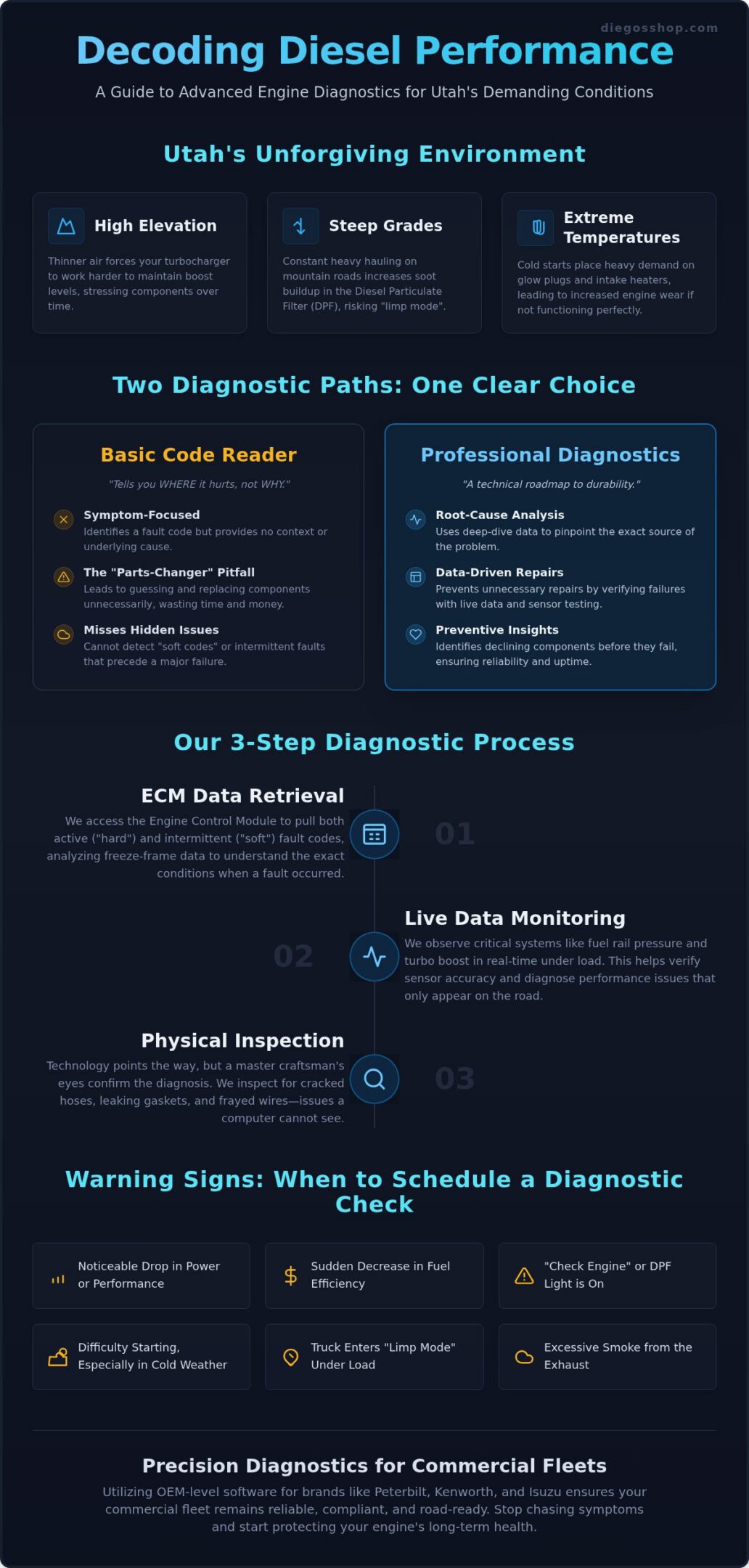
Our high elevation and steep mountain grades put immense stress on fuel delivery systems. Thinner air means your turbocharger must work harder to maintain the correct boost levels. The ECM is the brain that manages air-fuel ratios in varying altitudes. When temperatures drop in Utah County, glow plugs and intake heaters face heavy demand. If these components aren’t functioning perfectly, you’ll face hard starts and increased engine wear. Additionally, mountain hauling often leads to soot buildup in the Diesel Particulate Filter (DPF). Advanced diagnostics monitor DPF health and regeneration cycles to prevent your truck from entering “limp mode” on a steep climb.
Commercial vs. Residential Diagnostic Needs
Reliability is non-negotiable for businesses operating along the Wasatch Front. Commercial fleets require frequent diagnostic check-ups to maintain DOT compliance and ensure total uptime. While light-duty pickups like Ford, Chevy, and Ram use standard ports, their diagnostic data is highly specific to their high-pressure common rail systems. Heavy-duty trucks require specialized software to access deeper system layers. Catching a failing sensor or a slight drop in oil pressure through a diesel maintenance protocol is the difference between a productive workday and an expensive tow. We focus on providing a clear health report that keeps your equipment moving and your costs predictable.
The Technical Process: How We Decode Your Diesel’s Performance
A simple code reader tells you where it hurts, but it doesn’t tell you why. Professional diesel engine diagnostics Utah County involves a transition from basic error scanning to deep-dive data analysis. We don’t guess with your equipment. By utilizing OEM-level software for brands like Peterbilt, Kenworth, and Isuzu, we access the same high-level data used by factory technicians. This technical transparency is the foundation of our warrantied repair work, ensuring that every fix is backed by hard data and a commitment to durability.
Step 1: ECM Data Retrieval and Fault Code Analysis
The process begins by accessing the vehicle’s Engine Control Module (ECM) to pull a history of both “soft” and “hard” codes. Hard codes represent active failures, while soft codes often reveal intermittent issues that standard scanners miss. We analyze freeze-frame data, which provides a snapshot of engine conditions, such as RPM, load, and temperature, at the exact moment a fault occurred. This allows us to see the vehicle’s history through its own eyes, identifying patterns that lead to recurring downtime.
Step 2: Live Data Monitoring and Sensor Testing
Static codes only tell part of the story. We monitor live data streams to observe fuel rail pressure and boost levels in real-time while the engine is under load. This stage is critical for testing the accuracy of oxygen and temperature sensors within the exhaust stream. If you’ve noticed a sudden loss of power during a haul, a professional diagnostic session can determine if your EGR system is functioning within factory parameters or if a sensor is providing inaccurate readings that trigger “limp mode.”
Step 3: Physical Inspection and Verification
Technology is a powerful tool, but it’s no substitute for a master craftsman’s eyes. A computer cannot see a cracked intake hose, a leaking gasket, or a frayed wire. We use diagnostic data to point us toward specific mechanical failure points, then perform a manual inspection to verify the findings. This dual-layered approach ensures we identify the root cause rather than just treating the symptoms. At Diego’s Shop, we maintain a standard of total integrity. We provide a clear, honest report of our findings so you can make informed decisions about your fleet. Our goal is to restore your engine’s rugged performance with precision and accountability.
Diagnostic Codes vs. Real-World Solutions: Why Expertise Matters
A diagnostic trouble code (DTC) is a starting point, not a verdict. Many shops fall into the “parts-changer” pitfall, where they blindly replace whatever sensor a scanner mentions. This approach is expensive and rarely solves the underlying issue. For example, a code for low fuel rail pressure might be caused by a failing sensor, but it could also stem from a clogged filter, a leaking injector, or a worn lift pump. Professional diesel engine diagnostics Utah County require a blend of high-level data and master-level intuition to determine the true culprit.
We treat every diagnostic session as a forensic investigation. By integrating findings into a long-term diesel maintenance plan, we use current data to predict future failure points. This foresight protects the longevity of your high-value engine and ensures that you aren’t paying for the same repair twice. Technical skill matters, but the ability to interpret conflicting data points is what defines a master craftsman.
The Problem with DIY Code Readers
It’s tempting to use a $50 scanner from a big-box store, but these tools provide incomplete information for medium and heavy-duty trucks. Cheap readers often fail to see manufacturer-specific codes or proprietary data layers. They might tell you a code exists, but they won’t show you the freeze-frame data or the sensor voltage sweeps necessary for a real fix. Clearing a code without addressing the mechanical stress that caused it is dangerous. It masks the symptom while the internal damage continues to mount, eventually leading to a much larger bill.
Interpreting Complex Emission System Errors
Modern diesel trucks are equipped with sophisticated Aftertreatment systems. When a Diesel Particulate Filter (DPF) or Selective Catalytic Reduction (SCR) system malfunctions, the ECM often triggers “Limp Mode.” This protective state drastically reduces engine power to prevent environmental damage, effectively sidelining your truck. Navigating these errors requires specialized tools that can force a stationary regeneration or test the dosing of Diesel Exhaust Fluid (DEF). Connecting these diagnostic results to comprehensive diesel engine repair strategies is the only way to get back on the road with confidence. We focus on permanent solutions that keep your emissions system compliant and your engine running at peak efficiency.
Recognizing the Warning Signs: When to Schedule a Diagnostic Check
Ignoring a warning light is a gamble with your engine’s life. Your dashboard provides the first line of defense, but understanding the nuance of those signals is vital. A “Check Engine” light typically indicates a specific electronic or mechanical fault that needs immediate diesel engine diagnostics Utah County. In contrast, a “Service Engine Soon” light might signal a scheduled maintenance interval or a non-critical system reaching its limit. Neither should be ignored. These lights are your ECM’s way of telling you that it’s currently compensating for a problem it can’t fix on its own. Professional diesel engine diagnostics Utah County are the only way to confirm exactly what the computer is seeing.
Performance-Based Red Flags
Fuel economy is one of the most reliable indicators of engine health. If your MPG drops significantly without a corresponding increase in load or change in route, your management system is struggling. You might also notice excessive smoke from the exhaust. Black smoke often points to a rich fuel mixture or restricted air intake, while blue smoke suggests oil is entering the combustion chamber. White smoke is particularly concerning, as it often signals coolant leaks or unburnt diesel from a failed injector. If your truck is “hunting” for RPMs or idling roughly at a stoplight, the fuel delivery is no longer consistent. These symptoms aren’t just annoyances; they’re precursors to a total “no-start” condition.
Auditory and Sensory Warnings
Your senses are often as sharp as a scanner. New knocking or pinging sounds under acceleration suggest timing issues or pre-ignition that can melt a piston if left unchecked. The smell of unburnt diesel or a “rotten egg” scent from the exhaust indicates fuel leaks or a failing catalytic converter. You should also watch for delayed throttle response. In Utah’s high-altitude environment, a bit of lag is expected, but if that “turbo lag” feels worse than usual, your vanes might be sticking or your boost pressure is bleeding off. These auditory and sensory clues point to mechanical stress that a simple code scan might overlook.
For fleet managers, proactive diagnostics are the secret to passing reliable DOT truck inspections with confidence. Catching a soft code during a routine check prevents a failed inspection and the resulting fines. Whether you’re hauling through the canyon or idling in traffic, your truck’s performance should be predictable. If it isn’t, it’s time for a professional look. Contact Diego’s Shop today to schedule a precision diagnostic session and keep your equipment in peak condition.
Precision Diagnostics at Diego’s Shop: Keeping Utah Moving
Diego’s Shop in Springville serves as a specialized alternative to generic auto shops that lack the specific tools for diesel systems. We don’t just fix engines; we master the complex management systems that power them. Our facility is a strategic hub for Utah County and Wasatch Front fleets that cannot afford the risk of a misdiagnosis. We understand that light-duty pickups require different diagnostic logic than heavy-duty commercial rigs. By offering expert diesel engine diagnostics Utah County for light, medium, and heavy-duty vehicles, we provide a single point of accountability for your entire operation. We back our technical mastery with warrantied repair work, giving you the confidence that your truck is ready for the most demanding hauls.
Our Diagnostic Technology and Training
We make a continuous investment in the latest diagnostic hardware to ensure we can communicate with all diesel tiers. This includes dedicated, OEM-level software for Peterbilt, Kenworth, Isuzu, and Ford systems. Our technicians stay ahead of 2026 diesel emission standards, ensuring your vehicle remains compliant with Utah County’s strict air quality regulations. The “Diego’s Shop” promise is simple: we don’t guess, we diagnose. We use hard data and live-streamed sensor information to drive every repair decision. This ensures your service plan is based on facts rather than assumptions. Integrity is the foundation of our master-craftsman approach, and we take personal pride in the durability of every engine we touch.
Supporting Your Fleet Maintenance Goals
Commercial vehicles face unique stresses in the high altitudes and steep grades of Northern Utah. We offer customized diagnostic schedules for high-mileage vehicles to catch internal engine wear before it causes a roadside emergency. This early detection is the most effective way to reduce long-term operational costs and preserve your equipment’s value. For businesses looking to scale their operations, our fleet maintenance solutions provide a comprehensive path to rugged reliability. We invite you to experience a shop where capability meets honesty. Every diagnostic report we provide is clear, accurate, and actionable. Let us help you keep your business moving with precision, accountability, and a focus on long-term performance.
Protect Your Performance with Precision Troubleshooting
Precision troubleshooting is the only way to maintain a reliable diesel engine in the demanding terrain of the Wasatch Front. We’ve shown how professional diesel engine diagnostics Utah County go beyond simple code reading to identify the root causes of power loss and inefficiency. By catching small sensor errors or mechanical wear early, you prevent the catastrophic failures that lead to expensive downtime. Whether you’re managing a commercial fleet or an individual heavy-duty truck, data-driven decisions are your best defense against the “parts-changer” pitfall.
Diego’s Shop provides specialized expertise in light, medium, and heavy-duty diesel engines. We take pride in our master-craftsman approach and back our services with warrantied repair work. Proudly serving Springville and all of Utah County, we’re committed to keeping your equipment moving with total integrity. Don’t wait for a warning light to become a breakdown. Schedule Your Precision Diesel Diagnostic at Diego’s Shop Today and experience the peace of mind that comes with expert technical mastery. Your engine is built for the long haul; let’s keep it that way.
Frequently Asked Questions
How much does a diesel diagnostic service cost in Utah County?
Costs vary depending on the complexity of the vehicle and the depth of the evaluation required. A light-duty pickup typically requires less time than a heavy-duty commercial rig with multiple control modules. Professional shops usually charge a flat diagnostic fee that covers the initial data analysis and sensor testing. You should always ask if this fee is applied toward the final warrantied repair work if you choose to proceed with the recommended fix.
Can you diagnose my truck if the check engine light is not on?
Yes, we can identify “soft codes” and pending faults even if the dashboard light is currently dark. Many mechanical issues, such as a slight drop in fuel rail pressure or a sticking turbocharger vane, don’t immediately trigger a hard fault light. By accessing the ECM history, we can see intermittent performance drops that occurred during mountain hauling or cold starts. This proactive approach identifies problems before they lead to a total breakdown.
How long does a typical diesel engine diagnostic session take?
Most standard diagnostic sessions take between one and two hours to complete accurately. This timeframe includes the initial ECM data retrieval, live sensor monitoring, and a manual inspection of the engine bay. Complex electrical gremlins or intermittent communication errors between modules can take longer to trace. We prioritize accuracy over speed to ensure the root cause is identified correctly the first time, saving you from repeated visits and unnecessary downtime.
Will a diagnostic check tell me if my truck will pass a DOT inspection?
A diagnostic check focuses on engine management and emissions, which are critical components of a DOT inspection. While it won’t cover every physical safety item like tire tread or brake pad thickness, it will confirm if your DPF and SCR systems are compliant. Since emission-related “limp mode” issues are common causes for inspection failure, a session for diesel engine diagnostics Utah County is a vital step in preparing your fleet for the road.
Do you provide diagnostics for heavy-duty trucks like Peterbilt and Kenworth?
We utilize specialized OEM-level software specifically designed for heavy-duty brands like Peterbilt, Kenworth, and Isuzu. These vehicles use complex data protocols that generic automotive scanners simply cannot interpret. Our equipment allows us to perform forced regenerations, injector cutout tests, and cylinder contribution tests. Whether you’re operating a single dump truck or a regional commercial fleet, we have the technical mastery to decode your vehicle’s specific performance data and history.
Is it safe to drive my diesel truck if the “reduced power” light is on?
Driving in “reduced power” or “limp mode” is not recommended and should only be done to reach a safe stopping point or a repair facility. This mode is a protective measure by the ECM to prevent catastrophic engine or aftertreatment damage. Continuing to operate under heavy load while in this state can lead to permanent Diesel Particulate Filter clogging or internal mechanical failure. It’s best to have the vehicle diagnosed immediately to avoid a much larger repair bill.
Can advanced diagnostics help improve my truck’s fuel efficiency?
Advanced diesel engine diagnostics Utah County often reveal subtle inefficiencies that drain your fuel budget. We monitor injector pulse widths and boost pressures to ensure the air-fuel mixture is optimized for our high-altitude environment. Even a slightly dirty mass airflow sensor or a leaking intercooler pipe can cause the engine to work harder than necessary. Correcting these small discrepancies restores factory-level fuel economy and reduces the frequency of expensive, fuel-consuming DPF regenerations. For drivers looking to go beyond factory specs, ecufilesmarket.com offers professional ECU file modifications that enhance performance through Stage 1 and Stage 2 tuning.
A code scan only identifies the fault reported by the computer, while a full diagnostic identifies the physical cause of that fault. For example, a scan might show a “Lean Condition” code, but a full diagnostic determines if that’s caused by a vacuum leak, a failing fuel pump, or a faulty sensor. We use data analysis and mechanical testing to ensure we aren’t just replacing sensors. This master-craftsman approach ensures the repair actually fixes the problem.