

Common Peterbilt Engine Problems: A 2026 Troubleshooting Guide for Utah Fleets

A driver pulls 80,000 pounds up a steep climb in the Wasatch Range only to have the dash flash a red “STOP” lamp and drop the truck into limp mode. It’s a scenario Utah fleet owners know too well, and in 2026, these common Peterbilt engine problems are increasingly tied to complex software and sensitive aftertreatment systems. You rely on your equipment to handle the harshest grades in the West, yet the rising cost of Paccar-specific parts and a shortage of specialized technicians in Utah County can make every warning light feel like an expensive crisis.
We understand that your business doesn’t have time for guesswork or extended downtime. This guide will show you how to accurately diagnose the most frequent Paccar MX and Cummins X15 failures before they leave your drivers stranded on a mountain pass. We’ll examine the impact of recent 2026 software campaigns, such as the VECU3 update, and provide clear, practical steps for preventive maintenance. By the end of this article, you’ll have the knowledge to protect your bottom line and a reliable strategy for keeping your fleet in peak condition across Utah’s demanding terrain.
Key Takeaways
- Identify the distinct failure points for 2026 powerplants, including Paccar coolant module leaks and Cummins oil consumption issues.
- Understand the “limp mode” logic within aftertreatment systems to better manage the most common Peterbilt engine problems on the road.
- Implement a pre-climb cooling system audit specifically designed to protect heavy hauls against Utah’s steep mountain grades.
- Learn to monitor the critical relationship between oil and coolant temperatures to prevent catastrophic engine failure during high-stress climbs.
- Find a reliable partner for advanced diesel engine repair and fleet maintenance to catch fault codes before they result in costly downtime.
Common Peterbilt Engine Problems: The 2026 Landscape
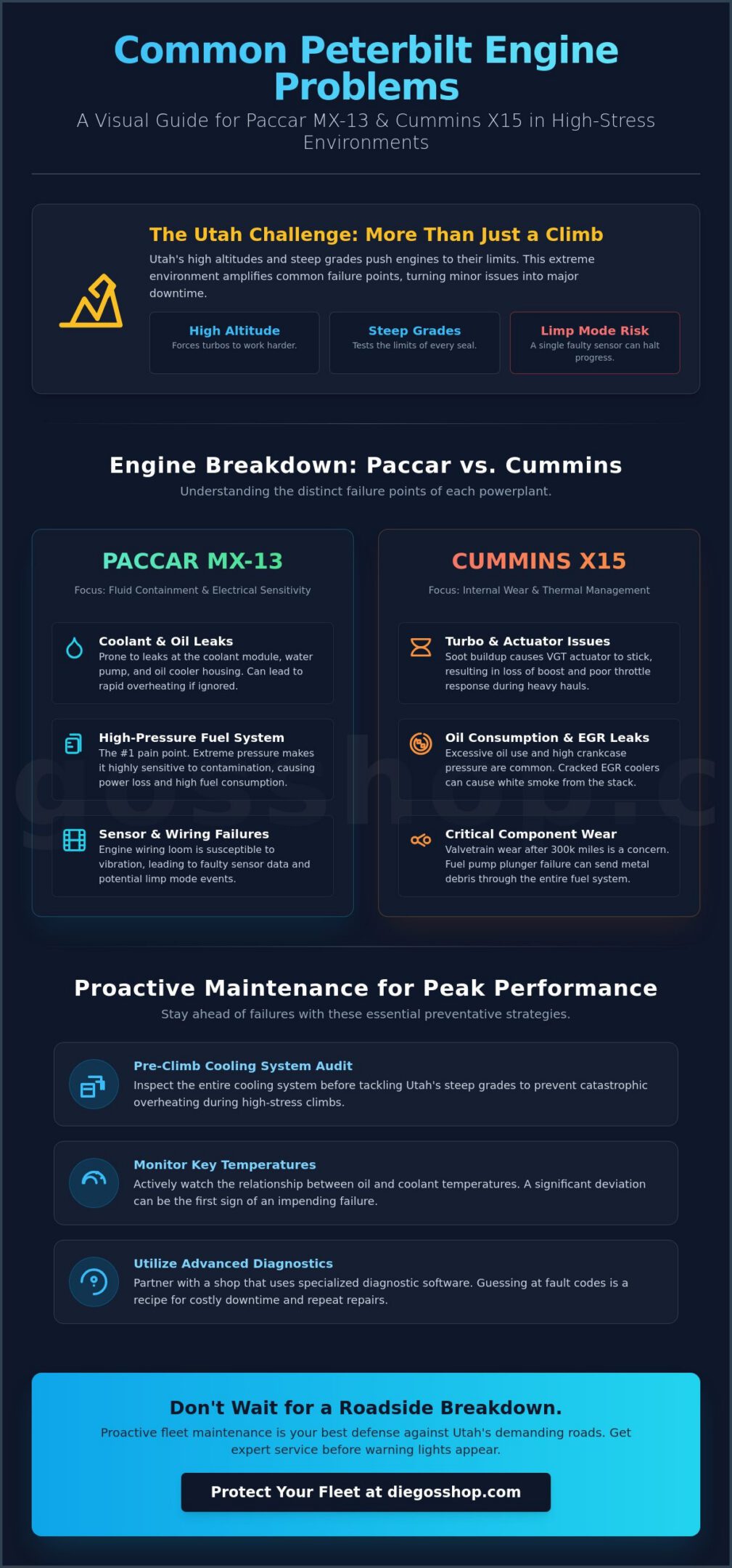
The heavy-duty landscape has shifted significantly over the last few years. While the Peterbilt Motors Company has traditionally offered various powerplant options, the 2026 market is firmly split between the Paccar MX-13 and the Cummins X15. These engines represent the peak of modern engineering, yet they bring a new set of challenges to the shop floor. Many common Peterbilt engine problems currently seen in Utah are the result of “smart” engine logic. These systems use a dense network of sensors to manage emissions and fuel economy. While efficient, this sensitivity means a single faulty sensor can trigger a “limp mode” event that halts your progress. Utah’s high altitude and extreme temperature swings put extra stress on these components. Thinner air at 6,000 feet forces turbos to work harder, while steep grades test the limits of every seal. Consistent diesel maintenance is no longer optional; it’s the only way to prevent these environmental factors from turning into catastrophic failures.
The Paccar MX-13: Innovation vs. Complexity
The MX-13 uses a compacted graphite iron (CGI) block to stay lightweight and durable. It’s a sophisticated design, but its high-pressure common rail fuel system is a frequent source of frustration. Fuel system precision is the #1 pain point for Paccar owners because the system operates at such extreme pressures that the slightest contamination causes issues. If the common rail pressure fluctuates, you’ll see a drop in power and a spike in fuel consumption. This impact on engine longevity is real. Keeping these systems clean and calibrated is essential for long-term engine health and preventing unexpected downtime.
The Cummins X15: A Heavy-Duty Alternative
Utah fleets often choose the Cummins X15 for its reputation as a mountain-climbing workhorse. Even with its rugged build, the X15 isn’t immune to common Peterbilt engine problems. We frequently see turbocharger and actuator failures, often linked to the heat and soot generated during heavy hauls up the canyon. Once a truck hits the 300,000-mile mark, valvetrain wear becomes a serious concern. Regular inspections of the cam lobes and rockers are vital. Catching these issues early keeps your truck on the road and prevents the high costs associated with a mid-haul breakdown. Reliability requires a proactive approach to these known mechanical stressors.
Paccar MX-13 vs. Cummins X15: Specific Failure Points
Troubleshooting common Peterbilt engine problems requires a specialized understanding of how Paccar and Cummins platforms diverge. While both powerplants are designed for heavy hauls, their mechanical weaknesses are distinct. Paccar engines often struggle with fluid containment and electrical sensitivity, while Cummins units face hurdles related to internal wear and thermal management. Understanding these specific failure points is the first step toward maintaining a reliable fleet on the Wasatch Front.
Mechanical Weaknesses in the Paccar Platform
The Paccar MX-13 is a feat of engineering, but it’s prone to coolant leaks at the module and water pump housing. These leaks aren’t just minor drips; they can lead to rapid coolant loss and overheating if ignored. We also frequently see oil cooler housing leaks, which create a significant mess and can contaminate other components. Beyond fluid leaks, the engine wiring loom is susceptible to vibration-related sensor failures. Because these engines rely on complex electronic logic, professional diesel engine repair for the Paccar platform requires specialized diagnostic software that many general shops simply don’t possess. Without the right tools, you’re just guessing at fault codes.
Cummins-Specific Technical Hurdles
The Cummins X15 is a beast on mountain grades, but it has its own set of technical challenges. Excessive oil consumption and high crankcase pressure are two of the most frequent complaints we hear from operators. If you notice white smoke from the stack, it’s often a sign of EGR cooler cracking, which allows coolant to enter the exhaust stream. Another common issue is the turbocharger VGT actuator sticking. This usually happens because of soot buildup, leading to a loss of boost and poor throttle response. Perhaps most critical is fuel pump “plunger” wear. If the plunger fails, it can send metal debris throughout the entire fuel system, turning a single component failure into a total system overhaul.
Intermittent misfires are another headache for Peterbilt owners, often traced back to fuel injector harness failures. These electrical breaks are hard to find because they often only manifest under specific load conditions or temperatures. From a master craftsman’s perspective, the Cummins X15 generally holds up better against the sustained stress of Utah’s steep climbs, provided you stay ahead of the EGR and fuel pump maintenance. Paccar engines offer excellent efficiency for regional hauls but demand a much more rigorous approach to sensor and seal inspections. If you’re seeing active fault codes, it’s time to let a qualified technician run a full diagnostic scan to prevent a roadside breakdown.
The Emission System Trap: EGR, DPF, and DEF Issues
The aftertreatment system remains the single largest contributor to Peterbilt downtime in 2026. While the base engines are built for durability, the hardware designed to scrub the exhaust is remarkably sensitive. Most common Peterbilt engine problems involving the emissions system lead directly to “Limp Mode.” This logic is programmed into the Electronic Control Unit (ECU) to protect the SCR catalyst and DPF from permanent damage. When the system detects a deviation in NOx levels or soot pressure, it cuts engine power to prevent further emissions. It’s a frustrating safety net that can leave a driver stranded on a steep Utah grade with only a fraction of their usual horsepower.
One specific 2026 challenge involves the DEF header and the Vehicle Electronic Control Unit (VECU) software. Even with recent updates, such as the Paccar campaign 37-004 issued in March 2026 to address compliance data, sensor glitches still provide phantom fluid level readings. Your dash might show a full tank even as the pump runs dry, or it might trigger a critical low-fluid warning when the tank is actually half-full. Additionally, excessive idling is a major enemy for local fleets. For trucks handling local Utah County deliveries, low exhaust temperatures prevent the DPF from reaching the heat required for a passive regeneration. This leads to rapid soot accumulation and the need for frequent, forced parked regens that eat into your delivery schedule.
EGR and DPF Technical Mastery
A clogged EGR valve often gives subtle warnings before a hard fault code appears. You might notice a slight drop in fuel economy or a rougher idle during cold starts. For OTR fleets, highway speeds usually maintain enough heat for clean operation, but local trucks need a different strategy. A diesel specialist can perform a deep clean of the DPF filter to remove the baked-on ash that standard regenerations cannot touch. This process restores exhaust flow and significantly improves your miles per gallon, keeping your operating costs under control.
The DEF System: More Than Just Fluid
The 2026 DEF pumps are showing signs of erratic pressure delivery, which often precedes a total failure. You should also watch for crystallization around the DEF injector nozzle. This white, crusty buildup blocks the spray pattern, leading to inefficient NOx reduction and eventual Limp Mode triggers. Using high-quality, fresh DEF fluid is non-negotiable. Contaminated or old fluid degrades the SCR catalyst, a component that is incredibly expensive to replace. Integrity in your maintenance routine saves you from these high-cost repairs down the line. Proper care ensures your aftertreatment system remains an asset rather than a liability.
Preventing Catastrophic Failure on Utah’s Mountain Grades
Utah’s geography is unforgiving for heavy-duty trucks. Pulling 80,000 pounds up Spanish Fork Canyon or Parleys Canyon is the ultimate stress test for any powerplant. It’s in these high-demand environments where common Peterbilt engine problems often transition from minor sensor glitches to total mechanical failures. Preventing a roadside disaster starts with a rigorous pre-climb cooling system audit. You must verify that your fan clutch engages exactly when it should. A delayed engagement at high altitude leads to rapid heat spikes that your radiator cannot recover from once the climb begins. Consistent fleet maintenance is the only way to ensure these components are ready for the vertical challenges of the Wasatch Front.
Monitoring the delta between your oil temperature and coolant temperature is a critical skill for mountain drivers. If your oil temperature begins to climb significantly faster than your coolant, it’s a clear sign of internal friction or a failing oil cooler. Managing your engine braking is equally vital. While the Jake Brake is essential for safety, improper use on long descents puts immense stress on the valvetrain. We recommend regular overhead adjustments to ensure your valves and injectors are seated correctly. Additionally, scheduling regular fluid analysis is a non-negotiable step for mountain-bound rigs. It’s the only way to detect microscopic metal shavings that signal internal wear before a component fails mid-climb.
Thermal Management in High Altitudes
High altitudes present a unique cooling challenge for diesel engines. Because the air is thinner at 6,000 feet, the efficiency of heat transfer is reduced, forcing your cooling system to work significantly harder than it would at sea level. This makes fan clutch engagement and radiator cleanliness paramount before summer mountain hauls. Rapid thermal cycling, which occurs when a truck finishes a hot grade and immediately begins a cold descent, is a leading cause of cracked cylinder heads. Drivers should always allow the engine to stabilize at a lower RPM before shutting down after a heavy pull.
Brake and Suspension Stress Points
Heavy mountain hauls strain more than just the engine block. The constant demand for air during braking puts excessive load on the air compressor, which can lead to oil blow-by if the compressor is already worn. You should also inspect your leaf springs and hangers for stress fractures after every major mountain run. These components take the brunt of the weight transfer on steep inclines. Preparing for dot truck inspections near me starts with catching these grade-stressed issues in the shop rather than on the side of I-15. If your rig is struggling with mountain climbs, contact Diego’s Shop today for a comprehensive engine and cooling system health check.
Expert Peterbilt Service at Diego’s Shop in Springville
Managing a fleet in Utah County requires a partner who understands the specific mechanical demands of the region. Diego’s Shop provides the technical mastery needed to resolve common Peterbilt engine problems before they result in a roadside crisis. We don’t just clear codes; we find the root cause of the failure. Our team specializes in the Paccar MX-13 and Cummins X15 platforms, ensuring your rig receives expert attention from technicians who speak the language of heavy-duty diesel engines. Precision is our standard.
Our facility is centrally located in Springville. This allows us to serve fleets across the Wasatch Front with speed and precision. We provide warrantied repair work that delivers total peace of mind for owners and operators. When you bring your truck to us, you’re choosing a partner dedicated to keeping your equipment in total control on the road. We maintain a no-nonsense approach to service that prioritizes your uptime and safety.
Why Choose a Specialized Diesel Shop?
Generic shops often lack the specialized diagnostic software required for modern Peterbilt systems. A master craftsman understands the nuances of these engines, from Paccar’s electrical sensitivities to Cummins’ thermal management needs. Our commitment to integrity and accountability means we provide durable repairs that stand up to the harshest mountain grades. By catching small issues early, we help local fleets reduce their total cost of ownership and avoid the high price of emergency repairs. We take pride in technical skill and the longevity of our work. Reliable service is the foundation of a successful fleet.
Schedule Your Peterbilt Health Audit
A comprehensive engine diagnostic at Diego’s Shop is more than a simple scan. We perform a deep-dive health audit to evaluate every critical system, from the aftertreatment sensors to the cooling system efficiency. Based on these findings, we build a custom maintenance plan tailored to your specific Peterbilt rig and hauling requirements. Proactive care is the only way to ensure rugged reliability for the long haul. Don’t wait for a warning light to dictate your schedule. Trust Diego’s Shop for your Peterbilt engine repair and keep your fleet moving with confidence. Quality work. Proven results.
Secure Your Fleet’s Performance on the Wasatch Front
Navigating the vertical challenges of Utah’s canyons requires more than just a powerful truck; it demands a proactive approach to maintenance. We’ve explored how identifying common Peterbilt engine problems early, from Paccar coolant leaks to Cummins oil consumption, can prevent a minor fault from turning into a total engine failure. By mastering aftertreatment systems and managing thermal stress during heavy hauls, you protect your equipment and your delivery schedule.
Diego’s Shop provides the specialized expertise in Paccar and Cummins engines necessary to keep your rig in peak condition. Our centrally located Springville facility serves the entire Wasatch Front with warrantied repair work and advanced diagnostics. We take pride in delivering durable solutions that offer total peace of mind for fleet owners. Don’t get stranded-Schedule your Peterbilt engine diagnostic at Diego’s Shop today to ensure your trucks are ready for the road ahead. Your success is built on the reliability of your fleet, and we’re here to guarantee it.
Frequently Asked Questions
What are the most common engine problems in a Peterbilt 579?
The most common engine problems in a Peterbilt 579 usually involve the aftertreatment system, including clogged DPF filters and faulty NOx sensors. Many operators also report coolant leaks at the water pump housing on Paccar models or turbocharger actuator sticking on Cummins units. These issues frequently trigger “limp mode” to protect the engine. Regular inspections of the wiring harness can prevent many of these sensor-driven failures before they stop your truck.
Why is my Paccar MX-13 losing power on mountain grades?
Power loss on mountain grades is often caused by the engine’s protective derate logic reacting to high coolant or oil temperatures. At high altitudes, the thinner air reduces cooling efficiency, forcing the system to work harder. Additionally, any restriction in the high-pressure common rail fuel system will manifest as a loss of pulling power under heavy load. Checking fan clutch engagement is a critical first step for resolving this power loss.
How often should I clean the DPF on my Peterbilt?
You should typically have your DPF professionally cleaned every 200,000 to 400,000 miles, depending on your duty cycle. Trucks used for local Utah County deliveries often require more frequent attention because they spend more time idling and less time at highway speeds. This prevents the exhaust from reaching the temperatures needed for passive regeneration. Monitoring soot levels and performing timely forced regens will extend the life of your filter.
What does a blinking DEF light mean on a 2026 Peterbilt?
A blinking DEF light usually indicates that the fluid level is critically low or the system has detected a major sensor malfunction. In 2026 models, this can sometimes be a phantom reading caused by software issues in the Vehicle Electronic Control Unit. If the light persists after you’ve refilled the tank, it likely points to a DEF header failure or a crystallized injector nozzle. Ignoring this signal will eventually result in a severe engine derate.
Is the Cummins X15 more reliable than the Paccar MX-13 for Utah hauling?
The Cummins X15 is often preferred for heavy mountain hauling due to its robust braking power and larger displacement. However, the Paccar MX-13 offers superior fuel efficiency for regional hauls and has become a staple for many Utah fleets. Both engines have specific failure points, so reliability depends more on your maintenance routine than the brand name. Choosing the right engine depends on your specific load weights and route profiles.
What are the early signs of EGR cooler failure in a diesel engine?
Early signs of EGR cooler failure include unexplained coolant loss and the presence of white smoke from the exhaust stack. You might also notice a rougher idle or a sticky residue inside the intake manifold. These symptoms suggest that the cooler has cracked internally, allowing coolant to leak into the combustion chamber. Catching these common Peterbilt engine problems early prevents hydraulic lock and expensive internal engine damage.
How can I prevent my Peterbilt from going into limp mode?
Preventing limp mode requires a combination of timely software updates and rigorous preventive maintenance of the aftertreatment system. Keeping sensors clean and ensuring your DEF fluid is fresh and uncontaminated are the most effective steps you can take. You should also avoid excessive idling, which leads to soot buildup. Addressing minor fault codes immediately prevents the ECU from triggering a power derate during a critical haul.
Where can I find expert Peterbilt engine repair in Utah County?
Expert Peterbilt engine repair is available at Diego’s Shop in Springville, Utah. Our technicians provide specialized service for both Paccar and Cummins platforms, using advanced diagnostics to pinpoint issues quickly. We serve the entire Wasatch Front with warrantied repair work and a commitment to keeping your fleet on the road. Whether you need a health audit or a major engine overhaul, we have the mastery to get the job done right.