

Choosing a Fleet Maintenance Provider in Utah: The ROI of Proactive Diesel Care

What if your biggest monthly expense wasn’t actually a cost, but a high-yield insurance policy against the failure of your most expensive assets? Most owners see repairs as a fluctuating overhead that eats away at profits. You’ve likely felt the sting of a truck sitting idle while revenue vanishes, or the anxiety of wondering if your older rigs will pass the new $250 registration fee requirements for high-emissions vehicles. When you’re choosing a fleet maintenance provider utah, you’re looking for more than a mechanic; you’re looking for a partner who keeps your business moving.
We understand that your diesel engines are the lifeblood of your operation. It’s time to stop reacting to breakdowns and start managing your fleet with the authority of a specialist. By moving to a proactive model, you can achieve a predictable monthly spend and significantly higher resale values for your assets. This article explains how professional fleet maintenance and preventive maintenance programs provide the peace of mind you need. You’ll learn how to leverage diesel engine repair strategies to navigate Utah’s HB0525 legislation while ensuring your warrantied repair work actually protects your bottom line.
Key Takeaways
- Break the “run-to-fail” cycle by identifying the hidden costs of emergency repairs, including towing fees and lost driver productivity.
- Understand the technical necessity of specialized care for modern diesel engines to prevent expensive failures in complex emission control systems like the DPF and SCR.
- Discover the specific inspection protocols and fluid analysis techniques you should prioritize when choosing a fleet maintenance provider utah.
- Learn how to calculate the “Downtime Math” to see exactly how proactive maintenance programs pay for themselves through increased fuel efficiency and asset longevity.
- Transform your maintenance strategy into a predictable monthly investment that protects the resale value of your trucks and ensures total fleet compliance.
The Financial Reality: Run-to-Fail vs. Proactive Fleet Maintenance
Many fleet owners fall into the “run-to-fail” trap. They wait for a warning light before scheduling service, believing they’re saving money by delaying expenses. This is the most expensive strategy you can adopt. When you’re choosing a fleet maintenance provider utah, you need a partner who understands that reliability isn’t a happy accident. It’s the result of disciplined, scheduled oversight. Waiting for a breakdown turns a simple component replacement into a catastrophic event that halts your operations. Uptime is your only real currency.
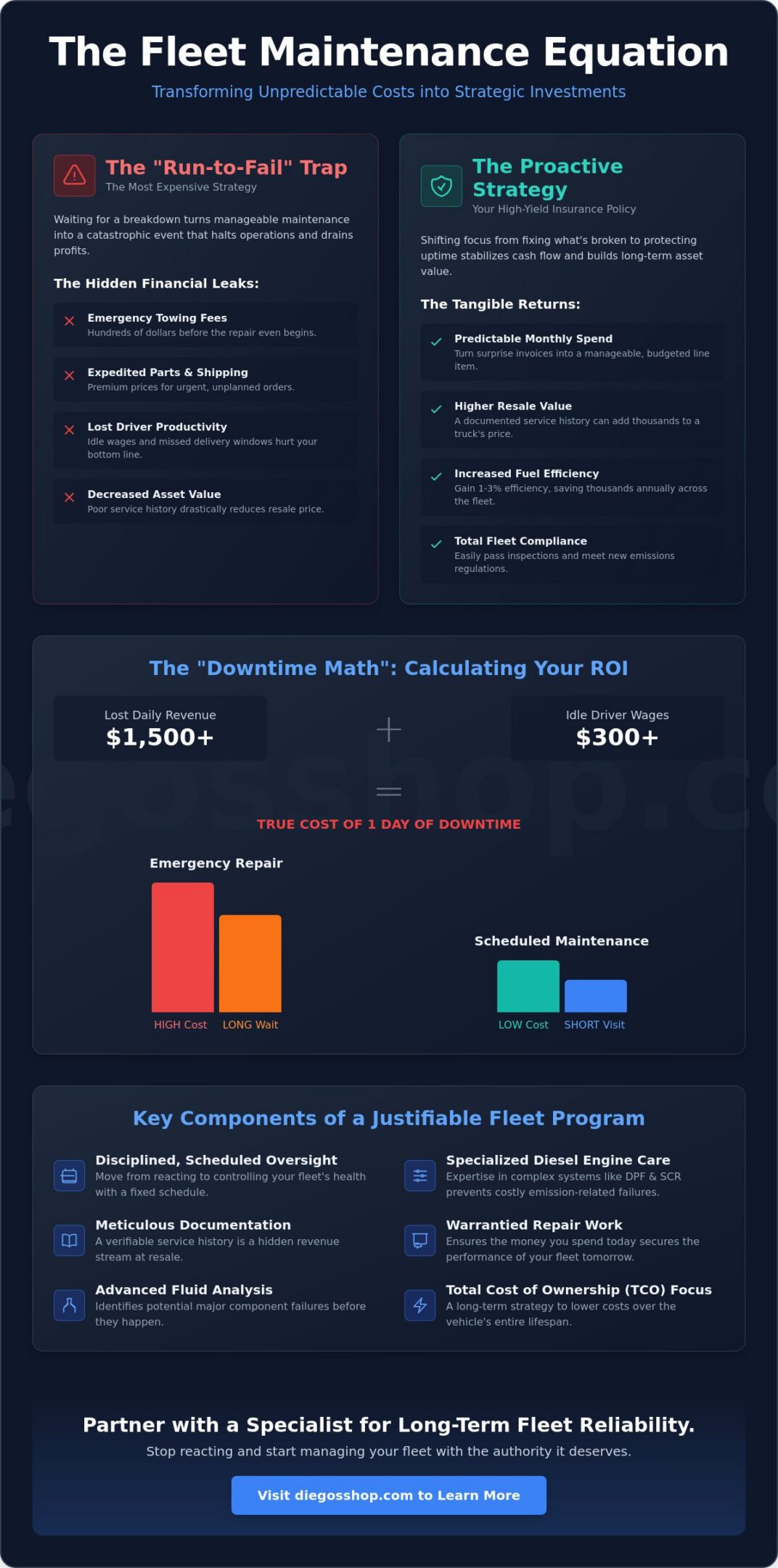
The true cost of a breakdown goes far beyond the invoice for a diesel engine repair. You have to account for the hidden financial leaks that drain your profit margins. These include:
- Emergency towing fees that can cost hundreds before a wrench even touches the truck.
- Expedited shipping costs for parts that would’ve been cheaper if ordered in advance.
- Lost driver hours and potential liquidated damages for missed delivery windows.
- The immense stress of reshuffling your entire schedule to cover a downed route.
The Psychology of the Maintenance Budget
It’s tempting to view maintenance as an optional expense during lean months. Many owners operate under the misconception that if the truck is moving, it’s fine. This mindset ignores the reality of mechanical wear. Preventive maintenance isn’t a “necessary evil”; it’s a core business strategy. By shifting your focus from fixing what’s broken to protecting your uptime, you stabilize your cash flow. You turn unpredictable surprises into scheduled, manageable events that don’t derail your monthly budget. It’s about maintaining total control over your equipment.
Total Cost of Ownership (TCO) Explained
Every asset has a Total Cost of Ownership. This includes the purchase price, fuel, taxes, and every dollar spent on upkeep. Whether you manage light, medium, or heavy-duty diesel assets, your goal is to lower the TCO over the vehicle’s lifespan. Effective Fleet management focuses on the long game. A structured program reduces major component failures, keeping your trucks on the road for five years or more without the need for a premature engine overhaul. Utilizing warrantied repair work further protects this investment, ensuring the money you spend today secures the performance of your fleet tomorrow. High-quality care ensures your assets remain compliant and valuable when it’s finally time to sell. Durable work is the foundation of a profitable fleet.
Calculating the ROI: How Maintenance Programs Pay for Themselves
Investing in a structured fleet program isn’t about spending more money; it’s about stopping the financial bleeding caused by neglect. When you’re choosing a fleet maintenance provider utah, you’re looking for a return on investment that shows up clearly on your balance sheet. The most immediate return comes from mastering the “Downtime Math.” A single day of a truck sitting in a shop costs you the daily revenue that asset generates, the driver’s idle wages, and the potential loss of a long-term contract. Scheduled shop visits are always faster and cheaper than emergency diagnostics because the technician is prepared and the parts are already staged for the job.
Documentation is another hidden revenue stream. A vehicle with a meticulous, verifiable service history can command thousands of dollars more at the end of its life. Buyers pay a premium for proof that the engine hasn’t been abused. By using data to improve fleet productivity, you ensure every dollar spent on a bay fee is an investment in the asset’s future resale value. High-quality expert diesel engine repair ensures your trucks stay on the road longer and sell for more when you’re ready to upgrade.
Fuel Economy and Engine Efficiency
Diesel engines are precision instruments that rely on perfect timing and clean air. Small efficiency gains of just 1% to 3% might seem minor, but they translate into massive annual savings across a full fleet. Clogged filters and worn injectors force the engine to work harder, burning more fuel to achieve the same power output. Regular preventive maintenance keeps your engines in the “sweet spot” where fuel consumption is minimized and power is maximized. This direct reduction in your largest recurring expense often covers the entire cost of the maintenance program itself.
Extending Asset Lifespan
The 500,000-mile goal should be the standard for every heavy-duty diesel asset in your yard. Proactive care makes the difference between a high-value trade-in and a total loss that drains your capital reserves. A single $500 inspection can prevent a $15,000 engine overhaul by catching a failing sensor or a small leak before it compromises the entire block. If you want to see how these savings look for your specific rigs, you can learn more about our preventive maintenance options. Protecting your engine today prevents a premature replacement cycle that could cripple your business growth.
Why Diesel Fleets Require Specialized Maintenance Justification
Modern diesel engines are not just larger versions of gasoline engines. They are high-pressure, high-temperature machines that require a specific caliber of technical skill. When you are choosing a fleet maintenance provider utah, you can’t settle for a shop that treats your Cummins or PowerStroke like a passenger car. High-pressure common rail systems and variable geometry turbochargers operate under extreme tolerances. A single lapse in oil quality or a contaminated fuel filter can trigger a chain reaction of component failures. Specialized care ensures these high-performance parts stay lubricated and efficient.
The health of your turbocharger is non-negotiable. It relies entirely on the integrity of your oil. Because diesel engines produce high levels of soot, your lubricant has a difficult job. If the oil breaks down, the turbo bearings are often the first to fail. This level of technical detail is why generalist shops often struggle with heavy-duty assets. You need a partner who speaks the language of diesel and understands the unique demands of heavy-duty operations. Complexity demands expertise.
The Emission System Crisis
The most common reason for modern trucks to sit idle is a failure in the emission control system. Clogged Diesel Particulate Filters (DPF) and failing Exhaust Gas Recirculation (EGR) coolers are notorious for forcing trucks into “limp mode.” This effectively kills your delivery schedule and creates a logistical nightmare. Proactive diesel maintenance on these systems prevents the buildup of soot that leads to forced regens. In Utah counties like Salt Lake, Davis, Weber, and Cache, staying compliant with emissions testing is a legal requirement. Keeping these systems clean isn’t just about performance; it’s about staying on the road legally and avoiding expensive fines. Precision requires discipline.
Heavy-Duty Diagnostics and Mastery
Mastery of modern diesel engine management requires more than a generic code reader. You need specialized diagnostic equipment that can communicate with the complex electronic control modules in heavy-duty rigs. When a technician pinpoints a sensor failure before it causes a breakdown, they save you thousands in labor and downtime. This technical mastery is your fleet’s best defense against rising operating costs. Ensuring all work is backed by warrantied repair work provides the long-term accountability your business deserves. Trust is built through durable, expert service that stands up to the rigors of the road.
Building Your Case: Key Components of a Justifiable Fleet Program
A justifiable maintenance program is built on consistency and data rather than guesswork. When you are choosing a fleet maintenance provider utah, look for a partner who utilizes standardized inspection protocols. This ensures every technician follows the same rigorous checklist every time a truck enters the bay. It is not enough to simply “look things over.” You need a systematic review of the drivetrain, suspension, and safety systems. Integrating driver feedback loops into these records ensures that small rattles or shifts in performance reported during pre-trip inspections are addressed before they become road-side failures. Accountability starts with a checklist.
Fluid analysis serves as the most powerful predictive tool in your arsenal. By regularly testing oil and coolant, we can identify internal engine wear, fuel dilution, or coolant contamination long before a catastrophic failure occurs. This process is essentially a blood test for your diesel engine. This data-driven approach allows for precise maintenance scheduling based on actual engine health rather than just mileage. It turns your maintenance schedule into a strategic defense against unexpected downtime. Knowledge is power in the shop.
Utah-Specific Operational Challenges
Utah’s geography places unique demands on heavy-duty equipment that generic programs often ignore. The steep mountain grades of Utah County test the limits of your braking and cooling systems daily. High-altitude operation in the Intermountain West also affects air-to-fuel ratios, requiring more frequent adjustments to maintain peak efficiency. During the winter, the heavy salt used on the Wasatch Front creates a corrosive environment that aggressively attacks chassis components and electrical connectors. You need a program tailored to the physical toll of our specific terrain to maintain long-term reliability.
The Documentation Trail
Clear, digital service records are essential for legal compliance and insurance purposes. Beyond safety, these records provide the evidence needed to justify maintenance spend to stakeholders. Documentation also helps you identify “lemon” vehicles that drain your resources. If the data shows one truck is consistently requiring more diesel engine repair than the rest of the fleet, it’s time to purge that asset. Staying ahead of the curve means making reliable DOT truck inspections a routine part of your operation rather than a stressful hurdle. If you want to transform your fleet’s reliability, schedule a professional fleet maintenance review today. Durable work requires a durable record.
Partnering with Diego’s Shop for Long-Term Fleet Reliability
Choosing a local specialist in Springville offers a level of personal accountability that generic corporate chains simply cannot match. When you’re choosing a fleet maintenance provider utah, you deserve a partner who views your equipment with the eye of a master craftsman. Diego’s Shop focuses on the durability of every repair, ensuring that your diesel assets remain on the road instead of taking up space in a bay. We prioritize technical skill and honest communication over flashy marketing. Our shop is grounded in the belief that hard work and specialized knowledge are the only ways to ensure your fleet’s longevity.
We don’t believe in one-size-fits-all solutions. Our approach to fleet maintenance involves customizing a strategy that fits the specific demands of your industry. Whether you’re hauling heavy loads across state lines or managing local delivery routes, your maintenance plan should reflect your actual wear and tear. By providing warrantied repair work, we offer the ultimate justification for your maintenance budget. You aren’t just paying for a fix; you’re investing in a guarantee that the work will hold up under the most demanding conditions. Quality is our baseline.
The Value of Personal Accountability
Having a seasoned master craftsman like Diego overseeing your fleet matters because it eliminates the bureaucracy of corporate management. You’ll have a direct relationship with the technicians who know your trucks’ histories. We handle a wide range of diesel equipment, from OTR long-haulers that need to stay compliant across several states to local dump trucks that face the daily grind of Utah’s construction sites. This hands-on expertise ensures that we catch the small details that generic shops often overlook. We take pride in technical skill and the reliability of our results.
Getting Started: Your Fleet Assessment
The first step toward a predictable maintenance spend is a baseline inspection of your current fleet health. We perform a comprehensive review of every asset to identify immediate safety concerns and hidden mechanical issues. This data allows us to work with you to prioritize repairs and phase in a preventive maintenance schedule that protects your cash flow. We help you move away from the stress of emergency breakdowns and toward a model of total control. Contact Diego’s Shop today to request a custom fleet service plan and secure the future of your business assets. Durable work is our promise.
Secure Your Fleet’s Future with Proactive Care
Your trucks are the foundation of your business. Transitioning from a reactive “run-to-fail” mindset to a proactive maintenance strategy isn’t just about avoiding breakdowns; it’s about maximizing the total lifecycle value of every asset in your yard. We’ve explored how specialized diesel care prevents expensive emission system failures and how documented service histories protect your long-term resale value. When you are choosing a fleet maintenance provider utah, you need a partner who understands the technical demands of the Wasatch Front and the Intermountain West.
At Diego’s Shop, we bring master-level expertise to every service. We specialize in maintaining Peterbilt, Kenworth, Isuzu, and Ford diesel engines with precision and integrity. From our shop in Springville, we serve the entire Wasatch Front with warrantied repair work that provides the peace of mind you need to focus on growth. Don’t let unpredictable repairs or failed inspections dictate your schedule. Take control of your uptime and build a more resilient operation today.
Request Your Custom Fleet Maintenance Plan at Diego’s Shop today. Let’s keep your fleet moving with the reliability your business deserves.
Frequently Asked Questions
How do I explain the cost of a fleet maintenance program to my CFO?
Explain that a formal program transforms maintenance from a volatile expense into a predictable investment in asset longevity. Focus on the Total Cost of Ownership (TCO). By stabilizing monthly spend, you eliminate the budget-killing surprises of emergency repairs and towing fees while protecting the resale value of the trucks.
Does a maintenance program really reduce the number of major repairs?
Yes, proactive oversight identifies mechanical wear before it triggers a catastrophic failure. Regular fluid analysis and standardized inspections catch small issues like failing sensors or coolant contamination. Addressing these minor problems prevents them from escalating into a full diesel engine repair or a total engine overhaul.
How often should diesel fleet vehicles be brought in for a full inspection?
Intervals depend on your specific duty cycle and vehicle type. Generally, heavy-duty over-the-road trucks should undergo a thorough inspection every 15,000 to 25,000 miles. Local vocational trucks, such as dump trucks or delivery vans, often require more frequent checks due to the high-stress nature of stop-and-go driving.
Can a maintenance program help my fleet pass DOT inspections more easily?
A structured program ensures your rigs are always in a state of compliance. When you are choosing a fleet maintenance provider utah, look for a specialist who integrates DOT checklists into every service visit. This routine oversight eliminates the stress of inspections and protects your business from costly safety violations.
What is the difference between preventive and reactive fleet maintenance?
Preventive maintenance involves scheduled tasks designed to keep a vehicle in peak operating condition. Reactive maintenance is the “run-to-fail” approach where you only fix what is already broken. Preventive care is significantly cheaper because it avoids the high costs of downtime and expedited emergency parts.
Is it better to have an in-house mechanic or partner with a local diesel shop?
Partnering with a specialized local shop often provides better ROI for small to medium fleets. This approach eliminates the overhead of specialized tools, diagnostic software, and technician training. You gain access to master-level technical skill and warrantied repair work without the burden of managing an internal service department.
How does cold Utah weather affect my fleet maintenance requirements?
Low temperatures increase the risk of fuel gelling and battery failure during the winter months. Utah’s road salt also creates a corrosive environment that aggressively attacks chassis components and electrical connectors. Regular cleaning and lubrication are essential to maintain the electrical integrity and structural durability of your fleet.
What specific diesel components are most prone to failure without regular service?
Emission control systems, including the DPF and EGR cooler, are highly sensitive to neglect and soot buildup. Turbochargers and high-pressure fuel injectors also require clean oil and filters to avoid premature failure. Staying disciplined with your fleet maintenance ensures these high-performance components stay out of “limp mode” and on the road.