

Avoiding Litigation from Truck Maintenance Negligence: A Fleet Owner’s Defense Guide

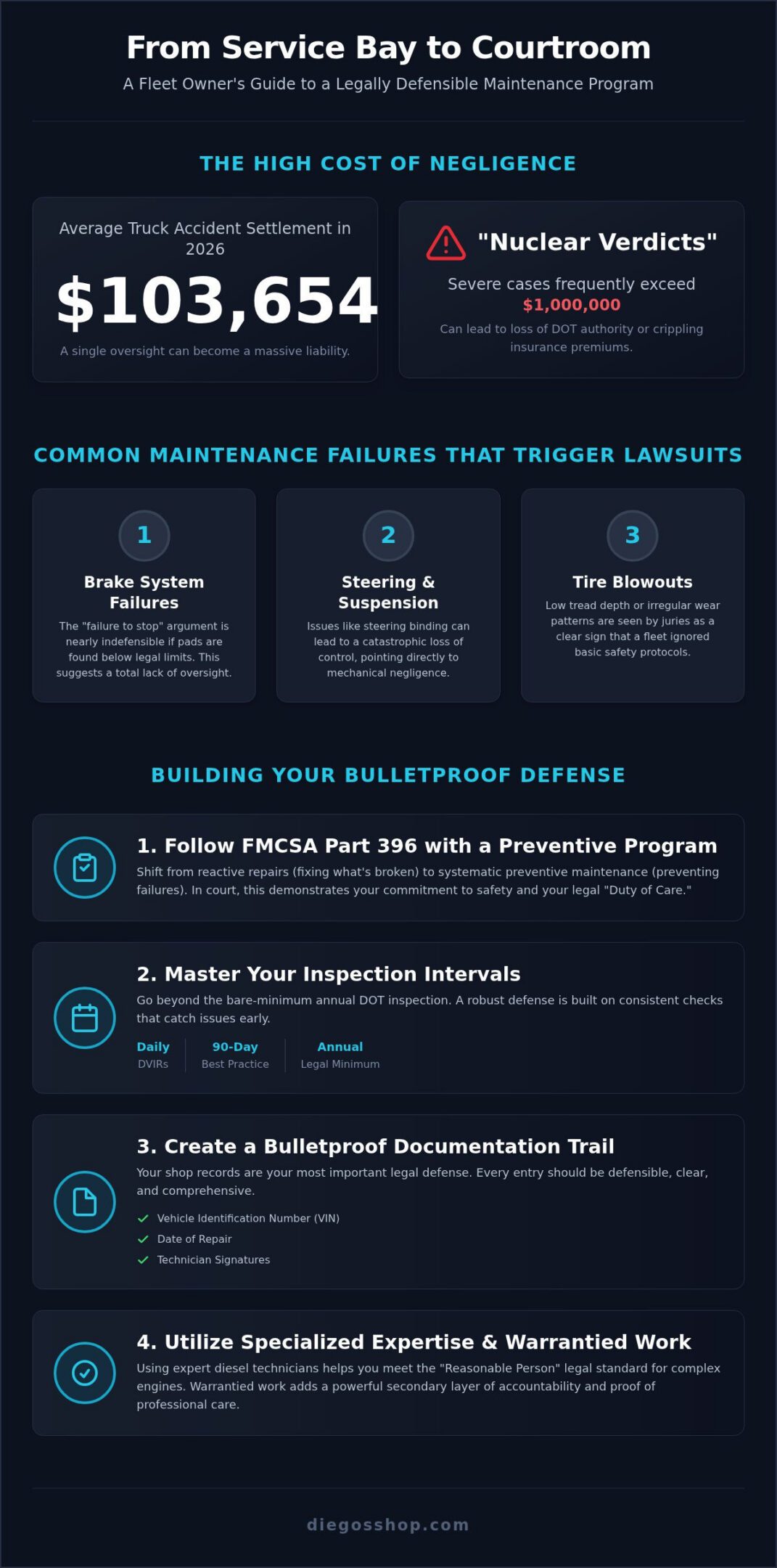
Did you know the average truck accident settlement in 2026 has climbed to $103,654, with severe cases frequently exceeding $1 million? For a fleet owner, a single oversight in the shop isn’t just a mechanical issue; it’s a massive legal liability. You likely feel the constant pressure of tightening FMCSA regulations and the fear that a single lawsuit could end your business. It’s frustrating when documentation feels like a maze and finding a shop that provides truly defensible, warrantied records seems impossible.
Avoiding litigation from truck maintenance negligence starts with shifting your perspective on the service bay. You aren’t just changing oil or replacing brakes; you’re building a legal defense. We’ll show you how to transform your routine maintenance into a powerful shield that protects your company from devastating negligence claims. This guide outlines the specific legal standards for 2026, explains how to create a documentation trail that holds up in court, and gives you the peace of mind that comes from knowing your fleet is compliant, safe, and fully protected.
Key Takeaways
- Understand how FMCSA Part 396 defines your legal maintenance duties and why a systematic preventive program is your first line of defense.
- Learn to build a bulletproof documentation trail for every repair by recording VINs, dates, and technician signatures that stand up under legal scrutiny.
- Discover why utilizing specialized diesel expertise helps you meet the “Reasonable Person” legal standard when managing complex modern engines.
- Master a clear strategy for avoiding litigation from truck maintenance negligence by using warrantied work to add a secondary layer of accountability.
- See how rigorous inspection protocols and specialized diagnostics identify hidden defects before they become catastrophic legal liabilities.
Understanding the High Cost of Truck Maintenance Negligence Litigation
Maintenance negligence is a specific legal failure. It occurs when a fleet owner fails to perform legally required inspections or neglects necessary repairs. In a courtroom, this isn’t just a technicality. It’s viewed as a conscious decision to prioritize speed and profit over the safety of the motoring public. Avoiding litigation from truck maintenance negligence starts with understanding that your shop records are your most important legal defense.
We are currently in the era of the “Nuclear Verdict.” As of September 2026, settlements for large truck accidents frequently reach seven figures. When a mechanical failure causes a crash, plaintiff attorneys look for any evidence of skipped maintenance. Cutting corners on routine service is the primary piece of evidence used to prove a fleet was reckless. The financial impact extends far beyond the initial settlement. A single negligence claim can lead to a permanent loss of DOT authority or insurance premiums that make operation impossible.
Common Maintenance Failures That Trigger Lawsuits
Certain mechanical issues are magnets for litigation because they suggest a total lack of oversight. These include:
- Brake System Failures: These lead to the “failure to stop” argument, which is nearly impossible to defend if pads were found to be below legal limits before the crash.
- Steering and Suspension: Mechanical issues like steering binding, which has been a noted concern for specific models like the International ProStar, can result in a catastrophic loss of control.
- Tire Blowouts: Juries see low tread depth or irregular wear patterns as a clear sign that a fleet ignored basic safety protocols during a routine motor vehicle service.
The Concept of ‘Duty of Care’ in Commercial Trucking
Every carrier has a fundamental legal obligation known as “Duty of Care.” This means you must keep your vehicles in safe operating condition through consistent preventive maintenance and expert repairs. If a case goes to trial, the jury’s perception of your brand depends entirely on your maintenance history. A fleet that ignores preventive maintenance is often seen as a company that doesn’t value human life. For Utah fleet owners, Duty of Care is defined as the legal responsibility to maintain equipment to a standard that ensures the safety of every driver on the road. Avoiding litigation from truck maintenance negligence requires demonstrating that you took every reasonable step to prevent a mechanical failure before the truck ever left the yard.
Meeting FMCSA Standards to Minimize Liability
Federal Motor Carrier Safety Administration (FMCSA) Part 396 is the definitive playbook for every fleet owner. It dictates the standards for inspection, repair, and maintenance that your business must follow to stay on the road. However, simply knowing these rules exists isn’t enough. Avoiding litigation from truck maintenance negligence requires a shift from reactive repairs to a systematic preventive maintenance (PM) program. In a legal setting, there is a massive difference between repairing a vehicle and maintaining it. Repairs happen after a failure; maintenance happens to prevent one. If you only address issues as they break, you’re providing a plaintiff’s attorney with a clear narrative of negligence.
While an annual DOT inspection is a legal requirement, treating it as your only safety goal is a dangerous mistake. These yearly checks are the bare minimum. They don’t account for the daily wear and tear that leads to catastrophic mechanical failure. A robust defense is built on the consistency of your shop’s schedule and the technical mastery of the hands touching your equipment. Following OSHA vehicle maintenance regulations and FMCSA standards ensures you have a baseline of safety that protects your drivers and your bottom line.
Mandatory Inspection Intervals
Daily Driver Vehicle Inspection Reports (DVIR) carry significant legal weight. They serve as a daily record that your drivers are actively looking for defects. When a driver notes an issue and it isn’t addressed, that document becomes a smoking gun in a lawsuit. Beyond daily checks, implementing a 90-day inspection cycle is the industry best practice for litigation defense. This frequency allows technicians to catch emerging issues like brake thinning or fluid leaks before they cause an accident. If you need a partner to manage these critical windows, look for Reliable DOT Truck Inspections in Utah County to ensure your records are accurate and complete.
Addressing Failure Points Before the DOT Does
Proactive maintenance focuses on high-risk components that often trigger roadside failures. For example, maintaining EGR and emission systems is more than an environmental concern; it’s a compliance factor that affects engine reliability and safety. Similarly, leaf springs and suspension components must be inspected for cracks or sagging to ensure the vehicle remains stable under heavy loads. Implementing a rigorous fleet maintenance strategy helps you identify these failure points in the shop rather than on the side of the highway. By catching these issues early, you demonstrate a commitment to safety that makes avoiding litigation from truck maintenance negligence a reality for your business. Our team is here to help you maintain total control over your fleet’s compliance and safety.
Building a Bulletproof Documentation Trail for Every Repair
In a courtroom, there is one rule that overrides everything else: if it isn’t written down, it didn’t happen. A judge or jury will not take your word that a truck was safe; they want to see the physical proof. Avoiding litigation from truck maintenance negligence requires a documentation strategy that is just as rigorous as your mechanical protocol. Every repair order must serve as a legal affidavit. Vague notes like “checked truck” or “fixed air leak” are useless in a deposition. You need specific, granular data points including the exact date of service, the vehicle VIN, the name of the technician, and a serialized list of every part used.
Compliance with FMCSA Part 396 means keeping these records for at least one year while the vehicle is in your fleet, and for six months after it leaves your control. While paper logs were once the industry standard, they are easily lost, damaged, or questioned in court. Digital records are superior because they are tamper-proof, timestamped, and instantly accessible during an audit. This level of transparency shows that your fleet operates with integrity and accountability.
The Anatomy of a Defensible Maintenance Record
A defensible record describes the “how” and “why” of a repair. Instead of generalities, your technicians should record hard measurements. Documenting brake pad thickness, tire tread depth, and fluid levels provides a baseline of the vehicle’s health at a specific moment in time. Highlighting warrantied repair work adds another layer of defense. It proves that the parts and labor met professional quality standards, shifting some of the accountability back to the manufacturer or the specialized shop.
Creating a Systematic Filing Process
A systematic filing process ensures you never scramble for documents during a legal challenge. You can implement this in three clear steps:
- Step 1: Digitize all DVIRs and shop invoices immediately to prevent loss or physical degradation.
- Step 2: Cross-reference maintenance logs with driver logs to prove that no scheduled service was skipped due to tight delivery windows.
- Step 3: Conduct quarterly internal audits of your maintenance files to identify any missing signatures or incomplete repair orders.
Maintaining this rhythm is essential for avoiding litigation from truck maintenance negligence. It builds a history of safety that is difficult for any plaintiff attorney to dismantle. When your records are organized and detailed, you project the image of a fleet owner who is in total control of their operation.
Why Specialized Diesel Expertise is Your Best Legal Defense
In a courtroom, your actions are often measured against the “Reasonable Person” standard. A jury will ask if a reasonable fleet owner would trust a complex Class 8 diesel engine to a generalist mechanic who lacks specialized training. Diesel engines in 2026 are highly sophisticated machines with intricate emission systems and electronic management controls. Using a general repair shop instead of a specialist can be framed as a lack of due diligence. Choosing a partner with technical mastery is a foundational step in avoiding litigation from truck maintenance negligence because it demonstrates that you prioritized expert oversight for your most critical assets.
Specialized diagnostics are the only way to identify deep-seated defects that a visual inspection might miss. These “hidden” issues are often the root cause of catastrophic accidents. When you use a shop that employs certified technicians, their credentials become part of your defense during a deposition. Their specialized knowledge provides a level of credibility that generalist records cannot match. This expert testimony can prove that you took every possible precaution to ensure the vehicle was roadworthy.
Generalist Shops vs. Diesel Specialists
Generalist shops often lack the specific tooling and proprietary software required for modern heavy-duty trucks. This creates a high risk of misdiagnosis, especially within complex exhaust after-treatment and fuel delivery systems. Proper diesel engine maintenance requires a deep understanding of how these systems interact under heavy loads. In a legal challenge, records from a specialized diesel shop carry more weight because they reflect a higher standard of care. They show that the work was performed by professionals who speak the specific language of your equipment.
Warranties as a Proof of Quality
A warranty is more than a service guarantee; it is a legal statement of confidence. When a shop provides warrantied work, they are standing behind the safety and integrity of the repair. This can help shift liability if a part fails prematurely despite proper maintenance. It distinguishes between owner negligence and a potential manufacturing or installation error. Diego’s Shop’s warranty acts as a trust signal for insurers by demonstrating that every repair meets a verifiable standard of durability and safety. If you want to ensure your fleet is handled by seasoned master craftsmen, contact us today for expert diesel repair services that protect your business and your reputation.
Strategic Fleet Maintenance with Diego’s Shop in Springville
Diego’s Shop provides a local, technical solution for fleet owners who refuse to compromise on safety. We understand that avoiding litigation from truck maintenance negligence requires more than a standard oil change. It demands a partnership with a specialist who understands the high stakes of commercial operations in Utah. Our shop serves the entire Wasatch Front, offering comprehensive diesel repair and maintenance services designed to withstand legal scrutiny. Whether you operate light duty delivery trucks or heavy duty Peterbilt and Kenworth rigs, we provide the technical mastery needed to keep your fleet compliant.
Our inspection protocols are built on a foundation of integrity and accountability. We don’t just look for broken parts; we search for emerging failure points that could lead to a catastrophic incident. By utilizing specialized diagnostics and a deep knowledge of modern diesel technology, we provide a layer of protection that generalist shops simply cannot offer. This proactive stance is your most effective tool for maintaining total control over your business’s future and avoiding litigation from truck maintenance negligence.
Our Preventive Maintenance Approach
We focus on catching small mechanical issues before they evolve into litigation sized disasters. A worn brake pad or a minor suspension rattle might seem insignificant in the yard, but in a courtroom, they are evidence of neglect. We develop customized preventive maintenance schedules based on your fleet’s specific duty cycle. This ensures every vehicle receives the exact care it needs to stay road ready. Every service we perform includes detailed, warrantied reporting. This documentation serves as your legal paper trail, proving that you met and exceeded your duty of care.
Serving the Wasatch Front Fleet Community
Our facility is conveniently located in Springville, providing easy access for fleets operating across Utah County. We take pride in supporting the local business community with reliable diesel expertise that keeps trucks moving and businesses protected. When you partner with us, you aren’t just hiring a mechanic; you’re enlisting a seasoned master craftsman who stands behind every bolt turned and every record filed. This commitment to technical excellence is how we help you build a legacy of safety and reliability for your operation.
Protect Your Fleet with a Culture of Compliance
Protecting your business from nuclear verdicts requires a shift from reactive repairs to a culture of total compliance. You’ve learned that meeting FMCSA standards is only the beginning. A bulletproof documentation trail and specialized diesel expertise are the pillars of a defensible operation. By prioritizing detailed records and expert diesel diagnostics, you demonstrate a commitment to safety that no plaintiff attorney can easily dismantle.
Avoiding litigation from truck maintenance negligence is a continuous process of technical mastery and rigorous oversight. Every instance of warrantied repair work and each comprehensive fleet inspection protocol adds a layer of accountability that protects your reputation and your bottom line. You don’t have to navigate these complex regulations alone. Our team provides the seasoned craftsmanship and precise reporting you need to stay on the road with total confidence.
Secure Your Fleet’s Future with Professional Maintenance at Diego’s Shop
Take control of your risk management strategy today. We are here to ensure your fleet remains a symbol of reliability and safety across the Wasatch Front.
Frequently Asked Questions
What is considered ‘negligent maintenance’ in a trucking lawsuit?
Negligent maintenance is the failure of a motor carrier to perform legally required inspections, repairs, or preventive services. In a lawsuit, this is proven by showing the fleet owner knew or should’ve known about a defect but allowed the vehicle to remain in service. This breach of duty often centers on skipped oil changes, ignored brake wear, or faulty steering components. Proper documentation is the only way to disprove these allegations.
How long should I keep maintenance records for my commercial fleet?
You must retain maintenance records for at least one year while the vehicle is in your control. If a vehicle leaves your fleet, FMCSA regulations require you to keep those records for an additional six months. These documents include all inspection reports and repair invoices. Keeping digital copies is a best practice for avoiding litigation from truck maintenance negligence, as it ensures records are tamper-proof and easily accessible during legal discovery.
Can a third-party repair shop be held liable for an accident caused by faulty repair?
A third-party repair shop can be held liable if an accident was caused by their specific faulty repair work. However, the fleet owner remains the primary party responsible for the vehicle’s overall safety on the road. Utilizing warrantied repair work from a specialist provides a secondary layer of accountability. This helps shift some liability back to the shop if they failed to meet professional standards during the technical service.
What are the most common maintenance failures cited in trucking litigation?
The most common maintenance failures cited in litigation include brake system malfunctions, tire blowouts, and steering component failures. Plaintiff attorneys frequently target these areas because they directly impact a driver’s ability to avoid a collision. Lighting and signal failures are also common triggers for negligence claims. Rigorous inspection protocols are essential to catch these issues before they result in a nuclear verdict or a devastating business ending lawsuit.
How do annual DOT inspections help in avoiding negligence claims?
Annual DOT inspections help by providing a baseline record of compliance for your fleet. They prove that at one specific point in time, the vehicle met federal safety standards. While these inspections are necessary, they are only the bare minimum requirement. Juries often look for a more frequent, systematic preventive maintenance program to prove that a fleet owner was truly diligent about safety throughout the entire year.
Is a written preventive maintenance plan legally required by the FMCSA?
The FMCSA requires every motor carrier to have a systematic inspection, repair, and maintenance program. While the regulations don’t mandate a specific written plan template, having a documented protocol is vital for your legal defense. A written plan demonstrates that your maintenance isn’t random but follows a professional, organized schedule. This level of organization is a key component in avoiding litigation from truck maintenance negligence during a courtroom challenge.
How does using a specialized diesel shop reduce my legal liability?
Using a specialized diesel shop reduces your liability by meeting the “Reasonable Person” standard in court. It proves that you entrusted complex machinery to technicians with specific mastery over modern diesel technology. Specialists use advanced diagnostics to find hidden defects that generalists often miss. This expert oversight creates a stronger, more credible defense during a deposition than records from a shop that lacks specialized certifications or tooling.
What should I do if a driver reports a safety issue on their DVIR?
You must ground the vehicle and address the safety issue immediately if it’s reported on a Driver Vehicle Inspection Report (DVIR). Once the repair is complete, a technician must sign the report to certify the vehicle is safe for operation. Ignoring a DVIR entry is one of the fastest ways to lose a negligence lawsuit. It provides direct evidence that you were aware of a safety defect but chose to ignore it.