
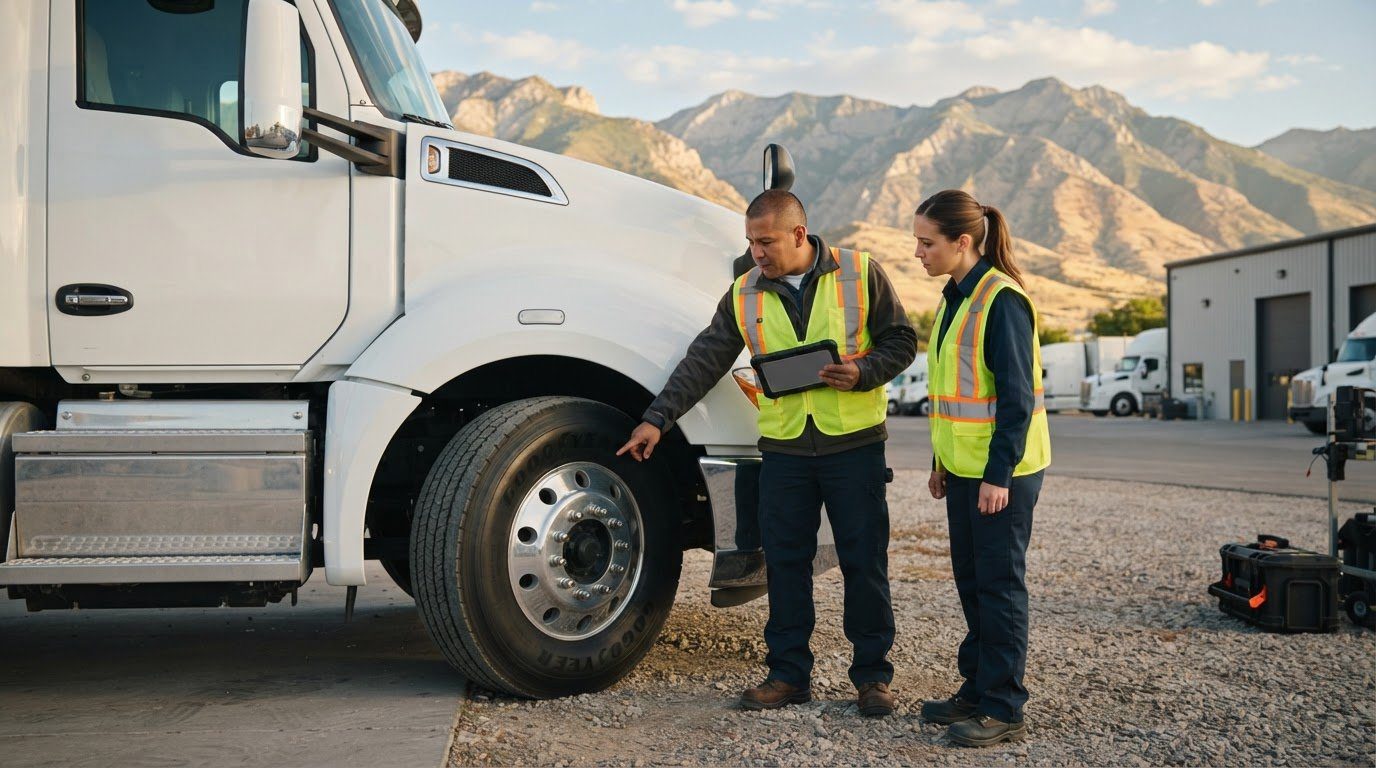
Diesel Fleet Maintenance in Spanish Fork, UT: Train Drivers to Report Issues Early

A faint squeal, a new vibration, or a warning light can be useful information when it reaches the right person promptly. A consistent reporting routine helps Spanish Fork operators make better-informed diesel fleet maintenance decisions and address concerns before they disrupt a route.
Drivers are often the first to notice a change, but they may dismiss it or report it without enough detail for a manager or technician to act. Make early reporting a simple part of the shift, not an extra burden. A practical process captures the symptom, identifies who will review it, and records what happens next.
This guide covers what drivers should report, how managers can prioritize follow-up, and how shop inspections and diagnostics fit into the process. Diego’s Shop provides diesel fleet maintenance, preventive maintenance, inspections, diagnostics, and repairs for light-, medium-, and heavy-duty vehicles. For fleets around Spanish Fork and Utah County, clear reports help connect what drivers notice with appropriate service follow-up.
Key Takeaways
- Give drivers a brief, repeatable way to record new symptoms and get useful details to dispatch and maintenance staff.
- Use clear triage categories to guide follow-up, while leaving diagnosis and repair decisions to qualified technicians.
- Assign report ownership and response expectations so concerns don’t get lost between shifts.
- Review recurring observations across vehicles and use those patterns to inform preventive maintenance planning.
- Reliable diesel fleet maintenance spanish fork ut depends on connecting driver reports with timely inspections, diagnostics, and repairs.
Why Spanish Fork diesel fleet maintenance depends on early driver reports
Early reporting means sharing a new symptom promptly, while the vehicle can still be assessed safely, rather than waiting until it affects a route or becomes harder to operate. Drivers hear how a truck sounds and feel how it responds during daily work. Their observations give managers and technicians useful context between scheduled service visits.
Driver reports support scheduled maintenance and technician inspections, but they do not replace either. A driver can report that a warning light appeared and describe when it happened. A technician determines what the light means and what attention the vehicle needs. That distinction is central to effective diesel fleet maintenance spanish fork ut. A useful report is timely, specific, and factual.
What drivers may notice before a diesel truck needs attention
Changes can be subtle: a new sound, unusual smell, vibration, altered handling, harder starting, or a visible warning indicator. Drivers don’t need to identify the cause. One symptom can have several possible explanations, so focus the report on what changed, when it began, and what the driver observed.
For example, a driver near Spanish Fork may notice a new warning light during a route. They should follow company procedures, report the indicator and when it appeared, and stop when appropriate if there’s a safety concern. Clear observations help managers decide what follow-up is needed without turning a report into a remote diagnosis.
How delayed reports affect fleet maintenance decisions
A late report, or one that leaves out when a symptom started, can make initial troubleshooting more difficult. The vehicle may have been driven in different conditions before anyone learns about the concern. A timely account helps managers share relevant details with the shop and plan an inspection around vehicle assignments, rather than passing along a vague complaint.
That coordination is part of fleet management, where vehicle use and maintenance decisions need to work together. It also connects driver observations to the broader approach in this guide to fleet maintenance and preventing downtime. A consistent reporting process gives maintenance staff a clearer starting point. Inspections and diagnostics establish what the truck actually needs.
Training diesel truck drivers for consistent reporting
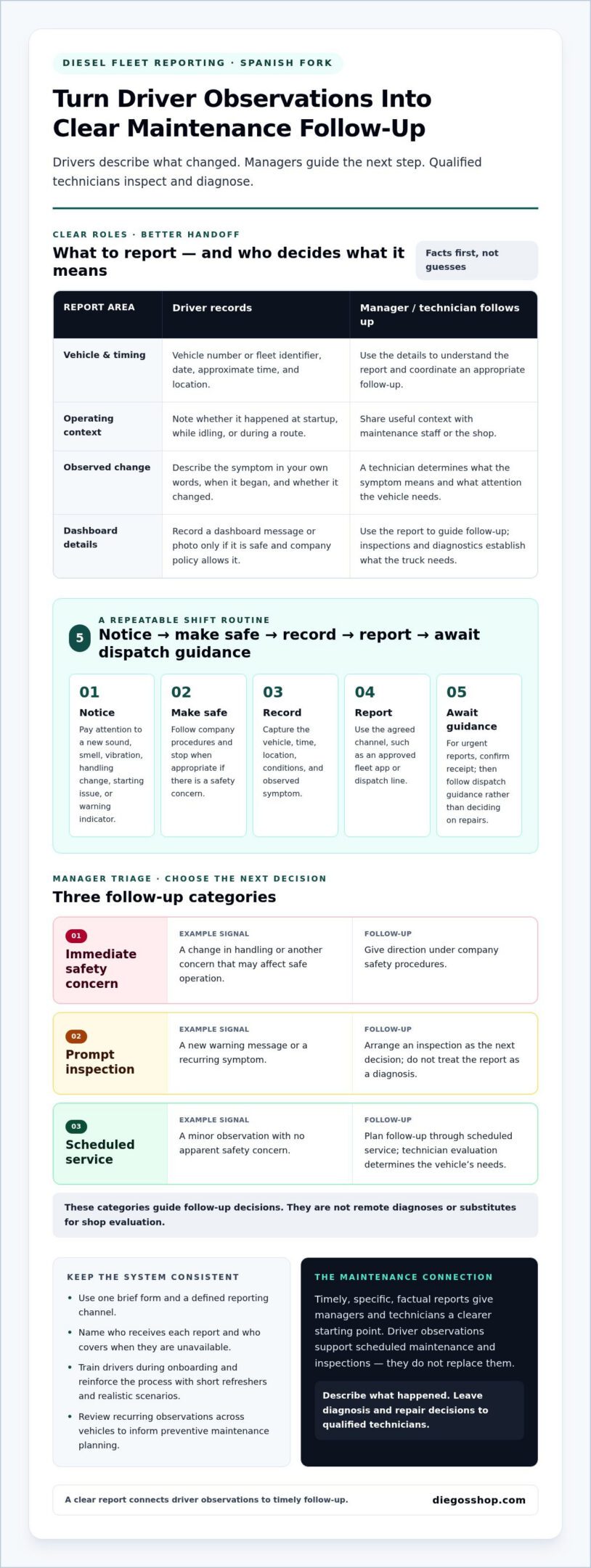
A reliable reporting routine should be easy to remember during a busy shift and clear enough for every driver to follow. Teach the same five steps across vehicle types: notice, make safe, record, report, and await dispatch guidance. This gives dispatch and maintenance staff a consistent starting point without asking drivers to diagnose mechanical problems.
Build the routine around one brief form and a defined reporting channel, such as an approved fleet app or dispatch line. Specify who receives each report and who covers when that person is unavailable. A written process helps keep diesel fleet maintenance spanish fork ut organized across shifts, routes, and light-, medium-, and heavy-duty vehicles.
Teach drivers what information to include in a report
Keep the form focused on details that help identify the vehicle and understand what happened. Ask drivers to record:
- Vehicle number or other fleet identifier, date, approximate time, and location.
- Operating conditions, such as whether the symptom appeared at startup, while idling, or during a route.
- The symptom in their own words, including when it started and whether it changed.
- Any dashboard message or photo, only if it can be captured safely and company policy allows it.
“The driver’s job is to describe what happened, make it safe, and report it through the agreed channel.” This keeps the process practical. A new vibration or warning light is useful information; a guessed diagnosis can send the conversation in the wrong direction.
Make reporting routine without blame or unnecessary paperwork
Explain that prompt, factual reporting supports safe decisions. It isn’t an admission of fault. Introduce the process during onboarding, reinforce it in short refreshers, and use realistic scenarios: a truck takes longer to start, a new odor appears, or a warning indicator comes on. Have drivers practice using the brief form instead of writing a long narrative.
Set a clear expectation for urgent reports: use the designated channel and confirm that a manager received the message. Drivers should then await dispatch guidance rather than making their own repair decision. If a fleet uses automated calls or texts, the FCC’s robocall guidance explains that communication format.
Consistent reports give managers useful observations to share with technicians during preventive maintenance, inspections, and diagnostics. Diego’s Shop provides diesel fleet maintenance in Utah County, supporting commercial fleets near Spanish Fork with maintenance and repair follow-up.
How Spanish Fork fleet managers should triage driver reports
A useful triage process sorts reports by the next decision they require, not by a driver’s guess about what’s wrong. For diesel fleet maintenance Spanish Fork UT fleets can use three practical categories: immediate safety concern, prompt inspection, or scheduled service. These categories guide decisions; they are not remote diagnoses or substitutes for shop evaluation.
A driver reporting a change in handling or another concern that may affect safe operation needs direction under company safety procedures. A new warning message or recurring symptom may call for prompt inspection, while a minor observation with no apparent safety concern may be recorded for scheduled service. Don’t rely on a generic checklist when a symptom is severe or changing. Escalate it promptly and follow company procedures on whether the vehicle should stop operating.
Separate urgent safety concerns from maintenance observations
Set expectations for who reviews reports and who can decide the next step. Managers should consider the driver’s description, the conditions when it occurred, and whether it has changed. Avoid setting technical thresholds without qualified guidance. For carriers and vehicles covered by the rule, the Federal Motor Carrier Safety Regulations address driver vehicle inspection reports and carrier follow-up on reported defects.
Turn reports into a useful diagnostic handoff
When arranging follow-up, pass the service team the driver’s own description, symptom timing, operating conditions, warning messages, and any recent changes. Preserve relevant details. Ask drivers not to clear or alter messages or other information unless instructed, since those details may help a technician assess the concern.
Track each report in one place so it stays visible until follow-up is complete. A basic log can include:
- Status: received, under review, inspection arranged, or closed.
- Assigned action: the person responsible for coordinating the next step.
- Follow-up outcome: inspection or repair findings, plus any remaining action.
Keep the distinction clear: a driver reports a symptom; a technician diagnoses its cause. This handoff helps managers coordinate vehicle assignments and shop evaluation without treating a report as a confirmed fault. It also creates a record of what was observed, what action followed, and whether the concern was resolved.
How to build driver reporting into a Spanish Fork fleet maintenance routine
A reporting routine works when every concern has an owner and a clear next step. For diesel fleet maintenance Spanish Fork UT operators can connect drivers, dispatch, maintenance staff, and the service team through one shared record. It should show what was reported, who reviewed it, what action was assigned, and how the concern was resolved.
Create a simple reporting workflow drivers can follow
Choose one consistent channel, such as a fleet form or dispatch process, and explain when drivers should use it. Assign someone to acknowledge incoming reports and identify who decides on inspection or maintenance follow-up. If responsibility transfers between shifts, record the handoff so the report stays visible.
Keep the record practical. Include the vehicle identifier, reported observation, date and approximate time, operating context, assigned action, service outcome, and any follow-up communicated to the driver. A closed report should reflect the outcome, not simply that someone received the message. This gives managers a reliable history to review if a similar concern appears again.
Use fleet records to improve preventive maintenance
Review reports for recurring patterns across vehicles and work conditions. A repeated observation on one vehicle may call for different follow-up than similar reports across several trucks. Compare notes by vehicle, system, route, and conditions, including the changing demands of Utah County commercial routes. Seasonal conditions can also vary, so record what drivers actually encounter instead of assuming every vehicle or route is affected in the same way.
Use these patterns to plan inspections and discuss maintenance priorities with the service team. Don’t create fixed service intervals from driver reports alone. Follow vehicle guidance and qualified assessment when setting maintenance timing; use reports to add context and identify concerns that deserve attention.
For broader owner and fleet guidance, consult the diesel maintenance handbook. A disciplined recordkeeping routine turns individual observations into useful maintenance history, giving managers and technicians a clearer basis for planning preventive maintenance.
For support connecting fleet observations with inspections, diagnostics, and maintenance, work with Diego’s Shop on fleet maintenance. Clear records make every service conversation more useful.
How Diego’s Shop supports diesel fleet maintenance near Spanish Fork
Diego’s Shop is based in Springville and serves commercial fleets across Utah County and the Wasatch Front, including operators near Spanish Fork. For fleets building a driver-reporting routine, accurate observations give the service conversation a useful starting point. Share what the driver noticed, when it happened, how the vehicle was being used, and whether the concern has occurred before. That context helps connect a report with the appropriate maintenance discussion, inspection, diagnostic work, or repair.
Match driver observations with the right diesel service conversation
Include the vehicle’s make, model, and fleet identifier, along with the symptom record and relevant maintenance history. Diego’s Shop works on light-, medium-, and heavy-duty diesel vehicles, including OTR trucks and dump trucks. Makes served include Peterbilt, Kenworth, Isuzu, and Ford. The right next step depends on the vehicle and the issue, so one report shouldn’t be treated as proof of a particular fault or a standard fix.
Drivers report what they observe; technicians assess the vehicle and determine what service is appropriate. Diego’s Shop provides preventive maintenance, inspections, diagnostics, and diesel repairs. Its repair work is warrantied. Clear records help keep the conversation focused on the truck’s symptoms and service needs.
Take the next step for your Utah County fleet
Before discussing service, gather recurring driver reports and related maintenance records. Note which vehicles are involved, whether similar observations have appeared across the fleet, and what follow-up has already taken place. This gives the service team a clearer picture than an isolated symptom and helps managers discuss inspection and maintenance priorities.
Consistent diesel fleet maintenance spanish fork ut connects observations with qualified evaluation and appropriate follow-up. Diego’s Shop supports fleets in Spanish Fork and Utah County with preventive maintenance, inspections, diagnostics, and repairs for commercial diesel vehicles. If your fleet has a new concern or a pattern of recurring reports, contact Diego’s Shop to discuss your diesel fleet service needs.
Make early reporting part of dependable fleet care
A reliable reporting routine turns a driver’s observation into useful information for managers and technicians. Keep the process consistent: drivers describe what they notice, managers coordinate follow-up, and technicians evaluate the vehicle. Clear records also help your team spot recurring concerns and bring them into preventive maintenance planning.
That coordination supports diesel fleet maintenance spanish fork ut fleets rely on to keep commercial vehicles dependable. Diego’s Shop is based in Springville and serves fleets across Utah County and the Wasatch Front with preventive maintenance, inspections, diagnostics, and diesel repairs. Its repair work is warrantied.
Bring vehicle details, maintenance records, and recurring driver reports into the service discussion. Discuss diesel fleet maintenance for your Utah County vehicles with Diego’s Shop to plan the next step for your fleet.
Frequently Asked Questions
How do you train truck drivers to report mechanical problems early?
Train drivers to follow the same short sequence every time: notice the change, make the vehicle safe, record the details, report through the designated channel, and await dispatch guidance. Practice the steps during onboarding and refreshers using realistic examples, such as a new sound or warning message. Make clear that drivers should describe what they observe, not diagnose the cause. Consistent practice makes prompt reporting easier across shifts.
What should a truck driver include in a maintenance report?
A useful report identifies the vehicle and explains what the driver noticed, when it happened, and under what operating conditions. Include the vehicle number, date, approximate time, location, and any dashboard message. Describe the symptom in plain language and note whether it changed or returned. Add a photo only if it can be taken safely and company policy allows it. These details help managers and technicians decide on appropriate follow-up.
When should a fleet driver stop driving and report a diesel truck problem?
A driver should follow company safety procedures and stop operating when a concern could make the vehicle unsafe to drive. Examples may include a serious change in handling or another severe, worsening symptom. Move to a safe place if possible, then notify dispatch or the designated manager promptly. Don’t rely on a generic checklist to decide whether a serious concern can wait. Managers should arrange appropriate evaluation rather than asking drivers to diagnose the problem.
How can fleet managers get drivers to report problems without blame?
Set the expectation that reporting is about sharing facts so the team can make informed safety and maintenance decisions, not assigning fault. Keep the form brief, provide one clear reporting channel, and acknowledge reports consistently. During onboarding and refreshers, practice describing symptoms without guessing at causes. Managers can reinforce the routine by thanking drivers for timely, factual reports and closing the loop with information about what follow-up was arranged.
How often should diesel fleet vehicles receive preventive maintenance?
There isn’t one interval that fits every diesel fleet vehicle. Follow the vehicle manufacturer’s maintenance guidance and have qualified service professionals consider the vehicle’s use, condition, and maintenance history when planning service. Keep records of completed work and driver observations so recurring concerns can inform inspection priorities. Don’t use a driver report alone to set a new service interval; use it as relevant context for maintenance planning and professional assessment.
Can a driver report help prevent diesel fleet downtime?
Yes. A timely, specific report can help managers identify a concern earlier, share useful context with the service team, and plan an appropriate inspection around vehicle assignments. It doesn’t guarantee that downtime will be avoided, and it doesn’t replace technician evaluation. For diesel fleet maintenance spanish fork ut fleets, consistent reporting connects what drivers observe on the road with maintenance decisions and helps keep follow-up from getting lost between shifts.
Where can Spanish Fork businesses get diesel fleet maintenance?
Spanish Fork businesses can turn to Diego’s Shop in Springville for diesel fleet maintenance serving commercial fleets across Utah County and the Wasatch Front. The shop provides preventive maintenance, inspections, diagnostics, and diesel repairs for light-, medium-, and heavy-duty vehicles. Fleet managers can bring vehicle details, maintenance history, and driver reports into the service discussion. Diego’s Shop’s repair work is warrantied, giving local fleets a diesel service resource nearby.