
Commercial Vehicle Inspection Checklist Utah: 2026 Compliance Guide

Could a single overlooked item on your pre-trip walk-around lead to a mandatory out-of-service order at the next Utah Highway Patrol weigh station? For fleet owners along the Wasatch Front, the fear of roadside failures and the rising costs of re-testing are constant pressures. You likely understand that while passenger vehicles have been deregulated, the standards for heavy-duty diesel equipment are stricter than ever. It’s frustrating to manage the gap between daily operations and complex state compliance.
We’ve developed this technician-verified commercial vehicle inspection checklist Utah guide to help you master these requirements and protect your bottom line. Since the May 2026 legislative session removed fee caps for inspections, choosing a reliable partner for preventive maintenance is now a critical financial decision. This article clarifies the distinction between State and DOT inspections and provides a clear, printable-style checklist for your drivers. You’ll also learn how a proactive maintenance program at a specialized diesel shop in Springville can catch mechanical failures before they become legal liabilities and expensive downtime.
Key Takeaways
- Understand why commercial vehicles over 10,001 lbs still require annual safety inspections despite the deregulation of passenger vehicle laws in Utah.
- Audit your fleet using a technician-verified commercial vehicle inspection checklist Utah to ensure lighting, visibility, and safety equipment meet 2026 standards.
- Learn to perform mechanical deep-dives into air brake systems and steering components to prevent costly out-of-service orders and re-testing fees.
- Implement a 30-day pre-inspection strategy and maintain a clean rig to project professionalism and technical integrity to Utah Highway Patrol inspectors.
- Partner with a specialized diesel shop in Springville for warrantied repairs and preventive maintenance that keep your heavy-duty trucks road-ready.
Utah Commercial Inspection Laws: What Applies in 2026?
Many fleet operators were relieved when Utah repealed safety inspections for passenger vehicles in 2018. That change created a common misconception that safety checks are a thing of the past. For diesel fleets, the requirements didn’t disappear; they became more focused. Under Utah Code Title 53-8-2, the Utah Highway Patrol maintains strict oversight of commercial motor vehicles to ensure road safety. If you operate a heavy-duty rig, your commercial vehicle inspection checklist Utah must still meet rigorous standards every year.
Compliance isn’t just about local laws. Utah’s regulations align with the Federal Motor Carrier Safety Administration (FMCSA) standards. Specifically, 49 CFR 396.17 mandates annual inspections for vehicles exceeding specific weight thresholds. Failing to meet these federal and state benchmarks can result in immediate out-of-service orders. Since May 6, 2026, House Bill 192 removed the cap on inspection fees. This means the market now dictates the cost, making it vital to choose a shop that provides thorough, warrantied work to protect your bottom line.
Vehicles Required to Have Annual Inspections
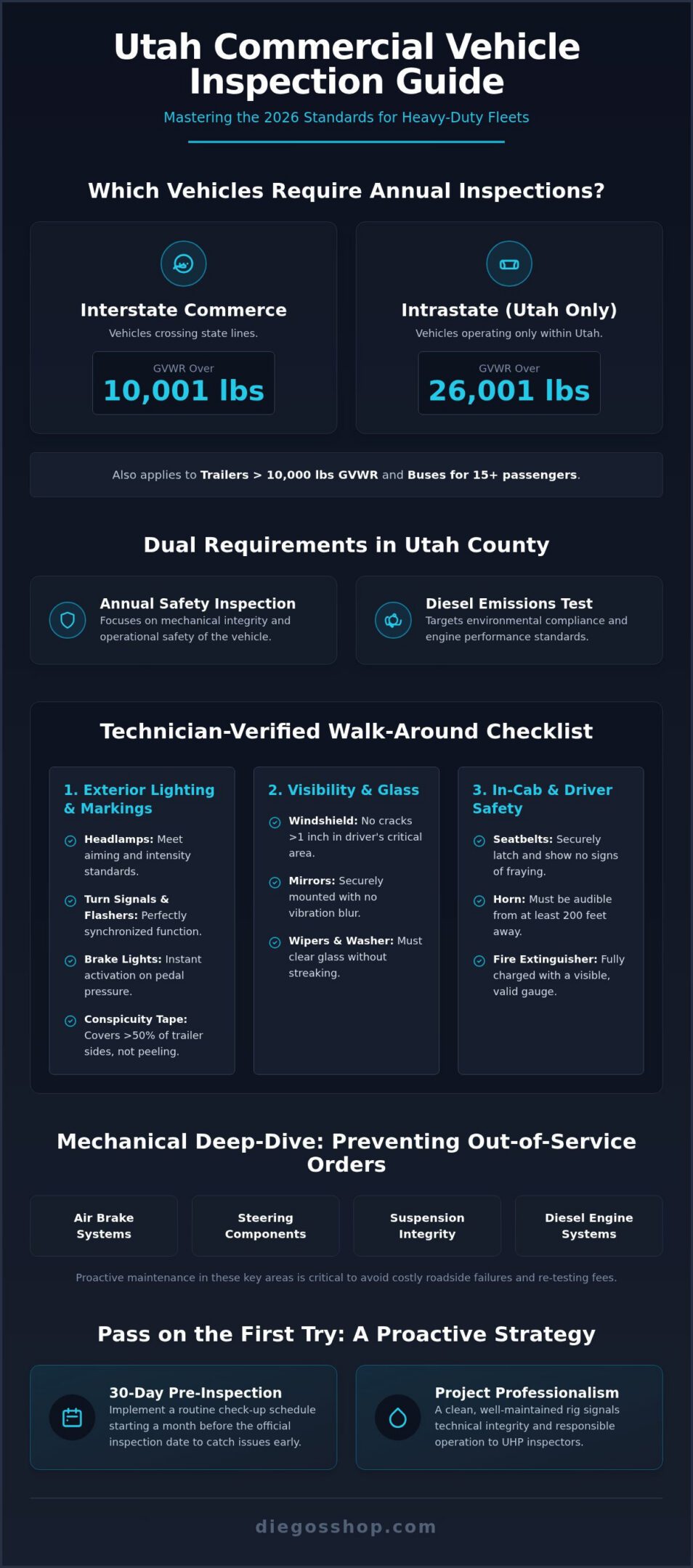
Utah law distinguishes between interstate and intrastate operations when determining inspection needs. For interstate commerce, any vehicle with a Gross Vehicle Weight Rating (GVWR) over 10,001 lbs must pass an annual safety check. If you operate strictly within Utah borders (intrastate), this requirement generally applies to vehicles over 26,001 lbs. This includes:
- Commercial tractors and heavy-duty semi-trucks
- Trailers with a GVWR exceeding 10,000 lbs
- Buses and any commercial vehicle designed to carry 15 or more passengers
Utah County Emissions vs. Safety Inspections
If your fleet is based in Springville or elsewhere in Utah County, you deal with a dual-requirement system. Safety inspections focus on mechanical integrity, while emissions testing targets environmental compliance for diesel engines. These are separate processes, but both are often required to complete your registration renewal. Newer commercial vehicles might qualify for an exemption from emissions testing for the first few years, but safety mandates typically apply annually regardless of the vehicle’s age. Utilizing a professional commercial vehicle inspection checklist Utah ensures you don’t miss these critical details during your pre-inspection routine. At Diego’s Shop, we specialize in modern diesel technology to ensure your engine meets these specific Utah County standards. Keeping your fleet compliant ensures you stay on the road without the threat of unexpected fines or delays.
The 2026 Utah Commercial Safety Inspection Checklist
Passing a Utah Highway Patrol inspection requires more than a casual glance. You need a systematic approach that mirrors the inspector’s path. A technician-verified commercial vehicle inspection checklist Utah ensures nothing is left to chance. This process starts with a thorough walk-around focused on visibility, safety markings, and structural integrity. By following a consistent routine, you eliminate the uncertainty that leads to roadside out-of-service orders.
Exterior Lighting and Markings
Lighting is the most common source of roadside citations. Your headlamps must meet specific aiming and intensity standards to ensure night-time visibility without blinding oncoming traffic. Turn signals and hazard flashers must synchronize perfectly; a single bulb failure can trigger a deeper investigation. Brake light activation timing is equally critical. These systems must respond instantly to pedal pressure to remain compliant with FMCSA regulations. Don’t forget conspicuity tape. If your reflective tape is peeling or covers less than 50 percent of the trailer sides, you’re at risk of a violation.
Visibility extends to your glass and mirrors. Inspect your windshield for cracks or chips. Utah laws are specific about the “critical area” directly in front of the driver. Any crack larger than an inch or positioned in the wiper’s path is an automatic failure. Mirrors must be securely mounted with no vibration-induced blurring. Wipers must clear the glass without streaking, and the washer fluid system must be fully operational at all times.
Inside the cab, the focus shifts to driver safety and emergency response. Seatbelts must latch securely and show no signs of fraying. The horn must be audible from 200 feet. You must also carry a fully charged fire extinguisher with a visible gauge and a set of three reflective triangles. If these tools are missing or damaged, your truck isn’t considered road-ready.
Chassis and Body Integrity
The foundation of your rig must be rock-solid. Inspect frame rails and cross-members for hairline cracks, sagging, or unauthorized welds. The fifth wheel plate requires proper lubrication and a locking mechanism that engages without excessive play. Fuel tanks are another high-priority area. Inspectors check for secure mounting straps and the integrity of the cap seal to prevent hazardous leaks. If you notice any fluid weeping around the tank, it’s time to address it immediately.
Finally, check your rubber and wheels. Steer tires require a minimum tread depth of 4/32 of an inch, while drive and trailer tires need at least 2/32. Look for “thumping” or uneven wear that suggests alignment issues. Lug nuts must be tight with no “rust trails” indicating movement or mounting failure. If you’re unsure about your wheel integrity, scheduling fleet maintenance with a specialist can identify these issues before they lead to a failed inspection. Durable work and technical precision are the only ways to stay ahead of the inspectors.
Mechanical Deep-Dive: Brakes, Suspension, and Diesel Systems
While a walk-around catches visible defects, the mechanical guts of your truck determine its true roadworthiness. Adhering to Utah commercial vehicle inspection laws means looking past the surface. You must evaluate the systems that handle the extreme stresses of the Wasatch Front’s terrain. A comprehensive commercial vehicle inspection checklist Utah is incomplete without a rigorous assessment of the air brakes, steering geometry, and the diesel powertrain’s integrity.
Brake System Compliance
Brakes are your first line of defense. During the air brake system test, you must monitor the compressor cut-in and cut-out pressures while listening for audible leaks. A leak rate exceeding 3 psi per minute for a single vehicle is an immediate red flag. Beyond the air system, you need to measure brake drum and rotor thickness against manufacturer specifications. Heat-cracked drums or rotors worn below the discard limit are common failure points that inspectors won’t overlook. We also verify S-cam and slack adjuster travel; if the pushrod stroke exceeds the limit for the chamber size, the system’s stopping power is compromised. Finally, the ABS warning light must cycle correctly. A persistent light indicates a sensor or modulator fault that can lead to a failed inspection.
The Diesel Powertrain Check
Modern diesel engines require specialized technical mastery to remain compliant. We focus on the exhaust system’s integrity, specifically looking for leaks in the EGR and DPF components. Black soot found downstream of the DPF indicates a cracked filter, which is a significant violation. Fluid leaks are also categorized by severity. While a “Class 1” dampness might pass, any “Class 3” leak that actively drips is an automatic failure. We inspect cooling fan operation and drive belt tension to ensure the engine doesn’t overheat under load. Active fault codes in the engine control module must be addressed, as they often point to underlying emission control issues that will trigger a rejection during the Utah County emissions portion of your registration process.
Steering and suspension components require a hands-on approach to detect subtle wear. We check tie rod ends, drag links, and the steering gear box for excessive play. Even a small amount of movement in these joints can cause wandering at highway speeds. Suspension health is equally vital. We look for cracked leaf springs or shifted leaves that indicate a mounting failure. Air bags must be inspected for dry rot and secure seating. Integrating these deep mechanical checks into your commercial vehicle inspection checklist Utah protects your drivers and your fleet’s reputation. Durable work is built on technical precision, not guesswork.
Pre-Inspection Strategy: How to Pass on the First Try
Success at the inspection station begins weeks before your actual appointment. We recommend conducting a formal internal review using your commercial vehicle inspection checklist Utah at least 30 days before your deadline. This buffer allows you to order specific diesel parts and schedule repairs without the pressure of an expiring registration. It’s much cheaper to fix a worn tie rod end on your own schedule than to have a truck sidelined at a weigh station during a peak delivery window.
The psychological aspect of an inspection is often overlooked. We call it the “Clean Truck” advantage. Inspectors are human; when a rig rolls in covered in Wasatch Front road grime with trash on the dash, they often assume the mechanical maintenance is just as sloppy. A clean, well-presented truck signals a culture of accountability and technical integrity. Similarly, having your maintenance records and previous DOT reports organized in a binder shows the inspector that you maintain total control over your fleet’s safety protocols.
Common Failure Points in Utah County
In our Springville shop, we see specific patterns of failure unique to the local climate. The heavy use of road salt during Wasatch Front winters is brutal on brake lines and electrical connectors. Salt-induced corrosion often causes intermittent lighting failures that are difficult to track down during a roadside stop. Leaf spring repair is another frequent necessity here; the combination of heavy loads and extreme temperature swings often leads to cracked or shifted leaves. We also suggest filling windshield chips immediately. Small pits from road debris can quickly turn into “fail-grade” cracks when the defroster hits a freezing windshield in the middle of January.
The ROI of Preventive Maintenance
Investing in fleet maintenance isn’t just a line item; it’s an insurance policy against downtime. Catching EGR or DPF issues during a scheduled service prevents the dreaded emissions failure that stalls your registration renewal. The cost comparison is clear: a scheduled repair is always more affordable than an emergency roadside call or the high cost of failed inspections and re-testing fees. By addressing the “low hanging fruit” like burnt-out bulbs and worn wiper blades early, you clear the path for a smooth, first-time pass. If you want to ensure your trucks stay road-ready and compliant, contact Diego’s Shop for a professional pre-inspection service that guarantees durable results.
Diego’s Shop: Professional Fleet Inspections in Springville
Managing a commercial fleet along the Wasatch Front requires a partner who understands the high stakes of compliance. At Diego’s Shop, we provide more than just a signature on a form. We offer specialized technical mastery of modern diesel technology for light, medium, and heavy-duty trucks. Our team uses a rigorous commercial vehicle inspection checklist Utah protocol to ensure every Peterbilt, Kenworth, Isuzu, and Ford diesel system in your fleet is optimized for performance and safety.
We believe in the durability of our work. When we identify a failure point during a pre-inspection, our repairs are warrantied to give you peace of mind. This commitment to quality ensures that your trucks don’t just pass the initial check; they stay road-ready for the long haul. Choosing a shop that stands behind its technical precision is the only way to eliminate the stress of roadside out-of-service orders and the high costs of re-testing.
Why Trust a Diesel Specialist?
Modern diesel engine management systems are complex. A general repair shop might lack the specialized diagnostic tools or the specific experience required to troubleshoot intricate EGR or DPF issues. When you work with a diesel specialist, you’re investing in a master craftsman’s eye for detail. We understand the specific thresholds for fluid leaks and the exact tolerances for air brake systems. Our approach is grounded in personal accountability and a no-nonsense work ethic. We treat your fleet’s uptime as our own responsibility.
Schedule Your Pre-Inspection Today
Don’t wait for a Utah Highway Patrol inspector to find a problem you could have solved in the shop. We offer comprehensive DOT truck inspections near me that address every requirement in the commercial vehicle inspection checklist Utah. Our team develops custom fleet service plans tailored to the specific needs of businesses in Springville and the surrounding Utah County area. We catch mechanical failures before they become liabilities.
Visit us at 1852 North Parkway Court in Springville to experience the difference that honest, expert maintenance makes. We focus exclusively on diesel systems to provide the highest level of service for your hardworking machinery. Our goal is to ensure your fleet remains a foundation of your profitability. Reliable expertise is just a phone call away. Quality is our promise.
Secure Your Fleet’s Future on Utah Roads
Proactive compliance is the difference between a profitable quarter and a fleet sidelined by violations. Mastering the commercial vehicle inspection checklist Utah requires a shift from reactive repairs to a disciplined maintenance schedule. By understanding the 2026 legal mandates and focusing on critical mechanical systems like air brakes and diesel powertrain integrity, you protect your drivers and your bottom line. Technical failures don’t have to be a source of stress when you have a systematic plan in place.
Diego’s Shop is Springville’s trusted fleet partner. We provide specialized diesel mastery and warrantied repair work that ensures your equipment meets every state and federal standard. Don’t leave your registration to chance or risk expensive roadside delays that drain your resources. Schedule Your Fleet Inspection at Diego’s Shop today to ensure your trucks remain road-ready. Our technical precision is your peace of mind. We’re here to help you navigate the complexities of modern diesel maintenance with total confidence.
Frequently Asked Questions
Does Utah require annual safety inspections for commercial trucks in 2026?
Yes, Utah mandates annual safety inspections for all commercial motor vehicles meeting specific weight thresholds. For interstate operations, this applies to vehicles over 10,001 lbs. For intrastate travel, the limit is generally 26,001 lbs. While passenger vehicle rules changed years ago, heavy-duty diesel rigs must remain compliant with Utah Highway Patrol standards to stay on the road. This ensures your fleet maintains high safety levels throughout the Wasatch Front.
What is the difference between a Utah State Inspection and a Federal DOT Inspection?
A Utah State Inspection ensures your truck meets local safety codes required for registration. A Federal DOT Inspection satisfies the FMCSA 49 CFR Part 396 requirements for interstate commerce. Most professional diesel shops perform these concurrently. Using a commercial vehicle inspection checklist Utah that covers both sets of standards prevents redundant downtime. This comprehensive approach ensures your equipment is legally compliant across state lines and within local jurisdictions.
Can any mechanic perform a commercial vehicle inspection in Utah?
Only technicians at state-approved inspection stations can perform the official Utah safety check. For federal DOT inspections, the mechanic must meet specific FMCSA qualification standards, including at least one year of experience or a combination of training and experience. At Diego’s Shop, our technicians possess the specialized mastery required to handle complex diesel systems. We ensure every inspection is performed with the technical precision necessary to guarantee compliance and safety.
What are the most common reasons for failing a commercial inspection in Utah County?
Lighting failures, such as burnt-out bulbs or cracked reflectors, are the leading cause of rejection. Inspectors also focus heavily on brake system integrity, specifically air leaks and slack adjuster travel. In Utah County, the corrosive road salt used during winter often damages electrical connectors and brake lines. Tires with tread depths below the 4/32 or 2/32 thresholds are another frequent failure point that we address during preventive maintenance.
How much does a commercial vehicle safety inspection cost in Springville?
As of May 6, 2026, the State of Utah removed the maximum fee cap for safety inspections. Inspection stations now set their own reasonable fees based on labor and vehicle complexity. Because rates are no longer regulated by the state, you should confirm the current pricing with your service provider before the work begins. We focus on providing thorough, warrantied inspections that reflect the technical expertise required for heavy-duty diesel fleets.
How long does a full commercial truck and trailer inspection take?
A professional inspection of a commercial truck and trailer generally takes between one and two hours. This timeframe allows for a meticulous review of the lighting, glass, cab interior, and deep mechanical systems. If the rig has multiple trailers or complex auxiliary equipment, the process may take longer. We value your time and work efficiently to provide a detailed assessment without cutting corners on safety or technical accuracy.
What happens if my commercial vehicle fails its inspection?
If a vehicle fails, the inspector provides a report detailing every defect that must be corrected. You have a limited window, typically 15 days, to complete the repairs and return for a re-inspection. The truck is legally prohibited from operating until it passes. We recommend addressing these issues immediately through warrantied repair work to avoid the high costs of failed inspections and unnecessary fleet downtime.
Are diesel emissions tests required for commercial registration in Utah County?
Yes, Utah County requires emissions testing for diesel vehicles based on model year and weight. This mandate is separate from the safety inspection but equally necessary for registration renewal. While the emissions test is a distinct process, both are essential for legal compliance. Our shop specializes in modern diesel technology, ensuring your engine management and emission control systems meet the rigorous environmental standards enforced along the Wasatch Front.