

Improving Your Fleet’s CSA Score Through Strategic Maintenance

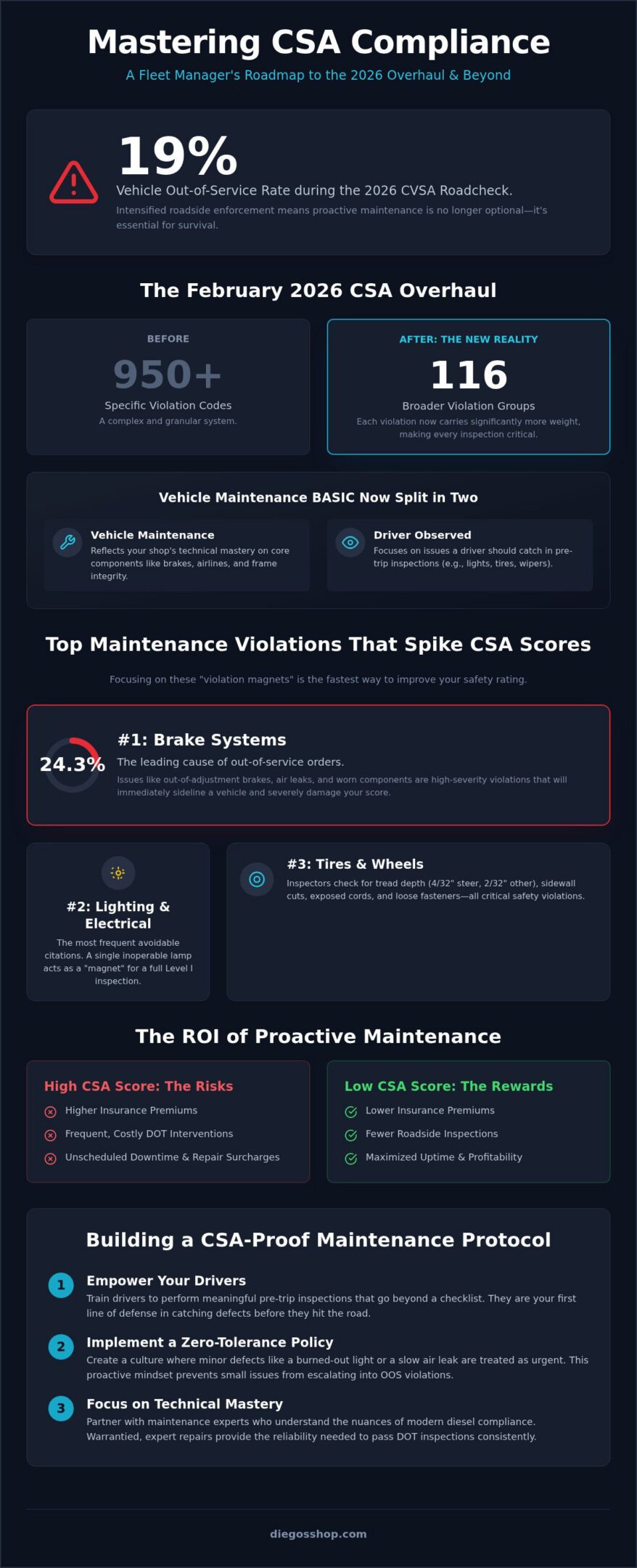
Did you know that during the 2026 CVSA Roadcheck, nearly one in five inspected vehicles was ordered out of service? With a 19% vehicle out-of-service rate, it’s clear that roadside enforcement is intensifying across the country. You’re likely feeling the pressure of rising insurance premiums and the frustration of costly, unscheduled downtime. It’s stressful to manage a fleet when you’re unsure which mechanical issues will trigger a DOT intervention or spike your scores in the newly consolidated compliance categories.
We understand that maintenance isn’t just a cost center; it’s a strategic shield for your operation. Improving a fleet’s CSA score through maintenance is the most effective way to reduce roadside inspections and protect your bottom line. By shifting from a reactive mindset to a proactive, technical partnership, you can ensure your vehicles remain reliable and compliant. This approach provides the peace of mind that comes from knowing your equipment is handled by experts who speak your language.
This article explores the February 2026 CSA overhaul, including the new split between Vehicle Maintenance and Driver Observed categories. You’ll learn how specific shop practices can lower your percentiles and keep your trucks moving. We’ll provide a clear roadmap to technical mastery that alleviates the uncertainty of modern diesel compliance and keeps your fleet in total control.
Key Takeaways
- Understand the 2026 CSA overhaul and how modern compliance categories prioritize recent mechanical violations to determine your safety ranking.
- Identify the most common avoidable violations, specifically in braking and lighting systems, that lead to frequent and costly out-of-service orders.
- Discover the financial benefits of improving a fleet’s CSA score through maintenance, including lower insurance premiums and reduced repair surcharges.
- Learn how to build a zero-tolerance maintenance protocol that empowers drivers to perform meaningful inspections and catch defects before they reach the scale.
- See how technical diesel mastery and warrantied repairs provide the reliability needed to pass DOT inspections and maintain uptime across the Wasatch Front.
Understanding the Link Between Maintenance and CSA Scores
The Compliance, Safety, Accountability (CSA) program is the primary monitoring system used by the Federal Motor Carrier Safety Administration (FMCSA) to identify high-risk carriers. It isn’t just a scoreboard; it’s a direct reflection of your fleet’s operational health. High scores trigger warning letters, investigations, and roadside interventions that can paralyze your business. Following the February 2026 overhaul, the system now uses 116 broader violation groups instead of the previous 950 codes. This means every individual violation carries more weight than it used to.
Improving a fleet’s CSA score through maintenance requires understanding that the FMCSA prioritizes recent data. Violations from the last 12 months have a significantly higher impact on your percentile ranking than older ones. This creates a “time weight” factor where a clean inspection today is the most effective way to dilute the damage of a past mistake. The 2026 update also simplified severity weighting into a two-tier structure, making it easier to see exactly how mechanical failures damage your standing.
The Vehicle Maintenance BASIC: Your Biggest Lever
The Vehicle Maintenance category is often the most controllable area of fleet compliance. It covers critical mechanical components including braking systems, lighting, tires, and fluid leaks. Under the 2026 rules, this category was split into two distinct scores: Vehicle Maintenance and Driver Observed. While the latter focuses on items a driver should catch during a pre-trip, the Vehicle Maintenance score remains a pure reflection of your shop’s technical mastery. The Vehicle Maintenance BASIC is the technical foundation of fleet compliance. A single out-of-service (OOS) order for a cracked brake drum or a leaking air line can spike a small fleet’s score instantly. Maintaining total control over these mechanical variables is essential for long-term stability.
How Roadside Inspections Feed the FMCSA System
Roadside inspections aren’t random events. Inspectors often look for “magnets” that suggest a lack of oversight. Visible defects like a cracked windshield, an inoperable clearance light, or worn tire treads are signals that a vehicle hasn’t seen a shop recently. These minor issues often lead to a full Level I inspection, where deeper mechanical problems are uncovered. Conversely, passing a roadside inspection provides a significant benefit to your data profile. These positive reports are vital because they increase your total number of clean inspections, which mathematically lowers your percentile ranking. Improving a fleet’s CSA score through maintenance starts with ensuring your trucks look as reliable as they perform, preventing the scrutiny that leads to costly fines.
The Top Maintenance Violations That Tank Your CSA Score
Data from the 2026 CVSA Roadcheck shows that brake system violations remain the leading cause of out-of-service orders, representing 24.3% of the total findings. These mechanical failures directly impact your Safety Measurement System (SMS) percentile. Improving a fleet’s CSA score through maintenance starts with identifying these high-weight violations before an inspector flags them at the scale.
Lighting and electrical issues are the most frequent avoidable citations in the industry. A single burned-out marker light or a flickering trailer connection signals to the DOT that your maintenance program is reactive rather than proactive. These visible defects act as “magnets” that invite inspectors to conduct a more thorough Level I inspection of your entire vehicle.
Tires and wheels are equally critical to your safety standing. Inspectors look for tread depth below 4/32 of an inch on steer tires or 2/32 on all other positions. They also check for sidewall cuts, exposed cords, and bulges that compromise structural integrity. Wheel issues, such as cracked rims or loose fasteners, are high-severity violations that will immediately remove a vehicle from service and damage your compliance record.
Brake System Mastery for Heavy-Duty Trucks
Automatic slack adjusters often fail because they are treated as maintenance-free components. In reality, internal gear wear or a lack of proper lubrication leads to out-of-adjustment brakes that won’t pass a roadside inspection. We also monitor air system integrity to prevent citations for “audible air leaks” at the glad hands or brake chambers. For medium-duty fleets, we maintain strict hydraulic brake schedules to ensure fluid levels and line integrity never fall below the required safety standards.
Diesel Engine Leaks and Emission Compliance
Distinguishing between a “wet” engine and a violation-worthy fluid leak is a matter of technical precision. FMCSA inspectors look for active dripping or pooling that could contaminate the roadway or cause a fire hazard. Modern diesel engines also require precise management of DPF and EGR systems to stay compliant. If these systems fail, the resulting “derate” mode limits vehicle speed, which becomes a major safety hazard on the highway. Consistent, expert diesel engine repair ensures your long-haul reliability and prevents performance-related safety citations. Our shop provides the technical mastery needed to keep your fleet’s emission systems in total compliance. If you need a partner to audit your equipment for potential violations, our Springville team is ready to help.
The ROI of Preventive Maintenance vs. CSA Fines
An Out-of-Service (OOS) order is far more expensive than the fine written on the citation. When a vehicle is sidelined, you face immediate costs from emergency towing, roadside repair surcharges, and potential late delivery penalties. Improving a fleet’s CSA score through maintenance is a calculated financial strategy to eliminate these variables. Industry data suggests that a high CSA score can increase insurance premiums by 15% to 30% on average. Underwriters view mechanical violations as a leading indicator of risk, and they price your policy accordingly.
The master craftsman approach focuses on the long-term durability of every repair. Catching a $200 brake adjustment or a faulty sensor in the shop prevents a $2,000 catastrophic failure on the side of I-15. We provide warrantied repair work to ensure that once a component is serviced, it stays fixed. This prevents the nightmare of repeat violations, which the 2026 FMCSA system penalizes heavily through increased severity weights.
Quantifying the Cost of Downtime
Revenue stops the moment a truck is pulled off the road, but your overhead costs do not. When a medium-duty truck is sidelined for a week, the lost opportunity cost often dwarfs the actual repair bill. Scheduled fleet maintenance pays for itself by maintaining vehicle uptime and securing more favorable insurance terms. Beyond the numbers, there is a significant impact on driver retention. Drivers are more likely to stay with a company that provides safe, well-maintained equipment. Reliable trucks reduce the stress of roadside inspections and keep your best operators behind the wheel.
The ‘Diego’s Shop’ Standard for Fleet Inspections
Our comprehensive inspection protocol is designed to mirror DOT Level I requirements. We believe that Improving Your Maintenance CSA BASIC score requires more than just a quick walk-around. It takes technical mastery of modern diesel systems to identify hidden electronic faults in emission controls or braking modules. Our specialists focus on improving a fleet’s CSA score through maintenance by identifying wear patterns in heavy-duty components before they lead to a violation. We build trust through transparent reporting and durable diesel repairs that stand up to the rigors of the Wasatch Front. This level of accountability ensures your fleet remains a reliable asset rather than a compliance liability.
Building a CSA-Proof Maintenance Protocol
Improving a fleet’s CSA score through maintenance requires a systematic approach that leaves nothing to chance. A protocol isn’t just a list of tasks; it’s a culture of technical accountability that begins in the yard and ends in the shop. By standardizing your response to mechanical wear, you remove the “luck” factor from roadside inspections. We recommend a four-step process to harden your fleet against DOT scrutiny:
- Step 1: Zero-Tolerance for Visible Defects. Implement a policy where no vehicle leaves the yard with a flickering clearance light or questionable tire tread. These are “magnet” violations that invite Level I inspections.
- Step 2: Meaningful Driver Training. Move beyond checking boxes on an ELD. Train your drivers to identify specific failure points, such as audible air leaks at the glad hands or heat-cracked brake drums.
- Step 3: Utah-Specific PM Intervals. The Wasatch Front’s steep grades and heavy road salt demand more frequent inspections. Establish mileage-based or hour-based schedules that account for these harsh operating conditions.
- Step 4: Rigorous Documentation. Maintain a detailed digital audit trail of every repair. With a 35% success rate for DataQ challenges, your shop records are your only defense against incorrect carrier assignments or duplicate entries.
Driver-Technician Communication Loops
Bridging the gap between what a driver sees on the road and what a mechanic fixes in the shop is critical. When a driver reports a “soft pedal” or a “pull to the left,” it must be documented immediately in the digital DVIR. This creates an audit trail that shows the DOT you are proactive about safety. Encouraging drivers to report minor issues early prevents them from becoming high-weight violations that damage your Vehicle Maintenance score. Clear communication ensures that the technical mastery of our shop is applied exactly where your fleet needs it most.
Advanced Diagnostics for Modern Diesel Fleets
Generic code readers are insufficient for maintaining compliance in a modern Peterbilt, Kenworth, or Ford diesel fleet. Improving a fleet’s CSA score through maintenance requires specialized diagnostics that can see deep into emission control modules. We use advanced tools to identify DPF and EGR faults before they trigger a “limp mode” event, which is a major safety hazard on the highway. For more technical insights on keeping your equipment running under pressure, refer to our 2026 Diesel Maintenance Handbook. If you’re looking for a partner to audit your current equipment, our Springville maintenance team is ready to provide the professional support your fleet deserves.
Why Utah Fleets Trust Diego’s Shop for CSA Compliance
Located in Springville, our shop serves as the hub for fleet reliability across the entire Wasatch Front. We understand that improving a fleet’s CSA score through maintenance requires a partner who takes personal accountability for every bolt turned. Unlike generic corporate service centers, we provide a master-craftsman approach to diesel engine repair. Our technicians possess deep expertise in Peterbilt, Kenworth, Isuzu, and Ford diesel platforms, ensuring your equipment receives specialized care regardless of its weight class. Whether you operate light-duty work trucks or heavy-duty long-haulers, we maintain total control over the technical variables that impact your compliance standing.
The “Diego’s Difference” is rooted in the durability of our work. We provide warrantied repair work because we believe a fix should stay fixed. This commitment directly protects your safety scores by preventing the repeat violations that the FMCSA penalizes so heavily. We partner with local businesses to create custom preventive maintenance plans that align with your specific duty cycles. By treating maintenance as a strategic shield rather than a recurring expense, we help you build a fleet that is fundamentally honest and dependable.
Local Expertise for Utah County DOT Standards
Utah’s geography presents unique challenges that national maintenance chains often overlook. The steep grades of our mountain passes put extreme thermal stress on braking systems, while winter road salt accelerates corrosion on air lines and electrical connections. These environmental factors are leading causes of the mechanical failures discussed earlier in this guide. We specialize in reliable DOT truck inspections in Utah County, focusing on the specific wear patterns caused by our local climate. Our shop offers the hands-on expertise required to identify these issues before they result in a roadside out-of-service order.
Next Steps: Securing Your Fleet’s Future
Protecting your bottom line starts with a clear understanding of your equipment’s current health. You can schedule a comprehensive fleet-wide maintenance audit at Diego’s Shop to identify potential BASIC-point earners before they reach the scale. This proactive step provides the peace of mind that comes from knowing your trucks are road-ready and fully compliant with 2026 FMCSA standards. Improving a fleet’s CSA score through maintenance is a continuous process of technical mastery and accountability. Don’t leave your safety standing to chance. Contact our Springville team today to secure your fleet, your drivers, and your professional reputation.
Secure Your Fleet’s Standing on the Wasatch Front
Managing a modern diesel fleet requires more than just keeping trucks on the road; it demands a strategic commitment to technical precision. By addressing high-weight violations like braking systems and lighting before they reach a roadside inspector, you protect your operation from the severe penalties of the 2026 CSA overhaul. Improving a fleet’s CSA score through maintenance is the most reliable way to reduce insurance premiums and eliminate the hidden costs of unscheduled downtime. This proactive approach ensures that your vehicles remain durable assets rather than compliance liabilities.
Our Springville location offers the technical mastery and warrantied repair work your business needs to stay compliant. We understand the specific rigors of Utah’s mountain driving and provide the local expertise necessary to keep your Peterbilt, Kenworth, or Ford diesel fleet in top condition. Our expert diesel technicians take personal accountability for every repair, providing the peace of mind that comes from total control over your equipment’s health. Don’t let a preventable mechanical failure damage your hard-earned safety ranking or your bottom line.
Request a Custom Fleet Maintenance Plan from Diego’s Shop and ensure your equipment is always road-ready. We look forward to helping you build a safer, more profitable fleet.
Frequently Asked Questions
What is the most common maintenance violation that affects CSA scores?
Lighting violations are the most frequent avoidable citations, but brake system issues remain the leading cause of out-of-service orders. According to the 2026 CVSA Roadcheck, brake-related findings accounted for 24.3% of vehicle out-of-service violations. These defects are high-severity events that immediately impact your safety ranking. Consistently improving a fleet’s CSA score through maintenance requires a focus on these critical systems to prevent roadside interventions and protect your professional reputation.
How long do maintenance violations stay on my fleet’s CSA record?
Maintenance violations remain on a carrier’s CSA record for 24 months. However, the FMCSA’s 2026 scoring methodology places a much heavier emphasis on violations that occurred within the last 12 months. This time-weighting system means that recent clean inspections are the most effective way to dilute the impact of older citations. Maintaining a consistent preventive maintenance schedule ensures that your most recent data points reflect a safe, reliable operation.
Can a clean DOT inspection actually lower my CSA score?
Yes, passing a DOT inspection without violations significantly benefits your standing. Your CSA score is a percentile ranking compared to similar carriers. When you receive a clean inspection report, it increases your total number of safety events without adding violation points. This mathematically lowers your percentile over time. Improving a fleet’s CSA score through maintenance ensures your trucks are ready to pass every roadside check, effectively neutralizing past mechanical failures.
Does every mechanical repair need to be documented for the FMCSA?
Federal regulations require carriers to maintain systematic inspection, repair, and maintenance records for every vehicle under their control. These documents must be kept for 365 days while the vehicle is in service and for six months after it leaves your fleet. Proper documentation is your primary defense during a DOT audit. It also provides the evidence needed to support DataQ challenges if an inspector issues an incorrect or duplicate citation.
How often should my fleet undergo a professional safety inspection?
While the FMCSA requires a formal inspection at least once every 12 months, high-utilization fleets should opt for professional safety checks every 90 days. Utah’s harsh mountain terrain and winter road conditions accelerate wear on critical components like brake lines and suspension. A quarterly inspection protocol allows our technicians to catch hidden faults before they trigger a roadside out-of-service order. Regular checks maintain the durability and integrity of your hardworking diesel equipment.
What is a DataQ challenge and how does maintenance documentation help?
DataQs is an online system that allows carriers to challenge the accuracy of FMCSA data. Challenges through this system have an approximate success rate of 35%, making detailed documentation critical. If you receive an incorrect citation, you can file a Request for Data Review. Shop records, including work orders for warrantied repair work, provide the objective proof needed to remove erroneous violations and protect your safety score from unfair damage.
Do light-duty diesel trucks like the Ford F-350 affect my fleet’s CSA score?
Yes, any commercial vehicle with a Gross Vehicle Weight Rating over 10,001 pounds contributes to your fleet’s CSA score. This includes popular light-duty diesel platforms like the Ford F-350 or Ram 3500 when used for business purposes. Many managers overlook these smaller assets, but a lighting or tire violation on a pickup carries the same weight as one on a heavy-duty Peterbilt. We provide specialized maintenance for all diesel weight classes to ensure total compliance.
How can I find a reliable shop for DOT inspections in Springville, Utah?
Diego’s Shop provides professional DOT inspections and fleet maintenance from our specialized facility in Springville. We serve the entire Wasatch Front with technical mastery of modern diesel and emission control systems. Our team focuses on building trust through transparent reporting and durable, warrantied repairs. You can rely on our seasoned technicians to audit your equipment for potential violations and provide the peace of mind that your fleet is road-ready and compliant.