

Diesel Engine Rebuild vs. Buying a New Truck: 2026 ROI & Decision Guide

Choosing to buy a brand-new truck might seem like the safest way to ensure uptime, but in 2026, it’s often the most expensive way to inherit new headaches. You’re likely feeling the pressure of skyrocketing vehicle prices and the frustrating unreliability of modern emissions systems that seem to spend more time in derate than on the road. When you weigh a diesel engine rebuild vs buying a new truck, the decision isn’t just about the initial price tag. It’s about protecting your bottom line and keeping your fleet moving without the constant threat of technical failures.
We understand that your truck is your livelihood, and every day it sits in the shop is a day of lost revenue. This guide provides a direct financial comparison between overhauling your current engine and investing in a 2026 model. You’ll learn how a master-level rebuild can add up to 500,000 miles to your vehicle’s life while avoiding the complex pitfalls of the latest factory tech. We’ll break down the total cost of ownership and reliability metrics so you can choose the path that maximizes your long-term ROI and provides the peace of mind you need to stay on the road.
Key Takeaways
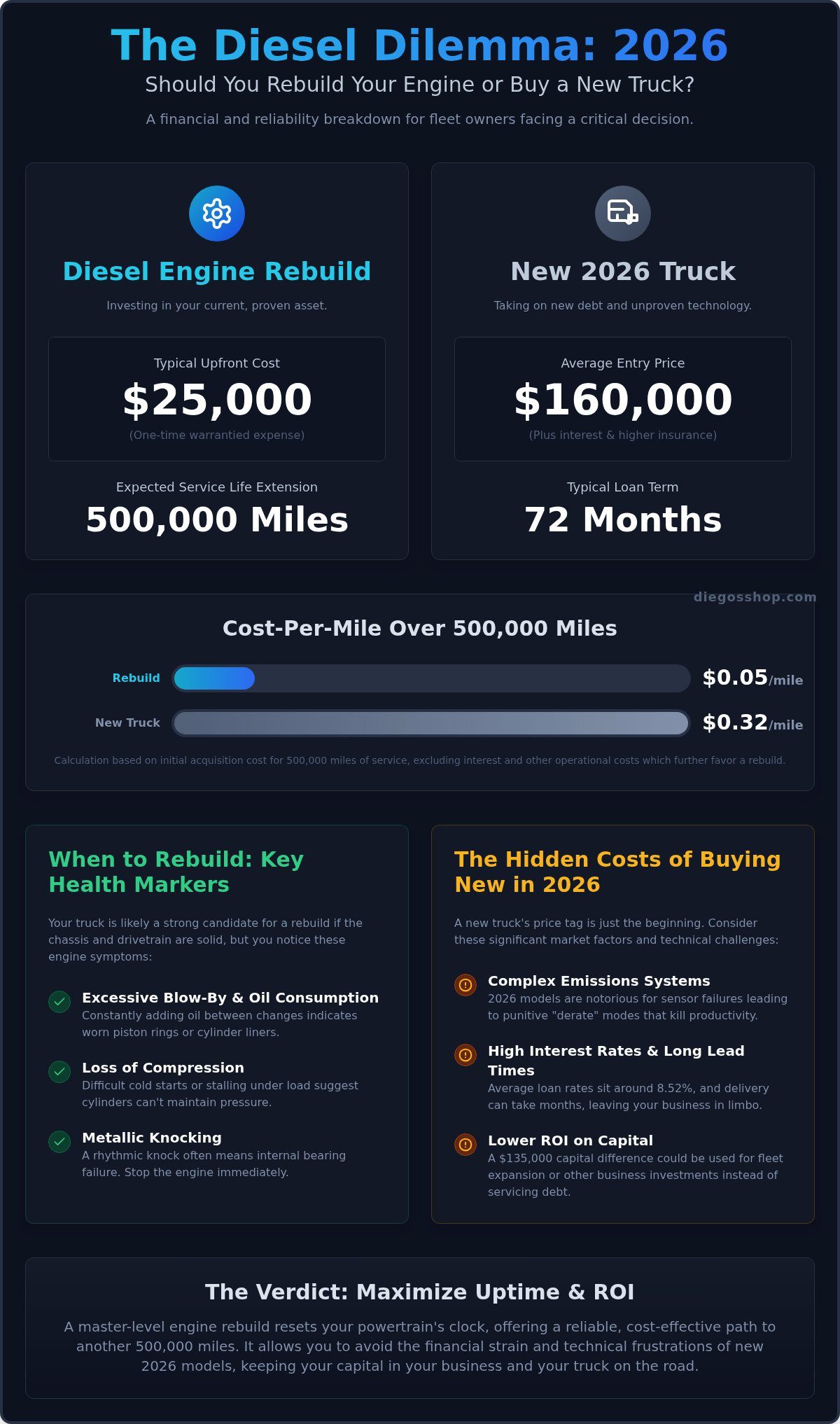
- Analyze the direct cost gap between a $25,000 engine overhaul and the $160,000 entry price for a new commercial vehicle.
- Evaluate the long-term ROI of a diesel engine rebuild vs buying a new truck by comparing cost-per-mile over the next 500,000 miles.
- Identify the specific chassis and drivetrain health markers that signal whether your truck is a candidate for a second life or a trade-in.
- Understand why older engines often provide better uptime by avoiding the complex and punitive emissions failures common in 2026 models.
- Learn why local, warrantied repair work from a master technician ensures your equipment stays on the road with dependable, long-term support.
The Diesel Dilemma: Should You Rebuild or Buy New in 2026?
Every fleet owner eventually hits a wall. Your truck is down, and the estimate for a major engine repair is sitting on your desk. You’re forced to decide: do you sink capital into an older asset or sign a high-interest note for a new one? In 2026, comparing a diesel engine rebuild vs buying a new truck requires looking past the initial invoice. It’s a choice between a known, dependable machine and a new, unproven one that carries significant financial weight.
We often see owners hesitate when a repair bill approaches 50% of the truck’s residual value. However, a high repair cost doesn’t always mean the truck is a loss. If the frame, transmission, and axles are solid, the engine is simply a component that can be renewed. A full rebuild replaces almost all internal wear parts, essentially resetting the clock on the powertrain. Understanding the fundamental design of a Diesel engine helps explain why these heavy-duty blocks are built to withstand multiple lives through proper machining and component replacement. In contrast, a partial overhaul, or “in-frame,” might address specific failures like head gaskets but leaves the bottom end untouched.
Signs Your Diesel Engine is Ready for a Rebuild
- Excessive blow-by and oil consumption: If you’re adding gallons of oil between scheduled changes, the piston rings or cylinder liners are likely worn beyond their service limits.
- Loss of compression: Frequent stalling under load or difficult starts in cold weather signal that the cylinders can no longer maintain the pressure required for efficient combustion.
- Metallic knocking: This sound usually indicates internal bearing failure. If you hear a distinct rhythmic knock, stop the engine immediately to avoid catastrophic damage to the block.
The 2026 Market: Why Buying New is More Complex
The current market hasn’t made it easy to trade up. Average interest rates for new vehicle loans sit around 8.52% for borrowers with good credit, which adds a massive burden to monthly cash flow. Lead times for new Peterbilt and Kenworth models remain a challenge, often stretching months into the future and leaving your business in limbo. Additionally, 2026 models are the final generation before major EPA emissions shifts in 2027. This forces many owners into complex systems that are notorious for sensor failures and punitive “derate” modes that kill productivity. Choosing a master-level overhaul at a specialist like Diego’s Shop allows you to maintain a reliable platform that your drivers trust and your team can actually maintain. It’s a strategic move that keeps your capital in the bank and your trucks on the road. Durable work requires durable machinery.
The Economics of a Diesel Engine Rebuild
The financial gap between these two options is staggering. A master-level rebuild typically costs around $25,000, while a new heavy-duty truck in 2026 enters the market at roughly $160,000. When you compare a diesel engine rebuild vs buying a new truck, you’re looking at a $135,000 difference. It’s vital to remember that labor constitutes 60% to 70% of that rebuild cost. You’re paying for the technical precision of a master craftsman rather than the massive overhead of a manufacturer’s assembly line. That saved capital doesn’t just vanish; it stays in your business to fund fleet expansion or facility upgrades.
Analyzing the cost per mile reveals the true long-term value of a diesel engine rebuild vs buying a new truck. If a quality overhaul adds 500,000 miles to your truck’s life, your acquisition cost for those miles is just $0.05 per mile. Buying a new truck for the same distance results in a cost of $0.32 per mile before you even account for interest or higher insurance premiums. Investing in warrantied repair work ensures that this $0.05 per mile investment is protected by a guarantee of durability and technical precision.
Monthly Payments vs. One-Time Repair Costs
A new truck loan often stretches 72 months with interest rates averaging 8.52% in 2026. This creates a fixed, high monthly overhead that drains your cash flow regardless of how much work you have on the books. A rebuild is a one-time expense. You pay for the service, and the asset begins earning for you immediately without a monthly bank obligation. ROI for a rebuilt engine is measured by the total cost of the overhaul against the 500,000 miles of extended service life it provides. It’s about turning a liability back into a high-performing asset.
Tax Advantages and Depreciation for Utah Fleets
Utah business owners can often leverage Section 179 deductions to write off the full cost of a major engine overhaul in a single tax year. This provides an immediate tax shield that you won’t get with a new truck, which must be depreciated over several years. Also, a new truck loses roughly 20% of its value the moment it leaves the lot. By rebuilding, you avoid that immediate equity hit. Keeping an older, reliable asset on your balance sheet maintains a lower debt-to-income ratio, making your business more attractive to lenders when you’re ready for true expansion. If you need an honest assessment of your current powertrain, schedule a diagnostic audit to see if a rebuild is your best financial move.
Hidden Costs of Upgrading to a New 2026 Truck
Buying a new truck in 2026 involves more than just a higher monthly payment. You’re entering a “tech-bloat” era where proprietary software and fragile sensors can sideline your vehicle for weeks. When evaluating a diesel engine rebuild vs buying a new truck, owners often overlook the ongoing maintenance costs of modern emissions hardware. A single failed NOx sensor or a glitch in the Diesel Exhaust Fluid (DEF) delivery system can trigger a “limp mode” event. This forces your truck to run at restricted speeds until a dealer with the right software can clear the code. These events don’t just cost money in repairs; they cost you credibility with your customers when loads are delivered late.
Modern systems are designed for compliance, not necessarily for the rugged reality of heavy-duty cycles in varying climates. Older engines, particularly those built before the most stringent 2026 standards, offer a mechanical simplicity that is increasingly valuable. They are easier to diagnose and don’t require specialized, dealer-only diagnostic tools for every minor adjustment. By rebuilding, you maintain a platform that your own team or a trusted local shop can service without being held hostage by proprietary manufacturer software.
Emissions Systems and Tech-Bloat
The 2026 DPF (Diesel Particulate Filter) and SCR (Selective Catalytic Reduction) systems are the most complex ever produced. While the EPA has proposed replacing punitive derates with audible alerts for 2027 models, 2026 trucks still face the risk of being restricted to 45 mph after a DEF failure. Replacing these sensors and filters over the vehicle’s life can cost thousands in parts alone. Pre-2020 trucks are gaining value in the Utah market precisely because they avoid these “forced upgrades.” They keep your drivers on the road instead of waiting in a dealer service bay for a sensor recalibration.
Insurance, Registration, and The Utah Factor
Operating along the Wasatch Front adds specific local costs to new vehicle ownership. In Utah County, property tax and registration fees for a new $160,000 heavy-duty truck are significantly higher than for a refreshed older asset. Insurance companies also charge a premium for late-model commercial vehicles due to their high replacement value and the expensive electronics embedded in their components.
Choosing a local diesel repair utah specialist like Diego’s Shop provides a strategic advantage. National dealers often have backlogs that stretch for weeks. A local expert focused on master-level overhauls can get your rebuilt engine back in service without the corporate bureaucracy. You get a truck that is mechanically new but financially manageable. This path avoids the immediate 20% depreciation hit while ensuring your equipment stays rugged and reliable for Utah’s demanding terrain. Keeping your current truck isn’t just about saving money; it’s about keeping control of your fleet.
Decision Framework: When to Rebuild vs. When to Trade
Deciding between a diesel engine rebuild vs buying a new truck requires a systematic approach. You aren’t just buying an engine; you’re investing in the future capacity of your business. The first step is a cold, hard look at the chassis. If the foundation of the truck is compromised, no amount of engine work will save the asset. You must also look at your route requirements. If your business is moving toward long-haul routes that require the absolute latest aerodynamic efficiencies, your strategy might differ from a local fleet operator.
Once the physical audit is complete, compare your total projected repair costs, including the engine, cooling system, and suspension, to the down payment of a new vehicle. In 2026, the cash flow impact of a new $160,000 truck is often more damaging than a one-time repair. Before making the final call, it’s essential to schedule a diesel diagnostics service with a master technician who can identify hidden failures that might derail your ROI. This expert consultation ensures you aren’t throwing good money after a bad block.
Assessing the Chassis: Is the Truck Worth Saving?
In Utah, the biggest enemy of a long-term rebuild strategy is road salt. Winter-salted roads along the Wasatch Front cause aggressive frame fatigue and corrosion. Inspect the frame rails for thinning or flaking that compromises structural integrity. Next, evaluate the transmission and differential health. If these major components have already been replaced or show no signs of metal in the fluid, the truck is a prime candidate for a second life. Don’t ignore the cab condition either. If the interior is falling apart and the HVAC system is failing, driver retention will suffer. A truck is only worth saving if your drivers can stay comfortable and safe for another 300,000 to 500,000 miles.
Calculating the Break-Even Point
Recouping the cost of a rebuild generally takes between 10 and 18 months of consistent operation, depending on your utilization rates. You must also factor in the ongoing diesel maintenance costs required to protect that new internal work. A rebuilt engine is a high-performance machine that requires strict adherence to fluid intervals and sensor monitoring. The ‘point of no return’ for an aging fleet asset occurs when the frequency of non-engine repairs, such as electrical gremlins and cab failures, creates more downtime than the savings of the rebuild can justify.
If your chassis is solid and your transmission is healthy, the math usually favors the overhaul. It’s a pragmatic choice for owners who value mechanical durability over high-tech features. To get a definitive answer on your truck’s viability, book a comprehensive health audit with our team in Springville today. We’ll help you determine if your current asset has another half-million miles of profit left in it.
Expert Diesel Engine Overhauls at Diego’s Shop
At Diego’s Shop in Springville, we don’t just fix engines; we restore the commercial backbone of our community. When you choose a diesel engine rebuild vs buying a new truck, you’re trusting us to deliver a machine that can handle the punishing mountain passes and extreme temperature swings of the Wasatch Front. Our master-level reconstruction process involves a complete teardown, precision machining, and the replacement of all critical internal components with high-durability parts, often sourcing performance components from Diesel Freak. We build for the long haul because we know your livelihood depends on it.
Our commitment to rugged reliability extends beyond the shop floor. Following a major overhaul, our fleet maintenance programs ensure that your investment is protected through every season. We monitor wear patterns and fluid health to prevent the minor issues that lead to major downtime. This proactive approach turns your refreshed asset into a predictable, high-performing tool for your business. We maintain total control over the process so you can maintain total control over your fleet.
Why Wasatch Front Fleets Trust Our Master Craftsmen
We specialize in the engines that power Utah’s heavy-duty industries, including Peterbilt, Kenworth, and Isuzu platforms. Unlike national dealers with rotating staff and corporate layers, we offer personal accountability. You’ll speak directly with the experts who handle your equipment. This direct line of communication builds the trust necessary for a successful long-term partnership. We take pride in our technical skill and the durability of every engine that leaves our bays. Our shop is a place where master craftsmanship meets modern diagnostic precision.
Our Warrantied Repair Work Guarantee
We stand behind our technical expertise with a warrantied repair work guarantee. This protection provides the peace of mind you need when deciding between a diesel engine rebuild vs buying a new truck. You get the reliability of a new powertrain without the crushing debt of a new vehicle purchase. To keep your ‘new’ engine running at peak efficiency, we integrate your truck into a customized preventive maintenance schedule. This ensures that every component, from the injectors to the cooling system, remains in top condition.
Ready to evaluate your truck’s future? The path to maximum uptime starts with an honest, master-level assessment. Contact Diego’s Shop for an engine evaluation today. We’ll help you run the numbers and determine the best strategy for your fleet’s long-term success. Let’s keep your business moving.
Maximize Your Fleet Uptime and ROI
Deciding on a diesel engine rebuild vs buying a new truck is a strategic pivot that determines your profitability for the next half-million miles. You’ve seen how preserving a solid chassis while refreshing the powertrain avoids the high interest rates and emissions risks of 2026 models. It’s about choosing the rugged reliability of a machine you already trust over the unproven complexity of a new factory build. This choice keeps your capital working for you rather than sitting in a bank’s interest column.
At Diego’s Shop, we specialize in providing that second life. Our team delivers expert diagnostics for Peterbilt, Kenworth, and Ford platforms, ensuring every overhaul meets master-level standards. We’ve served Springville and the entire Wasatch Front with a commitment to integrity and technical precision. Every engine that leaves our bay is backed by full warrantied repair work, giving you the confidence to tackle any grade or load.
Don’t let mechanical uncertainty stall your business growth. Take control of your fleet’s future with a data-driven health audit. Schedule a Diesel Engine Evaluation at Diego’s Shop Today and keep your trucks moving with the power they were built to deliver. Your hard work deserves a truck that works just as hard.
Frequently Asked Questions
How much does a typical diesel engine rebuild cost in 2026?
When evaluating a diesel engine rebuild vs buying a new truck, industry data for 2026 shows that overhauls typically range from $15,000 to $35,000. For instance, a Cummins ISX rebuild often costs between $18,000 and $25,000. These figures are far below the entry price of a new commercial vehicle. The final cost depends on the specific engine model and the extent of internal wear found during teardown.
How many miles can I expect to get out of a rebuilt diesel engine?
A high-quality engine rebuild can add 300,000 to 500,000 miles to a truck’s service life. This extension effectively resets the clock on your powertrain, allowing you to maximize the value of your existing chassis. Achieving these numbers requires a master-level overhaul and a commitment to strict preventive maintenance schedules. It’s a reliable way to keep your fleet operational without the debt of a new purchase.
Is a rebuilt engine as reliable as a brand-new one?
A master-level rebuild provides the same level of dependability as a new engine by replacing all critical wear components. In some cases, a rebuild is more reliable because it utilizes a proven engine block and avoids the complex software glitches found in 2026 models. Fleet owners often find that the rugged, predictable nature of an overhauled powertrain makes it the superior choice for consistent long-term uptime.
What is the average downtime for a full engine overhaul at Diego’s Shop?
An in-frame rebuild typically requires 7 to 14 days of shop time, while a full out-of-frame overhaul can take between 14 and 28 days. We understand that downtime directly impacts your revenue, so we focus on efficient, precise service delivery. This timeline allows for thorough machining and testing to ensure the engine meets our master-level standards. We maintain a clear schedule to help you plan your logistics.
Will a rebuild improve my truck’s fuel economy?
A rebuild often restores fuel economy to the engine’s original factory specifications by correcting internal inefficiencies. Worn rings, leaking valves, and tired injectors all waste fuel and reduce power. By replacing these components with new, precision parts, the engine operates at peak thermal efficiency. While it won’t exceed the design limits of your specific model, you’ll notice a smoother, more efficient performance under heavy loads.
Can I finance an engine rebuild like I can a new truck?
Many business owners utilize commercial equipment loans or lines of credit to fund major engine overhauls. While we don’t provide in-house financing, we can provide the detailed quotes and documentation your lender requires for the approval process. A rebuild is a capital investment that improves the asset’s value, making it a viable project for most commercial lenders. This approach preserves your cash flow while refreshing your fleet.
Does Diego’s Shop offer warranties on rebuilt commercial engines?
We provide a comprehensive warrantied repair work guarantee on all our engine overhauls. This coverage reflects our confidence in our technical skill and the durability of the components we use. We stand behind our work because we know how much you rely on your equipment to stay on the road. This guarantee provides peace of mind and protects your business from unexpected mechanical failures after the rebuild.
What happens if my truck’s chassis is too far gone for a rebuild?
If our health audit reveals severe frame fatigue or structural corrosion, we’ll provide an honest assessment that a diesel engine rebuild vs buying a new truck isn’t a sound investment. We don’t want you sinking money into a powertrain if the chassis can’t safely support it for the next 300,000 miles. In these cases, we’ll help you understand the technical requirements of your next vehicle purchase.