

CapEx vs. OpEx: Optimizing Your Commercial Truck Maintenance Budget for 2026

Your balance sheet has more impact on your fleet’s lifespan than the oil in your engines. With repair and maintenance costs rising to an average of 21.5 cents per mile, a single engine overhaul can either be a manageable investment or a financial disaster depending on how you book it. It’s frustrating when unpredictable repair costs disrupt your monthly cash flow, especially when you’re trying to figure out if a major repair qualifies as a betterment under complex IRS depreciation rules. Mastering your capex vs opex budget for commercial truck maintenance is the only way to maintain total control over your fleet’s financial health.
We understand that balancing the cost of new equipment against the price of maintaining aging diesel assets is a constant pressure. This guide provides a clear framework for categorizing maintenance tasks to improve your long-term fleet ROI and secure your bottom line. You’ll learn how to strategically report expenses to lower your tax liability and ensure your trucks stay on the road longer than the competition. We’ll start by defining the line between routine repairs and capital improvements so you can make every dollar work harder for your business in 2026.
Key Takeaways
- Learn to distinguish between routine repairs and “betterments” to ensure your accounting accurately reflects the long-term value of your diesel assets.
- Discover how to apply IRS Section 179 rules to major engine and transmission work to maximize your tax deductions for the 2026 fiscal year.
- Master the use of preventive maintenance as a strategic tool to stabilize monthly cash flow and prevent sudden, unplanned capital expenditures.
- Identify the financial “tipping point” for your fleet by understanding when a warrantied engine overhaul is a more profitable choice than purchasing new equipment.
- Build a more resilient capex vs opex budget for commercial truck maintenance that prioritizes asset durability and improves overall fleet ROI.
The Fleet Manager’s Guide to CapEx and OpEx Budgeting
Managing a fleet in 2026 requires more than just mechanical skill; it demands financial precision. Every dollar spent on your trucks falls into one of two buckets. Understanding the fundamental difference between immediate consumption and long-term value is the first step toward a healthy bottom line. Your Capital Expenditures (CapEx) represent investments in the future, while Operating Expenses (OpEx) cover the daily costs of staying on the road. For fleet managers, balancing the capex vs opex budget for commercial truck maintenance is a high-stakes game that dictates your company’s tax efficiency and overall profitability.
The impact of this classification goes far beyond simple bookkeeping. It changes how your company’s balance sheet looks to lenders and how much you’ll owe the IRS at the end of the year. When you categorize an expense correctly, you aren’t just filing paperwork; you’re managing the Total Cost of Ownership (TCO) for your diesel assets. A budget that leans too heavily on reactive repairs might indicate a fleet that’s losing its value. Conversely, a strategic plan shows a commitment to long-term asset health and fiscal accountability.
What is CapEx in Commercial Trucking?
CapEx refers to funds used to acquire or significantly upgrade physical assets. In the trucking world, this isn’t just about the initial purchase of a Peterbilt or Kenworth. It includes “betterments” that extend the truck’s useful life beyond one year. If a repair adds value or provides a new capability, it’s capitalized and depreciated over time. For example, a complete engine overhaul that resets the clock on a heavy-duty diesel engine is often treated as CapEx. This classification moves the expense from the profit and loss statement to the balance sheet, reflecting the asset’s increased value. Major truck purchases are only the beginning of capital planning; the real skill lies in identifying which major repairs should be capitalized to maximize long-term ROI.
What is OpEx in the Diesel World?
OpEx represents the day-to-day costs required to keep the wheels turning. These expenses are fully deductible in the year they occur, providing an immediate tax benefit for your business. Routine preventive maintenance, fuel, and driver wages are the backbone of OpEx. Unlike planned capital spending, OpEx can be volatile. Unplanned repairs, like a sudden sensor failure or a blown tire, can cause spikes in your monthly spending. While these costs are necessary, they don’t increase the truck’s overall market value; they simply restore it to its previous working condition. Mastering your capex vs opex budget for commercial truck maintenance requires keeping these daily costs predictable through disciplined maintenance schedules.
Properly distinguishing between these two categories ensures you don’t overpay in taxes or under-report your company’s value. It gives you a clearer picture of when a truck is still an asset and when it has become a liability. By understanding the financial logic behind every wrench turn, you can ensure your fleet remains both operational and profitable for years to come.
Capital Expenditures (CapEx): Investing in Your Fleet’s Future
Distinguishing between a routine fix and a capital investment is vital for a sustainable capex vs opex budget for commercial truck maintenance. In the diesel industry, the IRS looks for “betterments” to determine if an expense should be capitalized. A betterment is a repair that increases the asset’s value, extends its useful life, or adapts it to a new use. For example, replacing a failed sensor is a standard repair. However, a full transmission replacement that significantly upgrades the truck’s performance moves into the realm of CapEx. This distinction helps you build a balance sheet that reflects the true strength of your equipment.
Major Component Replacements as CapEx
Major engine work often sits on the fence between budget categories. An in-frame overhaul might be viewed as maintenance if it’s strictly restorative, but an out-of-frame overhaul that replaces all internal components typically qualifies as a capital investment. This is especially true when upgrading legacy trucks to meet 2026 emission standards. A professional engine rebuild adds years of reliable service to a Peterbilt or Kenworth, effectively resetting the asset’s depreciation schedule. Specialized additions like heavy-duty lift gates or advanced telematics are also capitalized because they provide new utility that wasn’t present at the time of purchase. These investments ensure your fleet remains competitive and technologically relevant.
Depreciation and Tax Benefits for Utah Fleets
For fleets operating along the Wasatch Front, the tax implications of these decisions are significant. For the 2026 tax year, the Section 179 deduction limit for heavy vehicles is $2.56 million. This allows you to deduct the full purchase price or the cost of qualifying betterments in the first year. Long-haulers running interstate routes will see different depreciation patterns compared to local dump trucks working in Salt Lake City or Provo. The key to justifying these capital values to auditors is having documentation of high-quality, durable work. Utilizing warrantied repair work provides the necessary paper trail to prove an overhaul was a long-term investment rather than a temporary patch. This level of accountability is what keeps a fleet financially sound during audits.
Categorizing these costs correctly ensures your capex vs opex budget for commercial truck maintenance reflects the true value of your fleet. It builds a stronger financial foundation and provides the peace of mind that your diesel assets are prepared for the miles ahead. By treating major repairs as investments, you secure the future of your operation.
Operating Expenses (OpEx): The Cost of Keeping Wheels Turning
Operating expenses are the immediate fuel for your business. While CapEx focuses on the long-term value of your trucks, OpEx covers the daily cash flow required to keep them moving. This includes everything from driver wages and fuel to the routine upkeep that prevents a catastrophic breakdown. In 2025, the American Transportation Research Institute (ATRI) reported that repair and maintenance costs rose to an average of 21.5 cents per mile. Successfully managing a capex vs opex budget for commercial truck maintenance requires a disciplined approach to these recurring costs. You don’t want to be surprised by your profit and loss statement at the end of the month.
Routine oil changes and mandatory annual DOT inspections for vehicles over 10,001 pounds are the ultimate OpEx investments. They aren’t just chores; they’re strategic tools. These expenses are fully deductible in the current tax year, providing immediate relief to your bottom line. More importantly, they provide the data needed to predict your fleet’s performance. When you control your operating costs, you stabilize your company’s uptime. High uptime leads to consistent revenue, while neglected OpEx leads to financial volatility.
Preventive Maintenance as a Recurring Expense
The secret to a stable budget is turning variable costs into fixed ones. By investing in scheduled fleet maintenance, you create a predictable spending pattern. This includes the regular replacement of consumables like filters, fluids, and tires. These items wear out by design, and budgeting for them prevents sudden spikes in your spending. Disciplined diesel maintenance is your best defense against capital loss. If you keep the small things running perfectly, you protect the massive investment you’ve made in your engines and transmissions. It’s about maintaining total control over the machinery that powers your livelihood.
The True Cost of Unplanned Repairs
Unplanned repairs are the enemy of a healthy OpEx budget. A failed EGR valve or a blown turbocharger doesn’t just cost money for parts and labor; it creates an expensive opportunity cost. Every hour a truck sits in a shop is an hour it isn’t earning on I-15. This “reactive” OpEx is significantly more expensive than proactive care. Using advanced diagnostics allows you to identify a failing component before it leaves a driver stranded. Shifting your strategy from reactive to proactive ensures that your maintenance remains a manageable line item rather than a monthly crisis. We believe in doing the work right the first time to ensure your fleet stays where it belongs: on the road. Quality work is the foundation of dependable service.
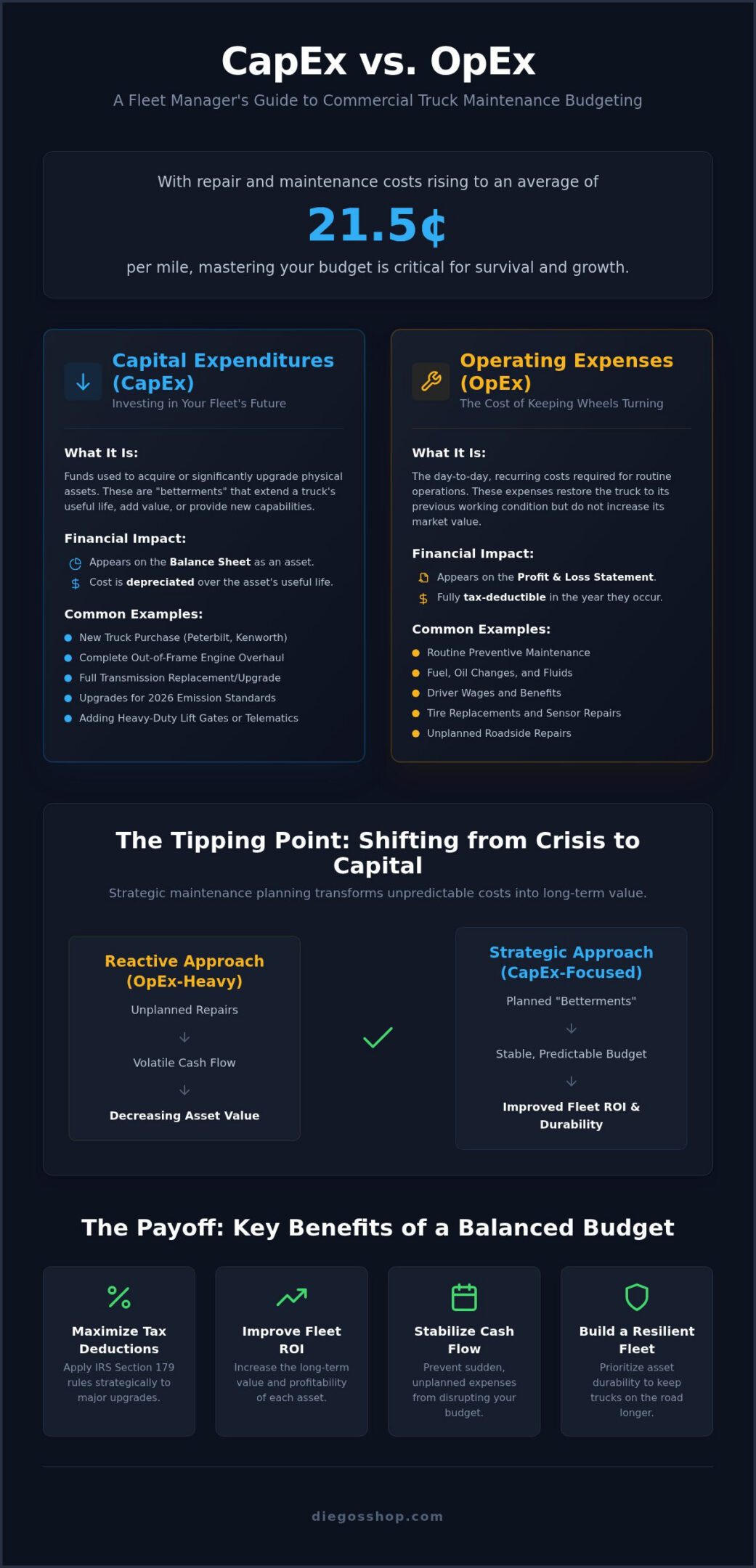
Strategic Balancing: Shifting Maintenance from Crisis to Capital
Finding the tipping point is where fleet managers earn their keep. It’s the moment when routine maintenance no longer makes sense for a deteriorating asset. By shifting to a capital mindset, you can transform a failing truck into a renewed asset. High-quality diesel engine repair is the bridge between these two worlds. It protects your original investment while avoiding the massive debt of a new vehicle purchase. Mastering your capex vs opex budget for commercial truck maintenance means knowing exactly when to stop patching and start rebuilding. This strategy ensures you aren’t just spending money to survive, but investing money to thrive.
A hybrid budget is the most effective way to manage a modern fleet. It acknowledges the necessity of daily operating costs while preparing for the inevitable major overhauls that define long-term success. When you move a major repair from an unplanned OpEx crisis to a planned CapEx investment, you stabilize your cash flow and improve your company’s creditworthiness. This level of financial control is what separates industry leaders from those who are constantly chasing their tails.
The Repair vs. Replace Framework
The financial logic of a rebuild is often undeniable. A $20,000 engine rebuild is a small fraction of the $180,000 price tag for a new 2026 heavy-duty truck. If the chassis and drivetrain still have a significant portion of their useful life, the rebuild represents a superior ROI. Utah’s harsh terrain, characterized by steep mountain grades and heavy winter road salt, accelerates the wear on critical components and demands more frequent ROI analysis. By focusing on the health of the entire drivetrain, you can justify the capital expenditure needed to keep a proven truck in service for another five years. It’s a no-nonsense approach to asset management.
Predicting Future Capital Needs
Fleet telematics and shop history are your best forecasting tools. By tracking fault codes and wear patterns, you can predict major failures months before they happen. This foresight allows you to create a “Sinking Fund” for upcoming CapEx requirements, ensuring the cash is ready when the work is scheduled. Regularly scheduled dot truck inspections near me act as an early warning system, identifying minor leaks or wear that signal a major component is reaching its limit. Using these inspections as a diagnostic tool helps you transition from reactive repairs to proactive capital planning. To ensure your fleet is prepared for the road ahead, contact Diego’s Shop for a comprehensive fleet evaluation.
Optimizing Your Maintenance Budget with Diego’s Diesel Expertise
Managing a fleet in Utah County requires a partner who understands both the mechanical and financial demands of the industry. At Diego’s Shop, we don’t just fix trucks; we help you protect your investment. We specialize in medium and heavy-duty diesel repair for major brands like Peterbilt, Kenworth, and Ford. By providing warrantied repair work, we ensure your major fixes qualify as secure capital investments rather than temporary patches. This level of technical mastery is essential for any fleet manager trying to balance a capex vs opex budget for commercial truck maintenance without sacrificing reliability.
Our approach to preventive maintenance is designed to stop OpEx spikes before they happen. We look for the small issues that lead to expensive roadside failures. By identifying wear early, we help you transition from reactive spending to proactive planning. This strategy keeps your operating costs predictable and your trucks on the road where they belong. We believe in providing total control over complex mechanical situations, giving you the peace of mind that comes from working with a seasoned craftsman who understands the value of your equipment.
Customized Fleet Service Plans
Every fleet has a unique duty cycle. A truck hauling heavy loads through the canyon passes of the Wasatch Front requires a different maintenance interval than one running flat miles on the interstate. We tailor our service plans to your specific needs, ensuring you aren’t over-maintaining or under-protecting your assets. Our detailed reporting helps your accounting team accurately classify expenses. When our master craftsmen identify “betterment” opportunities during routine service, we provide the documentation needed to support your capital planning. This transparency ensures your capex vs opex budget for commercial truck maintenance remains a tool for growth rather than a source of confusion.
Peace of Mind for the Long Haul
Trust and integrity are the foundation of our business. We take pride in the durability of our work and the technical skill of our team. Commercial diesel repair is a high-stakes field where hands-on expertise makes the difference between a profitable quarter and a financial setback. By taking personal accountability for every truck in our bays, we reduce the stress of fleet management. You can focus on your business while we handle the technical mastery. We invite you to experience the difference that a dedicated local partner can make for your bottom line. Schedule a fleet maintenance consultation at Diego’s Shop today.
Securing Your Fleet’s Financial and Mechanical Future
Mastering your capex vs opex budget for commercial truck maintenance is about more than just numbers on a page. It’s about maintaining total control over the machinery that powers your livelihood. By distinguishing between routine operating costs and strategic capital investments, you gain the clarity needed to make smarter, more profitable decisions. You now have the framework to categorize major overhauls as betterments, allowing you to maximize tax benefits while extending the useful life of your diesel assets.
Diego’s Shop is here to provide the technical mastery your fleet deserves. We offer expert diagnostics for Peterbilt, Kenworth, and Ford trucks, serving the Wasatch Front with integrity and skill. Our warrantied repair work on all major diesel systems ensures that your capital investments are protected for the long haul. We’re committed to helping you turn maintenance from a source of stress into a strategic advantage. It’s time to move beyond reactive repairs and build a budget that supports growth.
Request a Professional Fleet Maintenance Plan from Diego’s Shop to stabilize your budget and improve your ROI. Your trucks are built for hard work, and we’re here to ensure they stay on the road for years to come.
Frequently Asked Questions
Is a truck engine rebuild considered CapEx or OpEx?
A truck engine rebuild is typically considered a Capital Expenditure (CapEx) if it extends the asset’s useful life or increases its overall value. This process, often called a betterment, resets the mechanical clock on the engine. If the rebuild merely restores the truck to its previous working state after a failure, some accountants might classify it as an operating expense. However, most heavy-duty diesel overhauls are capitalized and depreciated over several years.
Can I deduct the full cost of a new commercial truck in 2026?
Yes, you can likely deduct the full cost of a new commercial truck in 2026 using the Section 179 deduction. For the 2026 tax year, the limit for heavy vehicles is $2.56 million. This allows businesses to write off the entire purchase price in the first year rather than depreciating it over a long period. It’s a powerful tool for fleets looking to modernize their equipment while reducing their immediate tax liability.
How do I classify a major tire replacement for a heavy-duty fleet?
Major tire replacements are almost always classified as Operating Expenses (OpEx). Tires are considered consumables because they wear out through normal use and don’t significantly increase the truck’s overall market value or life. Even when replacing all eighteen tires on a semi-truck, the cost is fully deductible in the year it occurs. This recurring expense is a key component of your monthly cash flow planning and daily operational costs.
What is the ‘Useful Life’ of a commercial diesel engine for accounting purposes?
For IRS accounting purposes, the useful life of a commercial diesel engine is generally five to seven years. While a well-maintained engine can run for over a million miles, the depreciation schedule is fixed by tax regulations. Understanding this timeframe is essential when balancing your capex vs opex budget for commercial truck maintenance. It helps you decide when to invest in a capital overhaul versus continuing with routine operating repairs as the asset ages.
Does preventive maintenance count toward my capital budget?
No, preventive maintenance does not count toward your capital budget; it’s a primary operating expense. Tasks like oil changes, valve adjustments, and fluid flushes are necessary to keep the vehicle in its existing condition. These costs are fully deductible in the current tax year. While they protect your capital investment, they don’t meet the IRS criteria for an “improvement” that would require capitalization on your company’s balance sheet.
How does the IRS distinguish between a repair and an improvement?
The IRS distinguishes between the two based on the nature of the work performed. Repairs are routine maintenance that keeps a truck in standard operating condition. Improvements are “betterments” that increase the truck’s value, extend its life, or adapt it for a different purpose. Correctly identifying these categories is vital for a capex vs opex budget for commercial truck maintenance. It ensures your tax filings are accurate and your financial reports reflect true asset value.
Why should Utah fleet managers worry about depreciation schedules?
Utah fleet managers must prioritize depreciation schedules to manage the financial impact of the Wasatch Front’s harsh operating environment. The steep mountain grades and heavy road salt use can accelerate wear, meaning a truck’s mechanical life might not always align with its tax life. Strategic depreciation allows you to offset these higher maintenance costs. It provides the cash flow needed to replace equipment before it becomes a liability to your operation.
What happens if I incorrectly classify an expense on my fleet budget?
Incorrectly classifying an expense can lead to tax penalties and audit risks. If you capitalize a routine repair, you’re delaying a deduction you could have taken immediately. If you deduct a capital improvement as an operating expense, you might underpay your taxes, triggering IRS scrutiny. Beyond tax issues, it distorts your fleet’s Total Cost of Ownership (TCO). This makes it difficult to determine if your trucks are truly profitable and when they should be replaced.