
Common Ford Power Stroke Problems: The 2026 Reliability & Repair Guide

A single metal shaving in your fuel system shouldn’t result in a total engine teardown, but for many diesel owners, it’s a reality that brings their business to a dead stop. Whether you’re hauling heavy loads up the Wasatch Front or managing a fleet in Utah County, understanding common Ford Power Stroke problems is the only way to protect your investment. Most drivers view these engines as bulletproof workhorses, yet every generation from the 6.0L to the latest 2026 models has specific vulnerabilities, including recent driveshaft recalls and high-pressure fuel pump risks, that can lead to catastrophic failure if they’re left unchecked.
It’s frustrating to deal with unpredictable downtime and the stress of a mounting repair bill. You need a truck that works as hard as you do without the constant fear of a dashboard warning light. This guide will identify the critical weak points for every Power Stroke generation and provide a clear plan to extend your truck’s life. We’ll also look at how Utah’s specific climate and the new 2026 emissions testing requirements impact your maintenance needs, helping you find the specialized expertise required to keep your engine running at peak performance.
Key Takeaways
- Understand how common Ford Power Stroke problems evolve across generations, allowing you to prioritize the right repairs for your specific engine model.
- Identify high-risk components like the CP4 fuel pump and plastic charge pipes to prevent sudden, expensive failures that lead to extended downtime.
- Learn how Utah’s unique high-altitude terrain and extreme temperature swings increase engine stress and which specialized maintenance steps counteract these factors.
- Use data-driven tools like oil analysis and professional inspection protocols to detect hidden wear before it causes a catastrophic engine shutdown.
- Build a proactive maintenance plan that transforms your truck from a potential liability into a reliable, long-term asset for your fleet or personal use.
The Evolution of Power Stroke: Why ‘Common Problems’ Vary by Year
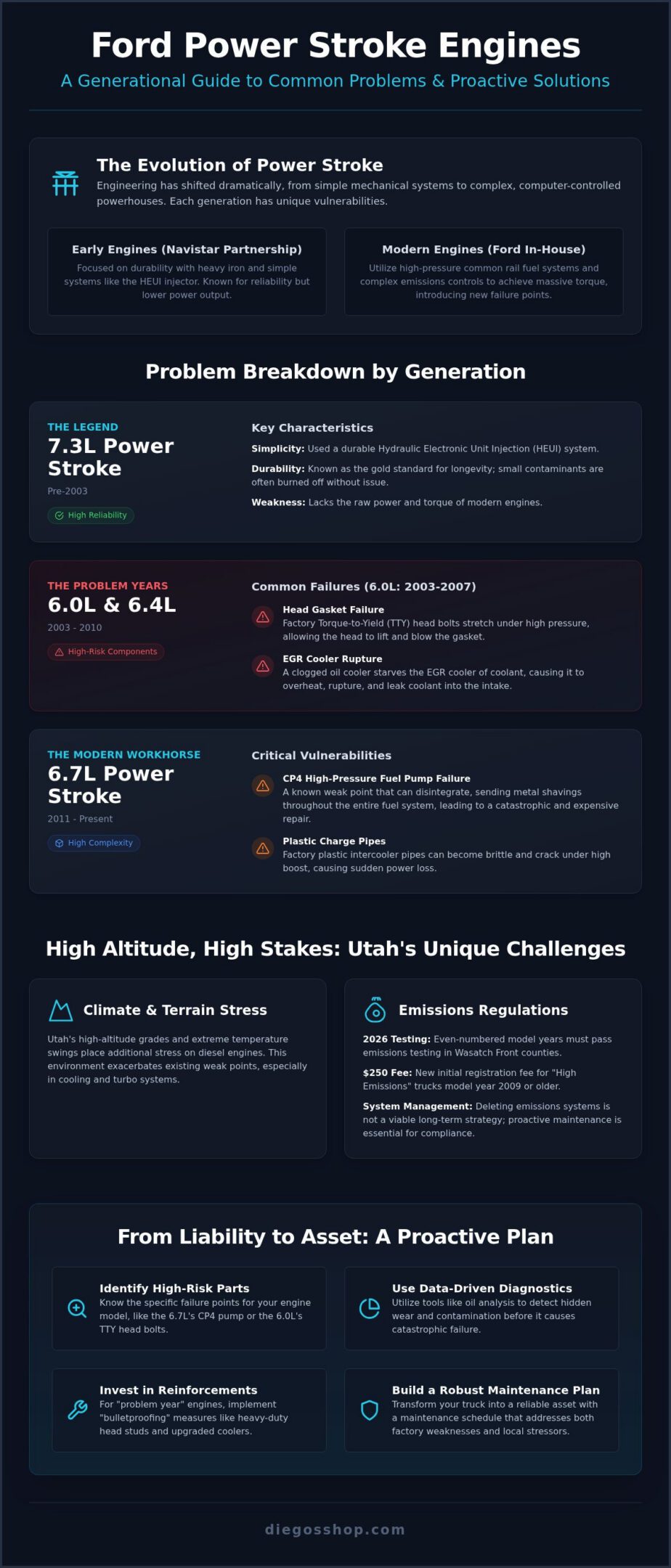
Understanding the history of the Ford Power Stroke engine family is essential for any truck owner. The issues you face in a 2002 F-250 aren’t the same as those in a 2026 High-Output 6.7L. For decades, Ford partnered with Navistar to build these powerplants, creating legendary engines like the 7.3L. However, as federal emissions standards tightened and the demand for higher torque increased, the partnership dissolved. Ford began designing and building the 6.7L in-house starting in 2011. This shift changed everything from diagnostic protocols to the common Ford Power Stroke problems technicians see in the shop today.
A “one size fits all” repair approach fails because the engineering philosophy shifted dramatically over the years. Early engines relied on heavy iron and simple mechanical systems. Modern versions use complex high-pressure common rail fuel systems and sophisticated computer controls to deliver 1,200 lb-ft of torque. Treating a modern 6.7L with the same diagnostic logic as an old 7.3L leads to misdiagnosis and wasted money.
The 7.3L Legacy vs. Modern Complexity
The 7.3L Power Stroke remains the gold standard for simplicity. It used a Hydraulic Electronic Unit Injection (HEUI) system that was incredibly durable, though it lacked the raw power of today’s engines. As Ford moved toward the 6.0L and 6.4L, they introduced variable geometry turbochargers and higher injection pressures. While these changes provided massive gains in horsepower, they also introduced more failure points. Modern engines are far more capable, but they require precision maintenance. A small amount of contamination that a 7.3L would simply burn off can now cause a $10,000 fuel system failure in a newer model.
The Impact of Emissions Controls on Diesel Longevity
Emissions regulations changed the reliability landscape more than any other factor. The introduction of Exhaust Gas Recirculation (EGR) and Diesel Particulate Filters (DPF) forced engines to “re-breathe” soot and run hot regeneration cycles. These systems are often at the heart of common Ford Power Stroke problems, leading to oil dilution and clogged coolers.
In Utah, these systems face extra scrutiny. As of 2026, even-numbered model years like 2022 and 2024 must pass emissions testing in counties along the Wasatch Front. Additionally, owners of trucks from 2009 or older now face a $250 initial registration fee under new “High Emissions Heavy Duty Vehicle” regulations. “Deleting” these systems isn’t a viable long-term strategy for local owners. Instead, proactive fleet maintenance and specialized cleaning are the only ways to ensure compliance while protecting engine longevity. Reliable performance depends on managing these systems rather than ignoring them.
Breaking Down the ‘Problem Years’: 6.0L and 6.4L Weak Points
The 6.0L and 6.4L eras represent a turbulent time for Ford diesel owners. While these trucks offer impressive power, they are responsible for the majority of common Ford Power Stroke problems that lead to heavy repair bills. Navigating these specific generations requires a technical understanding of where the factory engineering fell short. For fleet owners in Utah, these engines often require specific reinforcements to handle the stress of high-altitude towing and steep grades without suffering a terminal breakdown.
6.0L Power Stroke: Solving the Top-End Issues
The 6.0L Power Stroke, produced between 2003 and 2007, is notorious for head gasket failures. The root cause is the factory torque-to-yield head bolts. These bolts are designed to stretch, but under the high cylinder pressures of a diesel engine, they stretch too far. This allows the head to lift, blowing the gasket. This issue is often compounded by a clogged oil cooler. When the tiny passages in the oil cooler become restricted by coolant additives or debris, it starves the EGR cooler of coolant. This leads to the EGR cooler rupturing and leaking coolant directly into the intake manifold.
Bulletproofing is a multi-step reinforcement process involving the installation of heavy-duty head studs, upgraded oil coolers, and improved EGR components to fix factory design flaws in the 6.0L engine. By replacing the stretching bolts with solid studs, we provide the clamping force necessary to keep the engine sealed. If you are managing a fleet of these older workhorses, expert diesel engine repair can often save a 6.0L from the scrap heap by addressing these flaws before they cause a total meltdown.
6.4L Power Stroke: Managing the Fuel and Turbo System
Many technicians consider the 6.4L (2008-2010) the most at-risk Power Stroke generation. Its biggest weakness is the fuel system. The piezo-electric injectors are highly sensitive to fuel quality and can stick open, which quickly leads to fuel dilution in the oil or a cracked piston. Because the 6.4L uses a compound turbocharger setup to provide instant throttle response, the heat and pressure generated are immense. These turbos are complex to service and often require the cab of the truck to be removed for access, significantly increasing labor costs.
Fuel system reliability has been a recurring theme for Ford, as seen in the NHTSA recall for fuel pump failures that affected later 6.7L models. For the 6.4L, cleanliness is your only defense. You must identify early warning signs like rising oil levels or excessive white smoke before a piston melts. Given the high cost of a 6.4L long-block replacement, owners must weigh the price of major repairs against the truck’s remaining value. Regular oil analysis is the best tool for determining when it is time to fix the engine and when it is time to move on.
The Modern 6.7L Power Stroke: Common Failures and Fixes
Since its introduction in 2011, the 6.7L Power Stroke has served as the backbone of Ford’s Super Duty lineup. It is a formidable engine that moved away from the head gasket issues of the 6.0L, yet it introduced a new set of common Ford Power Stroke problems that can leave even the most diligent owner stranded. Modern complexity requires modern solutions. From the high-pressure fuel system to the intricate turbocharger components, understanding these vulnerabilities is the first step toward maintaining a reliable work truck.
The CP4 Pump Crisis and Disaster Prevention
The Bosch CP4 high-pressure fuel pump is often described as a “time bomb” within the diesel community. Unlike the older CP3, the CP4 relies heavily on the lubrication properties of diesel fuel. Modern ultra-low sulfur diesel (ULSD) often lacks the necessary lubricity to keep the pump’s internal components moving smoothly. When the pump fails, it generates fine metal shavings that circulate through the entire fuel system, including the injectors and fuel rails. A catastrophic failure of this nature can result in repair costs exceeding $10,000.
Installing a disaster prevention kit is a smart move for any 6.7L owner. These kits reroute the fuel flow so that if a pump fails, the metal debris is caught by the fuel filters rather than entering the injectors. Addressing these common Ford Power Stroke problems through hardware upgrades is essential, but regular fuel filter changes at a diesel engine repair specialist are also non-negotiable. Clean, lubricated fuel is the lifeblood of this engine.
Exhaust and Cooling System Nuances
The 6.7L utilizes a “Reverse Flow” cylinder head design where the exhaust exits into the “V” of the engine. This allows for shorter turbo plumbing and better efficiency, but it also concentrates heat in a way that can stress exhaust gas temperature (EGT) sensors. When an EGT sensor fails, the truck may trigger a “Stop Engine Now” warning, forcing an immediate shutdown to prevent damage. Early 2011 to 2014 models also struggled with turbocharger bearing failures due to a ceramic design. Ford eventually updated these to more durable steel bearings, but owners of early 6.7L trucks should remain vigilant.
Reliability is further complicated by the dual cooling systems. Ford uses two separate radiators and two water pumps to manage different temperature requirements for the engine and the intercooler. While effective, this creates more potential leak points. Owners should also watch for the “Death Wobble,” a violent steering wheel oscillation common in the F-250 and F-350 chassis. It is typically caused by worn track bar bushings or steering dampers and requires immediate attention to ensure safety on the road.
Finally, the plastic cold-side charge pipes on these engines are known to burst under high boost. When this happens, you lose all power instantly. Replacing these with aftermarket silicone or metal pipes is a simple fix that prevents a major headache during a haul. Proper maintenance ensures these modern machines stay on the road where they belong.
How Utah’s Climate and Terrain Impact Power Stroke Longevity
Utah’s unique geography presents a brutal testing ground for heavy-duty trucks. While Ford builds these engines for national standards, the specific conditions along the Wasatch Front can accelerate common Ford Power Stroke problems that owners in flatter, lower states rarely encounter. High altitude, extreme temperature swings, and steep mountain passes create a perfect storm of mechanical stress. Managing these challenges requires a specialized maintenance strategy that respects the demands of the Intermountain West.
Mountain Towing and Heat Management
Towing a heavy trailer up Parley’s Canyon or Spanish Fork Canyon puts immense strain on your engine’s cooling and transmission systems. These routes feature sustained 6% grades that force your Power Stroke to stay in high-boost mode for extended periods. Factory cooling systems often struggle to keep up under these conditions, especially when ambient summer temperatures exceed 90 degrees. It is vital to monitor your transmission fluid temperatures during these hauls, as excessive heat is the primary cause of premature transmission failure in heavy-duty Fords.
At altitudes of 4,500 feet and higher, the thinner air requires the turbocharger to spin faster to maintain boost levels, which significantly increases exhaust gas temperatures and places additional thermal stress on engine components. This extra work can lead to the turbocharger bearing failures mentioned in previous sections. Additionally, the Intermountain West is a dusty environment. Fine particulate matter can clog air filters much faster than the factory-recommended intervals suggest. We recommend more frequent filter inspections to ensure your turbo isn’t sucking in debris that could score the compressor wheel.
Winter Diesel Challenges in Springville and Beyond
Winter in Utah County brings its own set of risks. Sub-zero nights in Springville can lead to fuel gelling, where the paraffin wax in diesel fuel solidifies and chokes off the fuel lines. This is particularly dangerous for the sensitive CP4 pumps discussed earlier, as a lack of fluid flow can lead to immediate internal damage. Battery health is another critical factor. A diesel engine requires massive cranking amps to overcome high compression in the cold. If your batteries are over three years old, they may lack the strength to start your truck on a January morning.
Proper diesel maintenance is the only way to prepare your fleet for a Utah winter. This includes testing your glow plugs and block heater before the first frost hits to avoid being stranded. If your truck is struggling with cold starts or running hot on the canyons, it’s time for a professional evaluation. You can rely on Diego’s Shop for expert Utah diesel repair that accounts for our state’s unique terrain and climate. We understand exactly what it takes to keep a Power Stroke reliable in the high desert.
Proactive Maintenance: Turning ‘Problems’ into Performance
Waiting for a dashboard warning light is the most expensive way to own a diesel truck. While the factory engineering has its flaws, most common Ford Power Stroke problems are entirely predictable. By shifting from a reactive mindset to a proactive one, you can transform your vehicle from a source of anxiety into a reliable asset capable of exceeding 300,000 miles. At Diego’s Shop, we don’t just wait for parts to break. We use a “Fleet-Grade” inspection protocol designed to identify wear patterns before they result in catastrophic engine failure.
Data is your best defense against high repair bills. Regular oil analysis allows us to look inside the engine without taking it apart, catching traces of copper or lead that signal bearing wear or fuel dilution from a leaking injector. Similarly, proactive cooling system flushes are vital. As we discussed in previous sections, clogs in the oil cooler or EGR system are the primary killers of 6.0L and 6.7L engines. Keeping these passages clear is the simplest way to prevent a total top-end meltdown. For commercial owners, consistent fleet maintenance is the only proven strategy to eliminate unpredictable downtime and keep your crew on the job.
The Diego’s Shop Preventive Maintenance Checklist
Our maintenance approach is tailored to the harsh realities of the Wasatch Front. We recommend a tighter service schedule than the factory manual to account for our altitude and temperature extremes:
- Fuel Filter Intervals: We recommend replacement every 10,000 miles, rather than the factory-suggested 22,500, to protect the sensitive CP4 pump from contamination.
- Diagnostic Health Scans: We check for “soft codes” that haven’t triggered a check engine light yet but indicate sensors or emissions components are beginning to drift out of spec.
- Brake and Suspension Stress Tests: Given Utah’s steep grades, we perform deep inspections on braking systems and track bars to ensure your heavy-duty hauler remains safe under load.
Warrantied Repairs and Peace of Mind
There is a significant difference between a general mechanic and a master-level diesel specialist. Power Stroke engines require specific diagnostic tools and a deep understanding of high-pressure common rail systems that most shops simply don’t possess. We take pride in our technical skill and the durability of our work. That’s why we provide warrantied repair work, giving you the confidence that the job was done right the first time.
Don’t let common Ford Power Stroke problems dictate your schedule or drain your budget. Whether you’re a solo owner-operator or managing a large municipal fleet, our Springville facility is equipped to handle everything from precision diagnostics to major engine reinforcements. Contact us today to schedule a comprehensive health check and build a maintenance plan that keeps your truck on the road for the long haul. Expert care is the only way to ensure total control over your engine’s future.
Secure Your Engine’s Future on the Wasatch Front
Owning a Power Stroke in Utah means balancing high performance with the reality of mountain driving. We have explored how different engine generations face unique vulnerabilities, from the head gasket issues of the 6.0L to the fuel system sensitivities of the modern 6.7L. By understanding these risks and implementing a “Fleet-Grade” maintenance schedule, you shift the odds in your favor. Data-driven care and frequent inspections are the only ways to prevent a minor mechanical flaw from turning into a total engine teardown.
Navigating the landscape of common Ford Power Stroke problems requires more than just a general mechanic’s toolkit; it demands the precision of a master craftsman who understands the nuances of the Intermountain West. At Diego’s Shop, we specialize in commercial fleet uptime and master-level diesel diagnostics to ensure your truck remains a reliable tool for your business. Serving Springville and the entire Wasatch Front, we provide the peace of mind that comes from warrantied work and deep technical expertise.
Keep your Power Stroke on the road—Schedule your Expert Diesel Service at Diego’s Shop today. Your truck has plenty of miles left in it. Let’s make sure they are trouble-free.
Frequently Asked Questions
Is the 6.7 Power Stroke a reliable engine?
The 6.7L Power Stroke is widely considered the most reliable diesel Ford has produced since the 7.3L era. While early 2011 to 2014 models faced turbocharger and sensor issues, the third generation released in 2020 addressed most common Ford Power Stroke problems. Its compacted graphite iron block and integrated exhaust manifold make it a durable choice for heavy hauling, provided you manage the emissions system and fuel quality diligently.
What is the worst year for the Ford Power Stroke diesel?
The 2008 to 2010 model years, equipped with the 6.4L engine, are generally regarded as the most problematic for owners. These trucks suffer from fragile fuel systems and compound turbochargers that are notoriously expensive to service. Because these engines often require a complete replacement rather than a simple repair when a piston cracks, they represent a significant financial risk for second-hand buyers compared to other generations.
How much does it cost to fix a CP4 pump failure?
Fixing a catastrophic CP4 pump failure is one of the most expensive repairs in the diesel industry because it requires a complete fuel system overhaul. When the pump fails, it sends fine metal debris through the injectors, rails, and lines, meaning every component touched by fuel must be replaced or meticulously cleaned. It is a major investment that highlights why many owners choose to install disaster prevention kits before a failure occurs.
What are the early signs of a blown head gasket on a 6.0 Power Stroke?
Early warning signs of a blown head gasket on a 6.0L include white smoke from the exhaust and coolant residue around the degas bottle cap, often called “puking.” You might also notice a significant loss of coolant without any visible external leaks on the ground. This happens because high cylinder pressure escapes past the factory head bolts and enters the cooling system, eventually forcing coolant out of the reservoir under load.
Should I buy a used truck with a 6.4 Power Stroke engine?
Buying a used 6.4L Power Stroke is a high-stakes decision that requires a thorough pre-purchase inspection by a diesel specialist. While these trucks offer impressive power, their tendency for fuel dilution and cracked pistons makes them a gamble if maintenance records aren’t impeccable. Unless you have a dedicated budget for potential engine work, many professionals recommend looking toward a 6.7L or a properly reinforced 6.0L instead.
How often should I change the oil in my Power Stroke for maximum longevity?
For maximum engine longevity, we recommend changing your oil every 5,000 to 7,500 miles, especially when hauling in the Intermountain West. Although factory manuals sometimes suggest longer intervals, Utah’s high altitude and steep grades place extra thermal stress on engine oil. Frequent changes help remove soot and contaminants that can lead to premature wear on your bearings and high-pressure fuel components.
What does ‘Bulletproofing’ a Ford diesel actually mean?
Bulletproofing refers to a specific set of mechanical upgrades designed to correct factory design flaws in the 6.0L Power Stroke. The process typically includes replacing factory head bolts with heavy-duty studs, installing an upgraded oil cooler, and reinforcing the EGR system. By addressing these common Ford Power Stroke problems simultaneously, you create a much more dependable engine that can handle the rigors of daily commercial use without constant top-end failures.
Why is my Ford truck losing power when towing through Utah canyons?
Losing power while towing through Utah canyons is often caused by high exhaust gas temperatures or turbocharger heat soak. As you climb steep grades like Parley’s Canyon, the thinner air at high altitudes makes it harder for the turbo to provide sufficient boost without generating excessive heat. If the engine’s computer detects temperatures rising beyond safe limits, it will reduce power output to protect the internal components from thermal damage.