
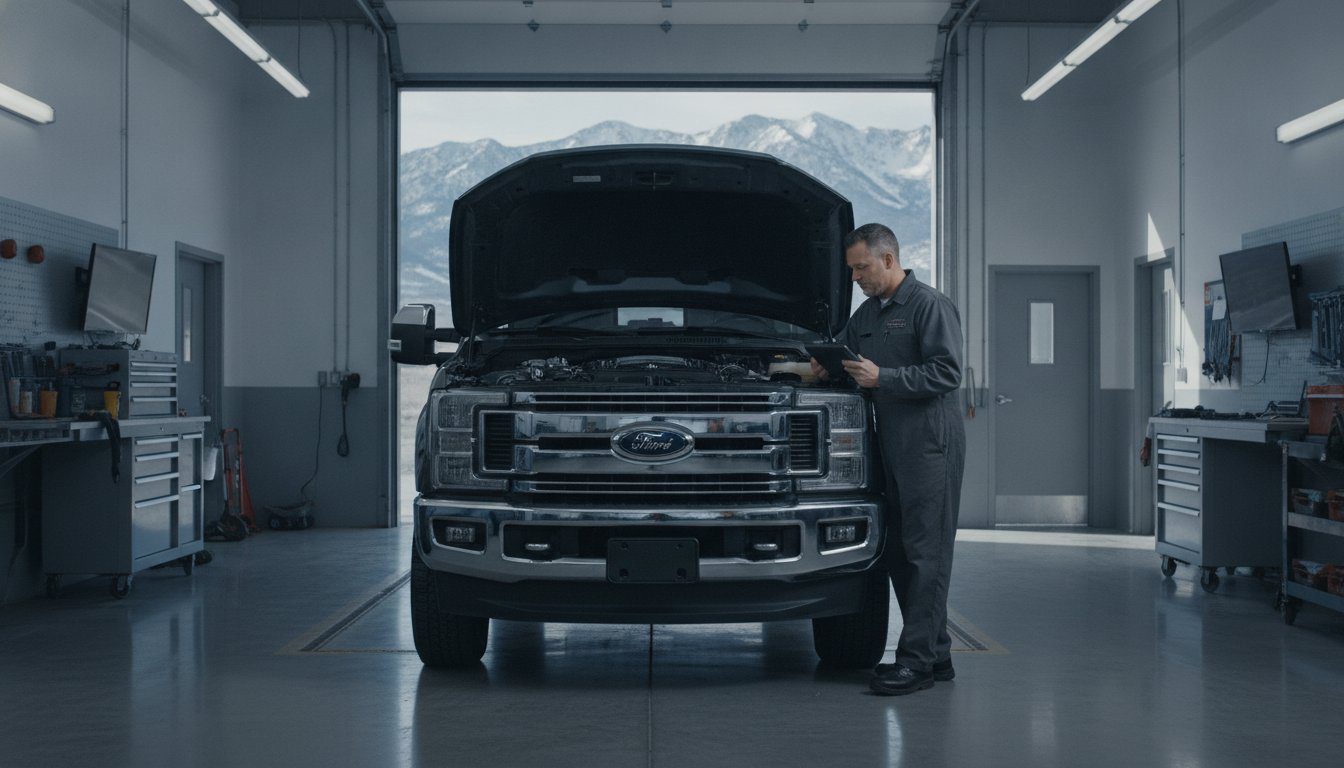
Common Ford Power Stroke Problems: A Guide to Reliability and Repair in 2026

Ford has already recalled more than 11 million vehicles in the first half of 2026, and for many Super Duty owners in Utah County, the stress of unplanned downtime is becoming a daily reality. You rely on your truck to power your livelihood, but the complexity of modern diesel systems can make even a minor sensor glitch feel like a financial disaster. Identifying common Ford Power Stroke problems before they sideline your fleet is the only way to maintain a profitable operation and avoid the frustration of a dead engine on the side of I-15.
We understand that you need clear answers, not technical jargon. This guide identifies the specific failures plaguing every engine generation, from the notorious 6.0L and 6.4L models to the latest 2026 Super Duty recalls involving driveshaft welds and instrument cluster failures. You will learn the professional maintenance strategies used by diesel specialists to prevent catastrophic fuel system breakdowns and stay compliant with Utah’s 2026 emissions regulations. Whether you are managing a fleet in Springville or a single work truck, this is how you build a reliable diesel that lasts.
Key Takeaways
- Understand why Ford moved production in-house and how this engineering shift changed the reliability landscape for Super Duty owners.
- Learn to spot the symptoms of common Ford Power Stroke problems like CP4 pump failures and 2026 recall issues before they cause a total system breakdown.
- Pinpoint the critical weaknesses in the 6.0L and 6.4L engines, including head gasket failures and high-pressure fuel leaks.
- Adapt your service schedule for Utah’s extreme conditions to manage high exhaust gas temperatures in the mountains and cold-start issues in the winter.
- Discover how professional fleet maintenance and warrantied repairs can eliminate the stress of unplanned downtime for your business.
The Evolution of Power Stroke Reliability: What Owners Need to Know
Understanding common Ford Power Stroke problems requires a look back at how these engines evolved from mechanical simplicity to electronic complexity. The Ford Power Stroke engine family has undergone four major iterations since 1994, moving from the legendary 7.3L to the controversial 6.0L and 6.4L, and finally to the current 6.7L powerhouse. The Power Stroke stands as a high-torque workhorse designed for both demanding commercial applications and heavy-duty residential towing. For decades, it has been the backbone of Utah’s construction and transport industries.
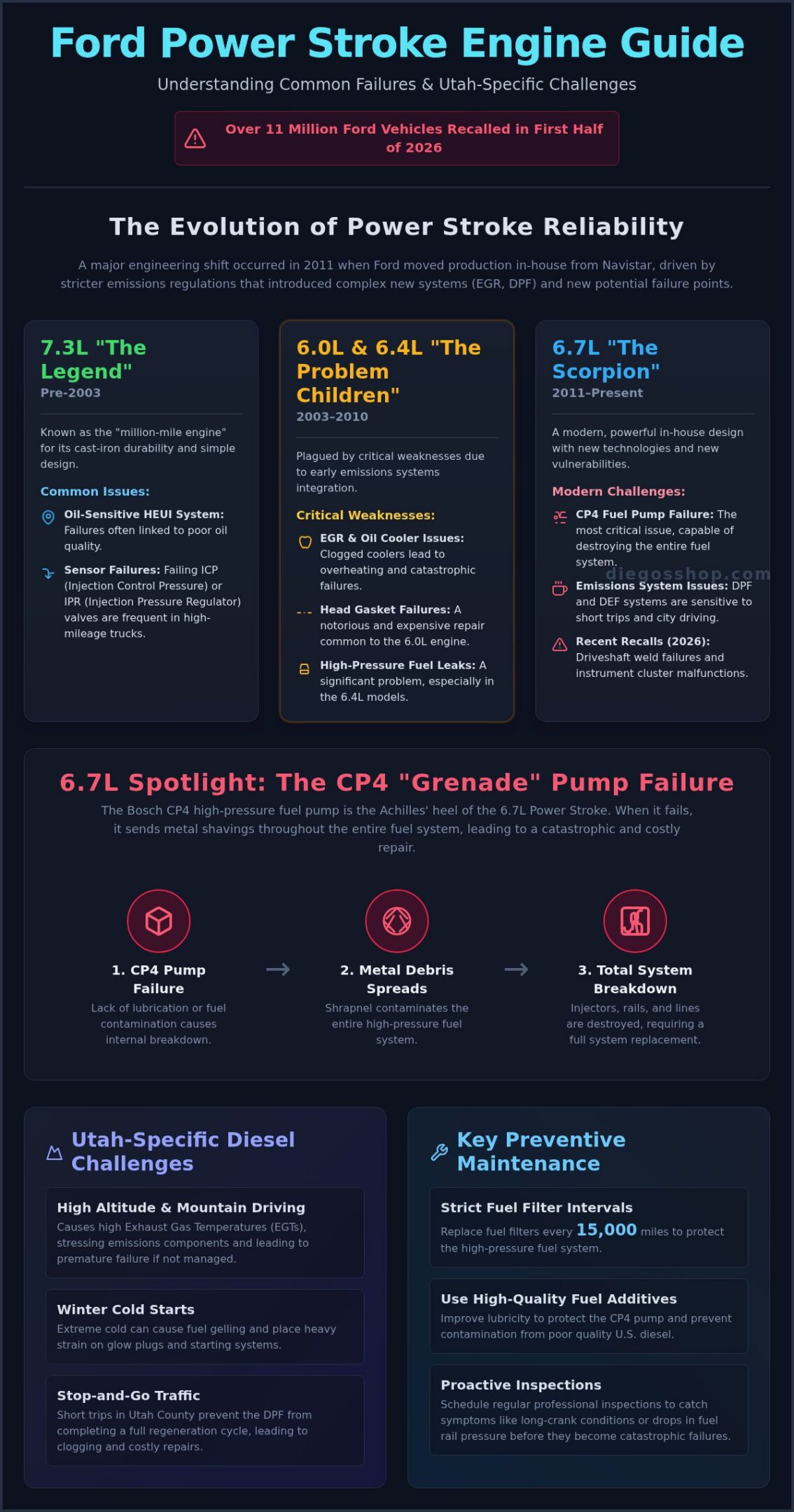
The year 2011 marked a massive shift in the reliability landscape when Ford moved production in-house. Before this, engines were built by Navistar; afterward, Ford took total control of the engineering and manufacturing process. This transition was driven by the “Emissions Era,” a period defined by increasingly strict federal regulations. These rules forced the integration of complex Exhaust Gas Recirculation (EGR) and Diesel Particulate Filter (DPF) systems. While these systems made trucks cleaner, they also introduced new layers of modern diesel diagnostics that require specialized tools and expertise to manage effectively.
The 7.3L Legacy: Why It’s Still on the Road
The 7.3L Power Stroke is often called the “million-mile engine” because of its cast-iron durability and straightforward design. It utilizes a Hydraulic Electronic Unit Injection (HEUI) system, which uses high-pressure engine oil to fire the fuel injectors. While robust, this system is sensitive to oil quality. We frequently see high-mileage 7.3L trucks with common Ford Power Stroke problems like failing Injection Control Pressure (ICP) sensors or Injection Pressure Regulator (IPR) valves. These engines lack the massive horsepower of modern diesels, but their lack of complex emissions hardware makes them a favorite for owners who prioritize simplicity over speed.
The 6.7L Era: A New Standard for Performance
Introduced in 2011, the 6.7L Power Stroke was a clean-sheet design that utilized a Compacted Graphite Iron (CGI) block. This material provides superior strength while reducing overall engine weight. Ford also moved to an innovative air-to-water intercooler system, which significantly improved towing efficiency by maintaining consistent intake temperatures. The trade-off for this performance is a massive increase in electronic monitoring. A single faulty exhaust temperature sensor or a DEF pump glitch can now trigger a “limp mode” event, effectively sidelining your truck until a specialist can clear the code and perform the necessary diesel engine repair. It’s a sophisticated machine that demands a proactive approach to maintenance.
Common 6.7L Power Stroke Problems (2011–2026)
While the 6.7L is a massive improvement over its predecessors, it’s not without its own set of mechanical hurdles. Owners frequently encounter common Ford Power Stroke problems that stem from high-pressure fuel components and sensitive exhaust treatment systems. Even the latest 2023–2026 High Output (HO) variants face growing pains. These newer models have already seen 2026 recalls for driveshaft weld failures and instrument cluster malfunctions that can leave a driver without critical engine data at startup. Staying ahead of these issues is the difference between a productive workday and an expensive tow bill.
Fuel System Vulnerabilities and Contamination
The Bosch CP4 high-pressure fuel pump is the most notorious failure point in the 6.7L lineup. It’s often referred to as a “grenade” because when it fails, it sends metal debris through the entire fuel system, including the injectors and rails. This catastrophic event often stems from the pump’s sensitivity to poor fuel quality and a lack of lubrication in U.S. diesel. This issue has been so widespread it’s led to recent fuel pump recalls. To protect your investment, we recommend using high-quality fuel additives and strictly adhering to a 15,000-mile fuel filter replacement interval. If you’re noticing a drop in fuel rail pressure or a long-crank condition, scheduling a preventive maintenance inspection is the best way to catch a failing pump before it destroys your injectors.
Emissions System: DPF and DEF Challenges
The emissions hardware on a 6.7L Power Stroke is designed for the open highway, not stop-and-go traffic in Utah County. Short trips prevent the Diesel Particulate Filter (DPF) from reaching the temperatures needed for a complete “Regen” cycle. This leads to soot buildup and eventual clogging. Utah’s harsh winters present another challenge as Diesel Exhaust Fluid (DEF) can freeze at 12 degrees Fahrenheit. If a DEF heater or pump fails, the truck’s computer will eventually limit your speed to a crawl. When these sensors act up, you need Expert Diesel Engine Repair: A Guide to Service Done Right to ensure the root cause is addressed rather than just clearing a code.
Early 6.7L models from 2011 to 2014 also faced specific turbocharger wastegate and actuator failures. These electrical glitches often trigger the dreaded “Pull Over Safely” message on the dash. While Ford has updated these components in later years, the complexity of the Variable Geometry Turbo (VGT) means that even a small sensor fault can mimic a total turbo failure. Accurate diagnostics are essential to avoid replacing expensive parts that still have life in them. Our shop focuses on pinpointing these exact failures to keep your repair costs manageable and your truck on the road.
The ‘Problem Children’: 6.0L and 6.4L Specific Issues
While the 6.7L dominates the current market, many Utah fleets still rely on the older 6.0L and 6.4L engines for heavy-duty work. These engines earned a reputation for being temperamental, but they can be reliable with a focused technical approach. Understanding common failure points is the first step toward preventing a total engine meltdown. These models require a specialist’s touch because their tolerances are much tighter than the older 7.3L, and a single cooling failure can lead to a chain reaction of broken parts.
The 6.0L Power Stroke is famous for head bolt stretching. Factory bolts often fail to handle the cylinder pressure, which eventually blows the head gaskets. However, the true silent killer of this engine is the oil cooler. When the tiny passages in the cooler clog with debris or degraded coolant, it starves the EGR cooler of necessary flow. This causes the EGR cooler to rupture, leaking coolant into the intake and potentially hydro-locking the engine. This sequence is one of the most expensive common Ford Power Stroke problems we diagnose in Springville.
The 6.0L ‘Bulletproofing’ Process
To make a 6.0L viable for daily commercial use, we often recommend a “bulletproofing” protocol. This process involves replacing the weak factory head bolts with high-strength ARP studs that don’t stretch under pressure. We also install an upgraded oil cooler and a more durable EGR system to prevent future ruptures. If your truck struggles to start on cold mornings, we look directly at the Fuel Injection Control Module (FICM). We test and repair these modules to ensure they provide the correct voltage to your injectors, even in sub-zero temperatures.
Is the 6.4L Worth Repairing in 2026?
The 6.4L Power Stroke was only produced for three years, and it presents a unique set of challenges for owners. Piston cracking and high-pressure fuel system leaks are frequent issues that can lead to catastrophic engine failure. These engines run extremely hot due to their twin-turbo setup and heavy emissions equipment. In 2026, owners must carefully weigh the high cost of a complex 6.4L repair against the price of a full engine replacement.
Because these engines are so high-strung, Diesel Maintenance is non-negotiable. A general mechanic might miss the subtle signs of a failing cooling system or a leaking injector. We provide the specific expertise and warrantied repair work required to keep these older workhorses in the field. Our goal is to provide peace of mind by ensuring your engine is built to handle the heavy loads and steep grades of the Wasatch Front.
Utah-Specific Diesel Challenges: Mountains, Cold, and Altitude
Beyond the air density, Utah’s winter road treatments are a hidden enemy for diesel owners. The road salt and brine used on I-15 don’t just cause body rust; they corrode sensitive electrical connectors and chassis components. These corrosive elements often lead to “ghost” sensor codes or failing glow plug modules, which can be difficult to diagnose without specialized equipment. When you combine this with the fact that naturally aspirated engines lose about 4% of their power for every 1,000 feet of elevation gain, it’s clear why your truck feels different at the top of a mountain pass than it does in the valley.
Towing in the Wasatch Front
Climbing Parleys Canyon or Spanish Fork Canyon with a heavy trailer is the ultimate test of a diesel’s cooling capacity. Many owners try to “tune” their trucks for more power to tackle these grades, but this can be dangerous. Without professional calibration, a high-power tune often leads to melted pistons or cracked cylinder heads due to excessive Exhaust Gas Temperatures (EGTs). You must monitor your EGTs and transmission temperatures in real-time to prevent permanent engine damage. Before you hook up for a heavy haul, ensure your vehicle is compliant and safe with our DOT Truck Inspections in Utah County.
Winter Diesel Management in Springville
Utah’s sub-zero nights are brutal on high-pressure fuel systems. Fuel gelling occurs when the paraffin wax in diesel fuel solidifies, clogging your filters and stalling the engine before you can even leave your driveway. We recommend using a high-quality winter-blend diesel and anti-gel additives starting in late October. For 6.7L owners, using your block heater is a simple way to extend engine life by reducing the friction of cold starts. Additionally, diesel trucks require massive cranking amps to start in the cold; our winters often kill batteries that would have survived another year in a warmer climate.
If your truck is struggling with steep mountain climbs or failing to start on cold Utah mornings, contact Diego’s Shop for a specialized diagnostic review to keep your engine running at peak performance.
The Diego’s Shop Solution: Preventive Maintenance & Warrantied Repair
Managing common Ford Power Stroke problems requires more than just a set of wrenches; it requires a systematic approach to diesel health. We’ve seen how a single failing sensor or a clogged cooler can sideline a truck for weeks. To prevent these scenarios, we utilize a 20-point diagnostic protocol specifically designed for Power Stroke engine management. This comprehensive check allows us to evaluate everything from high-pressure fuel system health to the efficiency of your cooling system. We don’t guess; we use data to ensure your truck is ready for the demands of the road.
Our shop serves as a specialized alternative to generic auto shops that lack the diagnostic tools for complex diesel systems. We focus on building trust through technical competence and personal accountability. When you bring your truck to us in Springville, you aren’t just getting a repair; you’re getting a promise of quality. This is the “Diego’s Guarantee.” Every repair we perform is backed by our commitment to integrity, ensuring that your fleet stays on the road and out of the shop.
Proactive Diagnostics vs. Reactive Repair
Waiting for a dashboard warning light is a risky strategy for any diesel owner. By the time a “limp mode” trigger occurs, the damage may already be extensive. We use advanced scan tools to catch sensor drift before it leads to a total breakdown. For example, monitoring your fuel rail pressure and injector balance rates can reveal a failing CP4 pump weeks before it “grenades.” Catching these issues early is the only way to avoid a $10,000 fuel system overhaul.
We also offer professional oil analysis programs to track engine wear at a microscopic level. This process identifies trace metals in your oil that signal premature bearing or piston wear. Regular preventive maintenance is the cheapest insurance you can buy for a $60,000 truck. It transforms unpredictable, expensive failures into manageable, scheduled service appointments that fit your business calendar.
Warrantied Repairs for Commercial and Residential Owners
We provide customized Fleet Maintenance plans designed to eliminate unplanned downtime for Utah businesses. Whether you operate a single F-350 or a large fleet of Peterbilt and Kenworth trucks, our protocols remain the same. We prioritize accountable service and warrantied repair work because we know your livelihood depends on the durability of our work. Our technicians are experts in the specific nuances of the 6.7L, 6.4L, and 6.0L platforms, ensuring your engine receives the precise care it needs.
Don’t let a preventable mechanical failure disrupt your operations or your family’s travel plans. Our team is ready to provide the expert diagnostics and durable repairs your Power Stroke deserves. Contact Diego’s Shop for expert Power Stroke service today.
Secure Your Fleet’s Future on the Road
Navigating the requirements of modern diesel ownership requires a balance of technical knowledge and proactive care. We have explored how identifying common Ford Power Stroke problems early can save your operation from five-figure repair bills and weeks of downtime. From the high-altitude demands of the Wasatch Range to the complex emissions requirements of the 6.7L platform, your truck needs a maintenance strategy that matches its environment. Relying on a general mechanic for these specialized systems often leads to recurring issues and wasted capital.
At Diego’s Shop, we specialize in expert diagnostics for light and medium-duty Ford trucks. Our local Springville shop provides the specialized care needed to keep your vehicle performing at its peak. We stand behind every job with warrantied repair work on all diesel engines; this ensures you have total peace of mind when you head back into the field. We’re committed to accountability and technical excellence in every service we perform for our Utah neighbors.
Schedule Your Power Stroke Diagnostic at Diego’s Shop to protect your investment and maintain total control over your fleet’s reliability. Your truck is a vital tool for your livelihood. We’re here to make sure it doesn’t let you down.
Frequently Asked Questions
What is the most reliable Ford Power Stroke engine year?
The 2015 to 2019 6.7L Power Stroke is widely considered the most reliable modern year due to the updated GT37 turbocharger and fuel system refinements. While the 7.3L remains a legend for simplicity, the 2015 and newer 6.7L engines offer the best balance of power and durability. These models avoid the turbo issues of the 2011 to 2014 era and provide a robust platform for high mileage work; when searching for these reliable model years, dealerships like Stone Road Auto are excellent resources for finding well-maintained pre-owned diesel trucks.
How often should I change the oil in my 6.7L Power Stroke?
We recommend changing the oil in your 6.7L Power Stroke every 5,000 to 7,500 miles to account for Utah’s extreme temperature swings and mountain towing. Although the truck’s computer may suggest longer intervals, frequent changes prevent soot buildup and oil shearing. This is a critical step in avoiding common Ford Power Stroke problems related to premature bearing wear and turbocharger failure.
Why is my Ford truck losing power and showing a ‘Reduced Engine Power’ light?
A “Reduced Engine Power” light usually indicates the truck has entered limp mode to protect the engine from damage. This is often triggered by a faulty Exhaust Gas Temperature (EGT) sensor, a clogged Diesel Particulate Filter (DPF), or a turbocharger actuator malfunction. You need a professional diagnostic tool to pinpoint the exact sensor or component that has failed before continuing to drive.
Is it worth ‘bulletproofing’ a 6.0L Power Stroke in 2026?
Bulletproofing a 6.0L remains a smart investment in 2026 if the truck’s body and frame are in good condition. By installing ARP head studs and an upgraded oil cooler, you resolve the factory design flaws that lead to head gasket failures. This process transforms a high risk engine into a dependable workhorse that can often outlast newer, more complex trucks.
How can I prevent CP4 fuel pump failure in my 6.7L diesel?
Preventing CP4 fuel pump failure requires a combination of high quality fuel additives and strict maintenance. You should replace your fuel filters every 15,000 miles and only use fuel from high volume stations to minimize contamination. Installing a disaster prevention kit is another effective way to ensure that if the pump does fail, it won’t contaminate the rest of your fuel system with metal debris.
What are the early signs of a head gasket failure in a Power Stroke?
Early signs of head gasket failure include white residue around the coolant degas bottle cap, also known as puking, and rising engine temperatures while towing. You might also notice white smoke from the exhaust or a sweet smell of coolant. If you see these symptoms, it’s vital to have a specialist perform a pressure test to confirm the gasket’s integrity before it leads to a hydro-locked engine.
Can Diego’s Shop handle large commercial fleet repairs in Utah County?
Diego’s Shop is fully equipped to manage large commercial fleet repairs for businesses across Utah County and the Wasatch Front. We provide comprehensive fleet maintenance for light, medium, and heavy duty trucks, including Ford, Peterbilt, and Kenworth models. Our team focuses on minimizing your downtime through scheduled preventive protocols and warrantied repair work that keeps your drivers on the road.
Does cold weather in Utah affect my Ford diesel’s emissions system?
Cold weather significantly impacts your diesel’s emissions system because Diesel Exhaust Fluid (DEF) can freeze at 12 degrees Fahrenheit. Utah’s sub-zero nights often lead to DEF heater or pump failures, which can trigger engine derate modes. Additionally, short winter commutes prevent the DPF from reaching the high temperatures needed for a regeneration cycle, leading to soot accumulation and potential clogging.