

Diesel Engine Oil Analysis for Fleets: Preventing Catastrophic Failure

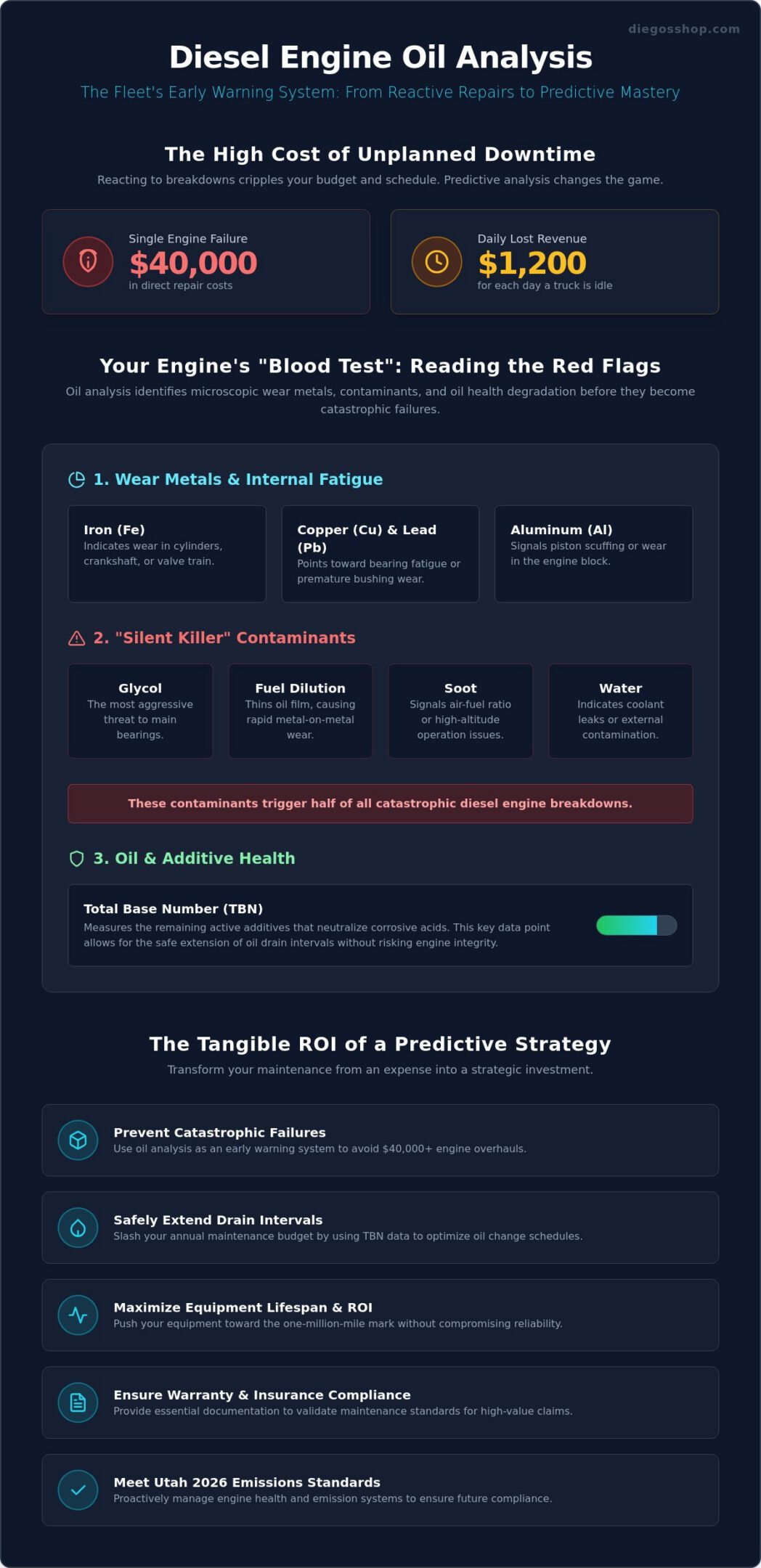
A single engine failure can cost your business up to $40,000 in direct repairs, while every day that truck sits idle on the Wasatch Front bleeds another $1,200 in lost revenue. You already know that managing a diverse fleet of Peterbilt, Kenworth, and Ford trucks is a constant battle against the clock. Utilizing a professional diesel engine oil analysis for fleets allows you to stop reacting to “surprise” breakdowns and start operating with total control over your equipment’s lifespan.
This strategy allows you to safely extend drain intervals and push your equipment toward the one-million-mile mark without compromising reliability. It turns your oil into a technical “blood test” for your machinery, providing the clear, actionable data you need to justify maintenance budgets and keep your trucks on the road. Instead of performing overhauls that came out of nowhere, you’ll have the technical mastery to see wear patterns months before they become catastrophic.
This guide explains how to use condition-based maintenance to eliminate unplanned downtime. We’ll show you how to interpret lab results to slash operating costs and ensure your fleet remains compliant with the updated 2026 Utah emissions standards.
Key Takeaways
- Identify internal engine wear before it leads to a $40,000 failure by using oil analysis as a diagnostic early warning system.
- Discover how a consistent program for diesel engine oil analysis for fleets allows you to safely extend drain intervals and slash your annual maintenance budget.
- Learn to spot the “silent killers”—glycol, fuel, soot, and water—that trigger half of all catastrophic diesel engine breakdowns.
- Understand how Utah’s high altitude and extreme temperature fluctuations impact oil oxidation and engine management.
- Transition from reactive, expensive repairs to a master-level predictive maintenance strategy that maximizes equipment lifespan and ROI.
What is Diesel Engine Oil Analysis for Fleets?
Diesel engine oil analysis for fleets is a sophisticated laboratory diagnostic process that evaluates the chemical and physical properties of used lubricant. By examining a small sample of oil, technicians can detect microscopic wear metals, chemical degradation, and external contaminants that are invisible to the naked eye. This process serves as a definitive early warning system, identifying internal component fatigue long before a driver notices a change in engine performance or a warning light illuminates the dashboard. Understanding What is Oil Analysis? allows fleet managers to move beyond reactive repairs and embrace a predictive strategy grounded in hard data.
For modern fleets operating heavy-duty Peterbilt or Kenworth trucks, this analysis is no longer optional. Modern diesel engines utilize complex emission control systems and high-pressure fuel injection that demand precise lubrication. A standard laboratory test might cost less than $100, yet it provides the technical insight needed to prevent a $25,000 engine overhaul. It’s the difference between a scheduled minor repair and a catastrophic roadside failure that sidelines your equipment for weeks.
The ‘Blood Test’ for Your Diesel Engine
Think of fluid analysis as a medical blood test for your heavy machinery. Just as a doctor uses blood work to find hidden health issues, we use oil samples to “see” inside the engine block without turning a single wrench. The days of checking oil health by its color on a dipstick are over. Modern synthetic oils can turn black within hours of an oil change due to soot suspension, yet they remain perfectly functional. Conversely, oil that looks clean might be dangerously diluted by fuel or contaminated with glycol.
Beyond maintenance, this data provides essential documentation for warrantied repair work. If a major component fails, having a consistent history of diesel engine oil analysis for fleets proves that you’ve maintained the equipment to professional standards. This level of accountability is often required by insurance providers and manufacturers when processing high-value claims. It provides peace of mind that your maintenance budget is being spent on verified needs rather than guesswork.
Key Components Analyzed in a Standard Kit
A comprehensive analysis kit looks for three primary categories of data: wear metals, contaminants, and additive health. Each element tells a specific story about the engine’s internal state. When we see a spike in specific metals, we know exactly where to look for trouble:
- Iron: Indicates wear in the cylinders, crankshaft, or valve train.
- Copper and Lead: These typically point toward bearing fatigue or bushings.
- Aluminum: Often signals piston scuffing or premature wear in the engine block.
We also monitor “silent killers” like soot, water, and fuel dilution. High soot levels can indicate an issue with the air-fuel ratio or high-altitude operation, while fuel dilution thins the oil film and leads to rapid metal-on-metal contact. Finally, the laboratory measures the Total Base Number (TBN), which tells us how much active additive is left to neutralize acids. This specific data point is what allows us to safely extend drain intervals without risking the integrity of your engine.
Reading the Red Flags: What the Data Reveals
A lab report is only as valuable as your ability to act on the information it provides. While many services provide raw numbers, a professional diesel engine oil analysis for fleets translates those figures into a clear roadmap for your maintenance team. It identifies the “silent killers” that lead to roadside breakdowns before they manifest as visible smoke or audible knocking. Scientific studies on urban equipment have shown The ROI of Predictive Maintenance is substantial when you catch these indicators early. It’s the difference between a simple seal replacement and a complete block failure.
Understanding wear metal concentrations is the foundation of this process. A spike in metals isn’t always a crisis, but it’s a signal that demands investigation. For example, if iron levels double between samples, it points to cylinder liner or gear wear that needs immediate attention. This data often reveals failing injectors or leaking EGR coolers months before they cause a total system shutdown. Maintaining a consistent history through Preventive Maintenance ensures these red flags are caught during a routine service rather than an expensive 2 AM emergency call.
The Danger of Glycol and Fuel Dilution
Glycol is the most aggressive threat to your engine’s main bearings. Research indicates that glycol contamination is responsible for approximately half of all catastrophic diesel engine failures. Even a small coolant leak can create an acidic environment that rapidly strips away bearing material. Fuel dilution is the presence of unburned diesel in the crankcase, typically caused by injector issues. When fuel dilution exceeds 2%, the protective oil film thins significantly. At 5%, your lubrication is severely compromised, leading to rapid cylinder wear and potential crankshaft damage.
Soot and Viscosity: The Performance Killers
Modern EGR systems are designed to reduce emissions but often increase soot loading in your oil as a byproduct. High soot levels act like liquid sandpaper, grinding down turbocharger bearings and valve trains over time. This relationship between soot and viscosity is critical for engine longevity. If left unchecked, excessive soot causes the lubricant to thicken into a heavy sludge. This restricted flow starves the engine of vital protection, especially during cold starts in the Utah winter. Regular diesel engine oil analysis for fleets monitors these levels to ensure your oil maintains the film strength required to protect your investment under heavy loads.
The ROI of Predictive Maintenance for Utah Fleets
Predictive maintenance isn’t just a technical theory; it’s a financial strategy that protects your bottom line. Utilizing a consistent program for diesel engine oil analysis for fleets allows you to extend drain intervals from a standard 25,000 miles to as much as 45,000 or 50,000 miles. This shift alone can cut your annual fluid and filter expenses by 40-50%. You’re no longer throwing away functional oil based on a generic calendar date. Instead, you’re making master-level decisions based on the actual condition of the lubricant inside your engines.
Beyond daily operational savings, this data builds a comprehensive health record for your assets. When it’s time to cycle out older units, documented analysis reports prove the engine’s integrity to potential buyers, significantly increasing resale value. Most importantly, it prevents the catastrophic failure costs that derail annual budgets. A single engine failure often costs between $20,000 and $40,000 in direct repairs. That figure doesn’t include the logistical nightmare of lost freight or the long-term damage to your reputation with clients.
Reactive Repair vs. Predictive Maintenance Costs
The financial gap between reactive and predictive care is vast. Replacing a failing injector identified through oil analysis is a manageable, scheduled expense that keeps the truck in service. Ignoring the warning signs leads to a full engine seizure, which is a business-altering event. This predictive approach ensures you aren’t “over-maintaining” your fleet or wasting resources on unnecessary oil changes. For those already facing mechanical issues, we provide Expert Diesel Engine Repair: A Guide to Service Done Right to restore your equipment to peak performance.
Maximizing Uptime on the Wasatch Front
Downtime on the Wasatch Front is exceptionally expensive. An idle truck loses between $800 and $1,200 per day in revenue. Diesel engine oil analysis for fleets gives managers the foresight to plan for spare vehicle needs rather than scrambling when a truck breaks down unexpectedly in Springville. This data-driven approach allows you to justify equipment upgrades based on documented wear trends. You can finally stop waiting for a total breakdown to force your hand and start managing your fleet with total control.
Implementing an Analysis Program in the Utah Climate
Utah’s unique environment demands a tailored approach to diesel engine oil analysis for fleets. High-altitude operation means your engines are breathing thinner air, which often shifts the air-fuel ratio and increases soot production. When combined with our extreme temperature swings, which can range from sub-zero winters to 100°F+ summers, the chemical stability of your lubricant is under constant assault. These conditions accelerate oil oxidation and additive depletion far faster than in more temperate regions. Managing a fleet here requires more than just following a generic manual; it requires local expertise.
Establishing a baseline for your specific trucks is vital because every engine brand interacts with the local environment differently. A single laboratory report is merely a snapshot in time. To truly master predictive maintenance, you need a series of samples to identify trends. If silicon levels are slowly rising across three samples, you have a failing air filtration system. If you only look at one report, you might miss the pattern until the engine has already sustained significant internal damage. Consistency is the foundation of technical mastery.
Sampling Intervals for Commercial Trucks
Your sampling frequency should reflect the intensity of the work. OTR long-haulers typically follow a mileage-based schedule, but local dump trucks or delivery vans operating in Utah County fall into the “severe service” category. These vehicles spend more time idling and endure more cold starts, which necessitates sampling every 250 to 500 hours rather than relying on a mileage odometer. For a detailed breakdown of these requirements, consult The 2026 Diesel Maintenance Handbook. It provides the specific protocols needed for rugged reliability in our region.
Local Environmental Factors
Local reports often show spikes in silicon or sodium that can be misleading to an untrained eye. In Utah, high silicon levels usually aren’t internal wear; they’re fine desert dust entering through the intake or a loose breather. High sodium often points to road salt contamination during the winter months rather than a coolant leak. Distinguishing between these local environmental factors and actual mechanical failure requires a shop that understands the Wasatch Front’s duty cycle. Cold starts in our sub-zero winters also exacerbate fuel dilution, as the engine runs rich longer to reach operating temperature. If you want to protect your equipment from these elements, contact Diego’s Shop to integrate professional analysis into your fleet’s preventive maintenance program.
To get accurate data, always take samples when the engine is at operating temperature. Draw the sample from the mid-stream of the drain or use a dedicated sampling valve. Avoid taking the very first or very last bit of oil from the pan, as this contains settled contaminants that don’t reflect the overall health of the lubricant. Following these best practices ensures your data is clean, representative, and actionable.
From Data to Dirt: How Diego’s Shop Closes the Loop
Data alone doesn’t keep a truck on the road. While a laboratory provides the numbers, Diego’s Shop provides the technical mastery required to act on them. Implementing a consistent diesel engine oil analysis for fleets is a vital first step, but the second step is closing the loop with professional intervention. We don’t just hand you a complicated PDF and expect you to figure it out. We integrate these diagnostic findings directly into our comprehensive fleet maintenance programs to ensure your equipment stays in peak condition.
Our team specializes in the complex management systems of major diesel platforms, including Peterbilt, Kenworth, Isuzu, and Ford. When a report indicates a potential issue, we perform the necessary warrantied repair work immediately. This proactive approach stops minor leaks or wear patterns from escalating into the catastrophic failures discussed earlier. We take personal accountability for the health of your fleet, treating every truck as if it were our own. It’s about providing the peace of mind that comes from knowing your maintenance is handled by seasoned experts.
Expert Interpretation and Action Plans
A lab’s automated recommendation is often generic and based on broad averages. It can’t account for the specific duty cycle of a local dump truck or the history of a high-mileage long-hauler. A master mechanic’s eye is essential for prioritizing repairs based on the severity of the report. We look at the trends across your diesel engine oil analysis for fleets to determine if a reading is a statistical outlier or a genuine mechanical crisis. This level of scrutiny prevents unnecessary parts replacements while ensuring that critical issues are never ignored. Every repair we perform is documented meticulously, which is essential for maintaining engine warranties and ensuring total DOT compliance.
Reliable Service for Springville and Beyond
We serve commercial fleets across the entire Wasatch Front, from Salt Lake City down to Spanish Fork. Our shop in Springville is built on a foundation of integrity, accountability, and rugged reliability. We understand the pressure fleet managers face to keep costs low and uptime high. By using oil analysis as our foundation, we provide a service that is grounded in hard facts rather than guesswork. This no-nonsense approach to diesel repair ensures your business remains profitable and your drivers stay safe. Don’t wait for a warning light to tell you there’s a problem. Schedule your fleet’s first round of oil analysis today and take total control of your maintenance budget. Professional service. Proven results.
Take Control of Your Fleet’s Future
Transitioning from reactive repairs to a data-driven strategy is the most effective way to eliminate unplanned downtime. By identifying wear metals and contaminants before they trigger a breakdown, you protect your bottom line and extend the life of your assets. Implementing a professional diesel engine oil analysis for fleets turns guesswork into technical mastery, allowing you to manage your maintenance budget with absolute certainty.
Diego’s Shop provides the specialized expertise required to handle medium and heavy-duty diesel systems across the entire Wasatch Front. We don’t just provide data; we deliver solutions through warrantied repair work performed by seasoned craftsmen. From our shop in Springville, we help you navigate the unique challenges of Utah’s climate and high-altitude operation. It’s time to stop waiting for failures and start preventing them.
Protect Your Fleet with Expert Analysis at Diego’s Shop
Your equipment is built for the long haul, and we are here to ensure it stays that way. Technical mastery. Rugged reliability.
Frequently Asked Questions
How much does a diesel engine oil analysis cost for a fleet?
The cost of a standard analysis is a minor investment that typically represents a small fraction of your total oil change expense. Prices vary depending on whether you require basic wear metal testing or advanced diagnostics like Total Base Number (TBN) and fuel dilution levels. Most fleet managers find that the ability to safely extend drain intervals quickly pays for the testing program many times over.
How often should I pull oil samples from my commercial trucks?
You should pull samples every 10,000 to 15,000 miles for over-the-road trucks or every 250 to 500 hours for severe-duty local equipment. Consistency is the most important factor in a successful program. Regular sampling allows you to establish a baseline and identify subtle wear trends before they escalate into a mechanical crisis, especially when operating in Utah’s extreme climate.
Can oil analysis really predict a total engine failure?
Yes, oil analysis acts as a diagnostic early warning system by detecting microscopic wear metals and contaminants long before they cause a breakdown. For example, a sudden increase in lead and copper levels indicates bearing fatigue. Catching these indicators allows our technicians to perform a targeted repair during a scheduled shop visit, preventing a catastrophic failure on the road.
What are the most common wear metals found in diesel oil reports?
Iron, copper, lead, and aluminum are the most frequent indicators of internal engine health. Iron usually signals wear in the cylinders or valve train, while copper and lead typically point to bearing degradation. Monitoring these concentrations through a professional diesel engine oil analysis for fleets allows us to identify exactly which internal components are reaching their service limit without tearing down the engine.
Do I need oil analysis if I already follow the OEM maintenance schedule?
Yes, because generic OEM schedules don’t account for the unique stresses of high-altitude operation or heavy towing on the Wasatch Front. A standard schedule is based on averages, but your specific duty cycle might be much harsher. Analysis provides a customized health report for your specific engine, often revealing hidden issues like fuel dilution or coolant leaks that a calendar-based change would miss.
How do I take a proper oil sample without contaminating it?
Take your sample from the mid-stream of the oil flow while the engine is at full operating temperature. Use a clean, dedicated sampling valve or a vacuum pump to draw the fluid directly into a sterile laboratory bottle. You must avoid taking oil from the very beginning or end of the drain, as these sections often contain settled debris that provides an inaccurate reading of the lubricant’s health.
Will oil analysis help me extend my oil change intervals safely?
Yes, monitoring the additive health and oxidation levels allows you to determine exactly when your lubricant has lost its protective qualities. Many fleets successfully extend their drain intervals by 40% or more by using a diesel engine oil analysis for fleets to justify the change. This data-driven approach ensures you maximize the life of your oil while maintaining total protection for your engine components.
What does high silicon in an oil report mean for my diesel engine?
High silicon levels usually indicate that dirt or desert dust is entering your engine through the air intake system. In our local Utah environment, this often points to a leaking air filter housing, a loose intake boot, or a failing seal. If you don’t address high silicon quickly, the particles act like liquid sandpaper, rapidly grinding down your cylinder liners and turbocharger blades.