
Diesel Engine Overhaul vs. Rebuild: Choosing the Right Life Extension for Your Fleet

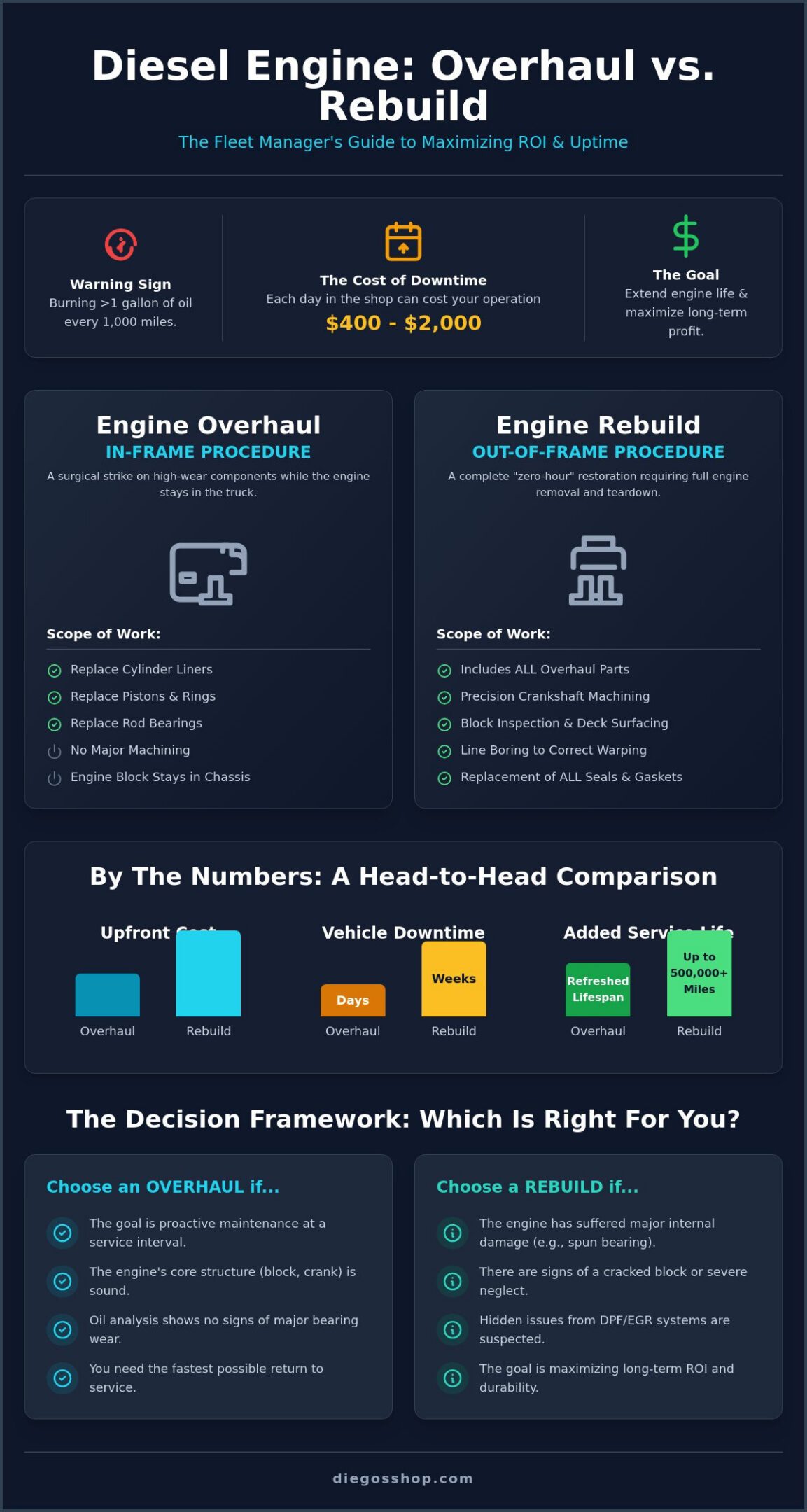
The cheapest way to get your truck back on the road today might be the most expensive mistake you make this year. When your engine starts consuming more than a gallon of oil every 1,000 miles, you’re facing a crossroads that determines your fleet’s profitability for the next half-decade. Choosing between a diesel engine overhaul vs rebuild isn’t just about comparing shop quotes; it’s about matching the depth of the repair to your vehicle’s specific duty cycle. We understand the stress of vehicle downtime on the Wasatch Front, where every day in the shop can cost your operation between $400 and $2,000 in lost revenue.
You deserve a truck that won’t break down again in six months, and that starts with clearing up the technical terminology. This article helps you master the financial differences between these two service levels so you can maximize your truck’s uptime and long-term ROI. We will compare the labor intensity of in-frame versus out-of-frame procedures, examine how a quality rebuild can add up to 500,000 miles of life, and provide the clarity you need to find a trustworthy shop in Utah County. By the end, you’ll have a clear roadmap for your engine’s second life.
Key Takeaways
- Identify the specific mechanical scope of in-frame procedures versus complete out-of-frame restorations to avoid overpaying for unnecessary labor.
- Use oil analysis and mileage data to master the diesel engine overhaul vs rebuild debate and choose the right life extension for your specific duty cycle.
- Evaluate the true ROI by weighing higher upfront rebuild costs against the 500,000-mile durability gained from a total engine teardown.
- Learn how state-of-the-art diagnostics protect your fleet from the compounding costs of failed repairs and lost revenue on the Wasatch Front.
Defining the Terms: What Is a Diesel Engine Overhaul vs. Rebuild?
Many fleet managers use the terms “overhaul” and “rebuild” interchangeably. In the shop, these words represent two very different financial and mechanical commitments. Misunderstanding the diesel engine overhaul vs rebuild distinction can lead to mismatched expectations when you receive a quote. A clear definition ensures you aren’t paying for a complete restoration when a targeted fix would suffice. It also prevents you from choosing a minor refresh when your engine actually needs a total teardown and specialized machining.
The most significant technical divide involves whether the engine block stays in the truck. An overhaul is typically an “in-frame” procedure. Technicians perform the work while the engine remains secured to the chassis. A rebuild is an “out-of-frame” process. We pull the entire unit from the vehicle for a total teardown. This distinction affects labor hours and the depth of inspection possible. For a deeper look into the standards of Engine Overhaul and Remanufacturing, industry definitions often lean on the degree of component replacement and machining required to return an engine to its original state.
The Anatomy of a Diesel Overhaul
An overhaul is a surgical strike on high-wear components. It focuses on the “top-end” and “bottom-end” of the engine without disturbing the block itself. For engines from manufacturers like Cummins or Isuzu, this typically includes replacing cylinder liners, pistons, rings, and rod bearings. It’s the ideal choice for a well-maintained engine that has reached its expected service interval but hasn’t suffered a catastrophic failure. You’re effectively refreshing the internal wear surfaces to restore compression and oil control. This keeps the truck on the road without the expense of a full engine extraction.
The Scope of a Complete Engine Rebuild
A rebuild is a comprehensive, “zero-hour” restoration. Because we remove the engine from the frame, our technicians gain 360-degree access to every component. This isn’t just about replacing parts; it’s about precision machining. We inspect the engine block and crankshaft for microscopic cracks and machine them back to original OEM specifications. Every seal, gasket, and wear component is replaced. This process is necessary when an engine has suffered major internal damage, such as a cracked block or a spun main bearing. A rebuild gives the engine a true second life, often capable of adding another 300,000 to 500,000 miles of service.
Technical Differences: In-Frame vs. Out-of-Frame Procedures
The technical divide between an in-frame and an out-of-frame procedure starts with the clock. Labor typically accounts for 60% to 70% of the total cost of an engine project. An out-of-frame rebuild requires significantly more shop time because the entire unit must be disconnected from the transmission, cooling system, and electrical harness before being lifted from the chassis. This extra effort provides 360-degree access to the block, allowing for precision machining that is physically impossible while the engine is still mounted. While an overhaul is a localized refresh, a rebuild is a total structural restoration.
Precision is the primary advantage of the “full pull.” When the block is on a machining stand, a specialist can perform deck surfacing to ensure a perfectly flat mating surface for the head gasket. We can also perform line boring to correct any warping in the main bearing bores. These steps are critical for long-term durability but cannot be performed during an in-frame overhaul. Additionally, modern emission systems like EGR and DPF add a layer of complexity. If a clogged DPF has caused excessive backpressure or heat soak, it can lead to hidden stress cracks in the block or head. A rebuild allows us to find these issues through magnetic particle inspection or pressure testing, whereas an in-frame might leave these ticking time bombs behind.
When an In-Frame Overhaul Makes Sense
An in-frame overhaul is a high-value choice when the engine’s core structure remains sound. If your oil analysis shows healthy levels of copper and lead, it suggests the crankshaft and main bearings are still in good condition. For medium-duty trucks like a Ford or Chevy diesel, this approach offers a faster “speed to market.” You can often get back on the road in days rather than weeks. This is the ideal path for proactive fleet managers who want to refresh high-wear components like liners and rings before a major failure occurs. If you are unsure which path fits your current engine health, a professional assessment for warrantied repair work can provide the data needed to decide.
The ‘Full Pull’: Why Out-of-Frame Rebuilds Win Long-Term
Catastrophic internal failures, such as a broken valve or a spun bearing, leave you with no choice but a full rebuild. This process addresses the hidden damage that an overhaul ignores. By stripping the block to its bare essence, we can replace every single seal and gasket while verifying the integrity of the oil galleries. The result is a performance profile that mirrors a brand-new engine. While the upfront investment is higher, the “zero-hour” status provides peace of mind for high-utilization fleets that cannot afford the risk of a secondary failure six months down the road. It is the definitive solution for maximizing the diesel engine overhaul vs rebuild ROI over the next half-million miles.
The Decision Framework: When to Overhaul vs. Rebuild
Determining the right path requires more than a glance at the odometer. While high mileage often signals the need for intervention, the “sweet spot” for a proactive overhaul usually arrives before a catastrophic failure occurs. We look for specific physical indicators, such as oil consumption exceeding one gallon per 1,000 miles. This is a primary red flag that your internal seals and rings are failing. When you analyze the diesel engine overhaul vs rebuild choice, your oil analysis report becomes your most valuable diagnostic tool. High levels of copper or lead in the oil indicate bearing wear that might necessitate an out-of-frame rebuild rather than a simple in-frame refresh.
Utah’s unique geography plays a critical role in this decision. Climbing Parleys Canyon or the steep grades of the Wasatch Front puts immense thermal stress on your engine. A truck that operates exclusively on flat ground might thrive with a standard overhaul. However, vocational fleets in Utah County often require the structural integrity of a rebuild. This ensures the block can handle the constant expansion and contraction caused by our extreme temperature swings and high-torque demands. If you are seeing excessive blow-by or a noticeable drop in compression, a “patch” won’t solve the underlying structural fatigue.
Evaluating the Fleet Lifecycle
Your long-term business plan should dictate the depth of your repair. If your strategy involves selling the truck within the next 12 months, a targeted overhaul might provide the necessary reliability without over-investing. Conversely, heavy-duty trucks like a Peterbilt or Kenworth often reach a critical crossroad at the 500,000-mile mark. At this stage, balancing the cost of a comprehensive rebuild against the $40,000 to $65,000 price tag of a new replacement engine is essential. A quality rebuild protects your ROI by extending the vehicle’s life for another half-million miles at a fraction of the cost of a new truck.
The Impact of Modern Emission Systems
Modern EGR and DPF systems have changed the math for engine longevity. These components can introduce soot and heat back into the engine, accelerating wear on cylinder liners and valves. When deciding on the depth of your repair, a rebuild must include a complete audit of the cooling and emission systems to prevent a repeat failure. Neglected preventive maintenance is the #1 driver of premature engine failure. By addressing these systems during a rebuild, you ensure the new internal components aren’t immediately compromised by old, failing peripheral parts.
Calculating the Real ROI: Downtime vs. Durability
The shop bill is only one variable in your fleet’s financial equation. When analyzing the diesel engine overhaul vs rebuild choice, you must calculate the cost per mile over the next three to five years. A full out-of-frame rebuild requires a larger capital investment than an in-frame overhaul. However, the value of that investment becomes clear when you compare it to the cost of a new replacement engine, which can reach between $40,000 and $65,000. By choosing a comprehensive restoration, you’re securing a second life for your truck at a fraction of the price of a new unit.
The hidden cost of downtime often outweighs the initial repair price. For vocational fleets in Utah County, a single day in the shop can result in $400 to $2,000 in lost revenue. If you choose a targeted overhaul for an engine with structural fatigue, you risk a secondary failure that could cost double in lost freight contracts and redundant labor. A rebuild mitigates this risk by providing the most comprehensive warrantied repair work available. Beyond reliability, a fresh rebuild restores OEM tolerances. This improves fuel efficiency, which can pay for the repair costs through savings at the pump over the first 100,000 miles of operation.
Addressing the ‘Just Patch It’ Objection
Throwing good money after bad is a common trap for fleet managers under pressure. Choosing a minor patch for an engine with a compromised block is a gamble that rarely pays off. Repeated minor repairs often exceed the total cost of a single, high-quality overhaul within just two years. For long-haul OTR drivers, the peace of mind that comes from a dependable engine is priceless. You don’t want your driver stranded in a remote canyon because you opted for the cheapest possible fix. To get an accurate assessment of your engine’s condition, consult with a specialist before making a final decision.
Fleet Scalability and Planning
Successful fleet operators don’t wait for a catastrophic failure to act. They integrate overhauls into a long-term preventive maintenance plan. By scheduling major engine work during seasonal lulls, you minimize the impact on your delivery schedules. This proactive approach allows for standardized engine work across your entire fleet, which improves overall reliability and simplifies part inventory. When every truck in your fleet follows a predictable life-extension schedule, your business stays profitable and your trucks stay on the road.
Why Diego’s Shop is the Wasatch Front’s Choice for Engine Work
Choosing between a diesel engine overhaul vs rebuild is a high-stakes decision that requires more than just a standard mechanic. It requires a partner who understands the mechanical nuances of heavy-duty machinery and the financial pressures of fleet management. At Diego’s Shop, we bring specialized expertise to every project, whether you’re managing a fleet of medium-duty delivery trucks or a single heavy-duty long-haul rig. Our Springville location offers a unique blend of local accountability and master-craftsman quality. We treat every engine as a testament to our technical skill and a promise of future reliability.
We don’t cut corners on the components that keep your business moving. Every diesel engine repair we perform utilizes high-quality parts that meet or exceed OEM specifications. We understand that your profitability depends on your truck’s uptime, so we never compromise on the integrity of seals, bearings, or liners. This commitment to durability is why vocational fleets across the Wasatch Front trust us with their most valuable assets. We build engines that are designed to survive the high-torque demands of Utah’s mountain grades.
Our Diagnostic-First Approach
We don’t believe in guesswork. Our process begins with state-of-the-art diagnostics that analyze everything from oil contamination to cylinder pressure. This technical data allows us to recommend the exact level of repair needed; we ensure you don’t pay for a full out-of-frame rebuild when a targeted in-frame overhaul is the superior technical choice. We prioritize transparency in our quoting process. You won’t face hidden fees or surprise “while-we’re-in-there” costs that blow your budget. We maintain direct communication with fleet managers throughout the entire process, providing a clear window into the work being performed on your equipment.
Warrantied Work You Can Trust
Trust is earned through consistent performance and personal accountability. We stand behind our master-level engine work with industry-leading warranties that protect your investment long after you leave our shop. Serving Springville, Spanish Fork, and the entire Utah County area, we’re the local choice for rugged, no-nonsense reliability. We know the demands of the local terrain, and we build engines that are ready for the long haul. Ready to keep your fleet moving? Schedule a consultation at Diego’s Shop today and let us help you maximize your truck’s ROI.
Secure Your Fleet’s Future on the Wasatch Front
Decisions regarding your engine’s second life shouldn’t be based on guesswork or the pursuit of the lowest immediate price. Whether you need the surgical precision of an in-frame overhaul or the comprehensive restoration of a full rebuild, the goal is always the same: maximum uptime and a protected ROI. Mastering the technical nuances of a diesel engine overhaul vs rebuild ensures you invest in the right level of durability for your specific duty cycle and long-term fleet goals.
Our team specializes in heavy-duty and medium-duty units, including Peterbilt, Kenworth, Isuzu, and Ford Diesel. We provide warrantied repair work for total peace of mind, ensuring your truck is ready for the steep grades and extreme temperatures of Utah County. We don’t just fix engines; we restore the reliability your business depends on every day. Our master-craftsman approach ensures your equipment remains a productive asset rather than a liability.
Ready to eliminate the uncertainty of engine failure? Request a Professional Engine Diagnostic at Diego’s Shop to get the technical data you need. Serving the entire Wasatch Front, we’re here to keep your business moving forward with power and precision.
Frequently Asked Questions
What is the average cost difference between a diesel overhaul and a rebuild in 2026?
Industry data for 2026 indicates that an in-frame overhaul generally costs between $15,000 and $25,000 for heavy-duty engines. A comprehensive out-of-frame rebuild is more expensive, with average costs ranging from $25,000 to over $40,000. This price gap reflects the significant labor involved in removing the engine and performing precision machining on the block and crankshaft.
How long does an in-frame overhaul typically take compared to an out-of-frame rebuild?
An in-frame overhaul is designed for speed and can often be completed in three to five business days. An out-of-frame rebuild requires two to four weeks depending on parts availability and the extent of the required machining. The extra time accounts for the complete extraction of the unit and the meticulous teardown needed for a zero-hour restoration.
Can an in-frame overhaul fix a cracked engine block?
No, an in-frame overhaul cannot address a cracked or compromised engine block. Fixing structural damage requires pulling the engine from the chassis for specialized welding or replacement. If a block is cracked, a full out-of-frame rebuild or a complete engine replacement is the only viable path to ensure the truck remains reliable on the road.
Will a rebuild improve my truck’s fuel economy?
Yes, a fresh rebuild restores the engine to its original OEM tolerances, which directly improves thermal efficiency and fuel economy. By replacing worn rings and liners, the engine regains lost compression and reduces internal friction. Many fleet operators find that the fuel savings over the first 100,000 miles help offset the initial investment of the diesel engine overhaul vs rebuild project.
Is it worth rebuilding a diesel engine with over 1 million miles?
Rebuilding is often worth the investment if the engine block and core components are structurally sound. With a new replacement engine costing between $40,000 and $65,000, a high-quality rebuild provides a more cost-effective way to extend the life of a proven chassis. We recommend a thorough diagnostic to verify the block’s integrity before committing to a million-mile restoration.
How do I know if my engine needs an overhaul or just a top-end repair?
A top-end repair focuses only on the cylinder head and valves, while an overhaul addresses the pistons, rings, and liners. We use oil analysis and blow-by testing to determine if wear has reached the bottom end of the engine. If diagnostics show high levels of copper or lead in the oil, it’s a clear signal that the bearings need attention beyond a simple top-end fix.
What brands of diesel engines does Diego’s Shop specialize in for overhauls?
Diego’s Shop provides master-level expertise for several major diesel manufacturers. We specialize in heavy-duty and medium-duty engines from Peterbilt, Kenworth, Isuzu, and Ford Diesel. Our technicians use specialized equipment and manufacturer-specific protocols to ensure every repair delivers the durability required for the steep grades of the Wasatch Front.
Does an engine rebuild include the turbocharger and fuel system components?
A standard rebuild focuses on the long block, but a comprehensive restoration often includes an audit of the turbocharger and fuel system. While some shops treat these as separate line items, we recommend inspecting or replacing them during a rebuild to prevent old peripherals from damaging new internal parts. This holistic approach ensures the entire power plant functions as a cohesive, reliable unit.