

How to Extend the Life of a Commercial Truck: The 2026 Fleet Longevity Guide

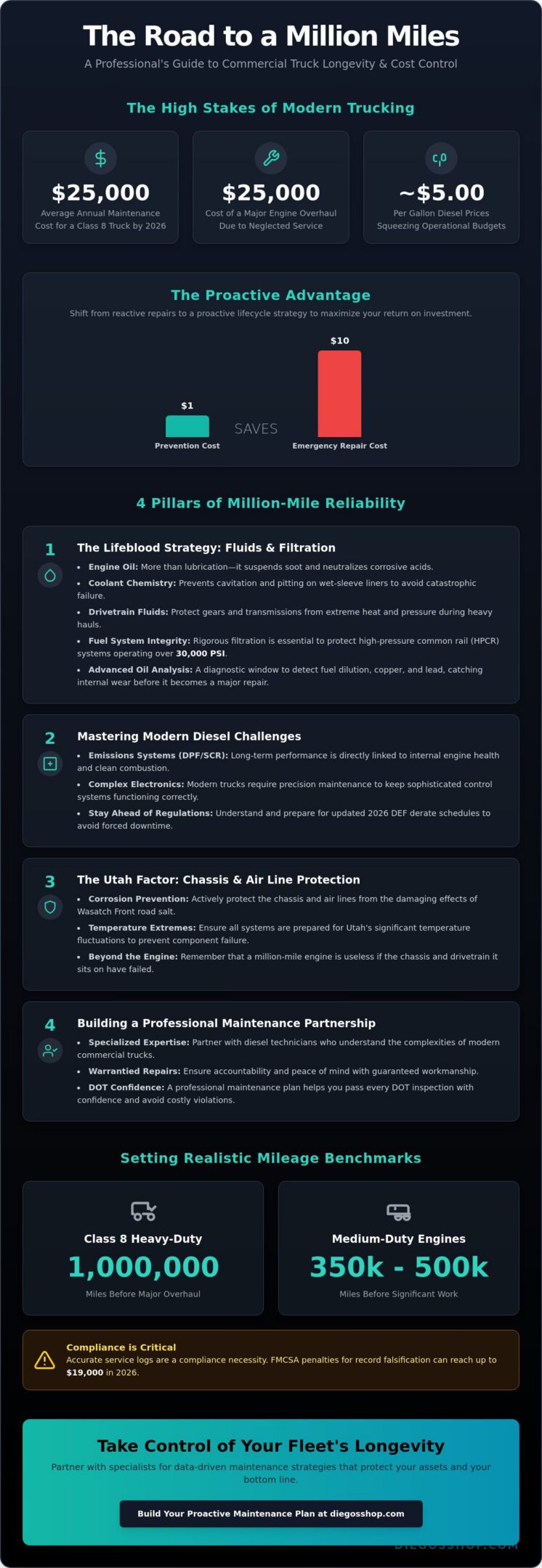
With the average annual maintenance cost for a Class 8 truck reaching up to $25,000 in 2026, can your business afford to treat service intervals as mere suggestions? You’ve likely felt the sting of rising parts costs and the frustration of a modern emission system putting your best driver out of service. Understanding how to extend the life of a commercial truck is no longer just about saving money; it’s about survival in a market where diesel prices hover near $5.00 a gallon. You need a strategy that goes beyond basic oil changes to ensure your equipment survives the long haul.
This guide provides the professional blueprint for pushing your diesel engines past the million-mile mark without a catastrophic failure. We’ll show you how to master the technical protocols required to achieve 500,000 miles without a major overhaul and keep your total cost of ownership low. From managing the new Utah heavy-duty emissions fees to navigating the updated 2026 DEF derate schedules, you’ll discover the specific maintenance habits that separate reliable fleets from those plagued by unplanned downtime. It’s time to take total control of your fleet’s longevity and pass every DOT inspection with confidence.
Key Takeaways
- Shift your operational focus from reactive repairs to a proactive lifecycle strategy that maximizes total return on investment for every vehicle.
- Learn how to extend the life of a commercial truck by implementing rigorous filtration protocols that protect sensitive high-pressure common-rail injectors.
- Understand the critical relationship between internal engine health and the long-term performance of complex DPF and SCR emission control systems.
- Protect your chassis and air lines from the corrosive effects of Wasatch Front road salt and extreme Utah temperature fluctuations.
- Discover why partnering with a specialized diesel technician for warrantied repair work ensures the accountability needed for million-mile reliability.
The Million-Mile Mindset: Why Commercial Truck Longevity Matters in 2026
Commercial truck longevity isn’t just about keeping the engine running. It’s about optimizing the total lifecycle ROI of your most expensive asset. In 2026, with diesel prices hovering near $5.00 a gallon and engine overhauls costing up to $25,000, you can’t afford a “wait and see” approach. Learning how to extend the life of a commercial truck requires a shift from reactive repairs to proactive prevention. Modern 2026 technology involves sophisticated electronics and emission controls that require more precision than the mechanical diesels of the past. High-quality maintenance keeps the truck on the road and significantly boosts its resale value when it’s time to upgrade.
Proactive maintenance is the hallmark of a professional operation. Every dollar spent on scheduled service prevents ten dollars in emergency repairs. This mindset protects your capital. It ensures your equipment remains an asset rather than a liability. When you prioritize longevity, you’re choosing to control your costs rather than letting the machinery control you.
The True Cost of Vehicle Downtime
Lost revenue starts with the repair bill but doesn’t end there. A single broken truck can trigger a domino effect that erodes client trust and frustrates your best drivers. In a market facing a shortage of over 174,000 drivers, keeping your team in reliable equipment is a critical retention strategy. A comprehensive fleet maintenance plan acts as an insurance policy against these hidden costs. It ensures you aren’t just paying for parts; you’re protecting your reputation and your bottom line. Reliability is the foundation of a profitable fleet.
Setting Realistic Mileage Goals
High mileage means different things depending on your equipment. A heavy-duty Class 8 truck is often built to see 1,000,000 miles. Medium-duty engines might target 350,000 to 500,000 miles before needing significant work. However, the engine often outlasts the chassis and drivetrain if they aren’t properly cared for. Consistent service logs are vital here. With FMCSA penalties for record falsification reaching $19,000 in 2026, accurate documentation is both a compliance necessity and a way to prove vehicle health for future buyers. Knowing how to extend the life of a commercial truck starts with setting these realistic benchmarks and tracking every mile with precision. Total vehicle health requires looking beyond the odometer.
The Lifeblood Strategy: Fluids and Filtration Protocols
Maintaining clean fluids is the most effective way to ensure your engine reaches its maximum potential. When considering how to extend the life of a commercial truck, you must prioritize the chemistry happening inside the block. Diesel oil changes do more than lubricate; they suspend soot and neutralize acids that would otherwise corrode bearings. Neglecting these intervals is the fastest way to turn a million-mile engine into a pile of scrap metal. Professional Preventive Maintenance ensures these fluids are changed before they lose their protective properties.
Coolant chemistry is equally vital for heavy-duty longevity. Modern wet-sleeve liners are susceptible to cavitation, where tiny bubbles implode against the liner wall and create microscopic pits. Without the right supplemental coolant additives (SCAs), these pits can eventually breach the liner and lead to catastrophic engine failure. Beyond the engine, gear oil and transmission fluid must withstand extreme heat and pressure. These fluids protect the drivetrain from premature wear during heavy hauls, yet they’re often the most overlooked components in a standard service routine.
Advanced Oil Analysis: Reading the Engine’s Future
Oil sampling allows you to catch internal wear before it leads to a seizure. By identifying key markers like fuel dilution or trace amounts of copper and lead, you can address minor issues before they become five-figure repairs. This data-driven approach removes the guesswork from your maintenance schedule. Oil analysis serves as a diagnostic window into internal engine health. It provides the hard evidence needed to justify a repair before a component fails on the road.
Fuel System Integrity and Contamination
Modern high-pressure common rail (HPCR) systems operate at pressures exceeding 30,000 PSI. At these levels, even microscopic particles act like sandblasters on your injectors. Choosing “cheap” fuel from unverified sources often introduces contaminants that lead to expensive injector failures. Rigorous water separator maintenance and frequent filter intervals are non-negotiable for anyone serious about how to extend the life of a commercial truck. Clean fuel is the only way to protect the precision components that keep your engine efficient and powerful. Consistent filtration is your best defense against the rising costs of diesel engine parts.
Mastering Modern Diesel Challenges: Emissions and Electronics
Many operators argue that modern emission systems are designed to fail. In reality, these systems act as a barometer for your engine’s internal health. A clogged Diesel Particulate Filter (DPF) or a failing Selective Catalytic Reduction (SCR) system is often the symptom, not the root cause. If an engine consumes excessive oil or leaks coolant internally, those contaminants head straight for the aftertreatment system. Understanding this relationship is vital for anyone learning how to extend the life of a commercial truck. You can’t separate the health of the block from the health of the exhaust.
Ignoring a minor sensor code is a recipe for disaster. Modern trucks use complex logic to protect themselves, which often results in “derate” modes that limit your speed or power. As of late 2025, the EPA updated the DEF derate schedule to provide a more structured warning phase, but the end result is the same: a truck that can’t pull a load. Addressing these issues requires expert diesel engine repair to ensure the electronics are communicating correctly. Proper calibration prevents the system from working against itself. This technical oversight is what keeps your fleet moving while others are stuck in the shop.
Proactive DPF and EGR Management
A “lazy” EGR valve often sticks before it fails completely, causing poor fuel economy and excessive soot buildup. Identifying this early prevents that soot from reaching the DPF and causing a premature blockage. While natural highway cleaning, known as passive regeneration, is ideal, some duty cycles require forced regenerations to maintain system integrity. Scheduled DPF cleaning intervals are mandatory to remove unburnable ash that builds up over time. If you wait until the dash light stays on, you risk melting the DPF core. This is an avoidable and expensive mistake that compromises the goal of how to extend the life of a commercial truck.
The Role of Professional Diagnostics
Basic code readers only tell half the story. Professional fleet management requires diagnostic tools that can see real-time data streams and command specific system tests. Modern wiring harnesses are prone to “ghost” electrical issues where a frayed wire or corroded connector mimics a sensor failure. Technical mastery allows a technician to find the specific fault rather than firing a “parts cannon” at the problem. This precision keeps your truck on the road and your maintenance budget under control. True longevity depends on accurate data and the skill to interpret it correctly.
The Utah Factor: Protecting Trucks from Wasatch Front Conditions
Operating a fleet along the Wasatch Front presents challenges that general maintenance guides often ignore. The extreme temperature swings in Utah County, where summer highs exceed 100 degrees and winter lows drop below zero, put immense stress on every seal and gasket. High-elevation operation is another critical factor. At these altitudes, turbochargers must spin faster to compensate for thinner air, which increases internal heat and wear. Understanding these local stressors is a vital part of how to extend the life of a commercial truck. Constant vigilance ensures these environmental factors don’t shorten your equipment’s lifespan.
Corrosion is a silent killer for trucks frequenting I-15. The salt and brine used for de-icing are highly corrosive to chassis components and air lines. If left unchecked, this chemical buildup eats through metal and degrades rubber, leading to air leaks and structural weaknesses. You need a maintenance strategy that accounts for the specific chemistry of Utah roads. Protecting your investment requires more than just mechanical repair; it requires environmental defense.
Winterization and Corrosion Control
Winter prep must begin long before the first Wasatch frost. Air dryer maintenance is your first line of defense against frozen lines. A saturated desiccant cartridge allows moisture to enter the air system, where it can freeze and cause brake failure or system lockups. In Springville, regular chassis washing and professional undercoating are essential longevity requirements. These steps prevent salt from nesting in the frame rails. Additionally, testing batteries and glow plugs early ensures your diesel engines start reliably when temperatures plummet. Reliability in winter starts with preparation in autumn.
Mountain Grade Cooling and Braking
Pulling heavy loads up Parley’s Canyon or Spanish Fork Canyon tests the limits of your cooling system. Water pumps and fan clutches must be in peak condition to handle the thermal load of a long mountain climb. If these components are weak, you’ll see temperature spikes that can warp heads or damage turbos. Transmission temperatures also require monitoring during heavy mountain hauling to prevent fluid breakdown. Safety is non-negotiable on these steep grades. Scheduling dot truck inspections near me ensures your braking system and engine retarder are fully functional before you commit to a steep descent. Knowing how to extend the life of a commercial truck means respecting the terrain it travels every day. Consistent inspections are the only way to guarantee mountain-ready performance.
Building a Professional Maintenance Partnership with Diego’s Shop
Achieving million-mile status for your fleet is not a matter of luck. It requires a partnership with a dedicated diesel specialist who understands the intricate physics of heavy-duty machinery. General repair shops often lack the specialized diagnostic tools and deep technical mastery required for modern 2026 diesel engines. When you’re determining how to extend the life of a commercial truck, you need a partner who views your equipment as a critical business asset, not just another job on the rack. A specialist provides the precision needed to keep complex systems like HPCR fuel injection and SCR aftertreatment functioning at peak efficiency.
Integrity and accountability are the cornerstones of our service. We provide warrantied repair work that gives fleet managers total peace of mind. This means we stand behind every bolt turned and every sensor calibrated. In an industry where unplanned downtime can disrupt entire supply chains, having a reliable expert who maintains total control over complex situations is your greatest competitive advantage. We take pride in the durability of our work because we know your livelihood depends on the performance of your machinery.
Every fleet operates under different conditions. A truck hauling heavy loads through Spanish Fork Canyon faces different thermal stresses than a local delivery vehicle. We develop a custom diesel maintenance schedule tailored to your specific duty cycle and mileage goals. This individualized approach ensures that your preventive care is never generic. It’s a targeted strategy designed to maximize the longevity of your specific drivetrain and chassis.
Preventive Maintenance as a Business Strategy
Scheduled inspections are a sophisticated financial tool. They significantly lower your total cost of ownership (TCO) by identifying wear patterns before they result in a roadside failure. Professional documentation is also a critical safeguard. With 2026 FMCSA civil penalties for record falsification reaching up to $19,000 per violation, having clear and honest service logs is essential for passing DOT audits. By positioning your fleet as the most reliable in Utah County, you build trust with your clients and retain your best drivers. High-quality maintenance is the ultimate insurance policy for your business reputation.
Get Started with a Comprehensive Inspection
Total fleet health begins with a professional evaluation at our Springville location. During a comprehensive inspection, we look for the minor leaks and “ghost” electrical issues that basic code readers often miss. Catching a small coolant leak or a fraying wire today prevents a catastrophic engine failure tomorrow. Our master craftsmen use their seasoned expertise to provide a clear picture of your vehicle’s health. Contact Diego’s Shop for a professional fleet maintenance consultation to secure the future of your equipment. Discover the difference that technical mastery and personal accountability make for your bottom line. We’re here to help you master how to extend the life of a commercial truck through every mile of the journey.
Secure Your Million-Mile Fleet Future
Your fleet is the backbone of your business. Keeping it on the road requires more than occasional repairs. It demands a comprehensive strategy that accounts for modern emission complexities and the unique environmental stressors of the Wasatch Front. By prioritizing high-efficiency filtration and data-driven oil analysis, you move closer to that million-mile goal. Mastering how to extend the life of a commercial truck is a continuous commitment to precision and technical oversight.
Diego’s Shop provides the specialized expertise needed to maintain medium and heavy-duty fleets with total accountability. Located in Springville, we serve the entire Wasatch Front with a focus on durability and integrity. We stand behind our work with warrantied repair work on all diesel services. This ensures you never have to worry about the quality of the fix. It’s time to stop reacting to breakdowns and start investing in long-term reliability.
Schedule your fleet’s preventive maintenance at Diego’s Shop and gain the peace of mind that comes with professional mastery. Your equipment was built to last. We’re here to make sure it does.
Frequently Asked Questions
How many miles can a commercial diesel truck realistically last?
A well-maintained Class 8 heavy-duty truck can realistically exceed 1,000,000 miles before requiring a major engine overhaul. Medium-duty engines typically reach between 350,000 and 500,000 miles. These milestones depend entirely on consistent service and high-quality filtration. Achieving such high mileage requires a proactive mindset that addresses minor wear before it results in a catastrophic failure. Consistent care is the only way to reach these professional benchmarks.
Is it worth repairing a truck with over 500,000 miles?
Repairing a truck with 500,000 miles is often a sound financial decision if the chassis and drivetrain remain in good condition. With the cost of new equipment rising in 2026, extending the life of your current fleet maximizes your initial investment. A professional evaluation can determine if the vehicle’s residual value justifies the repair. Keeping an older, reliable truck on the road often provides a better ROI than taking on new debt.
What is the most common cause of premature diesel engine failure?
Neglect of basic fluid chemistry and filtration is the leading cause of premature engine failure. Contaminated oil or imbalanced coolant leads to internal corrosion, bearing wear, and liner pitting. Modern engines are especially sensitive to fuel contamination in high-pressure common rail systems. Learning how to extend the life of a commercial truck starts with mastering these fundamental service intervals. Small oversights in the shop lead to massive bills on the road.
How often should I perform an oil analysis on my commercial fleet?
You should perform an oil analysis during every scheduled oil change to establish a baseline for engine health. This typically occurs every 15,000 to 25,000 miles depending on your specific duty cycle. Regular sampling allows you to detect fuel dilution or metal shavings early. This data-driven approach transforms your maintenance from a guessing game into a precise science. It’s the most cost-effective way to monitor internal engine wear.
Can proactive maintenance actually help me pass a DOT inspection?
Proactive maintenance is the most effective way to ensure your vehicles pass DOT inspections consistently. By catching issues like air leaks, worn brake pads, or lighting failures during scheduled shop visits, you avoid costly out-of-service violations. In 2026, FMCSA penalties for non-compliance are higher than ever. A rigorous service plan ensures your documentation is accurate and your equipment is always road-ready. It removes the stress of roadside checks.
What are the signs that my truck’s emission system is failing?
Frequent active regenerations and a noticeable drop in fuel economy are primary indicators of a failing emission system. You might also notice the engine entering a derate mode or see specific fault codes related to the DPF or SCR. Ignoring these signs often leads to a completely plugged filter or a melted core. Early intervention by a diesel specialist prevents these symptoms from escalating into a total system replacement or engine damage.
How does the Utah climate specifically affect my truck’s lifespan?
The Utah climate accelerates wear through extreme temperature fluctuations and the corrosive effects of road salt on I-15. Cold starts in the Wasatch Front winters stress batteries and glow plugs, while summer heat tests the limits of your cooling system. High-elevation mountain grades also force turbochargers to work harder. Understanding how to extend the life of a commercial truck in this region requires specific protocols for corrosion control and mountain-grade cooling.
What is the difference between preventive and predictive maintenance?
Preventive maintenance follows a set schedule based on time or mileage to replace parts before they fail. Predictive maintenance uses real-time data and diagnostic tools, such as oil analysis, to determine exactly when a component needs service. Both strategies are essential for a modern fleet. While preventive care covers the basics, predictive techniques allow you to address the specific needs of each individual engine. This combined approach ensures maximum uptime and reliability.