

Justifying a Fleet Maintenance Program: The ROI of Reliability in 2026

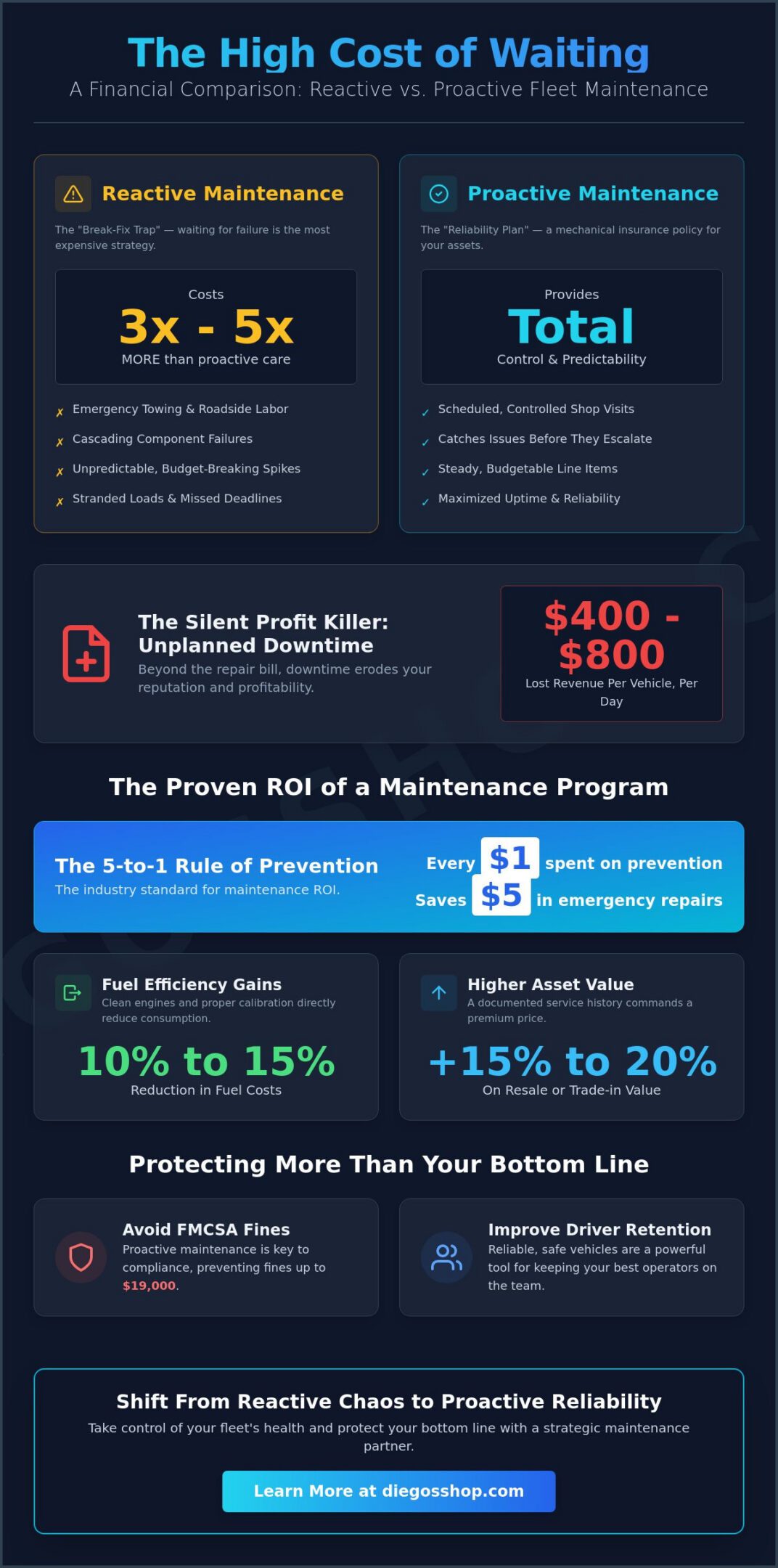
Unplanned, reactive repairs currently cost between three and five times more than scheduled, proactive maintenance. When you factor in that a single day of vehicle downtime in 2026 costs a typical small fleet up to $800 in lost revenue, the financial drain of a “fix it when it breaks” strategy becomes impossible to ignore. We understand that justifying a fleet maintenance program to stakeholders often feels like an uphill battle against immediate budget concerns. You’re likely tired of unpredictable repair bills, missed delivery deadlines, and the constant stress of potential $19,000 FMCSA fines for compliance oversights.
This article provides the hard data and strategic advantages you need to prove that professional maintenance is a mechanical insurance policy rather than a cost center. You’ll discover a clear ROI framework to present to your team, proven methods to reduce emergency repair frequency, and the specific steps required to regain total control over your fleet health. By shifting from reactive chaos to proactive reliability, you can protect your bottom line and ensure your drivers stay on the road.
Key Takeaways
- Understand the financial gap between reactive and proactive service, including how unplanned repairs often cost triple the price of scheduled shop visits.
- Discover the specific ROI metrics for fuel efficiency and asset longevity that make justifying a fleet maintenance program simple for any stakeholder.
- Learn how consistent maintenance serves as a powerful driver retention tool while shielding your business from increasing FMCSA compliance fines.
- Explore advanced diagnostic strategies like fluid analysis to monitor engine health and prevent catastrophic failures before they occur.
- See how moving to a strategic partnership with a professional shop provides the warrantied reliability needed to maintain total control over your fleet.
The Financial Reality: Reactive vs. Proactive Fleet Maintenance
Many operators view maintenance as an annoying expense that eats into their monthly margins. This mindset leads directly into the “Break-Fix Trap.” Waiting for a component to fail before addressing it is the most expensive way to run a diesel fleet. When you wait for a breakdown, you aren’t just paying for a part. You’re paying for towing, emergency labor rates, and the logistical nightmare of a stranded load. Justifying a fleet maintenance program becomes easy when you realize that emergency roadside assistance costs significantly more than a controlled, scheduled shop visit. Reactive repairs typically cost three to five times more than proactive service. It’s the difference between a planned oil change and an unplanned engine seizure.
Diesel engines are complex, integrated systems. A small issue, like a faulty sensor or a minor coolant leak, rarely stays small. It leads to cascading failures. For example, a neglected cooling system can lead to warped heads or seized pistons, turning a hundred-dollar fix into a twenty-thousand-dollar overhaul. Professional fleet management requires seeing maintenance as a strategic business asset rather than a recurring bill. It is a mechanical insurance policy that protects your most valuable physical assets from preventable destruction.
The Hidden Costs of Unplanned Downtime
Unplanned downtime is a silent profit killer. Data from 2026 shows that a single day of vehicle downtime costs a typical small fleet between $400 and $800 in lost revenue. This doesn’t even account for driver downtime. You’re often paying an operator to sit in a hotel or a waiting room while the truck is sidelined. Beyond the immediate cash flow, missed delivery deadlines erode customer trust. In a competitive market, contract penalties for late arrivals can quickly wipe out the profit margins of an entire month’s work. Reliability is your reputation on wheels.
Predictability: The CFO’s Favorite Metric
Financial leaders value predictability over almost everything else. A structured program turns unpredictable “emergency spikes” in your ledger into steady, budgetable line items. By using historical data and diagnostic trends, you can forecast upcoming repair needs months in advance. This data is essential when justifying a fleet maintenance program to stakeholders who only see the upfront cost. It allows for better cash flow management and prevents the “feast or famine” cycle that plagues many trucking companies. The Reliability Premium is the measurable value of knowing your equipment will start and perform every single morning without fail.
Calculating the ROI: How Maintenance Programs Protect the Bottom Line
Justifying a fleet maintenance program relies on hard numbers that prove an investment today prevents a catastrophe tomorrow. One of the most immediate returns is seen at the fuel pump. Diesel engines are precision machines. When fuel injectors are dirty or the Exhaust Gas Recirculation (EGR) system is restricted, fuel economy drops significantly. Fleets that prioritize clean combustion and proper engine calibration often see a 10% to 15% reduction in fuel consumption. Over 100,000 miles, that efficiency gain translates into thousands of dollars in direct savings per truck.
Asset longevity is the second pillar of ROI. A modern Class 8 truck is a $150,000 investment. By using regular oil analysis to monitor engine wear, you can extend the service life of that vehicle by two or three years. This delay in capital expenditure keeps more cash in your business. Furthermore, a documented maintenance history adds 15% to 20% to the vehicle’s resale or trade-in value. Buyers pay a premium for certainty. They want to see that the equipment was handled by professionals who didn’t cut corners. This level of oversight is a core competency taught in the Federal Fleet Manager Certification Program, which emphasizes that structured care is the only way to protect high-value assets.
The 5-to-1 Rule of Preventive Maintenance
The industry follows a simple standard: every $1 spent on preventive maintenance saves $5 in emergency repairs. Catching a worn component during a scheduled inspection is always cheaper than replacing it after a failure. Consider the difference in cost for a turbocharger issue:
- Scheduled Replacement: ~$2,500 (Part + planned labor)
- Catastrophic Failure: ~$8,500 (Towing + engine debris cleanup + turbo + lost revenue)
The cost-effectiveness of fleet truck repair is highest when the work is performed on your schedule, not the engine’s. Proactive service eliminates the “cascading failure” where one broken part destroys three others.
Fuel Economy and Emission System Health
Modern diesel emissions systems are highly sensitive. A clogged Diesel Particulate Filter (DPF) increases backpressure, which forces the engine to work harder and burn more fuel. Specialized diesel diagnostics can identify these issues before the truck enters “limp mode” on the highway. Avoiding a single emergency DPF replacement, which can cost up to $8,000, provides immediate justification for your maintenance budget. Proper care ensures your fleet stays compliant and efficient. If you’re ready to stabilize your operating costs, partnering with a dedicated shop can turn your maintenance from a headache into a competitive advantage.
Beyond the Numbers: Safety, Compliance, and Driver Retention
While the immediate financial returns of fuel savings and asset longevity are compelling, the most significant benefits of justifying a fleet maintenance program often appear in the form of avoided disasters. A single catastrophic brake failure or high-speed tire blowout creates liabilities that can bankrupt a small fleet. Beyond the physical risks, your maintenance records serve as a vital legal shield. In the event of a roadway accident, these logs prove your commitment to safety and help protect your business from claims of negligence. Reliability is not just a goal; it’s a requirement for staying in business.
Consistent care is also about operational optimization. The U.S. Department of Energy highlights the importance of Fleet Management & Optimization to ensure that every vehicle runs at peak efficiency. This optimization isn’t just about the engine; it’s about the entire safety profile of the vehicle. It ensures that every light, sensor, and safety system works exactly as intended. When every component is verified, you eliminate the uncertainty that leads to roadside accidents and costly litigation.
Passing DOT Inspections with Confidence
Surprise roadside inspections are a constant reality. An “Out of Service” (OOS) order doesn’t just stop your truck; it stops your revenue. When you invest in reliable DOT truck inspections in Utah County, you’re buying peace of mind. With FMCSA fines for falsified inspection reports reaching as high as $19,000 in 2026, the cost of a professional monthly inspection is negligible by comparison. A formal program automates the documentation process. It ensures you always have the digital or paper trail needed to satisfy regulators without a second thought.
The “Driver First” Strategy
The U.S. is currently facing a shortage of more than 80,000 truck drivers. In this competitive labor market, retaining your best operators is a survival requirement. Drivers don’t want to work for fleets that ignore mechanical issues or leave them stranded on the side of the road. Reliable equipment reduces driver frustration and eliminates the stress of operating a vehicle that feels unsafe. A professional fleet maintenance program is a recruitment tool for top-tier diesel operators who value their safety and their time. When you provide a truck that starts every morning and runs without a hitch, you’re telling your drivers that you respect their professionalism. This trust is the foundation of long-term retention.
Designing a Justifiable Program for Diesel Fleets
Designing a program that pays for itself requires moving beyond generic manufacturer checklists. While OEM guidelines provide a baseline, justifying a fleet maintenance program for heavy-duty diesel equipment involves an “OEM+” strategy. This means identifying the specific failure points of your engine models and adjusting service intervals to match your actual duty cycle. Fluid analysis is a cornerstone of this approach. By sampling oil and coolant, we can detect metal shavings, fuel dilution, or internal coolant leaks before they cause a catastrophic failure. It’s the difference between guessing when an engine needs a rebuild and using hard data to know exactly when to act.
The “Diesel Trio” consists of the EGR system, the DPF, and the Turbocharger. These three components are responsible for the majority of modern diesel downtime. Soot buildup in the EGR and DPF creates backpressure that strains the turbo and kills fuel economy. Regular, specialized inspections of these systems prevent the $10,000 repair bills that often occur when one component fails and takes the others with it. Additionally, don’t overlook tire management. Proper alignment and rotation are the lowest-hanging fruit for immediate ROI. A truck that is out of alignment fights the driver and burns more fuel every mile while wearing out expensive rubber prematurely.
Adjusting for the Wasatch Front Environment
Utah’s unique geography places extreme stress on diesel engines. The temperature swings from freezing winters to scorching summers, combined with the steep mountain grades of the Wasatch Front, accelerate oil breakdown and part fatigue. Trucks hauling heavy loads in Utah County operate under “severe service” conditions. This necessitates shorter intervals and more frequent inspections than a truck running flat highways in the Midwest. We recommend following diesel maintenance protocols specifically designed for our regional terrain to ensure rugged reliability for the long haul.
The Role of Specialized Diesel Diagnostics
Generic scanners often miss the subtle “ghost codes” that precede a major shutdown. Modern commercial diesel fleets require specialized diagnostic tools and technician mastery to interpret complex data streams. Integrating expert diesel engine repair into your long-term plan ensures that small electronic or mechanical anomalies are caught before they trigger a derate event. If you want to stop chasing emergencies and start managing a reliable fleet, contact our team today to build a custom maintenance schedule that protects your bottom line.
Diego’s Shop: Your Strategic Partner in Fleet Reliability
Many software companies promise to solve your fleet issues with a digital dashboard. While data is useful, a dashboard cannot turn a wrench or identify a failing bearing by sound. Diego’s Shop bridges the gap between digital oversight and mechanical reality. We move beyond being the shop you call only when a truck breaks down. Instead, we act as a strategic partner in your business success. Justifying a fleet maintenance program is much simpler when you have a dedicated team that understands your specific operational challenges and knows your trucks by their unit numbers.
Our approach is built on accountability and technical precision. We provide warrantied repair work that gives you peace of mind, knowing that every job is backed by a solid guarantee. This level of integrity is essential in an industry often focused on quick, temporary fixes. We take pride in the durability of our work and the long-term health of your equipment. When we service a vehicle, we treat it as a vital asset that represents your company’s reputation. Quality is our baseline.
The Diego’s Shop Difference in Springville
Located in Utah County, we bring specialized diesel knowledge to the entire Wasatch Front. Our technicians possess a deep technical mastery of modern diesel technology, including the complex emission controls that cause so much frustration for operators. We approach every vehicle with a master craftsman’s eye, ensuring that no detail is overlooked. This philosophy is the foundation of our expert diesel repair in Utah. We don’t just clear codes; we solve the root cause of the problem. Integrity and competence define every service we perform.
Customizing Your Fleet Maintenance Plan
No two fleets are identical. A light-duty delivery fleet in Provo has different requirements than a heavy-duty construction fleet hauling mountain grades. We build custom plans for light, medium, and heavy-duty diesel vehicles based on their specific duty cycles and environmental exposure. Our process is straightforward. We begin with a comprehensive assessment of your current fleet health, conduct a detailed inventory of your equipment, and establish a predictable service schedule. This structure allows you to plan your operations without the constant fear of a surprise breakdown.
Justifying a fleet maintenance program requires a partner who treats your bottom line with respect. We provide the technical expertise and the honest communication needed to keep your trucks on the road and your costs under control. Our goal is to provide total control over your fleet health so you can focus on growing your business. Reliability is our promise.
If you’re ready to stop reacting to failures and start managing for success, contact Diego’s Shop today to request a custom fleet service plan. We are ready to get to work.
Securing the Future of Your Fleet
The transition from reactive repairs to a structured maintenance strategy is the most effective way to protect your business’s bottom line in 2026. By focusing on the 5-to-1 savings ratio and the critical health of your diesel emissions systems, you aren’t just spending money; you’re investing in asset longevity and driver safety. Justifying a fleet maintenance program becomes a simple matter of looking at the data: reduced downtime, lower fuel costs, and the elimination of expensive FMCSA fines. Reliability is a choice that pays dividends every time your trucks leave the yard.
Diego’s Shop provides the specialized expertise needed to maintain Peterbilt, Kenworth, and Ford diesel systems with absolute precision. We proudly serve Springville and the entire Wasatch Front with warrantied repair work that stands up to the toughest mountain grades. Our team is ready to move you from the stress of the break-fix cycle into a position of total control. Build Your Custom Fleet Maintenance Program at Diego’s Shop and experience the peace of mind that comes from true professional partnership. Your fleet is too valuable to leave to chance.
Frequently Asked Questions
How much does a fleet maintenance program typically cost?
The cost varies based on your fleet’s age and mileage, but industry data for 2026 shows average maintenance costs for diesel trucks range between $0.15 and $0.25 per mile. Older vehicles over seven years typically see costs at the higher end of that scale. While these figures represent industry averages, the actual investment in a formal program is almost always offset by the reduction in emergency repairs, which cost three to five times more than scheduled service.
Can a small fleet of only 3-5 trucks benefit from a formal program?
Small fleets actually see some of the highest benefits because they lack the redundancy of larger operations. A single day of downtime can cost a small fleet up to $800 in lost revenue. When one truck goes down, 20% to 33% of your earning potential vanishes instantly. Justifying a fleet maintenance program for a small business is centered on protecting that limited cash flow from the shock of a $10,000 engine failure.
What is the difference between preventive and predictive maintenance?
Preventive maintenance relies on set schedules, such as changing oil every 15,000 miles or inspecting brakes quarterly. Predictive maintenance uses advanced diagnostics and fluid analysis to forecast exactly when a component will fail before it actually does. While preventive care is the foundation of any shop, predictive techniques allow us to “see inside” the engine. This shift helps in justifying a fleet maintenance program by eliminating unnecessary part replacements and focusing on actual wear.
How does a maintenance program help with DOT compliance in Utah?
A formal program ensures that every safety system, from lighting to air brakes, is inspected and documented according to FMCSA standards. In 2026, fines for falsified or neglected inspection reports can reach $19,000 per violation. By maintaining a digital or physical paper trail of every service, you protect your business from these heavy penalties. It also ensures your trucks pass roadside inspections along the Wasatch Front without being placed out of service.
Will a maintenance program increase the resale value of my trucks?
Documented maintenance history consistently adds 15% to 20% to the trade-in or resale value of a commercial diesel truck. Buyers and dealerships look for proof that the vehicle was serviced by professionals who followed strict protocols. A truck with a complete service log represents a lower risk for the next owner. This increased residual value is a significant, though often overlooked, component of your total return on investment.
Do I need a program if my trucks are still under factory warranty?
Factory warranties generally do not cover preventive maintenance or wear-and-tear items like tires, brake pads, and filters. Most manufacturers also require proof of regular service to keep the powertrain warranty valid. If you can’t prove the engine was maintained according to their standards, they may deny a major claim. A professional program ensures you stay in compliance with warranty terms while catching small issues the dealer might overlook during a basic oil change.
How often should diesel fleet trucks be inspected for the best ROI?
Most fleets see the best return with a comprehensive inspection every 10,000 to 15,000 miles, or at least once a month for local delivery vehicles. However, Utah’s “severe service” conditions, including steep mountain grades and extreme temperature shifts, often require more frequent checkups. Frequent inspections allow technicians to catch small leaks or sensor faults before they lead to a derate event or a roadside breakdown.
What are the most common diesel engine failures a program can prevent?
A structured program is designed to prevent the “Diesel Trio” of failures: EGR soot buildup, DPF clogging, and turbocharger seizure. These systems are highly integrated. If the DPF is restricted, backpressure increases and eventually destroys the turbocharger. By cleaning and inspecting these components on a schedule, you avoid the $8,000 to $12,000 repair bills that occur when these systems fail catastrophically on the highway.