

What’s Included in a Fleet Maintenance Program? A 2026 Guide for Fleet Managers

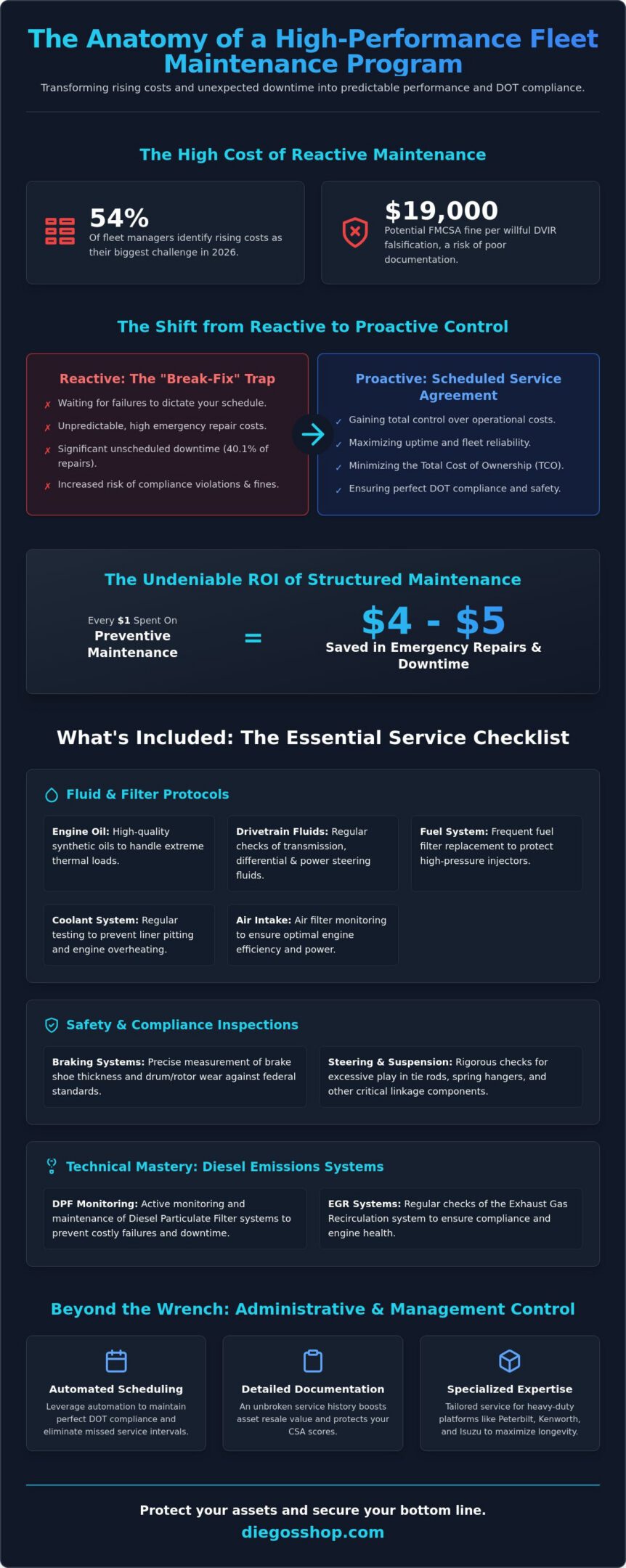
Over 54% of fleet managers identify rising costs as their biggest headache in 2026, yet many still struggle to define exactly what’s included in a fleet maintenance program that actually works. You’ve likely felt the sting of a sudden DPF failure or a missed delivery that cost more in lost trust than the actual repair bill. It’s a stressful way to run a business. This is especially true as modern diesel emission systems grow more complex and FMCSA fines for willful DVIR falsification now reach as high as $19,000 per violation.
We understand that you need reliability, not surprises. A professional maintenance strategy acts as a technical shield for your assets, protecting your bottom line from the volatility of emergency repairs. This guide outlines the essential components of a program designed to eliminate breakdowns and ensure total DOT compliance. We’ll provide a clear checklist of services that extend vehicle longevity, providing the peace of mind you need to focus on growth rather than the uncertainty of the shop floor.
Key Takeaways
- Shift from a reactive “break-fix” mindset to a proactive scheduled service agreement to gain total control over your operational costs.
- Identify what’s included in a fleet maintenance program to ensure your service provider covers critical fluid management and multi-point filter replacements.
- Master the technical requirements of modern diesel emissions systems, including DPF and EGR monitoring, to avoid the most common causes of emergency downtime.
- Leverage automated scheduling and detailed service documentation to maintain perfect DOT compliance and protect your CSA scores.
- Benefit from specialized expertise tailored to heavy-duty platforms like Peterbilt, Kenworth, and Isuzu to maximize the longevity of your specific assets.
Defining the Core of a Fleet Maintenance Program
A professional fleet maintenance program is a proactive, scheduled service agreement designed to keep your assets on the road. It isn’t a loose collection of occasional oil changes; it’s a rigorous protocol that replaces the stress of the “break-fix” mentality with total operational control. When you rely on a reactive approach, you’re essentially waiting for a failure to dictate your schedule. A structured program flips that script. It moves your business from a state of constant uncertainty to one of predictable performance.
The primary goal of understanding what’s included in a fleet maintenance program is to maximize your uptime while minimizing the total cost of ownership (TCO). In 2026, industry data shows that 53.7% of fleet maintenance is now scheduled, yet many managers still lose revenue to the 40.1% that remains unscheduled. By centralizing your service needs, you ensure that every technician who touches your vehicle is working from a master plan rather than just putting out fires. This level of discipline is what separates profitable fleets from those struggling with cash flow disruptions.
Preventive vs. Predictive Maintenance
Preventive maintenance (PM) is the bedrock of any fleet strategy. It relies on fixed intervals, such as specific mileage or engine hours, to perform essential tasks before components wear out. Predictive maintenance takes this a step further by using advanced diagnostics and telematics to catch potential failures before they manifest as a breakdown. For diesel fleets in 2026, a hybrid approach is the gold standard. This combines the reliability of scheduled intervals with the precision of real-time data monitoring. It ensures you don’t replace parts too early, but you never leave a vehicle vulnerable to a preventable roadside failure.
The ROI of Structured Maintenance
The financial argument for a structured program is undeniable. Research indicates that every $1 spent on preventive maintenance can save between $4 and $5 in emergency repairs and downtime costs. Beyond immediate savings, a comprehensive approach to fleet management significantly boosts the resale value of your equipment. A documented, unbroken service history proves to future buyers that the asset was cared for by professionals. Integrating consistent diesel maintenance into your operations provides long-term asset protection that keeps your trucks in the field for years longer than a neglected fleet. It’s about building durability into your business model. High-quality maintenance doesn’t just fix trucks; it protects your reputation for on-time delivery.
The Essential Service Checklist: What’s Included?
Knowing exactly what’s included in a fleet maintenance program allows you to hold your service provider to a higher standard of accountability. A professional checklist goes far beyond a simple visual inspection. It’s a technical deep dive into the systems that keep your trucks moving and your drivers safe. From the smallest grease fitting to the largest brake drum, every component requires a specific interval of care to prevent a cascading failure.
Fluid and Filter Protocols
Modern diesel engines are precision machines that demand high-quality synthetic oils. These fluids must maintain their viscosity under the extreme thermal loads found in heavy-duty hauling. When we manage your fleet, we look at the chemical health of every fluid in the vehicle. This includes transmission, differential, and power steering fluids. We also prioritize high-pressure common rail systems by performing frequent fuel filter replacements. Even tiny particles can cause thousands of dollars in injector damage. We also conduct regular coolant testing. This prevents liner pitting and overheating, two of the most common causes of preventable engine rebuilds. Clean air is just as vital, so we monitor air filters to ensure your engine isn’t working harder than it needs to.
Safety and Compliance Inspections
Heavy-duty safety depends on the integrity of your braking and steering systems. A comprehensive maintenance program includes precise measurements of brake shoe thickness and drum or rotor wear. We don’t just look at them; we measure them against manufacturer specifications to ensure they meet federal safety standards. We also perform rigorous checks on suspension components and steering linkages. Any sign of excessive play in a tie rod or a worn spring hanger is a red flag that we address immediately. This level of scrutiny is essential for maintaining commercial stability on the highway. Many operators integrate these checks with fleet management software to keep a digital paper trail of every adjustment. Staying ahead of these repairs is the most effective way to pass DOT truck inspections near me without the stress of a failed roadside stop.
Tire management is another critical factor in your bottom line. We monitor tread depth and maintain exact tire pressures to reduce rolling resistance and improve fuel economy. Finally, we perform thorough chassis lubrication. Greasing the fifth wheel, kingpins, and u-joints prevents the metal-on-metal friction that leads to premature component failure. If you’re looking for a partner who takes this level of pride in their work, our team is ready to help you secure your fleet’s future. This detailed approach is exactly what’s included in a fleet maintenance program when it is managed with integrity and technical expertise.
Technical Mastery: Diesel-Specific Systems & Emissions
Modern diesel engines require a level of technical depth that goes far beyond traditional mechanical work. When you evaluate what’s included in a fleet maintenance program, the focus must shift toward the complex electronics and emission systems that define 2026 standards. These systems are designed for efficiency, but they are also the most common failure points that lead to unscheduled downtime. Maintaining technical mastery over these components is the only way to ensure your trucks remain compliant and operational.
Precision is mandatory for fuel system health. We perform detailed fuel injector performance analysis, checking balance rates to identify failing injectors before they wash out a cylinder. We also conduct turbocharger health checks and boost leak testing. A small leak in a charge air cooler or a failing turbo actuator can significantly drop your fuel economy and increase exhaust gas temperatures, leading to long-term engine damage.
Managing Emission Control Systems
The Exhaust Gas Recirculation (EGR) valve and the Diesel Particulate Filter (DPF) are critical for passing Utah’s 2026 emissions testing. We provide rigorous monitoring of these systems to prevent your trucks from entering “limp mode,” a restricted power state that can strand a driver mid-delivery. Our protocols include EGR cleaning and valve testing to ensure proper flow. Because 2026 standards for Diesel Exhaust Fluid (DEF) quality are stricter than ever, we test for DEF contamination at every service interval. This level of specialized diesel engine repair knowledge is essential for keeping modern Selective Catalytic Reduction (SCR) systems functioning without costly sensor failures.
Heavy-Duty Engine Health
Internal engine health is monitored through consistent oil analysis. By examining the microscopic metal content in your used oil, we can detect premature bearing wear or coolant leaks before they turn into a $20,000 engine overhaul. We also perform cooling system pressure tests to identify weak hoses or leaking water pumps that might fail under load. This is especially vital for fleets operating in Utah. Our local geography presents unique challenges that standard maintenance schedules often ignore.
- Mountain Grades: Pulling heavy loads over the Point of the Mountain or through Parley’s Canyon puts extreme thermal stress on turbochargers and braking systems.
- Altitude Performance: Thinner air at high altitudes requires your cooling system and turbo to work harder, necessitating more frequent inspections.
- Climate Extremes: Utah’s swing from freezing winters to triple-digit summer heat causes rapid expansion and contraction of seals and gaskets.
Addressing these environmental factors is a core part of what’s included in a fleet maintenance program built for rugged reliability. We don’t just follow a generic manual; we adapt our service to the specific demands of the Intermountain West.
Administrative and Management Components
Technical mastery keeps your engines running, but administrative discipline keeps your business profitable. Understanding what’s included in a fleet maintenance program requires looking at the management side as much as the mechanical one. A professional program provides the data you need to move away from guesswork and toward informed decision making. In 2026, 30.8% of fleet managers still rely on spreadsheets to track their maintenance, but this manual approach often leads to missed intervals and compliance gaps. We replace that uncertainty with a rigorous system of documentation and reporting.
Our management protocols provide clear visibility into your cost-per-mile. This is essential for business owners who need to protect their cash flow from unpredictable repair costs. By tracking every service event, we help you identify “lemon” units that are costing more than they’re worth. We also monitor for recurring driver issues that might indicate a need for better training on equipment handling. This level of oversight ensures that every dollar you spend on your fleet is an investment in durability rather than just an expense.
Documentation and Record Keeping
Digital records are no longer optional for commercial operators. As of February 19, 2026, the FMCSA formally legalized electronic Driver Vehicle Inspection Reports (DVIRs) under rule FMCSA-2025-0115. At the same time, they increased fines for willful falsification of these records to as much as $19,000 per violation. We maintain detailed, digital service logs for every unit in your fleet to ensure you pass surprise DOT audits with confidence. These logs include all warrantied repair work, providing a complete history that protects your manufacturer coverage and boosts the vehicle’s eventual resale value. Having this data at your fingertips is a core part of what’s included in a fleet maintenance program managed with integrity.
Scheduling for Zero Disruption
Downtime is the enemy of your bottom line. We use telematics data to drive automated scheduling, ensuring that service happens exactly when it’s needed, not just when it’s convenient. A professional fleet maintenance partner coordinates parts availability before your truck even arrives at the shop. This “staged” maintenance approach avoids having your entire fleet down at once, keeping your deliveries on schedule. We focus on efficiency so your drivers spend more time on the road and less time in the waiting room. If you’re ready to eliminate the chaos of unscheduled repairs, schedule your next service with Diego’s Shop to experience a new level of operational control.
The Diego’s Shop Advantage for Utah County Fleets
Choosing a service provider is the final, most critical step in defining your operational success. While the checklist remains the same, the quality of execution varies wildly between shops. At Diego’s Shop, we believe that a personal name on the sign creates a higher level of accountability. You aren’t dealing with a revolving door of entry-level techs; you’re partnering with seasoned specialists who treat every truck like it’s their own. This hands-on expertise is exactly what’s included in a fleet maintenance program when you prioritize quality over the lowest bidder.
We specialize in the platforms that power Utah’s economy. Whether your fleet relies on the heavy-duty power of Peterbilt and Kenworth or the versatile performance of Isuzu and Ford diesel trucks, we have the diagnostic tools and technical knowledge to maintain them. Our team understands the specific engineering requirements of these brands, ensuring that every preventive service aligns with manufacturer standards while addressing the unique wear patterns we see in the Intermountain West. We take pride in the durability of our work and the longevity of your assets.
Serving the Wasatch Front
Our facility is centrally located on Parkway Court in Springville. This location allows us to serve the entire Wasatch Front efficiently, from the industrial hubs of Salt Lake County down through the growing corridors of Utah County. We’re deeply familiar with the environmental stresses your vehicles face every day. Between the corrosive road salt used in our winters and the extreme heat of the summer months, Utah trucks require a more aggressive protection strategy. We don’t just follow a generic manual; we adapt our service to the reality of your routes.
We invite fleet managers to visit our shop to see our operation firsthand. You’ll find a clean, organized environment where technical skill meets honest communication. We don’t hide behind jargon or vague estimates. We provide clear, direct information so you can make the best decisions for your business. Being a local partner means we’re here when you need us, providing the peace of mind that comes from knowing your fleet is in capable hands.
Your Partner in Commercial Success
Our promise is simple: we keep you moving so you can stay profitable. We view ourselves as an extension of your team, providing the master craftsman approach required for modern medium and heavy-duty equipment. By focusing on durability and integrity, we help you build a fleet that lasts longer and performs better. We understand that in the commercial world, a truck in the shop is a truck that isn’t making money.
The right partnership eliminates the stress of the unknown. When you know what’s included in a fleet maintenance program and you trust the people performing the work, you can focus on your core business. Contact Diego’s Shop today to build a custom fleet maintenance program tailored to your specific units and operational needs. We’re ready to secure your fleet’s future and protect your bottom line. Quality service is our signature.
Secure Your Fleet’s Operational Future
Success in the commercial hauling industry depends on the reliability of your equipment. We’ve explored the technical and administrative depth of what’s included in a fleet maintenance program, from emissions system monitoring to digital compliance tracking. Moving away from a reactive “break-fix” mindset is the most effective way to protect your bottom line and ensure your trucks remain on the road. By prioritizing preventive care, you eliminate the uncertainty of emergency downtime and the high costs of unscheduled repairs.
At Diego’s Shop, we provide the master-level diesel expertise your business deserves. We specialize in expert service for Peterbilt, Kenworth, and Isuzu platforms, ensuring every unit receives the precise technical attention it requires. Our team serves Springville and the broader Utah County area with a commitment to integrity and durability. We back our craftsmanship with warrantied repair work, giving you the peace of mind to grow your operations with confidence. Don’t leave your productivity to chance. Request a Custom Fleet Maintenance Plan from Diego’s Shop today. We’re ready to keep your business moving forward.
Frequently Asked Questions
What is the most important part of a fleet maintenance program?
Consistency is the most vital element of any successful program. A proactive schedule ensures that small issues, like a minor coolant leak or a worn brake pad, are caught before they escalate into a catastrophic failure. When you define what’s included in a fleet maintenance program, the focus should always be on preventive maintenance intervals that are never skipped, regardless of how busy your season becomes.
How often should commercial diesel trucks be inspected?
Most heavy-duty trucks require a professional inspection every 10,000 to 15,000 miles, though this varies based on your specific duty cycle. If your fleet operates on the steep grades of the Wasatch Front or in the extreme dust of rural Utah, more frequent intervals are necessary. We recommend a comprehensive safety and mechanical check at least every six months to ensure total operational control and compliance.
Can a maintenance program really lower my long-term repair costs?
Yes, structured programs significantly reduce your total cost of ownership by eliminating the premium prices associated with emergency repairs. Industry data shows that scheduled maintenance costs are far more predictable and lower than the expense of towing, lost revenue, and expedited parts. By investing in regular care, you avoid the $15,000 to $25,000 price tag often associated with major engine overhauls caused by neglect.
What happens if a truck in the program has an emergency breakdown?
When an asset in our program faces an unexpected issue, we prioritize that vehicle for immediate diagnostic attention. Our goal is to minimize your downtime by identifying the root cause quickly and utilizing our staged parts inventory to begin repairs. Because we already have your vehicle’s full service history on file, our technicians can work more efficiently to get your driver back on the road.
Do you handle DOT inspections as part of the maintenance program?
Is a fleet maintenance program worth it for small fleets of 3-5 trucks?
Small fleets actually have the most to gain from a structured program because they have less redundancy when a truck goes down. Losing one truck in a five-unit fleet represents a 20% drop in your earning capacity. Understanding what’s included in a fleet maintenance program helps small business owners stabilize their cash flow and protect their limited assets from the volatility of the repair market.
How do you track the service history of my vehicles?
We utilize digital documentation for every unit we service, creating a permanent and accessible record of all repairs and inspections. This history includes everything from fluid analysis results to warrantied repair work. Having a clear digital paper trail is essential for passing audits and maximizing the resale value of your trucks when it’s time to cycle them out of your fleet.
What brands of diesel trucks do you specialize in at Diego’s Shop?
Our technicians provide master-level expertise for the major platforms that power the commercial industry. We specialize in Peterbilt and Kenworth heavy-duty trucks, as well as Isuzu and Ford diesel medium-duty platforms. We maintain the specific diagnostic software and specialized tools required to service these brands to the highest professional standards of durability and performance.