

Fleet Vehicle Breakdown Prevention: A Master Craftsman’s Strategy for 2026

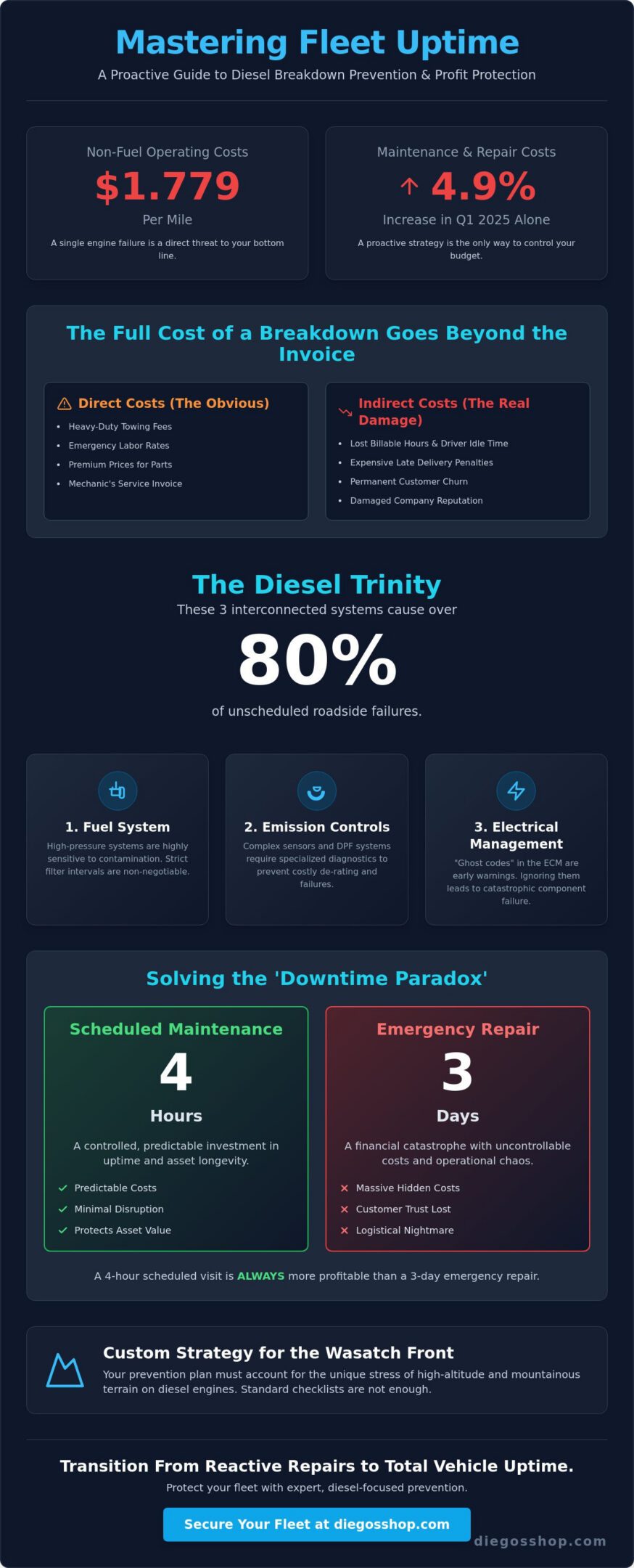
With non-fuel operating costs reaching a record $1.779 per mile, a single engine failure is no longer just an inconvenience; it’s a direct hit to your company’s survival. You know the sinking feeling of a missed delivery window or the sticker shock of an emergency tow that costs more than the actual repair. It’s frustrating to watch your profit margins evaporate because a truck is sitting on the shoulder of the highway instead of moving freight. You deserve a fleet that works as hard as you do, without the constant threat of “check engine” lights disrupting your schedule.
Effective fleet vehicle breakdown prevention requires more than just following a basic checklist. It demands a technical mastery of a diesel engine’s specific stress points and a proactive approach to the 2026 regulatory environment. This article provides the framework you need to eliminate unscheduled downtime and protect your bottom line through expert diesel-focused prevention. You will learn how to transition from reactive repairs to a strategy of total vehicle uptime, ensuring your maintenance budget stays predictable and your local reputation remains spotless.
Key Takeaways
- Learn why shifting from a “run-to-fail” mindset to a proactive technical discipline is the only way to protect your profit margins in 2026.
- Identify the three critical diesel engine systems that cause the vast majority of roadside failures and require specialized technical mastery.
- Discover how to customize your fleet vehicle breakdown prevention strategy to withstand the unique high-altitude and mountainous terrain of the Wasatch Front.
- Understand the “Downtime Paradox” and why a four-hour scheduled maintenance visit is always more profitable than a three-day emergency repair.
The True Cost of Reactivity: Why Breakdown Prevention Matters
Fleet vehicle breakdown prevention isn’t just a series of routine oil changes. It’s a technical discipline that requires a deep understanding of diesel mechanics and a refusal to accept “good enough.” In the current market, a “run-to-fail” strategy is a gamble where the house always wins. While skipping a service interval might seem like a way to save a few dollars today, the eventual bill for an emergency repair will always be higher. Planned maintenance is a controlled investment; a roadside failure is a financial catastrophe that you can’t schedule or contain.
When a single truck goes down, it creates a ripple effect across your entire operation. It isn’t just one driver sitting idle; it’s a broken link in your logistics chain. This disruption complicates every aspect of fleet management, from rerouting other assets to managing customer expectations. As we move through 2026, the industry is shifting toward predictive diesel diagnostics. With average maintenance and repair costs having increased by 4.9% in Q1 2025 alone, catching a failing sensor or a worn bearing before it snaps is the only way to keep your business profitable.
Calculating the Financial Impact of Unscheduled Downtime
The price of a breakdown goes far beyond the mechanic’s invoice. Direct costs are easy to track: you’ll pay for heavy-duty towing, emergency labor rates, and the premium prices associated with sourcing parts on short notice. However, the indirect costs often cut deeper. You’re dealing with driver idle time, expensive late delivery penalties, and the potential for permanent customer churn. If a client can’t trust your delivery window because your equipment is unreliable, they’ll find a competitor who prioritizes uptime. The Total Cost of Failure for a medium-duty truck is the combined financial weight of emergency recovery fees, lost billable hours, and the structural damage caused by operating a compromised diesel system.
The Role of Preventive Maintenance in Asset Longevity
Consistency is the foundation of durability. Regular service intervals do more than prevent immediate failures; they protect the long-term residual value of your fleet. A well-documented maintenance history is a badge of honor that pays off when it’s time to cycle out old equipment. Beyond the balance sheet, regular inspections are your best defense against regulatory headaches. Staying ahead of wear ensures you’re always ready for reliable DOT truck inspections near me, keeping your trucks legal and your safety rating intact. By treating every inspection as a chance to find a future problem, you ensure your assets remain on the road for hundreds of thousands of miles. Technical mastery prevents surprises. Reliability builds trust.
The Diesel Trinity: High-Risk Systems That Cause 80% of Failures
Modern diesel engines are marvels of engineering, but their complexity creates specific vulnerabilities that didn’t exist a decade ago. To master fleet vehicle breakdown prevention, you must focus your attention on what we call the “Diesel Trinity”: the fuel system, emission controls, and electrical management. These three interconnected systems account for the vast majority of unscheduled roadside stops. In the 2026 technical landscape, a “wait and see” approach to these components is a recipe for disaster. Specialized technical mastery is required to interpret how these systems communicate and where they are likely to fail under the stress of heavy-duty cycles.
Professional diagnostics are now the only reliable way to catch “ghost” codes—faults that flicker in the engine control module without immediately triggering a dashboard light. Ignoring these subtle warnings leads to catastrophic failures that could have been prevented with a simple sensor replacement. If you want to keep your trucks moving, you need a partner who understands the mechanical “why” behind the digital data. Establishing a routine fleet maintenance schedule allows a technician to identify these patterns before they result in a tow bill.
Fuel System Integrity and Contamination
High-pressure common rail (HPCR) systems are the heart of modern diesel performance, but they are incredibly sensitive to fuel quality. These systems operate at extreme pressures, meaning even microscopic particles of dirt or water can cause internal erosion. Strict fuel filter intervals are non-negotiable. If you notice a rough idle, unexpected power loss, or a slight haze in the exhaust, your injectors are likely crying for help. Catching injector wear early prevents a total engine shutdown and saves you from the massive expense of a full system flush and replacement.
Emission Controls: EGR and DPF Management
The 2026 emission control standards are the strictest in history. Soot buildup in the Exhaust Gas Recirculation (EGR) valve or the Diesel Particulate Filter (DPF) is the most common cause of “limp mode,” which effectively takes your truck out of service mid-route. You can’t rely on automatic regenerations alone. A comprehensive prevention strategy includes forced regens and professional DPF cleaning to remove the ash that heat cannot burn away. For complex issues involving these sensitive components, seeking expert diesel engine repair ensures your emission system stays compliant and functional.
Electrical Systems and Modern Engine Management
Data indicates that 50% of modern breakdowns are now electrical-related. It isn’t just about a dead battery; it’s about the complex web of wiring harnesses and sensors that manage every engine function. A failing alternator or a corroded ground wire can trigger a cascade of false fault codes, leading to unnecessary part replacements. In Utah’s climate, road salt and temperature swings accelerate corrosion in wiring connectors. Regular testing of your battery’s cold-cranking amps and a visual inspection of the harness are essential for maintaining cold-start reliability and preventing electrical gremlins from grounding your fleet.
Building a Prevention Framework for the Wasatch Front
Generic maintenance schedules often fail in the Wasatch Front because they ignore the reality of vertical elevation and thin air. A strategy for fleet vehicle breakdown prevention in Utah must account for the fact that a truck climbing Parley’s Canyon works twice as hard as one driving on a flat coastal highway. High-altitude operation changes the physics of diesel combustion. With less oxygen available, your engine’s turbocharger must spin faster to maintain the correct air-to-fuel ratio, which increases heat and accelerates wear on internal seals. If your maintenance plan doesn’t reflect these regional stresses, you’re essentially waiting for a component to fail under pressure.
Hardening your fleet against local conditions requires a seasonal approach. Winterization involves more than just checking antifreeze levels; it requires inspecting fuel heaters and testing glow plug resistance before the first freeze. Conversely, summer in the valley demands a focus on cooling system integrity to prevent the “heat-soak” that leads to cracked heads and blown gaskets. Integrating driver feedback into this loop is essential. Your drivers are the first to notice a slight change in exhaust tone or a new vibration in the steering column. When you treat their observations as technical data, you can catch a minor issue before it evolves into a roadside emergency.
Step 1: Establishing Data-Driven Service Intervals
Relying solely on mileage is a mistake for heavy-duty fleets. To maximize reliability, you should use engine hours and fuel burn as your primary metrics. A truck idling in I-15 traffic or operating a Power Take-Off (PTO) unit accumulates wear that an odometer simply won’t capture. We recommend a tiered schedule: “A” services for basic safety and fluids, “B” services for deep system inspections, and “C” services for comprehensive component testing. For baseline technical specifications tailored to these high-stress environments, refer to the 2026 diesel maintenance handbook.
Step 2: Implementing Rigorous Pre-Trip Inspections
A culture of “Checklist Mastery” is your best defense against negligence. You must train your drivers to look for specific early warning signs like “wet” spots on the pavement, unusual turbo whistles, or the acrid smell of burning electrical insulation. These daily walk-arounds shouldn’t be a formality. By documenting every finding in a centralized log, you create a trail of shop accountability. This ensures that a reported leak is actually repaired, not just wiped clean and sent back out on the road.
Step 3: Regional Hardening for Utah Conditions
Mountainous terrain demands over-servicing your braking and cooling systems. We perform cooling system pressure tests every spring to ensure your fleet can handle the heavy loads and high ambient temperatures of a Utah July. Likewise, brake system inspections must prioritize drum and rotor thickness to prevent brake fade during steep mountain grade descents. Applying a specialized undercoating and performing frequent high-pressure chassis washes is the only way to neutralize the aggressive salt-corrosion that destroys vehicle frames during Springville winters. Technical precision is the only way to outlast the environment.
Solving the ‘Downtime Paradox’: Scheduled vs. Emergency Service
“I can’t afford to have my truck in the shop” is the most frequent objection I hear from fleet managers. It’s a valid concern on the surface, but it represents a fundamental misunderstanding of how diesel engines operate. If you don’t proactively schedule your downtime, the machinery will eventually schedule it for you. Usually, this happens at the most expensive moment possible. This is the heart of the “Downtime Paradox”: the fear of losing four hours today often leads to losing four days next month. The math is simple, but the consequences of ignoring it are severe.
Effective fleet vehicle breakdown prevention solves this by replacing chaos with a controlled schedule. Consider the logistics of a typical work week. A scheduled preventive maintenance visit is a four-hour window that you control. You can move drivers to other assets or schedule the service during low-demand periods. Compare that to an emergency roadside failure. Between the tow truck arrival, the diagnostic queue at a busy shop, and the wait for specialized parts, you’re looking at a minimum of three days of lost revenue. With Element Fleet Management expecting a 20% to 25% increase in downtime over current repair timelines in 2026, the gap between the prepared and the reactive is only getting wider.
The Efficiency of Planned Fleet Repair
When a repair is planned, the entire process moves faster. We don’t start the clock when the truck arrives; we start it days before by pre-sourcing the necessary components. Parts are cheaper when they aren’t shipped via overnight emergency freight, and labor is more efficient when the technician has a clear, diagnostic-led objective. At Diego’s Shop, we prioritize fleet turnaround because we know your bottom line depends on movement. We don’t just “fix” trucks; we manage their health so they stay in the field. You can explore the technical details of this approach in our fleet maintenance guide.
Reducing the ‘Shop Cycle Time’
The goal of any professional diesel specialist is to reduce the “Shop Cycle Time,” which is the total duration an asset remains non-productive. General repair centers often struggle with modern diesel complexity, leading to misdiagnoses and the dreaded “comeback” where a truck returns days later for the same issue. We eliminate this waste by using advanced diagnostics to get it right the first time. By providing warrantied repair work, we offer the accountability that general shops can’t match. This predictability is the greatest psychological benefit for a fleet manager. You stop wondering if your trucks will finish the day and start knowing they will. It’s time to partner with a diesel specialist who values your uptime as much as you do.
Diego’s Shop: Professional Fleet Protection in Springville
Reliability is the currency of the trucking industry. At Diego’s Shop, we don’t just fix broken engines; we specialize in comprehensive fleet vehicle breakdown prevention for the most demanding commercial operations in Utah County. We understand that your fleet is the backbone of your business. When a truck is sidelined, it doesn’t just cost you a repair bill. It costs you reputation and revenue. Our approach is rooted in the technical mastery of medium and heavy-duty diesel systems, ensuring that every asset in your care is road-ready and compliant with the latest standards.
We take personal accountability for every bolt we turn. This master craftsman philosophy means we don’t look for the quickest fix; we look for the most durable one. By partnering with a local specialist who understands the unique stresses of the Wasatch Front, you gain a framework for fleet vehicle breakdown prevention that is built on integrity and technical precision. We help you move away from the stress of emergency repairs toward a predictable, managed maintenance cycle that protects your bottom line. Technical skill is our foundation. Your uptime is our priority.
Expert Service for the Wasatch Front
Serving Springville and the surrounding region requires more than just a set of wrenches. It requires an intimate knowledge of how Utah’s environment impacts diesel performance. We’re committed to keeping Utah’s commercial fleets moving by providing a level of service that corporate chains simply can’t match. Whether you’re managing a small delivery fleet or a heavy-duty long-haul operation, we provide the technical oversight necessary to prevent failures before they start. We invite you to join us for a professional fleet assessment to identify the hidden vulnerabilities in your current maintenance routine.
The Diego’s Shop Difference
Our facility is equipped with specialized diagnostic tools designed specifically for Peterbilt, Kenworth, Isuzu, and Ford diesel engines. We don’t guess at fault codes. We pinpoint the root cause of mechanical and electrical issues to ensure your trucks spend more time on the road and less time in the bay. Every service we perform is backed by our dedication to warrantied repair work, giving you the total peace of mind that comes from knowing the job was done right the first time. Reliability isn’t an accident; it’s the result of disciplined service and expert care. Contact us today to Request a Fleet Service Plan and secure the future of your operation.
Secure Your Fleet’s Future on the Wasatch Front
Success in the 2026 transport market depends on technical discipline, not luck. You have seen how mastering the “Diesel Trinity” of fuel, emission, and electrical systems can stop the majority of roadside failures before they begin. By transitioning away from the expensive “run-to-fail” cycle and adopting a regional framework tailored to Utah’s terrain, you protect both your equipment and your reputation. Predictability is the ultimate advantage for a fleet manager. It allows you to control your budget and your schedule without the constant threat of unscheduled downtime.
Keep your fleet on the road—Contact Diego’s Shop for a custom maintenance plan today. Your trucks were built to work; let’s ensure they stay that way.
Frequently Asked Questions
What are the most common causes of fleet vehicle breakdowns?
Electrical failures account for approximately 50% of modern diesel breakdowns. Other frequent culprits include fuel system contamination in high-pressure common rail engines and soot buildup within emission control components like the DPF and EGR valves. These systems are highly sensitive and require technical mastery to maintain, as even a minor sensor malfunction can trigger a “limp mode” event that grounds the vehicle.
How often should a diesel fleet vehicle undergo preventive maintenance?
Most diesel fleet vehicles require preventive maintenance every 10,000 to 25,000 miles, but this interval depends heavily on the duty cycle. For heavy-duty trucks operating in high-stress environments or mountainous terrain, using engine hours or fuel consumption as a metric provides a more accurate reflection of wear than mileage alone. Consistent intervals are the foundation of any successful fleet vehicle breakdown prevention strategy.
Is it really cheaper to maintain a fleet than to repair it when it breaks?
Preventive maintenance is significantly more cost-effective than reactive repair. With non-fuel operating costs reaching a record $1.779 per mile in 2024, a single emergency tow and roadside repair can cost triple the amount of a scheduled service. Proactive care keeps your maintenance budget predictable and prevents the cascading financial losses associated with missed deliveries and driver idle time.
What should be included in a commercial truck pre-trip inspection?
A thorough pre-trip inspection must include a walk-around to check tire pressure, tread depth, fluid levels, and visible leaks under the chassis. Drivers should also test all lighting systems, verify air brake responsiveness, and listen for unusual engine noises or turbo whistles. Documenting these findings daily ensures shop accountability and allows technicians to address minor issues before they evolve into roadside emergencies.
How do Utah’s road conditions affect diesel engine maintenance intervals?
Utah’s vertical elevation and high-altitude operation require shorter intervals for cooling and braking system inspections. The thin air forces turbochargers to work harder, increasing internal heat and stress on engine seals. Additionally, the aggressive road salt used during Wasatch Front winters necessitates frequent chassis washes and electrical connector checks to prevent corrosion-related failures in sensitive wiring harnesses and sensors.
Can preventive maintenance help my fleet pass DOT inspections?
Regular preventive maintenance is the most effective way to ensure your fleet passes DOT inspections without violations. By identifying worn components, air leaks, or lighting issues during a scheduled shop visit, you can address safety concerns before they result in expensive fines or “out of service” orders. A well-maintained fleet projects an image of professional accountability to regulatory agencies.
What is the difference between an ‘A’ service and a ‘C’ service for trucks?
An “A” service is a basic preventive maintenance check focusing on oil changes, lubrication, and safety inspections. It is typically performed frequently to catch minor wear. In contrast, a “C” service is a comprehensive structural and mechanical overhaul. This deeper service includes extensive system diagnostics, drivetrain inspections, and the replacement of long-life components to ensure the vehicle’s long-term durability and reliability.
How can I track maintenance data for a small to medium-sized fleet?
Small to medium-sized fleets can track maintenance data using specialized fleet management software, which typically costs between $25 and $45 per vehicle per month as of 2026. These digital tools allow you to automate service reminders, store digital Driver Vehicle Inspection Reports, and maintain consistent records. Proper data tracking is essential for optimizing your fleet vehicle breakdown prevention framework and managing total operating costs.