

Reliable Diesel Repair for Owner-Operators: Protecting Your Livelihood in 2026

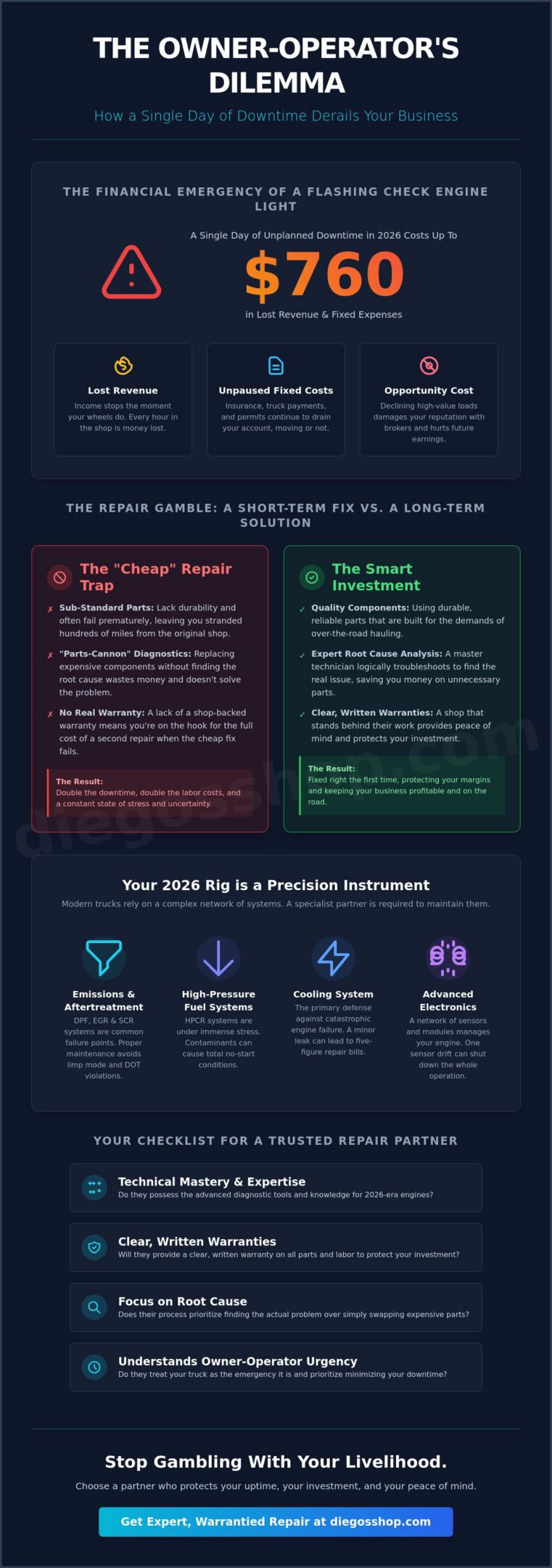
A single day of unplanned downtime in 2026 can cost an independent driver up to $760 in lost revenue and fixed expenses. When your check engine light flashes, it isn’t just a mechanical issue; it’s a direct threat to your livelihood. Finding reliable diesel repair for owner operators often feels like a gamble where the stakes are your reputation and your mortgage. You know that a shop that misdiagnoses a complex emissions fault doesn’t just waste your money; they waste your time, which is the one resource you can’t recover.
We understand that your truck is your office and your primary investment. This article will show you how to choose a repair partner to minimize downtime, ensure warrantied results, and keep your independent trucking business profitable. We will examine the essential standards for technical accountability, the impact of new FMCSA digital record-keeping rules on maintenance logs, and how to find a specialist who truly understands the urgency of the road.
Key Takeaways
- Calculate the true financial impact of downtime to understand why temporary fixes often cost more than professional engine overhauls.
- Master the complexities of 2026 emission control systems to keep your rig DOT-compliant and avoid expensive roadside violations.
- Identify when a mobile repair is sufficient and when specialized diesel repair for owner operators is required to protect your engine’s long-term health.
- Evaluate potential repair partners based on technical mastery and their willingness to provide clear, written warranties on all performed work.
- Learn why a dedicated local partner in the Wasatch Front offers the accountability and urgency necessary for independent trucking success.
The True Cost of Downtime for Owner-Operators
For a large corporate fleet, a broken-down truck is a manageable logistical hurdle. For an independent driver, it is an immediate financial emergency. When your equipment stops moving, your income stops with it, but your expenses continue to climb. Reliable diesel repair for owner operators is the only shield against the unpredictable nature of heavy-duty hauling. The stakes are personal. A fleet manager doesn’t lose sleep over a single unit sitting in a bay for three days; they have 50 others on the road. You, however, carry the weight of every missed mile.
This pressure often leads to reactive “firefighting,” where you chase the cheapest, fastest fix just to get moving again. This mindset is dangerous. True profitability in 2026 requires a shift toward strategic preventive maintenance and technical mastery. The psychological stress of mechanical uncertainty can be grueling. Constant worry about whether your rig will make the next climb or clear a DOT inspection drains your energy and focus. Moving from a state of constant repair to a state of planned maintenance provides the peace of mind necessary to run a successful business.
Calculating Your Daily Burn Rate
Your daily burn rate is the total cost of keeping your business alive while your truck is stationary. This includes fixed costs like insurance premiums, permits, and truck payments that don’t pause just because you’re in a shop. Then there is the “comeback” factor. A repair that fails 500 miles away from the original shop results in double the labor costs and double the downtime. In the context of independent trucking, opportunity cost is the net profit you lose when you are forced to decline a high-value, time-sensitive load because your equipment is sidelined. These missed contracts can damage your reputation with brokers, leading to fewer premium offers in the future.
Why ‘Cheap’ Repairs Often Cost the Most
Cutting corners on components is a recipe for disaster. Sub-standard parts often lack the durability required for over-the-road demands and rarely come with a shop-backed warranty. If a cheap part fails in another state, you’re on the hook for the full cost of a second repair. Poor diagnostics also drain your bank account. Many shops use a “parts-cannon” approach, replacing expensive sensors and components without finding the root cause.
Understanding how diesel engines work and how their complex systems interact is vital for a technician. A master craftsman who troubleshooters logically will always save you more money than a mechanic who simply swaps parts. Expert diesel repair for owner operators focuses on fixing it right the first time. This approach protects your margins from the high cost of repeated failures and keeps your business on the road.
Essential Diesel Engine Repairs and Systems to Monitor
The mechanical simplicity of the past has been replaced by sophisticated 2026-era electronics. Today, your truck relies on a network of sensors and control modules that manage everything from fuel timing to exhaust temperature. Understanding these systems is the foundation of quality diesel repair for owner operators. If one sensor drifts out of range, it can trigger a cascading failure that shuts down your entire operation. You need a partner who views your engine as a precision instrument, not just a block of iron. Precision is the difference between a truck that earns and a truck that sits.
Fuel system integrity is another critical area requiring constant vigilance. High-pressure common rail (HPCR) systems operate under immense stress. Even microscopic contaminants can erode injector tips or damage the high-pressure pump, leading to poor fuel economy or a total no-start condition. Similarly, your cooling system serves as the primary defense against catastrophic engine failure. A minor leak or a failing water pump can lead to warped heads and five-figure repair bills in a matter of minutes. Routine pressure tests and coolant analysis are small investments that prevent massive losses.
Mastering Emissions and Aftertreatment
Emission control systems like the DPF, EGR, and SCR are often the biggest headache for independent drivers. Clogged filters and failing EGR valves are common failure points that sideline owner-operators and lead to failed DOT inspections. Adhering to strict fleet maintenance protocols is the most effective way to prevent these systems from forcing your truck into ‘limp mode’. Advanced diagnostics allow technicians to identify sensor drift before it causes a total shutdown. Staying ahead of these issues ensures you remain compliant with Federal maintenance regulations, protecting you from heavy fines and unplanned stops.
Heavy-Duty Transmission and Drive Line Health
Your engine produces the power, but your transmission and drive line deliver it to the pavement. Signs of wear in heavy-duty transmissions, such as delayed shifts or unusual heat, are often overlooked until a major failure occurs. Drive line balancing and regular U-joint inspections are essential for long-haul comfort and component longevity. Excessive vibration doesn’t just annoy the driver; it creates harmonic stress that can damage sensitive engine electronics and seals over time. Maintaining these systems is part of a comprehensive approach to diesel repair for owner operators that prioritizes total vehicle health. If you suspect your rig isn’t performing at its peak, scheduling professional engine diagnostics can prevent a small vibration from becoming a major overhaul.
Choosing Between Mobile Patches and Specialized Shop Repairs
Mobile repair services play a vital role in the trucking industry, but they are often misunderstood. A roadside technician is a bridge, not a permanent solution. When you face a tire blowout, a dead battery, or a simple sensor swap, a mobile unit is the most efficient way to get moving. However, relying on roadside fixes for complex issues is a gamble that rarely pays off. High-quality diesel repair for owner operators requires a level of precision and cleanliness that the shoulder of a highway simply cannot provide. You need to know when to call for a tow and when to settle for a patch.
The primary limitation of a “roadside shop” is the environment. Modern engines are built to incredibly tight tolerances. Opening a high-pressure fuel system or an oil gallery in a windy, dusty environment introduces contaminants that can cause premature wear or total component failure. Specialized shops provide the controlled conditions necessary to protect your engine’s internal integrity. Furthermore, a physical facility offers access to heavy lifting equipment and precision machining tools that no service truck can carry. This infrastructure is essential for ensuring that a repair is performed to factory specifications rather than just “good enough” to reach the next state line.
The Controlled Environment Advantage
Cleanliness is not just a preference; it is a mechanical requirement. When performing major diesel engine repair, even a single grain of sand in a fuel injector can lead to a multi-thousand dollar failure. In a specialized shop, technicians work in bays designed to minimize environmental risks. They also have the time and space to perform comprehensive multi-point inspections. A mobile tech is often in a rush to reach the next breakdown, but a shop-based master craftsman can identify secondary issues like frayed wiring or weeping seals that a roadside check would miss. This thoroughness is how you stay ahead of FMCSA vehicle inspection regulations and avoid costly violations during your next transit.
Long-Term Reliability vs. Roadside Quick-Fixes
The difference between a “patch” and a “restoration” is the difference between surviving and thriving as an independent driver. A patch mentality focuses on the immediate symptom; a restoration mentality focuses on the root cause. Choosing a specialized shop for your diesel repair for owner operators allows you to build a relationship with a team that knows your equipment’s history. This home-base approach leads to better service tracking and more enforceable warranties. Most mobile repairs come with limited or no labor guarantees once the truck leaves the scene. In contrast, a reputable shop stands behind its work with written warranties that provide real peace of mind. Consistent maintenance at a dedicated facility is the only way to ensure your rig remains a reliable asset for years to come. Durable work requires a durable foundation.
Evaluating a Diesel Shop: Warranty, Expertise, and Integrity
Selecting a shop for your equipment isn’t just a maintenance choice; it’s a strategic business decision. In 2026, you cannot afford to leave your rig with a generalist who “thinks” they can handle the job. Technical mastery of your specific brand, whether it’s a Peterbilt, Kenworth, or a heavy-duty Ford, is the first requirement. You should ask a potential partner about their specific experience with your engine’s fuel system and electronics. A true specialist will speak your language and understand the nuances of your specific model without hesitation. This level of expertise ensures your truck is fixed right the first time, protecting your narrow margins from the cost of repeated failures.
Beyond technical skill, you must assess the shop’s infrastructure. Modern diesel repair for owner operators requires a significant investment in diagnostic software and hardware. If a shop relies on generic scanners or “old-school” guesswork, they’ll likely misdiagnose complex issues, leading to the “parts-cannon” approach mentioned earlier. Demand a clear, written diagnostic report before any work begins. A master craftsman uses data to find the root cause, providing you with a transparent roadmap for the repair. Finally, look for personal accountability. A shop where the owner stands behind the work offers a level of integrity that corporate chains rarely match.
The Power of Warrantied Repair Work
A warranty is the ultimate indicator of a shop’s confidence in its own technical skill. When you invest in warrantied repair work, you’re buying peace of mind. A legitimate diesel warranty should cover both parts and labor for a period that reflects the durability of the repair. If a shop is hesitant to put their guarantee in writing, it’s a clear signal to take your business elsewhere. For owner-operators who cross state lines, a shop-backed warranty provides a layer of protection against out-of-state failures. Knowing that your repair partner will stand by their work even if you’re 1,000 miles away is essential for long-haul stability.
Vetting for Integrity and Accountability
Integrity is often revealed in the details of the communication. When vetting a new shop, ask how they handle unexpected issues found during a teardown. A reliable partner will stop, call you with a detailed explanation, and provide an updated estimate before proceeding. Red flags include vague estimates, a refusal to show you the old parts, and a lack of specific diagnostic data. You’re looking for a partner who treats you like a business owner, not just another service ticket. This partnership approach leads to better communication regarding repair timelines and more accurate budgeting for future maintenance. If you’re tired of guessing games and want a shop that respects your time and your bottom line, schedule a consultation with Diego’s Shop today to experience true technical accountability.
Why Diego’s Shop is the Trusted Partner for Utah’s Independent Drivers
Diego’s Shop has deep roots in Springville. We understand the unique demands of Utah’s terrain and the heavy pressure independent drivers face every day. Our facility is not a generic corporate service center. It is a hub of technical mastery where personal accountability is the standard. We provide diesel repair for owner operators that focuses on the long-term health of your equipment. We know that your truck is your primary asset. Protecting that asset requires a partner who treats every repair with the urgency and precision it deserves.
Efficiency is our baseline. We respect your schedule and your bottom line because we know that stationary wheels don’t generate income. Our process combines high-level diagnostic technology with the seasoned intuition of a master craftsman. We don’t just clear fault codes; we eliminate the root cause of the problem. This commitment to technical excellence ensures that when you leave our bay, you do so with total confidence in your rig’s performance. Technical mastery is our signature.
Expertise Across All Major Diesel Brands
Whether you are piloting a Peterbilt or a Kenworth long-hauler, or managing a medium-duty Isuzu or Ford commercial fleet, we have the specialized knowledge required. Our Springville location serves as an ideal hub for drivers operating throughout Utah County and the Wasatch Front. We handle everything from complex engine overhauls to precision fuel system calibration. This breadth of expertise means you don’t have to hunt for different specialists. You have one reliable partner for your entire equipment roster. We speak the language of durability across every major brand.
A No-Nonsense Approach to Diesel Service
We value direct, grounded communication. You won’t find unnecessary jargon or vague excuses at Diego’s Shop. We provide the facts and the solutions you need to make informed business decisions. By leveraging proactive diesel maintenance, we help you prevent the next breakdown before it starts. This strategic mindset is what separates successful owner-operators from those struggling with constant mechanical failures. Our goal is to build a relationship based on integrity and technical excellence. Ready to get back on the road? Contact Diego’s Shop today for expert service.
Secure Your Road Ahead
Protecting your livelihood in a competitive industry requires moving beyond the quick fix and embracing a partnership built on technical accountability. You now understand how a controlled shop environment prevents system contamination and why a written warranty is the only true measure of service quality. By prioritizing specialized diesel repair for owner operators, you shift your focus from surviving the next mile to building a sustainable, profitable business. Technical mastery is not a luxury; it is a necessity for your long-term success.
Diego’s Shop provides the specialized expertise and warrantied repair work necessary for all major diesel brands. Our proven track record with OTR owner-operators across Utah County and the Wasatch Front ensures your rig receives master-level care. We understand the urgency of the road and the importance of fixing it right the first time. Schedule Your Expert Diesel Repair at Diego’s Shop to secure your equipment’s future. Keep your wheels turning and your business moving forward with confidence.
Frequently Asked Questions
What are the most common diesel engine problems for owner-operators in 2026?
Common issues include aftertreatment system failures, sensor malfunctions, and high-pressure fuel system wear. In 2026, the complexity of emissions electronics makes these systems the primary cause of unplanned downtime. Clogged DPF filters and failing EGR valves often trigger limp mode, forcing drivers off the road. Addressing these through specialized diesel repair for owner operators prevents minor sensor drifts from becoming catastrophic engine shutdowns and expensive roadside emergencies.
How can I reduce my diesel repair costs without sacrificing reliability?
Reducing costs requires a shift from reactive repairs to a strategic preventive maintenance mindset. Catching a weeping seal or a vibrating U-joint during a routine inspection prevents the cascading damage that leads to five-figure overhaul bills. Choosing a shop that uses advanced diagnostics rather than a “parts-cannon” approach ensures you only pay for what is actually broken. Precision saves more money than cutting corners on parts or skipping inspections.
Does Diego’s Shop offer warranties on heavy-duty engine overhauls?
Yes, we provide clear, written warranties on all heavy-duty engine overhauls and major repairs. We stand behind our technical mastery with guarantees that cover both parts and labor. This accountability is essential for independent drivers who need to know their investment is protected across the Wasatch Front and beyond. Our warrantied repair work provides the peace of mind necessary to keep your business stable and profitable through every mile.
Why is my diesel engine losing power or throwing an emissions code?
Loss of power is typically a protective “limp mode” response triggered by the Engine Control Unit. This often occurs due to sensor drift in the SCR system, a clogged DPF, or an EGR valve that is stuck. These codes indicate that the engine’s management system has detected a parameter outside of safe operating limits. Professional diagnostics are required to identify the root cause before these symptoms lead to a total vehicle shutdown on the highway.
How often should an owner-operator schedule a full diagnostic inspection?
We recommend scheduling a comprehensive diagnostic inspection every 25,000 to 50,000 miles or during every major preventive maintenance service. This proactive approach allows technicians to identify microscopic wear in the fuel system or early-stage cooling leaks. Regular inspections are the most effective way to manage the long-term health of your rig. Catching a problem in the bay is always cheaper than finding it on the shoulder during a delivery.
What is the difference between preventive maintenance and a DOT inspection?
Preventive maintenance focuses on the mechanical longevity and performance of your engine, while a DOT inspection focuses on legal safety compliance. Maintenance includes tasks like oil analysis, valve adjustments, and cooling system pressure tests. A DOT inspection verifies that your brakes, lights, and tires meet federal safety standards. Both are necessary to stay on the road, but only preventive maintenance protects your engine from internal failure and premature wear.
Can Diego’s Shop handle repairs for both my light-duty truck and my heavy rig?
Yes, our technicians maintain technical mastery across a wide spectrum of equipment, from light-duty pickups to heavy-duty OTR rigs. Whether you drive a Ford F-350 for local deliveries or a Peterbilt 389 for long-haul routes, we provide the same level of precision and accountability. This versatility makes our shop a reliable hub for all diesel repair for owner operators in the Springville area, regardless of the vehicle’s specific scale or brand.
What should I do if my diesel truck breaks down near Springville, Utah?
If you experience a breakdown near Springville, you should immediately secure your vehicle and contact our facility to coordinate a tow. Bringing your truck into a controlled shop environment is vital for accurate diagnostics and clean repairs. Roadside patches are often temporary and lack the warranties found in a specialized facility. We will work to assess the damage quickly and provide a transparent, grounded timeline for your return to service.