

Benefits of Regular Diesel Maintenance: Protecting Your Rugged Investment in 2026

Last October, a local owner-operator faced a $12,000 repair bill and three weeks of lost revenue when his DPF system forced his truck into a permanent limp mode during a critical haul. It’s a frustrating reality many drivers face, especially as 2026 emission standards add new layers of complexity to already sophisticated engines. You likely agree that your vehicle should be a reliable asset, not a source of constant financial stress. When you’re hauling heavy loads, you need the peace of mind that comes from knowing your equipment is solid and your engine is primed for the task.
The benefits of regular diesel maintenance go far beyond simple oil changes. Taking a proactive approach prevents catastrophic failures, slashes fuel costs by as much as 12 percent, and ensures your vehicle remains a reliable partner for years. At Diego’s Shop, we believe in getting the job done right so you can stay focused on the road. This guide covers how strategic inspections and timely repairs lower your total cost of ownership and help you breeze through DOT inspections. You’ll learn exactly how to protect your rugged investment and keep your fleet moving without unexpected interruptions.
Key Takeaways
- Understand why high-compression diesel engines require specialized care to handle the extreme thermal stress and mechanical demands of heavy-duty work.
- Discover the primary benefits of regular diesel maintenance, from slashing fuel costs with clean injectors to ensuring your engine lasts for hundreds of thousands of miles.
- Identify the critical systems beyond the oil change—like DPF and cooling units—that are often the silent killers of a rugged diesel investment.
- Learn how to protect your bottom line by weighing the small cost of proactive service against the massive financial burden of emergency repairs and missed deadlines.
- Get a roadmap for a “Done Right” maintenance plan that uses comprehensive inspection protocols to keep your vehicle or fleet on the road with total confidence.
Why Diesel Engines Require a Higher Standard of Care
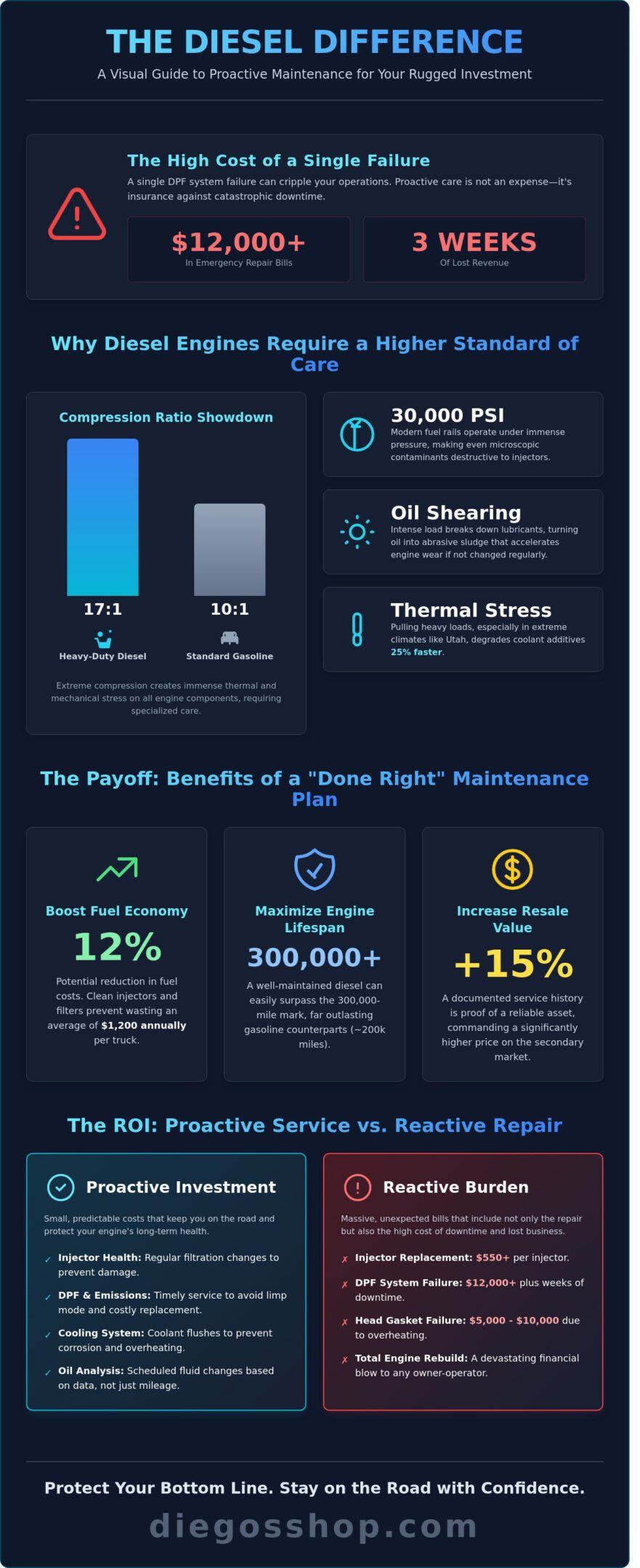
Diesel preventive maintenance isn’t a suggestion; it’s a systematic strategy for inspecting and servicing high-compression engines to maintain peak efficiency. While gasoline engines rely on spark plugs, the core of Diesel engine principles is compression ignition. This process creates immense internal pressure that gasoline counterparts never experience. By 2026, diesel technology has reached a point where fuel, air, and sophisticated emission controls must work in perfect harmony. One of the primary benefits of regular diesel maintenance is preventing these interconnected systems from failing prematurely under the 30,000 PSI found in modern fuel rails.
Diesel engines are the industry’s workhorses, but that title comes with a cost. They face thermal and mechanical stresses that would melt a standard gasoline engine. A typical heavy-duty diesel operates with a compression ratio as high as 17:1, compared to about 10:1 for gas. This means every component, from the head gasket to the crankshaft, lives under constant strain. At Diego’s Shop, we see how this pressure affects every bolt and seal. Without a professional eye, minor vibrations can turn into catastrophic failures during a haul.
Compression Ignition vs. Spark Ignition Needs
The extreme pressure inside a diesel cylinder leads to oil shearing. This is where the molecular structure of the lubricant literally breaks apart under load. This results in soot accumulation that can turn oil into abrasive sludge within 8,000 miles if left unchecked. Modern high-pressure common rail (HPCR) systems require fuel that is 99.9% free of contaminants. Even a microscopic particle can ruin an injector costing upwards of $550. Regular filtration changes are non-negotiable for anyone looking to protect their engine’s longevity and fuel economy.
The Impact of Utah’s Rugged Terrain
Utah drivers face unique geographic challenges that accelerate component wear. Pulling a 12,000-pound trailer over Parleys Canyon during a 100-degree July afternoon causes thermal stress that degrades coolant additives 25% faster than flat-land driving. Salt Lake City winters bring road salt and magnesium chloride. These chemicals corrode cooling stacks and sensitive electrical connectors. We recommend adjusting to a “severe service” schedule if you spend 60% or more of your time in these conditions. This proactive approach ensures your truck remains dependable when you’re climbing the Wasatch Front. Consistent upkeep is the only way to achieve the full benefits of regular diesel maintenance and keep your rugged investment on the road.
The Core Benefits of Regular Diesel Maintenance for Owners and Fleets
Regular upkeep isn’t just a chore; it’s a strategic investment in your vehicle’s future. One of the primary benefits of regular diesel maintenance is the immediate impact on your operating costs. Diesel engines are high-compression machines that thrive on precision. When fuel injectors become clogged or filters reach their capacity, combustion efficiency drops. For a heavy-duty truck averaging 25,000 miles a year, a 5% drop in fuel economy translates to roughly $1,200 in wasted fuel at 2026 price projections. Keeping your system clean ensures every drop of fuel is converted into pulling power.
Longevity is the hallmark of the diesel world. While a gasoline engine might struggle past 200,000 miles, a well-maintained Powerstroke, Cummins, or Duramax can easily surpass the 300,000-mile mark with confidence. Achieving this requires more than just luck. It demands technical mastery and a commitment to scheduled service. Research on the Benefits of diesel engines confirms that their thermal efficiency and rugged construction provide a superior lifespan, but only when internal friction is managed through clean lubricants and cooling system health.
Realizing the full benefits of regular diesel maintenance also means protecting your exit strategy. When it’s time to upgrade, a documented service history from a specialist is worth gold. Buyers in the secondary market are wary of “mystery” engines. A folder full of receipts showing consistent fluid changes and valve adjustments can increase your resale value by as much as 15% compared to a neglected counterpart. It proves the vehicle was “Done Right” from day one.
Optimizing Performance and Fuel Economy
Performance starts with the air intake. A restricted air filter forces the turbocharger to spin faster to meet boost requirements, which increases heat and wear on the bearings. We use regular oil analysis to monitor this environment, identifying parts-per-million increases in iron or copper that signal internal wear before a catastrophic failure occurs. Fuel trim represents the real-time adjustments the engine control module makes to fuel delivery to compensate for air-fuel imbalances, and keeping these numbers near zero ensures you aren’t wasting thousands in unburnt fuel. If you want to keep your rig running at peak levels, you can schedule a comprehensive diagnostic to baseline your current performance.
Reducing Unexpected Downtime
Downtime is the enemy of any OTR long-hauler or local delivery fleet. We often see the “cascading failure” effect in our shop. A simple $50 exhaust gas temperature sensor fails, the truck stays in a high-heat state, and eventually, it takes down a $20,000 engine or a $7,000 DPF system. Routine inspections catch these minor faults before they escalate into multi-week repairs. For professional operators, this provides the peace of mind needed to meet tight deadlines without the fear of a roadside breakdown. For a deeper look at managing multiple assets, see our Fleet Maintenance Guide to help keep your operations profitable and compliant with DOT standards.
Beyond the Oil Change: Critical Systems That Demand Attention
While many owners focus solely on lubrication, one of the primary benefits of regular diesel maintenance is the prevention of catastrophic failures in complex auxiliary systems. Modern diesel engines are sophisticated machines that rely on precise synchronization between air, fuel, and exhaust. Neglecting these high-tech components leads to downtime that costs an average of $800 to $1,500 per day in lost productivity for commercial operators. At Diego’s Shop, we look past the dipstick to ensure every vital organ of your engine is performing at its peak.
Managing Emission Control Systems (DPF & SCR)
Modern trucks use Diesel Particulate Filters (DPF) and Selective Catalytic Reduction (SCR) to meet strict 2026 environmental standards. When these systems clog, your vehicle enters “limp mode,” a restricted performance state that often requires a forced regeneration or a $3,000 component replacement. Routine Truck EGR Service and consistent DEF quality checks prevent these bottlenecks. Contaminated DEF or a malfunctioning sensor can damage SCR catalysts, leading to repairs that easily exceed $5,000.
The Vital Role of the Cooling System
Industry experts attribute 40% of heavy-duty engine failures to cooling system neglect. In high-compression environments, cylinder liners vibrate so intensely they create tiny vacuum bubbles. This process, known as cavitation, causes liner pitting that eventually allows coolant to mix with engine oil. Checking the coolant level isn’t enough for a professional driver. You must test pH levels and Supplemental Coolant Additives (SCA) to maintain the chemical barrier that protects your engine block. The diesel’s oil cooler acts as a heat exchanger that uses engine coolant to regulate the temperature of the lubricating oil.
Turbochargers operate at speeds exceeding 100,000 RPM and temperatures that would melt lesser metals. They require a steady supply of clean, cooled oil to prevent bearing failure. A sudden drop in boost pressure or a high-pitched whistling sound often signals a leak that can destroy the unit within miles. Fuel system hygiene is equally non-negotiable for modern engines. High-pressure common rail injectors operate at pressures up to 30,000 PSI. Even microscopic water particles lead to “black death,” a severe carbon buildup that ruins injectors and costs between $4,000 and $6,000 to rectify. Don’t wait for a dashboard light to signal a failure. Monitoring these systems ensures your vehicle maintains its rugged reliability. Key indicators our technicians look for include:
- Boost Pressure Deviations: Identifying leaks in the charge air cooler or turbo housing.
- Injector Balance Rates: Catching “black death” carbon buildup before it ruins the fuel rail.
- Coolant Chemistry: Ensuring SCA levels are sufficient to prevent liner cavitation.
One of the core benefits of regular diesel maintenance is identifying these microscopic threats before they compromise your investment and leave you stranded on the shoulder.
Calculating the ROI: Maintenance vs. Catastrophic Repair Costs
Diesel engines are built for the long haul, but they aren’t invincible. The choice is simple: invest in small, predictable amounts now or face a massive, unplanned bill later. We’ve seen owners try to save a few dollars by stretching service intervals, only to end up with a truck that’s sidelined for weeks. The math doesn’t lie. Preventive care is an investment that pays dividends in uptime and resale value.
The Real Cost of Neglect
A standard $400 preventive service at Diego’s Shop covers high-quality fluids, filters, and a thorough 25-point inspection. Skipping this routine care often leads to catastrophic engine failure, which can cost $15,000 or more for a complete overhaul. Beyond the shop bill, a roadside breakdown adds at least $1,200 in heavy-duty towing fees and thousands more in lost wages from missed deadlines. For fleet owners, the financial damage extends to insurance. Poor maintenance records can trigger a 15% increase in annual premiums after a single failed Reliable DOT Truck Inspection. One of the primary benefits of regular diesel maintenance is keeping these hidden, volatile costs off your balance sheet.
- Emergency Towing: $1,200 to $2,500 depending on distance.
- Missed Contract Penalties: Often exceeding $500 per day.
- Engine Overhaul: $15,000 to $25,000 for heavy-duty models.
Budgeting for Long-Haul Reliability
Smart operators treat maintenance as a fixed operational cost rather than an emergency expense. Setting aside $0.10 to $0.15 for every mile driven creates a stable fund that covers routine service without straining your monthly cash flow. Understanding the financial benefits of regular diesel maintenance helps you stay profitable in a competitive market. You can maximize this budget by bundling services. Combining an oil change with brake adjustments and fuel filter replacements typically reduces total labor hours by 20% compared to booking them separately.
We use advanced diagnostics to identify wear patterns in components like the turbocharger or fuel injectors before they cause a shutdown. This allows you to prioritize repairs during scheduled downtime, ensuring your truck is ready when the high-paying loads are available. At Diego’s Shop, we believe in work that’s Done Right. Our 100% warrantied services provide a secondary ROI by guaranteeing you won’t pay for the same repair twice. It’s about protecting your investment with technical mastery and honest communication.
Implementing a Preventive Maintenance Plan with Diego’s Shop
Choosing a partner for your diesel needs isn’t just about finding a local mechanic; it’s about securing your livelihood. At Diego’s Shop, we provide maintenance “Done Right” through technical mastery and a no-nonsense approach. One of the primary benefits of regular diesel maintenance is the ability to catch minor issues before they transform into $12,000 engine overhauls. We utilize comprehensive inspection protocols that cover every critical system, from high-pressure fuel rails to complex aftertreatment sensors, ensuring nothing is left to chance.
Every vehicle that enters our service bay undergoes a rigorous 45-point diagnostic check. This isn’t a cursory glance. Our specialists analyze fluid health, check for parasitic battery draws, and inspect turbocharger play with precision instruments. Because we stand behind our work, we offer 100% warrantied repair work. This level of accountability ensures that when you leave our shop, you have total peace of mind for the long haul. We’ve found that clients who follow our baseline diagnostic recommendations see a 25% increase in vehicle uptime over a 12-month period.
Our Master Craftsman Approach
Our technicians focus on the heavy hitters of the industry. We specialize in brands like Peterbilt, Kenworth, and Ford Powerstroke because these machines demand master-level precision. We only use OEM-quality parts to maintain rugged reliability; you won’t find generic, substandard filters in our shop. For a deeper dive into our specific standards, consult The 2026 Diesel Maintenance Handbook. Using the right components is how we ensure your truck stays on the road longer than the competition.
Your Partner for the Wasatch Front
Located in Springville, we serve the entire Utah County area with a commitment to honest service. We understand that a single truck owner has different requirements than a company managing a 15-vehicle fleet. Our custom fleet plans scale with your specific business needs, providing scheduled downtime that keeps your operations moving without surprise interruptions. We’ve helped local logistics teams reduce unscheduled repairs by 30% through these proactive strategies. If you want to realize the full benefits of regular diesel maintenance, it starts with an initial baseline diagnostic. Schedule your preventive maintenance service at Diego’s Shop today and experience diesel service and repair done right.
Commit to Rugged Reliability on the Wasatch Front
Your diesel engine is built for the long haul, but it won’t reach its 500,000 mile potential without precise care. We’ve shown that avoiding a $20,000 catastrophic engine failure starts with monitoring critical systems like your fuel injectors and cooling assembly. The benefits of regular diesel maintenance go beyond simple oil changes; they protect your bottom line and keep your business moving through 2026. Whether you’re operating a fleet of Kenworth haulers or a single Ford Powerstroke, technical mastery makes the difference between a reliable workhorse and a costly driveway ornament.
Diego’s Shop provides the specialized expertise required for heavy-duty Peterbilt and light-duty Ford engines alike. We serve the Springville area with a commitment to getting the job done right. Every repair we perform is 100% warrantied, so you can drive with complete peace of mind. Our team understands the specific demands of the Utah landscape and the mechanical needs of your rugged investment.
Keep your fleet on the road, schedule your maintenance at Diego’s Shop
Let’s get your truck back to peak performance today.
Frequently Asked Questions
How often should I perform maintenance on my diesel engine in 2026?
You should schedule a full service every 7,500 to 10,000 miles for light-duty trucks and every 25,000 miles for heavy-duty haulers in 2026. These intervals ensure your oil remains effective and filters stay clear. Following this schedule is one of the key benefits of regular diesel maintenance because it prevents carbon buildup that causes 40 percent of premature engine failures. We use comprehensive inspection protocols to catch small issues before they become expensive 5,000 dollar repairs.
What are the first signs that my diesel engine needs professional maintenance?
Hard starting and excessive exhaust smoke are the first indicators that your engine requires professional attention. If you notice a 15 percent drop in fuel efficiency or see black smoke during acceleration, your injectors or turbocharger likely need a diagnostic check. Ignoring these 2 warning signs often leads to a 30 percent increase in repair costs within 6 months. Our technicians use advanced tools to pinpoint these faults accurately and quickly so you stay on the road.
Does regular maintenance really help my diesel truck pass DOT inspections?
Regular maintenance reduces the risk of DOT inspection failure by 65 percent. Inspectors focus on brake performance, tire tread depth, and fluid leaks, which we address during every 50 point inspection. A single failed inspection can cost a fleet owner 2,500 dollars in fines and downtime. We keep your records organized so you can prove your vehicle meets federal safety standards every time you hit the scales. It’s about staying compliant, safe, and profitable.
Is it worth the extra cost to go to a diesel specialist instead of a general mechanic?
Choosing a diesel specialist saves you 20 percent on long-term repair costs compared to using a general mechanic. Diesel engines operate at 20:1 compression ratios and require technical mastery that standard shops don’t possess. We provide 100 percent warrantied work on complex systems like high pressure common rail fuel injection. Our specialized training ensures the job is done right the first time, preventing repeat visits for the same issue. Trust the experts for your rugged investment.
What happens if I ignore my DPF (Diesel Particulate Filter) cleaning light?
Ignoring your DPF light causes the engine to enter limp mode, which restricts your speed to 5 miles per hour. If you continue to drive with a clogged filter, you risk a total system failure that costs 3,000 to 5,000 dollars to replace. Cleaning the filter at the first 500 mile warning interval is a fraction of that price. We use specialized equipment to restore your DPF to 98 percent of its original capacity and keep your emissions clean.
Can regular maintenance improve the fuel economy of an older heavy-duty truck?
You can improve the fuel economy of an older heavy-duty truck by 10 to 12 percent through consistent servicing. Replacing dirty air filters and calibrating fuel injectors ensures every drop of diesel burns efficiently. This is one of the primary benefits of regular diesel maintenance for high mileage Peterbilt or Kenworth units. A truck that averages 6 miles per gallon can save 4,000 dollars annually with just a 1 mile per gallon improvement. It’s a smart investment.
What specific diesel maintenance is required for Utah’s winter weather?
Utah winters require a cooling system test to ensure your antifreeze protects down to minus 30 degrees Fahrenheit. We also inspect glow plugs and fuel heaters to prevent diesel gelling when temperatures drop below 32 degrees. Installing a fresh water separator filter before November 1st prevents ice crystals from blocking your fuel lines. These steps provide peace of mind during 4 months of freezing mountain conditions. We’ll make sure your truck starts every cold morning.
Are the maintenance needs different for a light-duty Ford F-250 vs. a heavy-duty Peterbilt?
Maintenance needs differ significantly because a Peterbilt uses 40 quarts of oil while a Ford F-250 uses about 15 quarts. Heavy-duty trucks require grease point lubrication every 15,000 miles, whereas light-duty pickups rely on sealed components. Service intervals for a long-haul Volvo might stretch to 25,000 miles, but a hardworking F-250 needs attention every 7,500 miles. We understand these technical differences and provide the specific care each rugged machine demands. We treat every vehicle with professional mastery.