
Turbocharger Repair for Diesel Trucks: The 2026 Owner’s Guide to Service Done Right

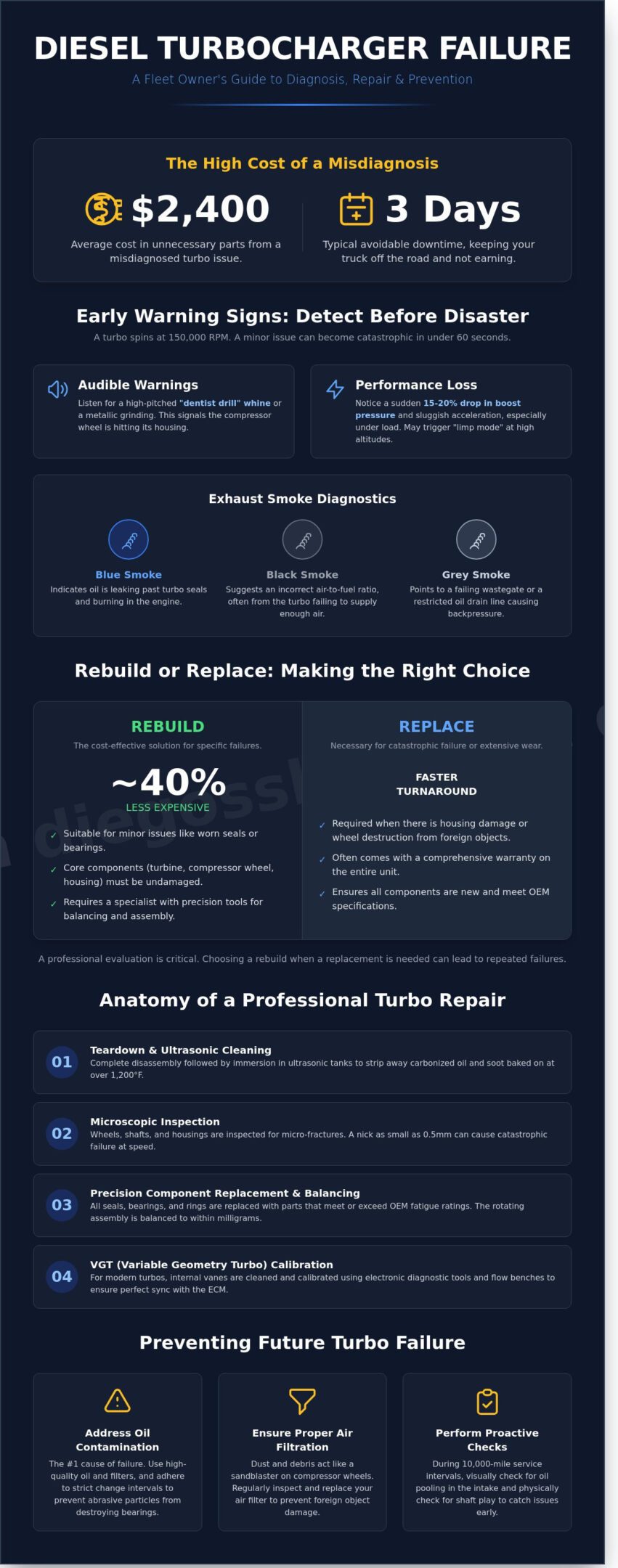
A misdiagnosed turbocharger issue costs the average fleet owner $2,400 in unnecessary parts and three days of avoidable downtime. You know that every hour your truck sits idle in a service bay is an hour it isn’t earning. It’s frustrating to face a sudden loss of power or an unusual whistle, especially when you’re skeptical about whether a shop will provide a lasting fix or just a temporary patch. We understand that your livelihood depends on rugged reliability and technical mastery.
This guide simplifies the complex world of turbocharger repair for diesel trucks so you can make informed decisions. You’ll learn how to distinguish a simple intake leak from a total turbine failure, evaluate the 40% cost difference between rebuilding and replacing, and choose a specialist who stands behind their work with a 100% warranty. We’re going to break down the diagnostic steps and the exact components that must be inspected to ensure the job is done right the first time. From light duty pickups to heavy duty long haul giants, we’ll show you how to restore your engine’s power and fuel efficiency for the long haul.
Key Takeaways
- Identify early warning signs like the “dentist drill” whine and sudden loss of boost to prevent minor issues from turning into catastrophic engine damage.
- Evaluate the critical criteria that determine whether you should choose a rebuild or a full replacement through professional turbocharger repair for diesel trucks.
- Learn how to protect your investment by addressing the leading causes of failure, including oil contamination and improper air filtration.
- Gain peace of mind by understanding the technical mastery and rigorous inspection protocols required to restore your vehicle’s rugged reliability.
Signs Your Diesel Truck Turbocharger is Failing
Early detection is the difference between a manageable seal replacement and a $5,000 engine overhaul. Understanding what a turbocharger is helps you realize it’s a precision instrument spinning at up to 150,000 RPM. When components fail at those speeds, the symptoms are immediate and severe. If you hear a high-pitched “dentist drill” whine or a metallic grinding sound, the compressor wheel is likely making contact with the housing. This mechanical friction sends metal shavings into your intake, which can destroy a diesel engine in under 60 seconds. Professional turbocharger repair for diesel trucks prevents these catastrophic outcomes before they escalate.
Watch your boost gauge for a sudden 15% to 20% drop in manifold pressure. This loss of boost leads to sluggish acceleration, especially when you’re hauling loads over 10,000 pounds. Your exhaust smoke provides a reliable visual diagnostic for internal health:
- Blue Smoke: This indicates oil is leaking past the turbo seals and burning in the combustion chamber.
- Black Smoke: This suggests an incorrect air-to-fuel ratio, often caused by a turbo failing to provide enough oxygen for a clean burn.
- Grey Smoke: This color often points to a failing wastegate or restricted oil drain lines that cause backpressure.
A “Check Engine” light is often the final warning. Modern diesel ECMs trigger specific fault codes like P0299 for underboost conditions or P0234 for overboost. These codes aren’t suggestions; they’re clear indicators that your forced induction system is no longer operating within safe parameters.
Performance Red Flags on the Wasatch Front
Driving at elevations above 4,200 feet in Utah forces your turbo to work harder to maintain air density. This extra stress often triggers “limp mode,” where the truck’s computer limits engine output to 2,500 RPM to prevent total failure. You must distinguish between a blown turbo and a simple boost leak. A boost leak usually involves a loose $30 silicone coupler or a cracked intercooler pipe, while a blown turbo involves internal mechanical destruction. If your truck loses power on a steep grade like Parleys Canyon, it’s a critical warning that requires immediate attention.
Visual and Physical Inspections
Visual checks save you thousands in labor. Remove the intake boot and look for oil pooling; more than a thin film indicates failing internal seals. Check for “shaft play” by gently moving the compressor nut. While a tiny amount of side-to-side (radial) movement is normal to allow for oil film, any in-and-out (axial) movement means the thrust bearing is shot. Consistently following the diesel maintenance handbook allows you to catch these issues during 10,000-mile service intervals. This proactive approach ensures your turbocharger repair for diesel trucks happens on your schedule, not during an emergency breakdown on I-15.
The Anatomy of Professional Turbocharger Repair
Professional turbocharger repair for diesel trucks begins with a complete teardown and a precision cleaning process. We don’t just wipe parts down. We use ultrasonic tanks and specific media blasting to strip away carbonized oil and soot deposits that bake onto components at temperatures exceeding 1,200 degrees Fahrenheit. Once clean, we perform a microscopic inspection of the compressor wheel, turbine wheel, and bearing housing. Even a 0.5mm nick on a blade can lead to catastrophic failure at high speeds. We replace every seal and bearing with high-grade technical components that meet or exceed the original manufacturer’s fatigue ratings. Understanding the common causes of turbo failure helps our technicians identify if the damage resulted from oil starvation or foreign object ingestion, ensuring the root issue is solved.
Mastering Variable Geometry Turbos (VGT)
Modern Cummins and Powerstroke engines rely on VGT technology to reduce lag and improve efficiency. These systems use internal vanes that move to change exhaust flow. When carbon builds up, these vanes get stuck, which leads to overboost conditions or a sluggish throttle response. We restore movement through specialized chemical cleaning and use electronic diagnostic tools to perform actuator calibration. This ensures the engine computer and the mechanical vanes are perfectly synced. We utilize the specialized flow benches and electronic scanners required for modern Holset and Garrett turbos to guarantee the repair is done right.
Technical Mastery and Precision Tolerances
At speeds exceeding 100,000 RPM, the margin for error disappears. A tiny vibration at idle becomes a destructive force at full boost. Professional diesel engine repair requires restoring the unit to OEM-spec performance through rigorous testing and assembly. We focus on the fine details that 90% of general shops overlook. Our approach to turbocharger repair for diesel trucks centers on technical mastery and rugged reliability. Turbocharger balancing is the process of using a high-speed VSR machine to ensure the rotating assembly remains stable within a tolerance of less than 0.5 G-force at speeds up to 150,000 RPM.
If your truck is losing boost or making a high-pitched whistling sound, it’s time to consult with a specialist before a minor seal leak turns into a total engine replacement. We provide the honest, warrantied service your heavy-duty equipment needs to stay on the road.
Repair, Rebuild, or Replace: Making the Right Choice
Choosing between a repair, a rebuild, or a full replacement is a high-stakes decision that impacts both your immediate cash flow and your truck’s long-term reliability. A precision rebuild typically costs between $900 and $1,600, while a brand-new OEM unit for a Class 8 truck often exceeds $3,800. You have to know when the metal is still viable. If the turbine housing shows heat-stress cracks wider than 0.005 inches or if the compressor wheel has suffered “fodder” damage from ingested debris, the unit is scrap. In these cases, turbocharger repair for diesel trucks is no longer an option; replacement is the only safe path forward.
Downtime is the silent killer of profitability for fleet managers. A full replacement gets you back on the road in roughly 6 to 8 hours if the part is in stock. A custom rebuild might take 48 hours at a specialized shop. If you’re an owner-operator losing $1,200 in daily gross revenue, the $1,500 you save on a rebuild might be offset by the loss of a high-paying load. We analyze these numbers with you to ensure the choice fits your schedule and your budget.
The Long-Term ROI of Warrantied Rebuilds
A professional rebuild saves most operators 30% to 50% compared to buying new. For a fleet manager overseeing 12 trucks, that represents a $22,000 difference over a three-year maintenance cycle. However, a rebuild is only as good as its guarantee. Professional warrantied repair work provides the legal and financial protection a commercial operation requires. When done right, a rebuilt turbo often lasts 150,000 to 200,000 miles. You’ll reach that milestone easily if you follow turbocharged engine maintenance best practices such as 5,000-mile oil intervals and 3-minute cool-down periods after long hauls.
Avoiding the Pitfalls of “Cheap” Replacements
It’s tempting to buy “eBay turbos” or uncertified knock-off brands that cost $500. These units often use inferior Grade 2 titanium or low-carbon steel that can’t handle the 1,250-degree exhaust temperatures of a working diesel. If a cheap compressor wheel shatters at 100,000 RPM, it sends metal shards directly into your intake manifold. This turns a standard turbocharger repair for diesel trucks into a $25,000 engine overhaul. Expert diagnosis prevents these disasters by identifying the root cause before you spend a dime. Many times, what looks like a blown turbo is actually:
- A $60 boost leak in a silicone boot.
- A clogged DPF creating excessive backpressure.
- A faulty electronic actuator that just needs recalibration.
Don’t replace a healthy turbo because of a $100 sensor failure. We use comprehensive inspection protocols to ensure every dollar you spend goes toward a real solution.
Preventing Future Turbo Failure: Proactive Maintenance
Oil contamination and starvation account for 40% of all turbocharger failures. This is the single biggest threat to your engine’s performance. Turbochargers spin at speeds exceeding 150,000 RPM, requiring a constant, pressurized film of oil to prevent metal-on-metal contact. Without this lubrication, the internal bearings fail within seconds. Proactive maintenance isn’t just a suggestion; it’s the only way to ensure your diesel engine remains dependable under heavy loads.
The Role of Clean Oil and Filtration
Synthetic oils are essential for modern diesel engines because they maintain their protective properties at temperatures reaching 1,300 degrees Fahrenheit. Conventional oils often break down and “coke,” leaving behind hard carbon deposits that block narrow oil passages. Integrating high-quality lubricants into your fleet maintenance plan protects the center housing rotating assembly from premature wear. When we perform a turbocharger repair for diesel trucks, we always insist on replacing the oil feed line. Old lines frequently harbor hidden sludge or debris that can destroy a brand-new turbo immediately upon startup.
Monitoring System Health
Digital telematics and boost gauges provide the data you need to spot efficiency drops before they lead to a breakdown. A drop of just 2 PSI in boost pressure often signals a developing intake leak or a failing wastegate. You must also monitor Diesel Particulate Filter (DPF) health closely. A clogged DPF creates excessive backpressure, which forces heat back into the turbo housing and puts immense stress on the seals. A clogged air filter restricts intake flow, creating a vacuum that pulls the compressor wheel forward and causes turbo surge. This axial thrust can snap a shaft if left unaddressed.
High-quality air filters are your primary defense for the compressor wheel. Filters must capture particles as small as 5 microns to prevent “dusting.” This occurs when microscopic debris erodes the leading edges of the compressor blades, ruining the turbo’s balance. Once the wheel is out of balance, vibration will eventually destroy the bearings.
Never shut down a hot engine immediately after a heavy haul or a long climb. Let the truck idle for 3 to 5 minutes to allow oil to circulate and cool the center housing. If you stop the engine while the turbo is glowing, the oil trapped inside will cook, leading to catastrophic bearing failure. Look for soot trails around the exhaust manifold or oil residue on the intake boots during your weekly inspections. These small signs indicate leaks that force the turbo to overspin to meet demand. Catching a loose clamp today prevents a total turbocharger repair for diesel trucks next month.
Keep your rig running with rugged reliability. Schedule your professional turbo inspection at Diego’s Shop today.
Diego’s Shop: Rugged Turbo Repair Done Right
Diego’s Shop is built on a foundation of rugged reliability and technical mastery. We understand that your truck isn’t just a vehicle; it’s your livelihood. Whether you’re hauling freight across the I-15 corridor or managing a local delivery route, a blown turbo can halt your operations instantly. We specialize in comprehensive turbocharger repair for diesel trucks, providing the precision required for high-performance systems. Our technicians use advanced diagnostic tools specifically calibrated for heavy-duty giants like Peterbilt and Kenworth, as well as light-duty powerhouses like the Ford F-250. Every repair we perform is backed by our 100% warrantied promise, ensuring that the work is done right the first time.
Why Utah Fleet Owners Trust Our Team
Utah’s driving environment is demanding. Between the steep grades of the Wasatch Front and the corrosive road salt used during our winters, diesel engines face unique stressors. Our team applies a “Done Right” philosophy to every complex turbo system we service. We don’t guess at problems. We use detailed diagnostic reports to identify the exact cause of failure, whether it’s oil contamination or a cracked housing. This transparency helps fleet managers plan their budgets without the fear of hidden costs. We’ve found that local fleets using our preventative inspection protocols see a 15% reduction in unexpected roadside failures annually.
- Specialized Diagnostics: Precise software for Peterbilt, Kenworth, Ford, and Volvo systems.
- Honest Pricing: Clear, upfront estimates with no hidden shop fees.
- Local Expertise: Knowledge of how high-altitude driving affects turbo boost and heat management.
- Warrantied Work: 100% guarantee on all diesel turbo services and components.
Get Your Truck Back on the Road
Minimizing downtime is our priority at our Parkway Court shop in Springville. When you schedule a visit, we begin with a thorough multi-point inspection to determine if a simple actuator fix or a full turbocharger repair for diesel trucks is necessary. We maintain a streamlined workflow to get commercial drivers back on the road within 24 to 48 hours for most standard turbo services. Our goal is to provide peace of mind through honest communication and dependable results. You can trust our seasoned craftsmen to handle your rig with the respect it deserves.
Restore Your Diesel Power and Efficiency
Ignoring a screaming turbo or excessive black smoke can lead to engine failure costs exceeding $3,000. Successful turbocharger repair for diesel trucks requires more than just a quick fix; it demands technical mastery of the specific tolerances found in light, medium, and heavy-duty systems. By sticking to a strict 5,000 mile oil service interval and monitoring boost pressure, you can extend your turbo’s lifespan by years. Diego’s Shop brings rugged reliability to every rebuild and replacement we perform in Springville and Utah County. We back our expertise with 100% warrantied repair work, ensuring your Ford, Kenworth, or Volvo stays in peak condition. You shouldn’t have to guess about the health of your rig. Our specialists provide the honest answers and precision service you need to keep your fleet moving forward. We’ve got the tools and the experience to get the job done right.
Schedule Your Professional Turbo Diagnostic Now
Trust your truck to the experts who care as much about your uptime as you do.
Frequently Asked Questions
How much does it typically cost to repair a diesel truck turbo?
Repairing a diesel truck turbo typically costs between $1,200 and $4,500 depending on the damage level and truck model. Minor seal replacements might stay under $1,500; however, a full internal overhaul often hits the $3,000 mark. These prices reflect current 2026 market rates for parts and labor. We provide a detailed estimate after our 30 point diagnostic check so you know exactly what you’re paying for.
Can I drive my truck with a failing turbocharger?
You shouldn’t drive your truck once you notice turbocharger failure symptoms like thick smoke or power loss. Operating a vehicle with a damaged turbo can send metal shards directly into the engine intake, causing a total engine failure within 50 miles. This turns a $2,000 repair into a $25,000 engine replacement. If your boost levels drop by 15% or more, pull over and call for a tow immediately.
How long does a professional turbo rebuild take?
A professional turbo rebuild usually takes between 24 and 48 hours from the moment we pull the unit. Our technicians spend the first 3 hours on teardown and ultrasonic cleaning to inspect every component. We then balance the rotating assembly to within 0.001 grams of factory specifications. This efficient turnaround ensures your truck returns to the road without unnecessary downtime, keeping your delivery schedule on track.
What is the difference between a turbo rebuild and a remanufactured turbo?
A turbo rebuild involves cleaning and repairing your truck’s original unit, while a remanufactured turbo is a pre-assembled part that meets factory standards. Rebuilds are often 20% cheaper because you aren’t paying for a new housing. Remanufactured units are better for fast swaps since they’re ready on the shelf. We help you choose the best option for your turbocharger repair for diesel trucks based on your current housing’s condition.
Does Diego’s Shop offer a warranty on turbocharger repairs?
Diego’s Shop provides a 12 month or 12,000 mile warranty on all turbocharger repairs and installations. This coverage ensures that every seal, bearing, and wheel we install performs as expected under heavy loads. We stand behind our work because we use certified components and follow strict torque sequences. It’s our way of guaranteeing that your service is done right the first time you leave our bay.
Is it better to repair my turbo or buy a new one for a commercial fleet?
Fleet managers should opt for remanufactured turbos to maintain a 98% uptime rate across their vehicles. While a brand new OEM turbo offers a 500,000 mile lifespan, a high quality repair costs 40% less and provides similar reliability for regional hauls. If your truck has over 750,000 miles, investing in a new unit is often the smarter long term financial move to avoid repetitive labor costs.
Why do turbochargers fail so often on diesel engines?
Oil contamination and excessive heat cause 90% of turbocharger failures in diesel engines. Since turbos spin at 150,000 RPM, even a 2 micron particle in the oil can score the bearings instantly. Heat soak after a hard haul also cooks the oil inside the lines, creating carbon deposits that block flow. Regular 5,000 mile oil changes and proper cool down periods prevent these common issues from grounding your fleet.