
Diesel Particulate Filter Cleaning Near Me: The 2026 Buyer’s Guide for Utah Fleets

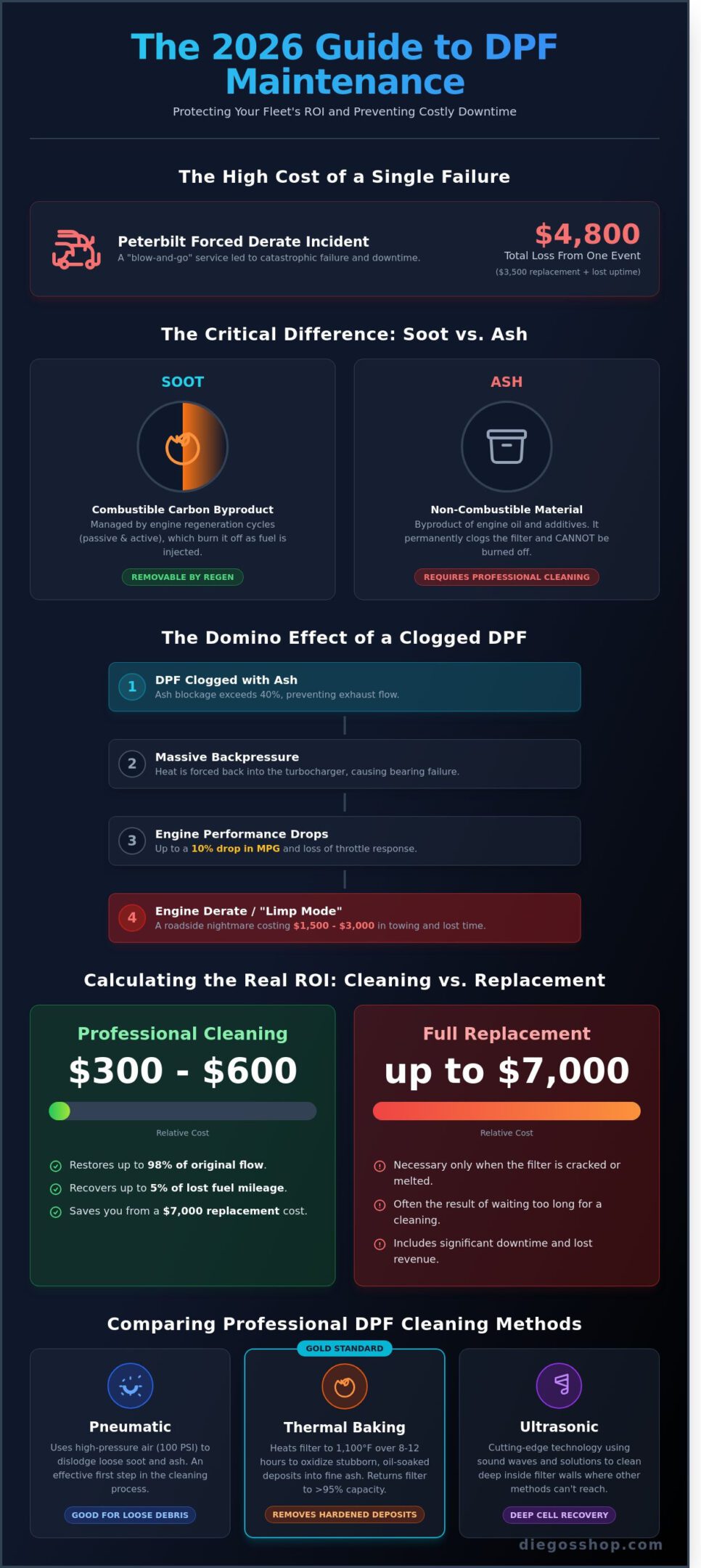
Last November, a fleet manager in Provo watched $4,800 vanish when a single Peterbilt hit a forced derate on the climb toward Soldier Summit. That truck wasn’t just stuck; it was facing a $3,500 replacement bill because a cheap blow-and-go service failed to remove the hardened ash. When you search for diesel particulate filter cleaning near me, you aren’t just looking for a repair. You’re looking for a way to protect your heavy duty investment from preventable failure.
Every hour in limp mode hits your bottom line. We believe your fleet deserves rugged reliability and technical mastery that keeps your drivers on the road. This 2026 guide shows you how to choose a professional DPF service in Utah County that restores 98% of your filter’s original flow and recovers up to 5% of lost fuel mileage. We’ll walk through the inspection protocols and documented recovery proofs you need to ensure the job is done right.
Key Takeaways
- Understand the massive ROI of professional maintenance, where a $300-$600 cleaning can restore 95% of flow capacity and save you up to $7,000 in replacement costs.
- Compare advanced pneumatic, thermal, and ultrasonic cleaning technologies to ensure your service provider has the technical mastery to avoid damaging fragile ceramic substrates.
- Locate the most reliable diesel particulate filter cleaning near me to combat the accelerated soot buildup caused by Utah’s high-altitude grades and extreme winter idling.
- Learn why the transition from passive to active regeneration eventually fails and how to implement a proactive cleaning schedule that prevents costly engine derates.
- Discover the specific diagnostic testing and flow reporting protocols used by Springville specialists to guarantee your fleet maintains rugged reliability.
Why Professional DPF Cleaning is Non-Negotiable in 2026
Modern diesel engines rely on the Diesel Particulate Filter (DPF) to trap 95% of harmful particulate matter. In 2026, with emission standards tighter than ever, your aftertreatment system is the most critical component for staying road-legal. Your engine uses passive and active regeneration to manage soot levels. Passive regeneration happens during high-speed hauling, while active regeneration injects fuel to burn off buildup. However, these cycles eventually fail because they only target soot, not ash.
The difference between ash and soot is the reason professional cleaning is a requirement, not an option. Soot is carbon-based and combustible. Ash is a non-combustible byproduct of engine oil and fuel additives that permanently lodges in the filter substrate. No amount of highway driving will clear it. When ash blocks more than 40% of the filter capacity, the engine enters “limp mode.” A roadside derate is a nightmare that costs operators between $1,500 and $3,000 in towing fees and lost uptime.
The Consequences of Ignoring DPF Restricted Flow
A clogged filter creates massive backpressure that travels upstream. This pressure forces heat back into the turbocharger, which leads to bearing failure and oil seal leaks. You’ll also notice your fuel economy tank. Engines struggling against a restricted exhaust can see a 10% drop in MPG as they work harder to push air through. DPF backpressure creates a restrictive force that prevents the engine from breathing properly, which forces fuel injectors to work harder and can lead to premature failure of the fuel system.
When to Search for DPF Cleaning Near Me
Smart maintenance starts before the dashboard lights up. You should look for early warning signs like a sudden drop in throttle response or a sharp increase in the frequency of active regens. If your truck used to regen once a day and now does it every 150 miles, the filter is reaching its limit. Most heavy-duty manufacturers set the primary maintenance milestone between 150,000 and 250,000 miles for a professional ash pull.
Searching for diesel particulate filter cleaning near me at the first sign of trouble saves your hardware. Waiting for a “DPF Full” light often means the filter is already face-plugged or cracked. A cracked filter cannot be cleaned and requires a full replacement, which can cost upwards of $7,000. We focus on technical mastery to ensure your system is cleaned right the first time, protecting your rugged reliability and your bottom line.
Comparing DPF Cleaning Methods: Pneumatic, Thermal, and Ultrasonic
Cleaning technology has evolved significantly from the days of simple air-knives and manual tapping. Modern recovery systems now capture nearly 98% of particulate matter during the cleaning process, protecting both the environment and your shop’s air quality. This evolution matters because the ceramic substrate inside your filter is fragile. A single mistake in temperature control or air pressure can cause thermal shock, leading to internal cracks that ruin a $3,000 component. Diego’s Shop relies on technical mastery and precision diagnostics to avoid these costly errors. We ensure every job is “Done Right” because we understand the high stakes of commercial operations. When you search for diesel particulate filter cleaning near me, you need a technician who treats your equipment with the respect it deserves. This commitment to quality is the same standard we apply to our Expert Diesel Engine Repair services.
Pneumatic vs. Thermal Baking
Pneumatic cleaning uses high-pressure air at roughly 100 PSI to dislodge loose ash from the filter cells. It’s an effective first step, but it cannot remove oil-soaked soot or hardened deposits. That’s where thermal baking comes in. By heating the filter to 1,100 degrees Fahrenheit over a controlled 8 to 12 hour cycle, we oxidize organic materials into fine ash. We always perform a “Pin Test” and a high-intensity light test to check for internal melting or hairline cracks. For most fleets, combining these two methods is the gold standard. It consistently returns the filter to 95% or more of its original flow capacity, ensuring your truck stays out of “limp mode.”
The Case for Ultrasonic Cleaning
Ultrasonic cleaning represents the cutting edge of DPF maintenance. This method uses high-frequency sound waves and specialized chemical solutions to create millions of microscopic bubbles. These bubbles implode, reaching deep into the walls of the ceramic cells where air cannot reach. It’s often the only way to save a filter with over 90% restriction or one that has been contaminated by coolant or oil. While a standard bake and blow takes a full day, ultrasonic cleaning can sometimes reduce turnaround time for severely plugged units. It’s a specialized tool in our arsenal that provides a deeper clean than traditional methods alone. If you want to ensure your fleet stays on the road with maximum efficiency, contact our specialists for a comprehensive diagnostic review of your exhaust system.
- Pneumatic: Best for routine maintenance and loose ash removal.
- Thermal: Required for oxidizing stubborn soot and oil residues.
- Ultrasonic: The ultimate solution for “un-savable” or severely plugged filters.
Choosing the right method depends on the specific state of your filter. We don’t guess; we measure. By using flow-bench testing before and after the service, we provide documented proof that your diesel particulate filter cleaning near me was handled with professional precision.
Cleaning vs. Replacement: Calculating the Real ROI for Your Fleet
Fleet managers often face a stark choice when a DPF light illuminates. The financial gap between maintenance and replacement is massive. A professional cleaning typically costs between $300 and $600. In contrast, a new OEM filter for a heavy-duty truck ranges from $3,000 to $7,000. Choosing a professional service restores 95% or more of the original flow capacity. This allows your equipment to perform with the same efficiency as a brand-new unit at a fraction of the capital expenditure.
Speed is important, but quality dictates your bottom line. A rushed job that ignores soot deep within the substrate leads to 20% more frequent regenerations. This creates unnecessary downtime and wastes fuel. When searching for diesel particulate filter cleaning near me, prioritize shops that use aqueous or thermal-pneumatic methods rather than quick “bake and blow” techniques. Our Fleet Maintenance Guide details how scheduled cleanings prevent the $1,500-per-day loss associated with unexpected roadside breakdowns. Finding reliable diesel particulate filter cleaning near me means looking for technical mastery rather than just the lowest price.
Maximizing Filter Lifespan Through Preventive Care
Regular cleaning prevents ash from hardening into a glass-like substance that permanently blocks the ceramic core. Using CJ-4 or CK-4 low-ash diesel oil reduces the rate of particulate buildup by 15%. Fuel additives also help by lowering the temperature needed for passive regeneration. You can find more technical insights in our 2026 Diesel Maintenance Handbook. Consistent care ensures your DPF reaches its full 500,000-mile design life without structural failure.
When a DPF Filter is Unsalvageable
Not every filter is a candidate for cleaning. We inspect for “face plugging” where oil or coolant has soaked the substrate. If the internal ceramic has melted or cracked due to extreme heat, the filter is scrap. Never use “de-cored” or hollowed-out filters. By 2026, emissions enforcement is stricter than ever; running a hollowed unit risks $10,000 fines and severe engine backpressure issues. At Diego’s Shop, we provide warrantied repair work. If we can’t restore it to 95% flow, we’ll tell you upfront. We believe in service done right, backed by a 100% guarantee on every cleaned unit.
Choosing a DPF Specialist in Springville and the Wasatch Front
Finding a reliable diesel particulate filter cleaning near me involves more than just picking the closest shop on a map. In Utah, the environment dictates how your emissions system performs. General repair shops often lack the specialized equipment required to verify if a DPF is actually restored to its original flow capacity. You need a specialist who uses flow bench testing to provide documented results. This data proves your filter is clear before it goes back on your truck, preventing a repeat failure within 500 miles. Don’t settle for a “jack of all trades” mechanic when your uptime is on the line.
Utah-Specific Diesel Challenges
Driving over Soldier Summit at 7,477 feet or pulling heavy loads through Parley’s Canyon puts immense stress on heavy-duty engines. These steep grades demand high exhaust temperatures for passive regeneration, yet our winter conditions often prevent filters from reaching those targets. High-altitude air density reduces the available oxygen for combustion, which shifts the air-to-fuel ratio and significantly increases soot production during heavy throttle applications.
In Wasatch County, trucks often spend 15% to 25% of their runtime idling in freezing temperatures. This creates a “wet soot” that bakes onto the filter walls. A standard “forced regen” cannot fix this level of accumulation. Local expertise is vital because we understand how Utah’s 40-degree temperature swings affect your pressure sensors and diesel exhaust fluid (DEF) systems.
The Diego’s Shop Difference in Springville
Diego’s Shop provides the technical mastery required for heavy-duty brands like Peterbilt, Kenworth, Volvo, and Isuzu. We support local fleets operating from Provo to Salt Lake City with a focus on Rugged Reliability. Our process ensures every job is Done Right the first time. We utilize advanced cleaning technology that removes 95% of ash and soot, restoring your fuel economy by up to 5%.
- Flow Bench Testing: We measure restriction levels before and after cleaning to ensure factory-spec performance.
- Fleet Support: We offer prioritized scheduling for businesses running multiple units across the Wasatch Front.
- Brand Expertise: Specialized diagnostics for light-duty pickups and Class 8 long-haul giants.
When you search for diesel particulate filter cleaning near me, you aren’t just looking for a quick fix. You’re looking for a partner that stands behind their work with honest, warrantied service. We identify the root cause of your clogging, whether it’s a faulty EGR valve or a leaking fuel injector, to ensure your truck stays on the road longer.
Keep your fleet moving with our professional emissions services. Schedule your DPF cleaning at Diego’s Shop today.
Schedule Your Professional DPF Service at Diego’s Shop
Finding a reliable source for diesel particulate filter cleaning near me shouldn’t be a source of stress for fleet managers or owner-operators. At Diego’s Shop in Springville, we’ve built our reputation on technical mastery and straightforward service. You can book your DPF inspection by calling our office or visiting our facility located near the 1600 West corridor. We handle everything from light-duty Ford F-250s to heavy-duty Kenworth and Peterbilt long-haulers with the same level of precision.
When you drop off your vehicle, you can expect a transparent process. We don’t just hook up a machine and hope for the best. Every service begins with a comprehensive diagnostic phase to identify the root cause of soot buildup. We provide detailed flow reports at both the start and finish of the process. This documentation gives you proof of the restoration and helps you track the health of your emissions system over time. Our goal is to ensure your truck leaves the shop in peak condition, backed by our “Done Right” promise.
To maximize your time, we recommend combining your DPF service with our DOT Truck Inspections in Utah. Scheduling these together reduces your total downtime by 50% and ensures that both your safety components and emissions systems are compliant in a single visit. It’s a practical way to keep your maintenance records organized and your trucks on the road longer.
Our Comprehensive DPF Inspection Protocol
- Pre-cleaning flow test: We measure backpressure in inches of water to establish a precise baseline of the filter’s restriction levels.
- Visual inspection: Our technicians use high-intensity internal lighting and pin-gauges to check for oil soaking, cracked cordierite, or cell melting that could signal a failed filter.
- Final flow test: After our thermal and pneumatic cleaning process, we run a final test to verify a restoration of 95% or better of the original factory flow capacity.
Get Your Fleet Back on the Road
We understand that every hour your truck sits in a bay is an hour of lost revenue. Our team targets a 24-hour turnaround for standard diesel particulate filter cleaning near me, allowing you to maintain your delivery schedules without interruption. We provide honest advice; if a filter is structurally compromised or “cooked” beyond repair, we’ll tell you immediately. We won’t waste your money on a cleaning that won’t last. Our shop is built on rugged reliability and the integrity of our word.
Contact Diego’s Shop for a DPF Cleaning Quote today. Let us handle the technical details so you can focus on the road ahead.
Protect Your Fleet With Rugged Reliability
Maintaining a heavy-duty fleet in 2026 requires more than just basic oil changes. Professional DPF maintenance is essential to avoid the $7,000 price tag of a full filter replacement. By choosing advanced thermal or ultrasonic cleaning, you can restore your equipment to 98% of its original flow capacity. This proactive approach keeps your Peterbilt or Kenworth trucks compliant and fuel-efficient on every haul across the Wasatch Front.
You don’t have to navigate complex emissions standards alone. Since 2021, our team has provided technical mastery to local operators who need diesel particulate filter cleaning near me that they can trust. We stand behind every service with 100% warrantied repair work because we believe in diesel service done right. Our specialists understand the unique demands of heavy-duty engines and prioritize your uptime above all else.
Restore Your Engine Performance; Schedule DPF Cleaning at Diego’s Shop
Your trucks are the backbone of your business, and we’re here to ensure they stay on the road for years to come.
Frequently Asked Questions
How much does DPF cleaning cost in Utah County?
In Utah County, a professional DPF cleaning typically costs between $350 and $600 depending on the filter size and its current condition. This price covers the specialized pneumatic cleaning and flow testing that ensures your filter meets OEM specifications. We provide honest, upfront pricing so you don’t face unexpected fees when you pick up your truck. Investing in this service now prevents a $3,000 replacement bill later.
How long does a professional DPF cleaning service take?
A standard professional cleaning takes approximately 24 hours from drop-off to completion. This timeframe allows our technicians to perform a thorough inspection, conduct the cleaning cycle, and run a final flow test to verify the results. If your filter requires a deep-cleaning thermal bake, the process can extend to 48 hours. We prioritize efficiency to get your vehicle back on the road without sacrificing technical mastery.
Can I clean my DPF filter myself with a pressure washer?
You shouldn’t use a pressure washer to clean your DPF because it often causes permanent damage to the delicate cordierite or silicon carbide core. High-pressure water can crack the internal cell walls or wash away the precious metal coatings required for emissions control. A damaged filter usually costs $2,500 or more to replace. Professional shops use controlled air and heat to remove 95% of ash safely without risking the unit’s integrity.
What is the difference between a DPF regen and a professional cleaning?
A regen cycle burns off accumulated soot by turning it into ash, but it can’t remove the ash itself. Over time, this ash builds up and occupies space, which increases backpressure on your engine. Professional diesel particulate filter cleaning near me involves physically removing that ash using specialized equipment. While a regen happens during operation, a professional service is the only way to restore the filter’s full capacity after 150,000 miles.
How often should a commercial truck DPF be cleaned?
Commercial trucks generally require a professional cleaning every 150,000 to 200,000 miles to maintain rugged reliability. If your truck spends 60% of its time idling or in stop-and-go traffic, you may need to service the filter every 100,000 miles. Keeping a strict maintenance schedule prevents premature turbo failure and keeps your exhaust system operating at 100% efficiency. We track these intervals to ensure your fleet stays compliant and productive.
Will a cleaned DPF pass a Utah DOT inspection?
A professionally cleaned DPF will pass a Utah DOT inspection as long as the substrate is intact and the housing shows no signs of tampering. Our cleaning process restores the filter to within 1% or 2% of its original flow capacity. We provide a detailed report of the flow test results which serves as proof of service. This documentation gives you peace of mind during roadside checks or annual safety inspections.
Can a DPF be cleaned if the engine is already in limp mode?
We can often clean a DPF even if your truck is in limp mode, provided the internal filter hasn’t melted or cracked. When searching for diesel particulate filter cleaning near me, look for a shop that performs a full diagnostic first. Limp mode is triggered when backpressure exceeds 5 PSI or sensors detect a failure. We’ll identify the root cause to ensure the cleaning is done right and the code stays cleared.
Does DPF cleaning improve fuel mileage?
Cleaning your DPF can improve fuel mileage by 3% to 5% by reducing engine backpressure. When a filter is clogged with ash, the engine works harder to push exhaust gases through the restriction, which wastes fuel. Restoring the flow allows the engine to breathe easier and reduces the frequency of active regens. For a long-haul driver covering 100,000 miles a year, this 5% improvement saves roughly $2,500 in annual fuel costs.