
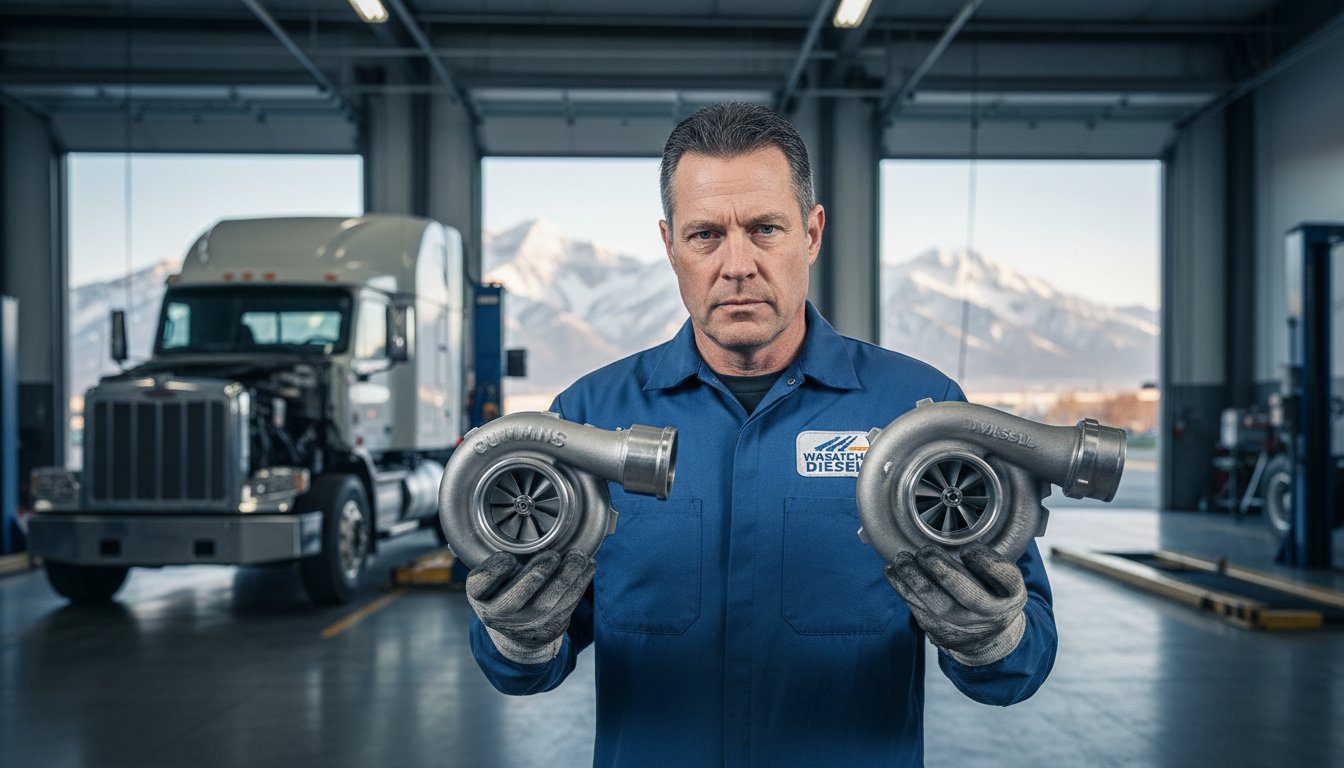
OEM vs. Aftermarket Diesel Parts: The Fleet Owner’s Guide to Rugged Reliability (2026)

When a truck in your fleet goes down, every minute of downtime costs you money. You’re immediately faced with a critical decision: pay the premium for a dealership part that might have an extended lead time, or take a chance on an aftermarket component of unknown quality? This constant debate over oem vs aftermarket diesel parts is one of the most significant challenges a fleet owner faces, directly impacting your budget, your schedule, and the long-term health of your engines. This isn’t just about the initial price tag; it’s about securing the rugged reliability your entire operation depends on.
This guide is built to deliver clarity and confidence. We will provide a straightforward, honest framework for mastering the critical differences between factory and aftermarket components. You will learn exactly when to invest in OEM parts for peace of mind and when a high-quality, warrantied aftermarket solution is the smarter, more cost-effective choice. Our goal is to empower you with the technical knowledge to maximize your fleet’s uptime, protect your assets, and ensure every repair is a repair Done Right.
Key Takeaways
- Master a decision-making framework to determine when to invest in OEM and where premium aftermarket parts can maximize your fleet’s ROI.
- Uncover the engineering reality behind modern diesel components and learn how advanced manufacturing has leveled the quality playing field.
- Move beyond a simple cost comparison by analyzing the complete oem vs aftermarket diesel parts debate through the lens of component criticality, vehicle age, and total cost of ownership.
- Learn how the Magnuson-Moss Warranty Act protects your fleet, allowing you to use high-quality aftermarket parts without risking your original factory warranty.
Understanding the Basics: What Are OEM and Aftermarket Diesel Parts?
When your diesel truck needs a repair, the debate over oem vs aftermarket diesel parts is one of the first hurdles you’ll face. Making an informed decision is critical for the performance, reliability, and longevity of your vehicle. At its core, the choice comes down to understanding where a part comes from and what it was designed to do. Getting this right is the first step in getting your diesel service done right.
An Original Equipment Manufacturer (OEM) part is produced by the vehicle’s original maker or by a company they contract to produce it. These are the same components your truck was assembled with at the factory. It’s also important to distinguish between “Genuine” and “OEM.” A “Genuine” part comes in a vehicle-branded box (like Ford or Freightliner), while an “OEM” part is the identical component from the actual manufacturer (like Bosch or Cummins) but sold in their own packaging. They are often the same part, just with different branding and pricing.
Aftermarket parts, on the other hand, are manufactured by independent companies. These components are engineered to function as a replacement for the original part and are often designed to meet or even exceed the factory specifications. The quality and performance can vary widely, from basic replacements to high-performance upgrades.
The Heritage of OEM Diesel Components
For many fleet managers and truck owners, OEM parts are the default “safe” choice. They are the result of the manufacturer’s extensive research and development, guaranteeing a perfect fit and familiar performance. This assurance comes at a cost, often referred to as the “dealership markup,” which covers the brand’s validation process, warranty, and distribution network. You are paying for a known quantity with zero guesswork involved.
The Evolution of the Diesel Aftermarket Industry
The aftermarket industry has matured far beyond its old reputation for “cheap copies.” Today, leading aftermarket manufacturers are engineering powerhouses, sometimes creating parts that fix known flaws in the original factory design. These “better-than-OEM” solutions are especially common for hardworking trucks from brands like Peterbilt and Kenworth, where a robust aftermarket offers everything from improved durability to enhanced performance, giving owners more control over their vehicle’s capabilities.
Quality vs. Cost: The Engineering Reality of Modern Diesel Components
The debate over oem vs aftermarket diesel parts often assumes a simple trade-off: original parts offer quality, while aftermarket parts offer savings. The reality is far more complex. Modern manufacturing technology, including CNC machining and 3D scanning, has empowered reputable aftermarket manufacturers to meet-and often exceed-OEM specifications. This shift has been so significant that it has drawn regulatory attention, with a comprehensive FTC Report on Repair Restrictions examining the consumer’s right to choose reliable repair options beyond the dealership.
For today’s diesel engines, precision is non-negotiable, especially concerning emissions systems. The intricate components of EGR and DPF systems demand exact tolerances to function correctly and avoid costly failures. A lower price tag on a part from a trusted aftermarket brand doesn’t mean lower quality; it reflects a competitive market, not inferior materials. These companies invest heavily in material science, often developing alloys and seals that provide superior heat resistance or durability compared to the original factory component.
When Aftermarket Engineering Outperforms the Factory
In some cases, the aftermarket provides a direct solution to known OEM design flaws. For example, many Ford 6.0L Power Stroke owners upgrade to aftermarket head studs and EGR coolers that are engineered to correct the original design’s vulnerabilities. Specialized brands focus entirely on perfecting a single component category, leading to innovations that master mechanics trust for heavy-duty performance and rugged reliability. It’s why many seasoned technicians prefer specific aftermarket gaskets that offer a better seal than the factory original.
The Risks of “White Box” or No-Name Parts
The critical distinction is not between OEM and aftermarket, but between reputable brands and anonymous “white box” parts. Sourcing cheap components from unverified online marketplaces is a high-stakes gamble. These parts often lack quality control, using substandard materials that can’t withstand the extreme pressures and temperatures of a modern diesel engine. At Diego’s Shop, we only use vetted, warrantied parts from suppliers we trust. A single faulty sensor or bolt can lead to catastrophic engine failure-a risk we will never pass on to our customers.
For fleet managers sourcing their own parts, it’s crucial to stick with specialized online suppliers rather than general marketplaces. For instance, there are dedicated e-commerce stores that focus solely on truck and trailer components, offering a more reliable and vetted selection; you can learn more about Truckparts Corner as an example of one such specialist.
This trend towards specialized, expert suppliers isn’t limited to the trucking industry. In other high-tech fields, like commercial drones, the same principles of sourcing quality parts and relying on expert service apply to maintain the fleet. If you’re curious about this parallel, you can learn more about Drone Doctor LLC, a dedicated provider for drone sales, parts, and repairs.
The Comparison Framework: When to Choose OEM and When to Go Aftermarket
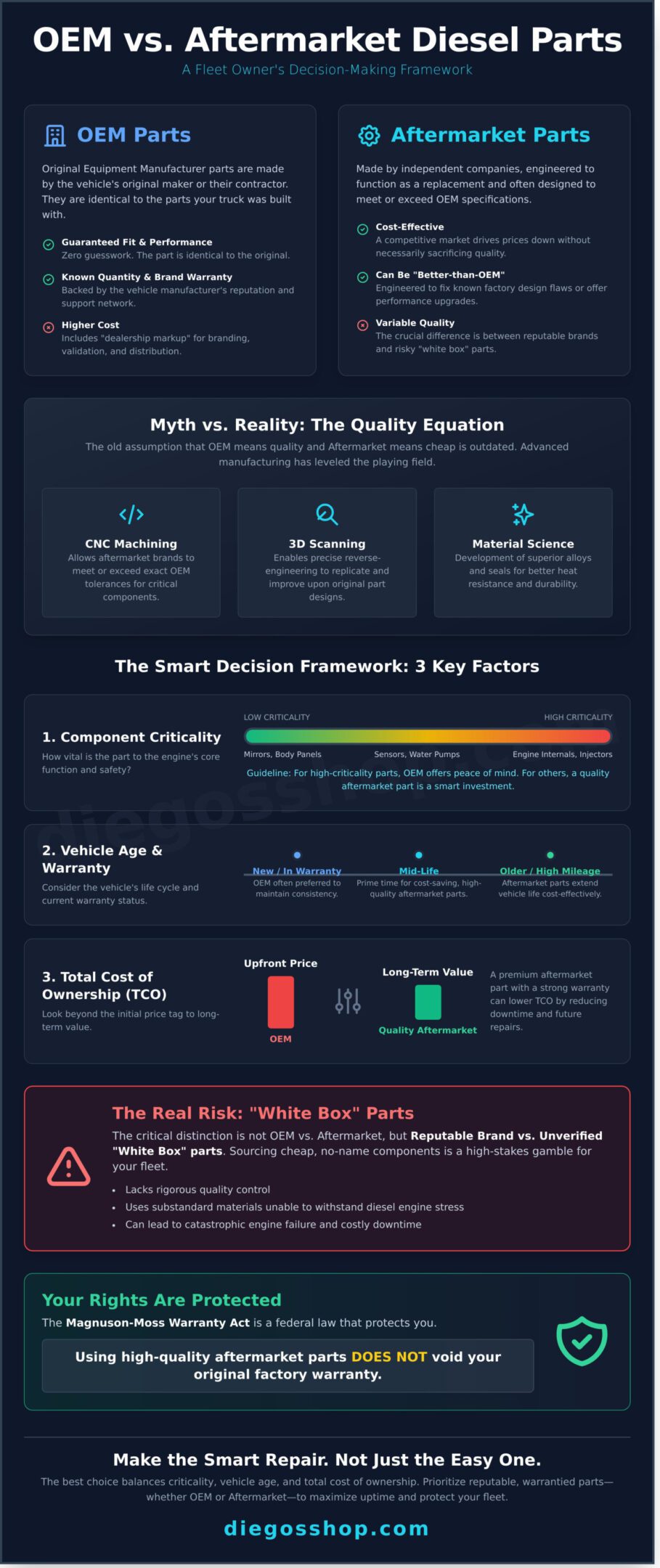
Making the right choice in the oem vs aftermarket diesel parts debate isn’t about finding a single “best” answer; it’s about making the best decision for your specific truck and situation. The right part depends on a strategic balance of your vehicle’s age, its primary use, and your budget. For newer trucks, especially those still under warranty or destined for high-mileage, long-haul routes, the guaranteed performance of OEM parts is often a non-negotiable investment. Conversely, for older, out-of-warranty trucks running local routes, high-quality aftermarket parts can provide significant, practical savings.
It’s also critical to consider the impact on resale value. A well-maintained service history featuring genuine OEM parts for major repairs can be a powerful selling point for medium and heavy-duty trucks, assuring potential buyers that the vehicle was maintained to the highest standard.
Critical Engine Components: The Case for OEM
For mission-critical systems, OEM is the most reliable path. This includes sophisticated electronic components like sensors and Engine Control Modules (ECMs), where perfect software compatibility is essential for performance and diagnostics. Internal engine parts-pistons, camshafts, and timing components-demand the exact tolerances and material specifications guaranteed by the original manufacturer. Using anything else, especially on a truck under warranty, introduces unnecessary risk and can compromise long-term reliability.
Wear Items and External Components: The Case for Aftermarket
Aftermarket parts shine when it comes to routine wear items and external components. Brake systems, suspension parts, and lighting offer a prime opportunity to reduce maintenance costs without sacrificing safety, provided you choose a reputable brand. Many fleet managers rely on aftermarket parts to keep older vehicles running cost-effectively. Furthermore, the “Availability Advantage” is a major factor; when an OEM part has a weeks-long backorder, a quality aftermarket alternative can prevent costly downtime. Reputable sources often provide a detailed OEM vs. Aftermarket Parts Comparison, confirming that for many common repairs, the aftermarket delivers exceptional, reliable value.
Protecting Your Investment: Warranties, Lead Times, and Fleet ROI
For any fleet manager, the decision between oem vs aftermarket diesel parts goes far beyond the initial price tag. It’s about total cost of ownership, vehicle uptime, and long-term return on investment. A common myth is that using aftermarket parts will void your manufacturer’s warranty. This is incorrect. The federal Magnuson-Moss Warranty Act protects your right to choose your repair parts and service provider without jeopardizing your vehicle’s warranty.
The most significant factor in this calculation is the true cost of downtime. While waiting for a back-ordered OEM part, a truck sitting idle isn’t just a parked asset-it’s lost revenue, missed deadlines, and a damaged reputation. Premium aftermarket parts are often more readily available, getting your vehicle back on the road and earning money faster. This immediate availability can make a high-quality aftermarket part significantly more profitable than its OEM equivalent.
Navigating Warranty Claims and Labor Coverage
Not all warranties are created equal. An OEM part often comes with a “part-only” warranty, typically for 12 months. If that part fails, the manufacturer provides a replacement, but you pay for the labor again. In contrast, premium aftermarket parts frequently offer longer warranties (24 months or more) that include both parts and labor. At Diego’s Shop, our warrantied repairs provide comprehensive peace of mind, ensuring your investment is protected from bumper to bumper.
Calculating ROI for Commercial Fleet Maintenance
Smart fleet management focuses on “Cost per Mile.” A slightly more expensive, durable aftermarket part that prevents a single roadside breakdown on I-15 has an infinitely better ROI than a cheaper alternative. For Springville-based fleets constantly navigating the steep grades of the Wasatch Front, rugged reliability isn’t a luxury-it’s essential. Proactive maintenance with trusted, warrantied parts is the key to maximizing uptime and protecting your bottom line. It’s how we get the job Done Right.
Why Diego’s Shop Prioritizes Warrantied Repairs for Utah Fleets
For fleet managers, the debate over oem vs aftermarket diesel parts isn’t just about cost-it’s about uptime, reliability, and long-term performance. At Diego’s Shop, we move beyond the debate by focusing on a complete, guaranteed solution. Our philosophy is simple: we provide Diesel Service and Repair Done Right. This means we don’t just swap components; we deliver a comprehensive repair that we stand behind completely.
We understand the appeal of aftermarket parts, which is why we’ve established a rigorous vetting process for our suppliers. Only manufacturers who demonstrate rugged reliability and consistent quality make the cut. This allows us to confidently install parts that meet or exceed OEM standards without the premium price tag. For fleets operating along the Wasatch Front, our Springville, Utah, location provides a convenient, centralized hub for expert service that minimizes downtime.
Ultimately, our 100% warrantied work removes the risk from your decision. When you partner with us, the responsibility for performance rests on our shoulders, not yours. We guarantee the part and the labor, giving you total peace of mind.
Mastery of Modern Diesel Technology
Our certified technicians possess a deep understanding of modern diesel systems. We don’t guess-we diagnose the specific failure mode to determine the ideal part for the job, whether it’s OEM or a trusted aftermarket alternative. With precision and expertise, we service all major brands, including Peterbilt, Kenworth, Volvo, and Ford heavy-duty trucks. We treat your fleet with the same meticulous care as if it were our own because we know your business depends on it.
Schedule Your Professional Diesel Consultation
Stop worrying about the nuances of the oem vs aftermarket diesel parts choice and let our experts build a reliable strategy for your fleet. We invite Utah fleet managers to our Springville shop for a comprehensive assessment. We can develop custom maintenance plans based on our thorough inspection protocols to keep your vehicles on the road. For an honest, expert consultation, contact Diego’s Shop today.
Your Fleet’s Uptime is Non-Negotiable: The Final Verdict
Navigating the choice between OEM and aftermarket parts is a critical decision for every fleet owner. The key takeaway is that this decision extends far beyond the initial price tag; it’s a strategic calculation of long-term value, vehicle uptime, and total cost of ownership. While high-quality aftermarket parts have their place for less critical systems, OEM components provide unmatched peace of mind with guaranteed fit and performance. Ultimately, the debate over oem vs aftermarket diesel parts is best resolved by partnering with a trusted technician who understands the specific demands of your vehicles.
At Diego’s Shop, we eliminate the guesswork. As Springville’s local leader in rugged reliability, we provide expert guidance and stand behind our work with 100% Warrantied Repair Work. Our specialized expertise in Peterbilt, Kenworth, and Ford diesel engines means we install the right part, every time, to protect your investment and keep your fleet on the road where it belongs.
Don’t leave your fleet’s performance to chance. Get Your Diesel Fleet Serviced Right-Schedule an Inspection at Diego’s Shop Today and experience the confidence that comes with service done right.
Frequently Asked Questions
Does using aftermarket parts void my manufacturer warranty?
This is a common concern, but the short answer is no. Using an aftermarket part does not automatically void your vehicle’s manufacturer warranty. A federal law, the Magnuson-Moss Warranty Act, requires the manufacturer to prove that the specific aftermarket part caused the need for repairs before they can deny warranty coverage. We always recommend using high-quality, reputable parts to ensure performance and protect your investment, a standard we uphold on every job.
Are aftermarket diesel parts lower quality than OEM?
This is a persistent myth. While some aftermarket parts are made to be cheaper alternatives, many reputable brands produce parts that meet or even exceed OEM specifications. In the performance diesel world, for instance, many aftermarket components are engineered for superior strength and durability. The key is knowing which brands are reliable. At Diego’s Shop, we only source and install parts-both OEM and aftermarket-that meet our high standards for rugged reliability and performance.
Which diesel engine parts should I always buy OEM?
For certain critical components, we strongly recommend sticking with OEM. This includes complex electronics like Engine Control Modules (ECMs) and transmission control modules, as well as highly specific sensors that integrate deeply with your truck’s software. These parts require precise calibration that aftermarket versions can sometimes fail to replicate perfectly, potentially causing performance issues down the road. For these core systems, OEM ensures factory-spec performance and complete compatibility.
How much can I save by choosing aftermarket parts for my fleet?
For fleet managers, the cost savings can be substantial. Depending on the component, aftermarket parts can be 20% to 60% less expensive than their OEM counterparts. When you multiply this across a fleet for common maintenance items like filters, brake components, and lighting, the annual savings can easily run into thousands of dollars. The debate over oem vs aftermarket diesel parts often comes down to balancing this initial cost savings with long-term reliability.
What is the Magnuson-Moss Warranty Act?
The Magnuson-Moss Warranty Act is a 1975 federal law designed to protect consumers. It makes it illegal for manufacturers or dealers to void your warranty simply because you used an aftermarket part. They must be able to prove that the aftermarket part was the direct cause of the mechanical failure. This law gives you the freedom to choose quality aftermarket parts for repairs and maintenance without fearing the loss of your factory warranty protection.
Why do some aftermarket parts have better warranties than OEM?
Aftermarket manufacturers operate in a highly competitive market and use strong warranties as a key selling point. To build trust and stand out, a premium aftermarket brand will often back its products with a longer or more comprehensive warranty than the OEM. This demonstrates confidence in their engineering and material quality, which in many cases is designed to improve upon the original part’s weaknesses. It’s a direct promise of reliability and value.
How do I know if an aftermarket brand is reliable?
Vetting an aftermarket brand requires diligence. Look for industry certifications (like ISO 9001), a long history of positive reviews from other truck owners, and a strong warranty. However, the most reliable method is to trust the experience of a professional diesel shop. At Diego’s Shop, we have years of hands-on experience and know which brands deliver rugged reliability. We do the research on parts so you get a repair that is Done Right.
Can Diego’s Shop help me choose between OEM and aftermarket for my specific truck?
Absolutely. This is a core part of our service. Our certified technicians will give you an honest, expert recommendation based on your specific vehicle, your budget, and how you use your truck. We’ll explain the pros and cons of each option for the required repair, ensuring you have all the information to make a confident decision. Our goal is to provide the best possible solution for your needs, ensuring every repair is Done Right.