
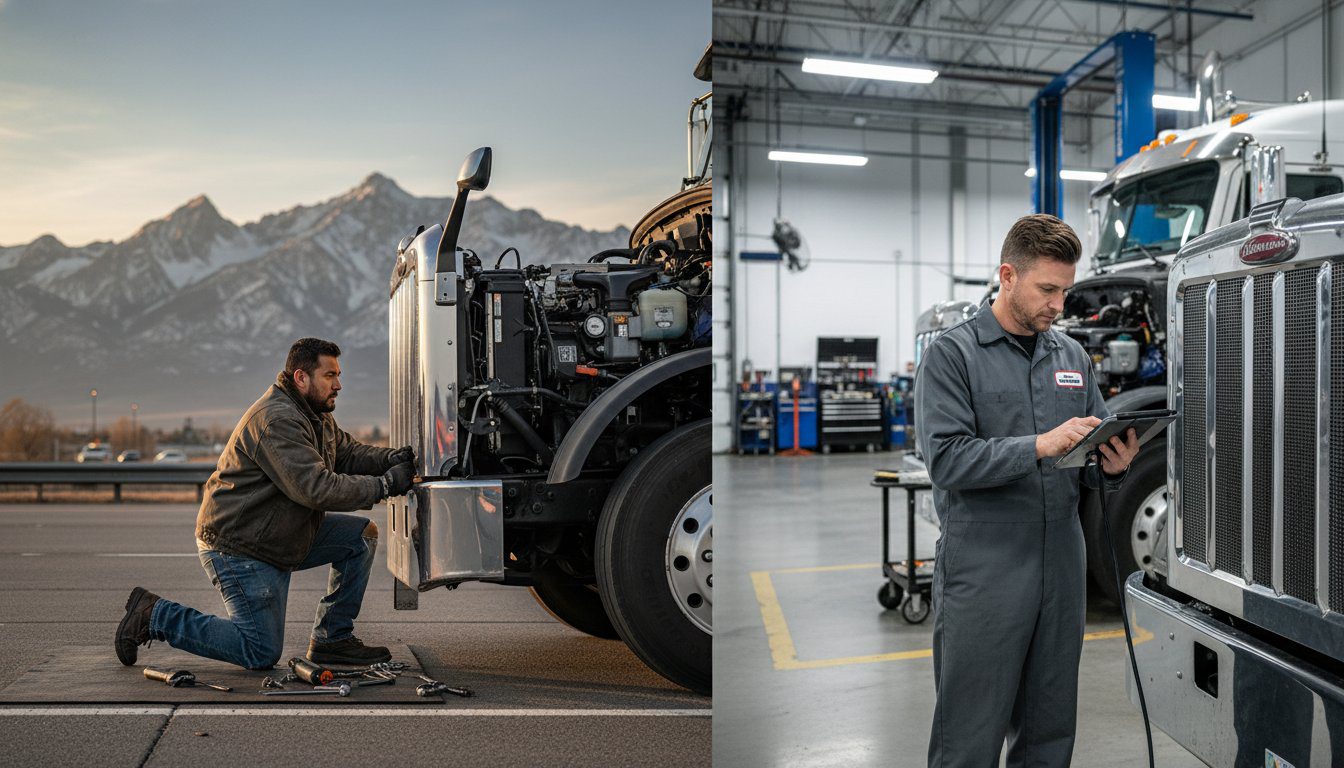
Mobile Diesel Mechanic vs. Shop: Which Is Right for Your Fleet in 2026?

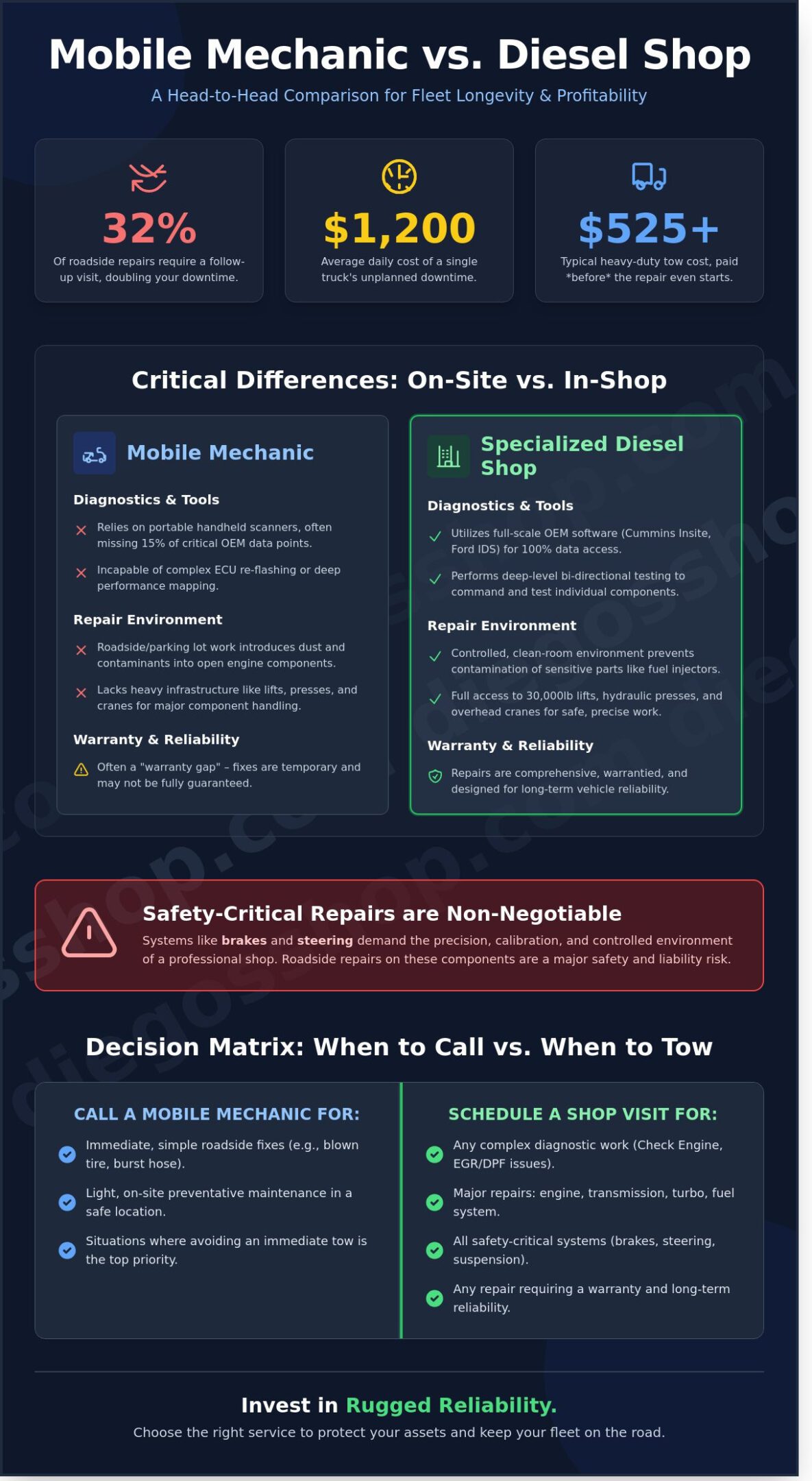
The convenience of a roadside fix might actually be the most expensive decision you make this quarter. While it feels like a win to avoid a tow, a 2024 industry report found that 32% of roadside diesel repairs require a follow-up visit within fourteen days because the root cause wasn’t fully diagnosed. Choosing between a mobile diesel mechanic vs shop isn’t just about location; it’s about the technical mastery required for your engine’s longevity. You’re likely tired of watching your margins evaporate every time a truck sits idle. Downtime costs the average fleet owner $1,200 per day, and the pressure to get back on the road often leads to “parts cannon” mechanics who swap components without a real plan.
We believe every repair should be done right the first time. This guide compares both repair models to help you protect your bottom line in 2026. We’ll examine the hidden costs of mobile services, explain how to secure a 100% warrantied repair, and outline the specific inspection protocols that prevent repeat component failures. You’ll finish this article with a clear strategy to minimize downtime and ensure your fleet maintains its rugged reliability. We provide the honest, expert perspective you need to keep your heavy-duty assets on the road where they belong.
Key Takeaways
- Learn how to balance on-site convenience with the technical mastery required for long-term diesel engine health.
- Compare a mobile diesel mechanic vs shop based on diagnostic tool depth, environmental safety, and the vital “warranty gap.”
- Identify which safety-critical repairs, such as steering and brakes, should never be performed outside of a controlled shop environment.
- Uncover the hidden costs of mobile repairs and why shop-based service provides the rugged reliability your fleet needs to stay on the road.
- Master our decision matrix to choose the right service level for major brands like Peterbilt, Kenworth, and Ford Powerstroke.
Understanding Your Diesel Repair Options: Mobile vs. Shop-Based Service
Diesel engines have evolved into high-tech machines. Choosing between a mobile diesel mechanic vs shop involves more than just a location preference; it’s a choice between immediate roadside assistance and the deep technical mastery found in a controlled environment. Mobile repair focuses on getting a truck moving after a breakdown or handling light preventative maintenance on-site. In contrast, the shop-based model provides a comprehensive solution for complex engine overhauls and sophisticated diagnostics. By 2026, EPA regulations have made diesel exhaust systems incredibly complex. These systems require precise calibration that’s often impossible to achieve in a parking lot or on a freeway shoulder. Deciding between a mobile diesel mechanic vs shop is often the difference between a temporary fix and a permanent solution.
The Rise of On-Site Truck Repair
Mobile services offer a lifeline for OTR drivers facing unexpected downtime. In Utah County, a standard heavy-duty tow often exceeds $525 before the truck even reaches a service bay. Avoiding this cost is the primary appeal of mobile repair. It’s a fast way to handle a blown tire or a burst radiator hose. However, many “chuck-in-a-truck” operations lack the advanced diagnostic software needed for 2026 Cummins or PowerStroke engines. They provide convenience but often lack the specialized tools for deep-system failures.
The Enduring Value of the Diesel Specialist Shop
Physical infrastructure remains the backbone of rugged reliability. Heavy-duty lifts capable of hoisting 30,000 pounds allow technicians to inspect every inch of a chassis safely. Precision work, like fuel injector replacement or turbocharger rebuilding, requires a clean-room environment to prevent microscopic contaminants from ruining a $4,000 part. We believe in diesel service and repair done right. That means using stationary equipment like hydraulic presses and overhead cranes that a mobile van simply cannot carry. A shop environment ensures every repair is honest, warrantied, and performed with absolute technical mastery. This controlled setting is essential for:
- Precision diagnostics: Using stationary, high-speed servers for deep ECU flashing.
- Heavy lifting: Safe removal of transmissions and engine blocks.
- Cleanliness: Preventing dust and debris from entering open engine components.
- Comprehensive inspections: Full access to the undercarriage and suspension systems.
Reliable fleet management requires a partner who understands these differences. While a mobile unit might save you a tow today, a specialized shop ensures your vehicle stays on the road for the next 500,000 miles.
The Technical Edge: Why Complex Diesel Diagnostics Require a Shop Environment
Choosing between a mobile diesel mechanic vs shop involves more than just calculating travel time. It’s about the depth of the diagnostic data. While mobile units rely on portable handheld scanners, a dedicated facility utilizes full-scale OEM software like Cummins Insite, Ford IDS, or CAT Electronic Technician. These systems allow for deep-level bi-directional testing. This means we don’t just read a code; we command the vehicle’s computer to test individual components under load. A tablet on a tailgate simply cannot replicate the server-side processing power required for complex ECU re-flashing or detailed performance mapping.
- Tool Depth: Mobile setups often miss the 15% of data points only accessible through hardwired OEM interfaces.
- Heavy Infrastructure: A 50-ton hydraulic press and overhead cranes allow for safe handling of 1,500-pound engine blocks and transmissions.
- Precision Machining: Roadside repairs can’t resurface a cylinder head or true a warped manifold, leading to repeat failures.
Complex EGR and DPF issues are notorious for being “fixed” on the roadside only to return 48 hours later. This happens because the root cause, such as a sticking turbocharger vane or a leaking EGR cooler, requires a tear-down that isn’t feasible in a parking lot. At Diego’s Shop, we don’t settle for temporary solutions. We find the source of the soot load to prevent future downtime.
Mastering Modern Diesel Management Systems
Modern common-rail fuel systems operate at pressures reaching 36,000 PSI. At this level, microscopic contaminants act like sandpaper. A roadside repair in an uncontrolled environment risks introducing dust that can lead to a $7,000 fuel system failure within 500 miles. We use a 27-point inspection protocol to identify the root cause of electronic faults. This technical mastery ensures we aren’t just clearing codes, but providing comprehensive diesel repairs that stay fixed. We’ve found that finding the root cause saves fleet managers an average of $4,500 in avoided secondary repairs per year.
Environmental Factors in Utah County
The Wasatch Front presents unique challenges. Utah County winters often see 40-MPH wind gusts and temperatures dropping below 15 degrees. These conditions make it impossible to achieve the precise torque sequences required for internal engine work. Metal expands and contracts with temperature; performing a head gasket repair in a snowstorm is a recipe for premature failure. Our shop maintains a controlled 65-degree environment year-round. This stability is essential for maintaining Rugged Reliability. It’s the only way to ensure every bolt is tightened to the exact foot-pound specified by the manufacturer without the interference of ice or grit.
Comparing the Real Costs: Towing Fees vs. Long-Term Reliability
When fleet managers weigh the mobile diesel mechanic vs shop debate, they often focus on the immediate invoice. It’s a mistake to ignore the total cost of ownership. Mobile service calls frequently start with a $175 dispatch fee. This doesn’t include the hourly rate or the markup on parts the mechanic had to buy at retail because they don’t have a warehouse. In a professional shop, 92% of common diesel parts are already on the shelf. This eliminates the “waiting for the parts runner” downtime that kills productivity.
- Mobile mechanics often charge 15% to 20% more for parts to cover their travel expenses.
- A shop environment allows for complex diagnostics that mobile scanners simply can’t handle.
- Preventive maintenance in a bay catches 4 out of 5 potential roadside failures before they happen.
The “Warranty Gap” is another hidden drain on your budget. If a mobile contractor installs a faulty water pump on a Peterbilt 579, getting them back to the roadside to fix their own mistake is difficult. You’ll likely pay a second service fee to a different technician. Choosing a shop means you’re investing in technical mastery that stays in one place. It’s about ensuring the job is finished correctly the first time.
The Truth About Towing Costs
Towing feels like a penalty. It isn’t. Spending $600 on a tow to a certified facility ensures the truck gets a comprehensive diagnostic. A 2024 industry study showed that roadside repairs fail 18% more often than shop repairs. When a repair fails on the shoulder, you’re paying for a second service call plus the original tow you tried to avoid. Diego’s Shop maintains partnerships with three local heavy-duty recovery teams to reduce these expenses for our regular fleet partners.
Accountability and Warrantied Repair Work
Accountability is the bedrock of “Diesel Service and Repair Done Right.” If a remanufactured turbocharger fails, a physical shop provides a clear point of contact for a 100% warrantied fix. Independent mobile contractors rarely offer a written guarantee that covers both parts and labor. At Diego’s Shop, we stand behind every wrench turn. You know exactly where to find us. This rugged reliability reduces emergency spend by 22% annually for fleets that prioritize a mobile diesel mechanic vs shop comparison based on long-term value rather than just the first hour of labor.
Decision Matrix: When to Call a Mobile Mechanic and When to Schedule a Shop Visit
Choosing between a mobile diesel mechanic vs shop depends on the technical depth of the repair and the immediate safety of the driver. Fleet managers who optimize uptime often follow a 70/30 rule. They perform 70% of preventative maintenance on-site to keep trucks moving, while reserving the remaining 30% of complex diagnostics for the controlled environment of a service bay. Safety remains the non-negotiable priority. If a vehicle has compromised air brakes, steering linkage failures, or structural frame damage, it belongs in a shop. These systems require the precision of heavy-duty lifts and specialized alignment racks to ensure the work is done right.
Emergency triage requires a different logic. If a Kenworth is stranded on the shoulder of I-10 at 3 AM with a blown coolant hose, a mobile technician is the only logical choice. The goal is to stabilize the vehicle and avoid a $500 towing fee. However, once the truck is mobile, a follow-up shop visit ensures the root cause is addressed. Data from 2024 shows that fleet operators who combine on-site oil changes with quarterly in-shop deep inspections reduce their roadside breakdown frequency by 22% annually.
Best Repairs for Mobile Diesel Mechanics
Mobile units excel at high-speed, low-complexity tasks that don’t require heavy lifting equipment. If your Ford F-250 has a dead battery or a failed alternator, a mobile tech can swap those parts in under 60 minutes in your yard. They are also ideal for cold-start assistance during winter months and minor electrical fixes like replacing burnt-out marker lights. Simple fluid top-offs and belt replacements are perfect for mobile service because they require minimal specialized tooling.
Critical Repairs That Belong in a Diesel Shop
Major internal failures demand the technical mastery found only in a fully equipped facility. Engine rebuilds, transmission swaps, and heavy-duty drivetrain repairs require overhead cranes and clean-room conditions to prevent contamination. Comprehensive DOT truck inspections also belong in the shop. A Level 1 inspection involves a 37-step protocol that is difficult to execute thoroughly in a parking lot. Our shop provides the 100% warrantied work and rugged reliability your fleet needs for these high-stakes repairs. For complex diagnostics and major overhauls, schedule a professional diesel service today.
Diego’s Shop: Providing Rugged Reliability and Warrantied Diesel Repair in Utah
We operate on a simple, firm promise: “Diesel Service and Repair Done Right.” Based in Springville, our facility serves fleet managers across the Wasatch Front who need more than a temporary patch. We’ve built our reputation on being a trusted partner for those who can’t afford downtime. Our team doesn’t just clear error codes; we diagnose the underlying mechanical issues that lead to repeated failures. This commitment to integrity and professional expertise ensures every truck leaving our bay is ready for the rigors of the road.
Our shop serves as a hub for heavy-duty excellence. We provide 100% warrantied work, giving you the peace of mind that your investment is protected. By focusing on high-quality parts and precise technical execution, we eliminate the uncertainty often associated with independent repairs. We take personal accountability for every vehicle, treating your fleet’s uptime as our own priority.
Why Springville Fleets Trust Our Technical Mastery
Technical mastery isn’t something we claim; it’s something we demonstrate daily. Our technicians possess deep engine expertise in the brands that power American commerce. Whether you’re running a fleet of Kenworth or Peterbilt heavy-duty haulers, or you rely on the specific torque of a Ford Powerstroke, we understand the nuances of these machines. We focus on comprehensive engine health rather than the “quick fix” culture that often leads to secondary breakdowns.
As a local, family-owned business, we answer directly to our neighbors. This accountability means we don’t cut corners. We use advanced diagnostic tools to map out a vehicle’s health long before a check engine light appears. To get ahead of potential failures, you can schedule a comprehensive inspection today and see the difference that professional mastery makes for your equipment.
Building a Reliable Fleet for the Future
The choice between a mobile diesel mechanic vs shop often defines the lifespan of your vehicles. While mobile units offer convenience for minor issues, our shop environment allows for the deep, proactive maintenance that prevents roadside emergencies altogether. Transitioning from reactive repairs to a structured shop-based maintenance program can reduce your emergency repair spend by as much as 30% annually.
Looking toward the logistics demands of 2026, reliability is your greatest competitive advantage. Partnering with a diesel specialist allows you to plan for the long term. We help you move away from the stress of unexpected failures and toward a predictable, profitable operation. Trust your diesel to the craftsmen who prioritize rugged reliability and honest service. We’ll make sure your fleet is built to last, one warrantied repair at a time.
Maximize Your Fleet’s Uptime With Precision Diesel Care
Deciding between a mobile diesel mechanic vs shop comes down to the depth of the repair required. While mobile services handle 30 minute roadside fixes, a specialized shop provides the 100% diagnostic accuracy needed for complex engine and transmission work. Cutting corners to avoid a $400 towing fee often results in $6,000 or more in lost revenue when a temporary fix fails on the road. For fleet owners in 2026, the priority is long term reliability over a quick patch.
Diego’s Shop delivers the technical mastery required for heavy-duty giants like Peterbilt and Kenworth, along with specialized service for Ford diesel pickups. From our facility in Springville, we serve the entire Wasatch Front with a commitment to rugged reliability. Every repair we perform is 100% warrantied, so you don’t have to worry about the same part failing twice. We take pride in being the partner you can trust to get the job done right the first time.
Schedule Your Warrantied Diesel Service at Diego’s Shop
Your trucks are your livelihood, and they deserve the highest level of professional care. Let’s get your fleet back on the road with the confidence that only master craftsmanship provides.
Frequently Asked Questions
Is a mobile diesel mechanic cheaper than a repair shop?
Mobile mechanics aren’t always cheaper because they charge a call-out fee between $150 and $250. You save $600 on towing costs, but mobile labor rates often sit 15% higher than shop rates. This covers the mechanic’s fuel and specialized vehicle maintenance. For a quick fix, it’s efficient, but long repairs are more affordable in a fixed, controlled location like ours.
Can a mobile mechanic perform a full DOT truck inspection?
Yes, certified technicians can complete full DOT inspections at your location. We follow the 13-point FMCSA checklist to ensure every truck in your fleet meets federal safety standards. This process takes about 60 to 90 minutes per vehicle. Once finished, we provide the official decals and documentation required for legal operation on interstate highways, ensuring your drivers stay compliant and safe.
What are the main disadvantages of using a mobile diesel mechanic?
The biggest drawbacks are limited tooling and weather dependency. A mobile van can’t fit a heavy-duty alignment rack or specialized machining tools found in a facility. Environmental factors like 100-degree heat or heavy rain can also slow down labor by 30%. These limitations make complex diesel repairs difficult to complete with the same speed and precision as a climate-controlled shop environment.
How do I know if my diesel engine repair requires a shop environment?
You must use a shop if your repair involves pulling the engine or heavy transmission work. Mobile setups lack the 50-ton presses and overhead cranes found in a dedicated facility. When choosing between a mobile diesel mechanic vs shop for an in-frame overhaul, the shop environment ensures the 100% precision required for long-term reliability and technical mastery that mobile units can’t match.
Does Diego’s Shop offer warranties on all diesel repair work?
We offer a 12-month or 12,000-mile warranty on every job we perform. This commitment to Rugged Reliability means you don’t have to worry about the integrity of the repair. We provide honest, warrantied work because we take pride in our technical mastery. If a part we installed fails within the warranty period, we fix it at no additional cost to your business.
What happens if a mobile repair fails while I am on the road?
You should contact the service provider immediately to exercise your warranty rights. Breakdowns cost fleets an average of $1,000 per day in lost revenue, so speed is essential. At Diego’s Shop, we use digital tracking to verify previous work instantly. If our repair fails on the road, we prioritize your vehicle to get it back in service, ensuring your promise of delivery remains intact.
How can preventive maintenance in a shop reduce my need for mobile mechanics?
Scheduled shop visits catch 40% of potential failures before they lead to a roadside emergency. By performing a 45-point inspection every 10,000 miles, we spot small leaks or frayed wires that a mobile tech might miss on a busy shoulder. Spending $300 on a shop-based oil change and inspection prevents a $1,500 emergency bill for a mobile mechanic and a tow truck.
Do mobile mechanics have the same diagnostic software as a diesel shop?
Most mobile mechanics carry laptop-based OEM software, but shops offer more stable diagnostic environments. At Diego’s Shop, we utilize the latest 2026 software versions for brands like Peterbilt and Kenworth. This allows us to clear complex fault codes that basic mobile scanners might miss. This accuracy is vital when comparing a mobile diesel mechanic vs shop for electrical diagnostics and engine performance tuning.