
Medium Duty Truck Preventive Maintenance in Utah County: The 2026 Guide

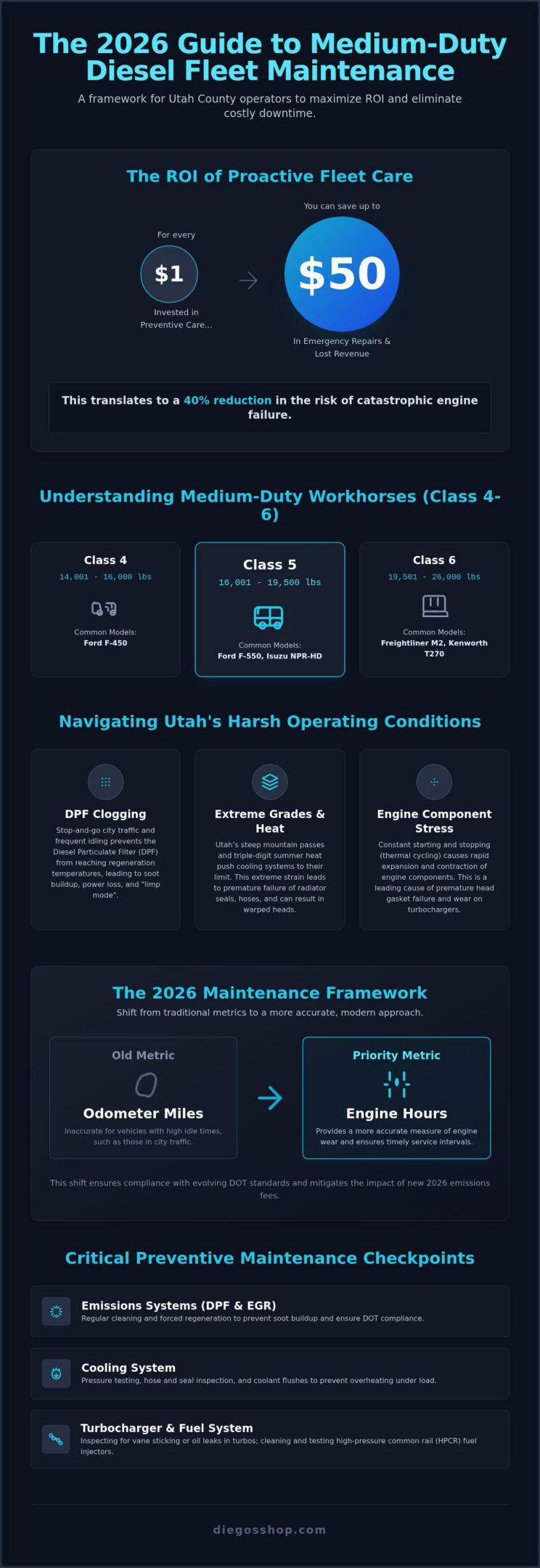
For every dollar you invest in proactive care, research shows you can save up to $50 in emergency roadside repairs and lost revenue. In the high-stakes world of Utah logistics, that isn’t just a statistic. It’s the difference between a profitable fleet and a failing one. You’ve likely felt the sting of a Class 5 diesel sitting idle while your driver waits for a tow on I-15. It’s expensive, it’s stressful, and it usually happens during your busiest season when every minute counts.
We understand that generalist auto shops often lack the specialized knowledge required for heavy workhorses. This 2026 guide reveals how a targeted strategy for medium duty truck preventive maintenance Utah County operators can rely on will eliminate that uncertainty and protect your fleet’s ROI. We’ll show you how to navigate the region’s unique challenges, from steep mountain grades to the new 2026 heavy-duty emissions compliance fees. You’ll discover the specific protocols for Isuzu, Ford, and Kenworth diesel engines that help your trucks exceed 300,000 miles while staying fully compliant with DOT safety standards. It’s time to turn your maintenance schedule into a predictable business asset.
Key Takeaways
- Identify the specific mechanical requirements of Class 4-6 diesel workhorses, including popular models like the Isuzu NPR and Ford F-550.
- Combat Utah-specific diesel challenges like DPF clogging and cooling system strain through specialized medium duty truck preventive maintenance Utah County.
- Learn how to eliminate the “downtime tax” and reduce the risk of catastrophic engine failure by 40% through proactive fleet care.
- Implement a 2026 maintenance framework that prioritizes engine hours over odometer miles to ensure more accurate service intervals.
- Understand the impact of new 2026 registration fees and DOT standards on your medium-duty fleet operations along the Wasatch Front.
What is Medium Duty Diesel Repair? Understanding Class 4-6 Trucks
Medium-duty trucks are the backbone of local commerce. According to the standard truck classification system, these vehicles fall into Classes 4 through 6, with a Gross Vehicle Weight Rating (GVWR) between 14,001 and 26,000 pounds. You see them everywhere in Provo and Orem. They’re the Isuzu NPR box trucks delivering supplies, the Ford F-550 service rigs on construction sites, and the Freightliner M2 vans handling last-mile logistics. These vehicles are essential to our local economy, but they require a specific approach to medium duty truck preventive maintenance Utah County businesses can trust.
Because these trucks bridge the gap between heavy-duty semis and light-duty pickups, they require specialized diagnostic tools. You can’t just hook them up to a standard OBD-II scanner and expect a full picture. Engines like the Isuzu 4HK1 or the Ford 6.7L PowerStroke use sophisticated proprietary software for deep diagnostics. Investing in fleet maintenance that uses the right equipment ensures that small sensor glitches don’t turn into expensive roadside failures.
The Anatomy of a Medium-Duty Diesel Engine
These engines are engineered for low-end torque. Their turbocharger configurations are specifically tuned to move heavy loads through city traffic rather than just cruising at highway speeds. However, this urban focus comes with a cost. The high-pressure common rail (HPCR) fuel systems are incredibly efficient but highly sensitive to fuel contaminants. Even a tiny amount of water or debris can ruin an injector and stall your operations.
Stop-and-go routes also put immense pressure on emission control systems. Diesel Particulate Filters (DPF) and Exhaust Gas Recirculation (EGR) valves need heat to function correctly. Frequent idling in Utah County traffic prevents these systems from reaching “regeneration” temperatures. This leads to soot buildup and the dreaded limp mode. Consistent medium duty truck preventive maintenance Utah County services help clear these systems before they fail on the road.
Top Brands We Service in Springville
At Diego’s Shop, we focus on the specific brands that keep the Wasatch Front running. The Isuzu NPR and NQR series are the masters of urban delivery. Their cab-over design makes them perfect for tight streets. For those in the trades, the Ford F-450 and F-550 are the gold standard for durability and power. We also handle Kenworth and Peterbilt medium-duty models, which offer heavy-duty reliability in a more maneuverable package. We know these engines inside and out, providing the honest, technical expertise your business deserves.
Common Mechanical Challenges for Utah’s Medium-Duty Fleets
Utah’s geography is notoriously unforgiving to diesel engines. While highway cruising allows a truck to reach optimal operating temperatures, the realities of local delivery routes in Provo or Springville create a different set of mechanical stressors. This is why specialized medium duty truck preventive maintenance Utah County programs are essential to avoid the “limp mode” that sidelines so many local fleets.
DPF clogging is the most frequent issue we see in Class 4-6 vehicles. When a truck spends its life in city traffic, the exhaust rarely gets hot enough to naturally burn off soot. This leads to frequent regeneration failures and eventual power loss. Adhering to FMCSA maintenance requirements ensures these systems remain functional and your fleet stays compliant with federal safety standards.
Cooling systems also face extreme strain here. Between the triple-digit summer heat and the steep mountain passes, radiator seals and hoses are pushed to their limits. A minor leak can quickly escalate into a warped head when climbing a grade under load. Similarly, turbochargers often show early signs of wear through vane sticking or oil leaks. Catching these early prevents a total turbo failure that could cost thousands in unplanned repairs.
The Impact of Stop-and-Go Driving on the Wasatch Front
Idling in I-15 traffic is significantly harder on a diesel engine than long-haul cruising. It leads to rapid soot buildup in EGR valves, which chokes the engine and kills fuel economy. Thermal cycling, the constant expansion and contraction of engine components during frequent starts and stops, is the leading cause of premature head gasket failure in medium-duty trucks. If your trucks spend hours in traffic, your preventive maintenance schedule must account for these hidden engine hours.
Utah-Specific Environmental Factors
High altitude operation requires precise air-fuel ratio management to prevent power loss in Utah County. Wasatch winters also demand proactive care for glow plugs and batteries. A failed plug can prevent a cold start on a sub-zero morning, leaving cargo stranded. Finally, mountain grade braking is a safety priority. Descending steep grades with a full load stresses exhaust brakes and rotors. We inspect these to ensure your drivers have the stopping power they need when navigating our canyons.
Our approach to medium duty truck preventive maintenance Utah County focuses on these specific environmental variables to keep your trucks on the road and your business moving forward.
The ROI of Preventive Maintenance vs. Emergency Repair
Every fleet manager knows the repair bill is only half the story. The “Downtime Tax” is the real profit killer. When a Class 6 truck breaks down on I-15, you don’t just pay for the tow, the parts, and the labor. You also pay for the missed deliveries, the idle driver, and the potential loss of a long-term contract. This is why the medium duty truck preventive maintenance Utah County businesses invest in is a financial strategy, not just a mechanical chore. It’s about protecting the revenue that vehicle generates every single day.
By catching a small coolant leak or a sticking turbo vane early, you avoid the five-figure engine overhaul later. Professional fleet maintenance reduces the likelihood of catastrophic engine failure by 40%. It also pushes the lifespan of your assets. A well-maintained Isuzu or Ford can easily exceed 350,000 miles, maximizing your initial investment. Fluid analysis is a key part of this process. We sample the oil and coolant to find trace metals, which act as an early warning system for internal engine wear before it ever becomes a breakdown.
Diego’s Shop Maintenance Strategy
We don’t believe in “one size fits all” solutions. Your route from Provo to Salt Lake City is different from a local Springville delivery loop. We customize service intervals based on your actual engine hours and load factors rather than just mileage. Following Effective fleet maintenance tips, we provide detailed documentation for every service. This simplifies your DOT compliance and ensures your internal record-keeping is always audit-ready. Proactive care is always cheaper than reactive panic.
Software Diagnostics and ECM Updates
Modern diesel engines are complex, rolling computers. We use advanced scanners to identify “pending” fault codes. These are issues the Engine Control Module (ECM) sees but hasn’t triggered a dashboard light for yet. Catching these early prevents a mid-route shutdown. We also perform critical ECM updates that can improve fuel efficiency and overall performance. Keeping a digital tracking history doesn’t just help with maintenance; it significantly increases your truck’s resale value. Buyers want to see a record of technical integrity and consistent care.
Building Your 2026 Maintenance Schedule: A Utah County Framework
Building a maintenance schedule in 2026 requires more than a spreadsheet and a calendar. It demands a technical framework that accounts for the specific environmental stressors of the Wasatch Front. Your first step is a baseline fleet audit of all Class 4-6 vehicles. You need to know the exact health of every DPF, turbocharger, and fuel system before you can plan for the future. This audit establishes a “health floor” for your entire operation.
Second, you must define service intervals based on engine hours rather than odometer miles. A truck idling in Orem traffic for three hours a day incurs significantly more engine wear than one cruising the open highway. If you only track miles, you are missing half the wear cycle. This shift in perspective is the cornerstone of effective medium duty truck preventive maintenance Utah County fleets use to stay operational during peak seasons. Accuracy in tracking leads to predictability in costs.
Third, implement a multi-point inspection for every oil change. We look for “silent killers” like coolant electrolysis or early injector spray pattern issues. Fourth, schedule mid-life component refreshes. Replacing a turbocharger or a set of injectors at a planned interval is much cheaper than a roadside failure on I-15. Finally, always partner with a specialist who provides warrantied repair work to protect your budget from part defects and premature failures.
The 2026 Diesel Maintenance Checklist
- Oil and fuel filter changes: These are your first line of defense against high-pressure fuel system failure. We use only premium filters that meet or exceed OEM specifications.
- DEF system health checks: We verify pump pressures and injector spray patterns to prevent “induction” shutdowns that trigger limp mode.
- Brake and suspension inspections: Heavy commercial loads on mountain grades demand perfect braking performance. We inspect pads, rotors, and air lines for any signs of heat stress.
Questions to Ask Your Diesel Specialist
- Do you have manufacturer-specific diagnostic software for Isuzu or Ford? Generic scanners often miss deep-seated ECM issues that only proprietary software can detect.
- What is your typical turnaround time for commercial fleet diagnostics? You need a partner who understands that every hour of downtime is lost revenue for your business.
- How do you handle warranty claims on parts and labor? Accountability is the mark of a professional master craftsman.
If your current maintenance plan feels reactive, it is time for a more disciplined approach. Contact us at Diego’s Shop to build a custom fleet maintenance program that keeps your trucks on the road and your business moving forward.
Why Diego’s Shop is the Wasatch Front’s Medium-Duty Authority
Choosing a partner for medium duty truck preventive maintenance Utah County businesses can rely on comes down to accountability. We are not a generalist auto shop that happens to work on trucks. We are specialists. Our facility in Springville is built to handle the unique demands of Class 4-6 diesel workhorses. Whether you manage a fleet of Isuzu NPR box trucks for urban delivery or Ford F-550 service rigs for heavy construction, we provide the technical precision your vehicles require.
Located in Springville, we are perfectly positioned to serve the entire Wasatch Front, including Provo, Orem, and Spanish Fork. We understand that for local businesses, a truck is more than a vehicle; it’s a mobile office and a primary revenue generator. That is why we provide comprehensive diesel engine repair with a focus on durability and technical integrity. The Diego’s Shop Promise is simple: we provide honest, no-nonsense service delivered by master diesel craftsmen who take pride in the longevity of their work.
Custom Fleet Solutions
Your fleet’s needs are defined by your cargo and your routes. A truck hauling heavy equipment through the canyon faces different stressors than one making stop-and-go deliveries in downtown Provo. We create tailored maintenance plans that account for these specific variables. Our goal is to move beyond reactive repairs and build long-term partnerships with Utah businesses. To support your operations, we offer priority scheduling for commercial clients. We know that every hour your truck sits in a bay is an hour of lost revenue. Our workflow is designed to minimize operational disruption while maintaining the highest standards of safety and performance.
Mastering Modern Diesel Technology
The diesel landscape is changing rapidly. As we move through 2026, emission standards and engine management systems are becoming increasingly complex. We invest heavily in the latest diagnostic equipment specifically designed for medium-duty platforms. Our team undergoes continuous training to stay ahead of these technological shifts. We don’t just clear fault codes; we find the root cause of the issue. By using high-quality parts that can withstand Utah’s rugged conditions, from sub-zero winters to triple-digit summer heat, we ensure your medium duty truck preventive maintenance Utah County plan delivers a real return on investment. Technical excellence is our baseline; your peace of mind is our mission.
Secure Your Fleet’s Performance for the Road Ahead
Maintaining a medium-duty fleet in 2026 is about more than avoiding a breakdown. It’s a commitment to your business’s bottom line. By shifting to an engine-hour framework and addressing Utah’s unique environmental stressors, you protect your Class 4-6 assets for the long haul. We have discussed how specialized care for Isuzu, Ford, and Kenworth engines prevents the “downtime tax” that drains profitability. Proactive care ensures your trucks remain reliable tools rather than unpredictable liabilities.
At Diego’s Shop, we provide the technical mastery your workhorses deserve. Our Springville facility specializes in medium duty truck preventive maintenance Utah County operators trust to keep their delivery routes and service calls on schedule. Every job we perform is backed by our commitment to warrantied repair work, giving you total peace of mind. Whether you’re based in Provo, Orem, or anywhere along the Wasatch Front, we are here to ensure your trucks stay on the road. Schedule Your Medium-Duty Diesel Maintenance at Diego’s Shop Today and let us handle the technical complexities while you focus on your business. We look forward to being your partner in fleet reliability.
Frequently Asked Questions
How is medium-duty diesel repair different from light-duty pickup repair?
Medium-duty diesel repair focuses on vehicles with a GVWR between 14,001 and 26,000 pounds. Unlike light-duty pickups, these trucks are engineered for constant commercial loads and often feature specialized components like cab-over designs or air brakes. The diagnostic software required for brands like Isuzu or Freightliner is significantly more advanced than standard consumer tools. These workhorses face different thermal cycles, requiring a technician who understands commercial duty cycles rather than just passenger transit.
What are the most common signs of DPF failure in a medium-duty truck?
The most common signs of Diesel Particulate Filter (DPF) failure include frequent active regeneration cycles and a noticeable loss of engine power. You might also see a limp mode warning on the dashboard or experience poor fuel economy. In some cases, visible black smoke from the exhaust indicates a cracked filter. Because medium-duty trucks often idle in Utah County traffic, soot builds up quickly, making these symptoms a primary focus of our technical inspections.
How often should I schedule preventive maintenance for my delivery fleet?
You should schedule medium duty truck preventive maintenance Utah County services based on engine hours rather than just odometer miles. For local delivery fleets, we recommend a comprehensive check every 150 to 200 engine hours. This approach accounts for the wear caused by idling and stop-and-go driving. It’s the most effective way to prevent small leaks from escalating into catastrophic failures during your peak delivery windows or busy seasons.
Does Diego’s Shop offer warranties on medium-duty diesel repairs?
Yes, Diego’s Shop provides warrantied repair work on all medium-duty diesel services. We stand behind our technical expertise and the durability of the parts we install. This commitment to accountability gives fleet managers peace of mind. It’s about knowing your investment is protected against premature failures. Whether it is a turbocharger replacement or a fuel system overhaul, our goal is to deliver reliable results that keep your commercial vehicles on the road.
Can you handle DOT inspections for Class 4-6 trucks in Utah County?
We provide comprehensive inspections that ensure your Class 4-6 trucks meet all federal and state safety regulations. Our master technicians examine critical systems including brakes, lighting, steering, and suspension components. Staying compliant with these standards is essential for avoiding costly fines and out-of-service orders. We document every inspection thoroughly, providing you with the digital records necessary to satisfy DOT requirements and maintain a high safety rating for your commercial fleet.
Why is my diesel truck losing power when climbing mountain grades in Utah?
Power loss on mountain grades is often caused by turbocharger inefficiencies or restricted air-fuel ratios at high altitudes. Utah’s steep climbs also put extreme strain on the cooling system, which can trigger the engine control module to reduce power to prevent overheating. We often find that clogged fuel filters or soot-heavy EGR valves are the culprits. A professional diagnostic check can pinpoint the exact mechanical bottleneck ensuring your truck handles the Wasatch Front terrain with confidence.
Do I need a specialized diesel shop for a simple oil change on a box truck?
While a basic oil change seems simple, a specialized diesel shop performs a multi-point inspection that generalist shops often miss. We check DEF system pressures, fuel filter integrity, and DPF soot levels during every service. Medium-duty trucks require specific oil grades and high-capacity filters designed for commercial duty cycles. Entrusting your medium duty truck preventive maintenance Utah County to diesel specialists ensures that your vehicle is evaluated by technicians who understand professional workhorses.
What is the typical turnaround time for a medium-duty engine diagnostic?
Most medium-duty engine diagnostics are completed within 24 to 48 hours. We use advanced proprietary software to quickly identify fault codes and mechanical issues. Our goal is to minimize your downtime by providing an accurate assessment and a clear repair plan as fast as possible. Once we identify the root cause, we communicate the findings directly to you, ensuring you have the information needed to make informed decisions for your fleet operations.