

Identify Stuck VGT Actuator Sounds and Driving Safety

To identify what a stuck VGT actuator sounds like, listen for clicking with uneven movement, such as a sweep that stalls or jitters. A brief sweep or occasional clicking can be normal; a loud, siren-like whine or scraping may point to a turbocharger problem rather than a typical actuator sound.
It’s easy to mistake one noise for another. The sound is more useful when paired with changes in boost, engine response, or exhaust-brake performance. This guide explains which noises may signal a fault, when symptoms can make driving risky, and why cleaning a sticking VGT may not provide a lasting fix. You’ll also learn when diesel diagnostics and repair can help determine whether the actuator, turbo vanes, or another component needs attention.
Key Takeaways
- Distinguish a brief actuator sweep or clicking from uneven movement and noises that may point to a turbocharger fault.
- Consider how carbon buildup and vane movement affect whether cleaning may provide lasting relief.
- Use boost-control symptoms and diagnostic codes as clues, and treat reduced power or exhaust-brake performance as reasons to assess driving risk.
- For recurring VGT concerns across a fleet, preventive maintenance and diesel engine repair can help address problems before they disrupt operations.
Actuator clicking and abnormal movement sounds
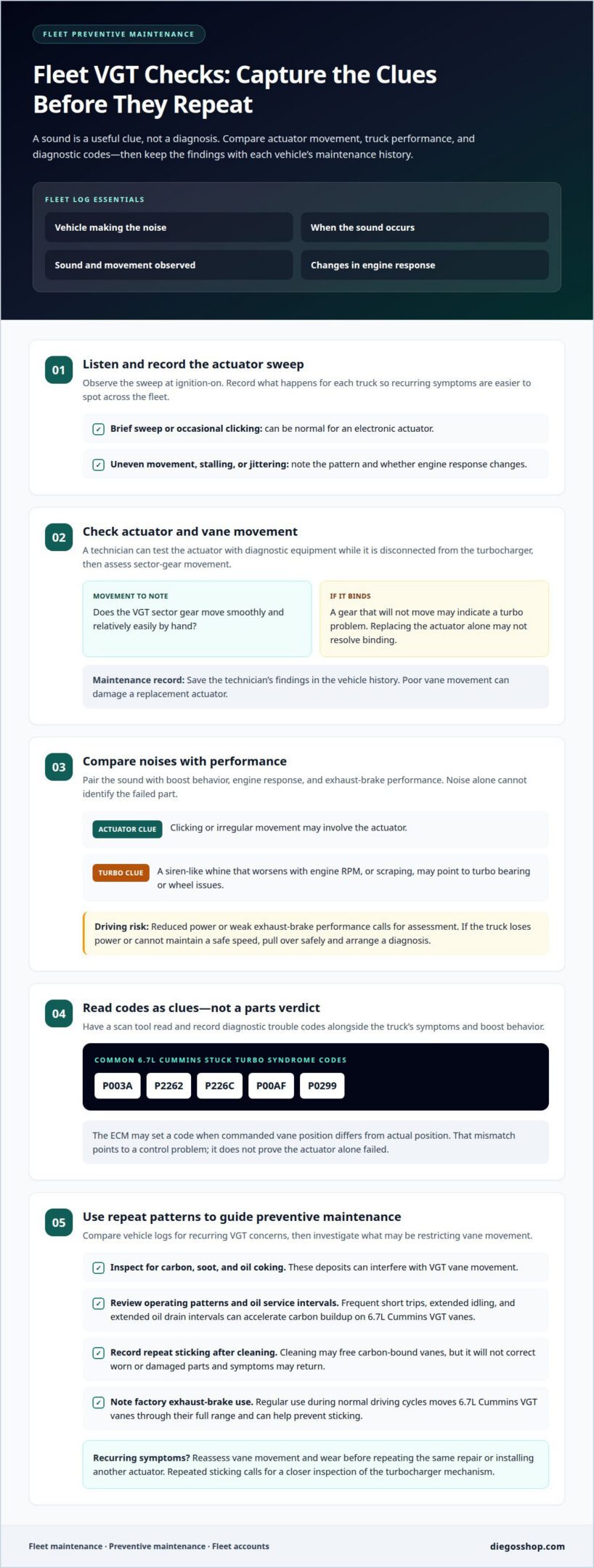
Compare actuator movement with its sound, then record the observations for each vehicle. A consistent fleet log can help identify recurring VGT concerns and inform preventive maintenance planning.
-
Listen for Actuator Clicking
Observe each truck’s actuator sweep at ignition-on and note its sound and movement. To describe what a stuck VGT actuator sounds like, record whether the movement is uneven, stalls, or jitters. Some electronic actuators click while moving, and a brief sweep can be normal. Track which vehicle makes the noise, when it occurs, and whether engine response changes. Comparing records across fleet vehicles can reveal recurring symptoms.
-
Check Vane and Sector Gear Movement
Have a technician test the actuator with diagnostic equipment while it is disconnected from the turbocharger. Then assess whether the VGT sector gear moves smoothly and relatively easily by hand. A gear that will not move may indicate a turbo problem and possibly an actuator fault. Record the findings in the vehicle’s maintenance history. Poor vane movement can damage a replacement actuator, so replacing the actuator alone may not resolve binding.
-
Compare Actuator and Turbo Noises
Compare what a stuck VGT actuator sounds like with the noises recorded for each truck. Clicking or irregular movement may involve the actuator; a siren-like whine that worsens with engine RPM, or scraping, may point to turbo bearing or wheel issues. Noise alone cannot identify the failed part. Repair or replacement cost depends on the fault, labor, and calibration. Diego’s Shop can provide an honest quote after assessing the concern.
Will cleaning my stock VGT actually fix Stuck Turbo Syndrome long-term?
Cleaning can free carbon-bound vanes, but it may not prevent symptoms from returning. On a high-mileage turbo with a previous failure, cleaning may provide only temporary relief before symptoms return.
-
Identify Carbon Buildup on the Vanes
Inspect the variable geometry vane assembly for carbon deposits and restricted movement. Carbon can keep the vanes from moving through their range, causing sticking and impaired boost control. Frequent short trips, extended idling, and extended oil drain intervals can accelerate carbon buildup on 6.7L Cummins VGT vanes. Cleaning may restore movement, but it won’t correct worn or damaged parts.
-
Check for Oil Coking and Soot
Look for deposits around the vane mechanism that could interfere with movement. Soot and oil coking can build up in the VGT mechanism, so consider operating patterns and oil service intervals when assessing why sticking has returned. Don’t install a replacement actuator as the only repair if the vanes still bind. Poor VGT movement can quickly damage a replacement actuator.
- Assess whether cleaning addresses the cause, not just the restriction. Regular use of the factory exhaust brake during normal driving cycles moves 6.7L Cummins VGT vanes through their full range and can help prevent sticking. If symptoms return after cleaning, reassess vane movement and wear before repeating the same repair. Repeated sticking calls for a closer inspection of the turbocharger mechanism.
For recurring sticking, arrange a professional diesel inspection before another actuator install.
Can you keep driving with turbo actuator symptoms?
A stuck actuator can occur alongside reduced boost, weak exhaust-brake performance, or limited engine response. If the diesel truck loses power or cannot maintain a safe speed, pull over safely and arrange a diagnosis.
-
Note Symptoms Alongside the Sound
Record when the symptoms occur and how the engine responds. Intermittent boost loss, a weakening exhaust brake, or limited RPM alongside actuator noise helps describe the fault. One reported truck could not rev above 1500 rpm. Treat severe power loss as a reason to stop safely, not to continue into traffic. Sound alone cannot establish whether actuator failure or a mechanical turbo problem is responsible.
-
Check Turbo Diagnostic Codes
Have a scan tool read and record the diagnostic trouble codes. Common 6.7L Cummins Stuck Turbo Syndrome codes include P003A, P2262, P226C, P00AF, and P0299. The ECM detects a VGT fault when commanded vane position differs from actual position, and it may set codes. Codes narrow the diagnosis; they don’t prove the actuator alone failed. A reported combination of P003A, P00AF, and U010C accompanied intermittent VGT and exhaust-brake problems.
- Consider diagnostic codes alongside the truck’s symptoms and boost behavior. A mismatch between commanded and actual variable-vane position points to a control problem, but the underlying cause may involve actuator movement or the turbo mechanism. Don’t assume replacing the actuator will resolve a mechanical restriction. Diagnosis should distinguish an electrical control fault from sticking vanes or turbo damage before repair.
For persistent boost-control symptoms, schedule diesel engine repair to identify the fault before it worsens.
Diego’s Shop
Diego’s Shop helps diesel owners and fleet managers address VGT concerns with diesel engine repair, fleet maintenance, and preventive maintenance. If a truck has recurring boost-control symptoms, abnormal actuator movement, or reduced performance, a repair assessment can help determine the next step.
For fleet accounts, tracking repeated symptoms across vehicles can support preventive maintenance planning and help teams address repair needs before they disrupt operations. Diego’s Shop also provides warrantied repair work, giving fleet managers a clear path from diagnosed concerns to completed repairs.
When discussing the concern, share the truck’s symptoms, diagnostic codes, and any changes in performance. Contact Diego’s Shop to discuss VGT symptoms or fleet maintenance needs.
Make the Next Maintenance Decision with Confidence
Knowing what a stuck VGT actuator sounds like is a useful starting point, but the next decision should account for the truck’s operating history and how the concern affects work. Treat recurring symptoms as information about reliability, not just a noise to clear.
For fleet managers, consistently recording driver observations and service findings can make follow-up more useful across vehicles. That context helps maintenance planning distinguish an isolated concern from a pattern that deserves attention, without assuming every truck needs the same repair. Keep the focus on safe operation and a clear diagnostic path.
A deliberate next step supports better decisions and steadier fleet planning. For help assessing your diesel’s needs, contact Diego’s Shop. Move forward with a clear plan for dependable operation.
Frequently Asked Questions
Ready to solve your boost problem?
Yes. If boost trouble is disrupting a work truck, give Diego’s Shop the stored codes, when symptoms appear, and any change in engine response. Those details help frame the diagnostic concern instead of treating a noise in isolation. Diego’s Shop supports diesel owners and fleet maintenance in the shop’s location. Contact the shop to discuss next steps.
What sounds does a stuck VGT actuator make?
A stuck actuator may click during movement or make an uneven, interrupted sweep. A brief startup sweep or clicking alone does not prove failure. Note when the sound occurs and whether it changes with engine load. A distinct whistle or siren-like whine may point to a turbocharger concern, so record it separately for diagnosis.
Can a stuck VGT actuator cause rattling, clicking, or exhaust noise?
Clicking can accompany actuator movement, but rattling or exhaust noise alone cannot identify the cause. Note when the sound happens, whether it follows engine RPM, and whether boost or exhaust-brake performance changes at the same time. A siren-like whine or scraping may indicate turbo bearing or wheel issues, so sound alone is not enough to isolate the fault.
What diagnostic trouble codes indicate a stuck VGT actuator?
Common 6.7L Cummins Stuck Turbo Syndrome codes include P003A, P2262, P226C, P00AF, and P0299. P003A, P00AF, and U010C have also been reported with intermittent VGT and exhaust-brake issues. Treat codes as diagnostic clues, not proof of one failed part. Compare them with commanded and actual vane-position data.
Is it safe to drive with a stuck VGT actuator?
Driving safety depends on whether the truck can maintain controllable power for the conditions. If it loses boost, struggles to accelerate, or can’t keep pace with traffic, move to a safe place and stop rather than continuing the route. A reported 6.7L Cummins would not rev above 1500 rpm, illustrating why reduced engine response needs prompt attention.