
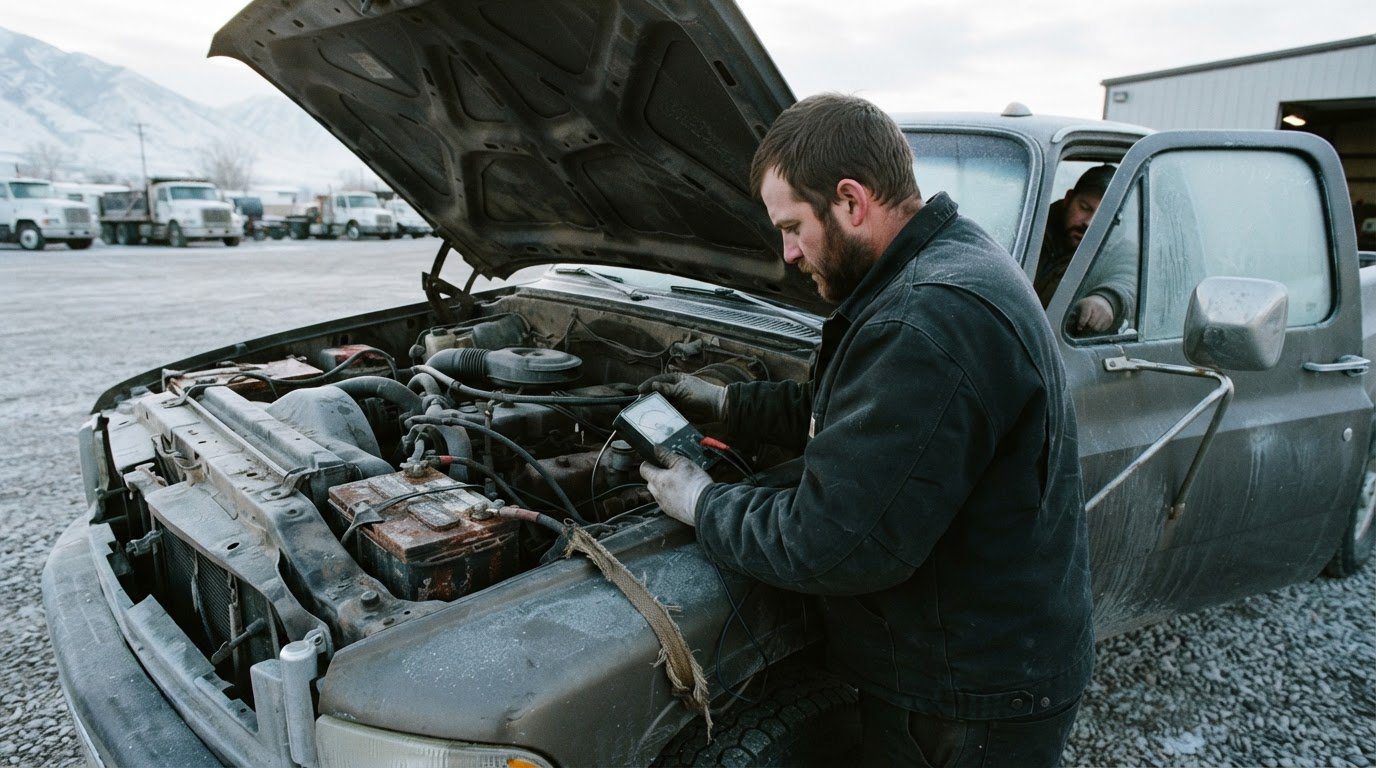
How to Troubleshoot Intermittent Diesel Starting Issues by Symptom

Intermittent diesel starting issues can disrupt fleet schedules and vehicle availability. Fleet maintenance teams can help address them by noting whether an engine cranks slowly, clicks without cranking, or cranks normally without firing. Test the battery before moving on to the starter, cables, and grounds.
Intermittent faults can be hard to pinpoint because a truck may start normally between failures. Tracking symptoms as part of fleet preventive maintenance can help narrow the cause: slow cranking or clicking points to the starting circuit, while normal cranking shifts attention to other systems.
This guide explains how to interpret those symptoms and inspect the starter circuit, including cable connections and ground paths. For fleet accounts, recording symptoms can help identify where diagnosis should begin and when a persistent issue calls for professional diesel repair.
Key Takeaways
- Use the symptom to narrow the starting fault: slow cranking, clicking without cranking, and cranking without firing point to different diagnostic paths.
- Test the battery and inspect its connections before concluding that the starter has failed.
- Assess cable and ground connections for faults that can interrupt current even when components appear intact.
- For trucks that start unreliably, fleet preventive maintenance and diesel engine repair can help identify starting-system problems before they disrupt operations.
What Causes a Diesel Starter to Fail?
A systematic approach to troubleshooting intermittent starting issues on a diesel begins by distinguishing a no-crank from an engine that cranks but won’t start. Battery, cable, starter, charging, and fuel faults each require different checks.
-
Identify starting-problem symptoms
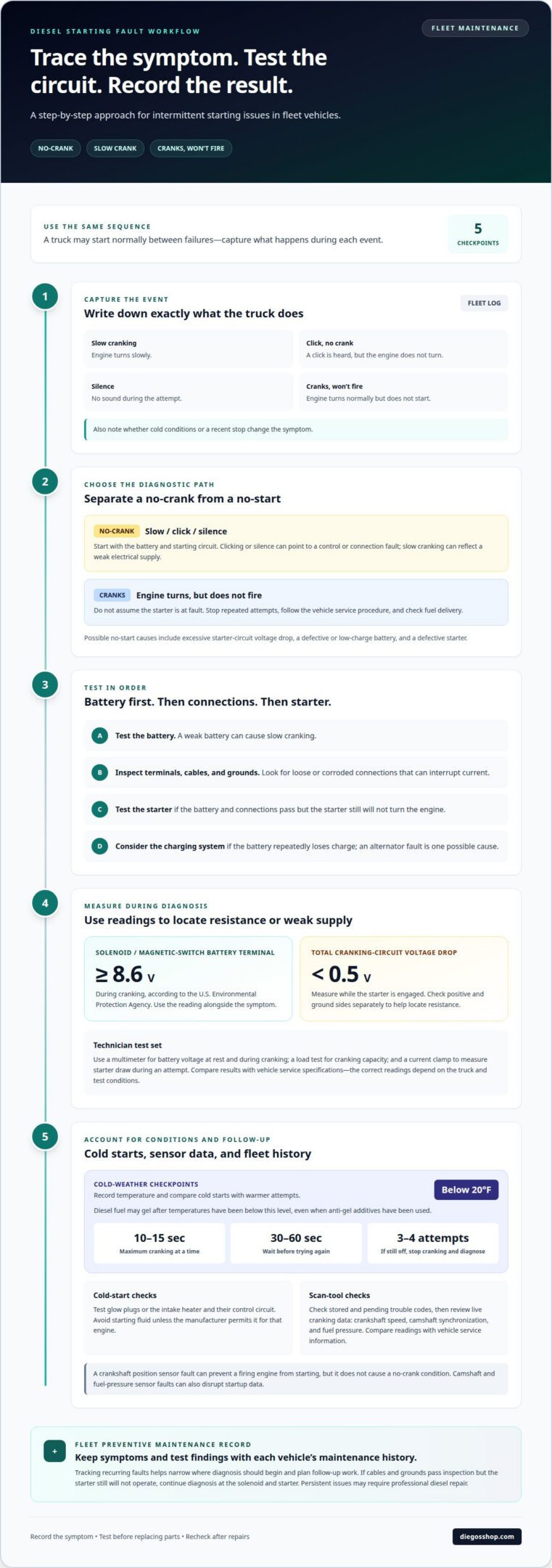
Record what happens on each attempt: slow cranking, a click without cranking, silence, or normal cranking without the engine firing. Note whether cold conditions or a recent stop change the symptom. The U.S. Environmental Protection Agency identifies excessive voltage drop in the starter circuit, a defective or low-charge battery, and a defective starter as possible no-start causes.
If the engine cranks but doesn’t start, stop repeated attempts and follow the vehicle’s service procedure. Check fuel delivery rather than assuming the starter is at fault.
-
Distinguish battery, cable, starter, and alternator faults
Test the battery first, then inspect its terminals, cables, and grounds for loose or corroded connections. A weak battery can cause slow cranking, while damaged connections can interrupt current. If those checks pass but the starter still won’t turn the engine, test the starter. A battery that repeatedly loses charge may indicate a charging-system problem, including an alternator fault.
For troubleshooting intermittent starting issues on a diesel, use test results to distinguish a charging fault from a starter or cable problem. Diagnostic and repair costs vary with the cause, parts, and labor; pricing is provided after a quote request.
-
Check battery voltage and starter current draw
A technician can use a multimeter to measure battery voltage at rest and during cranking. A battery load test assesses cranking capacity, while a current clamp can measure starter draw during an attempt. Results must be compared with vehicle service specifications because correct readings depend on the truck and test conditions.
For fleet preventive maintenance, record each vehicle’s symptoms and test findings alongside its maintenance history. This helps track recurring starting faults and plan follow-up work. For cold-start trouble, test the glow plugs or intake heater and their control circuit. If the engine cranks without firing, check fuel delivery and follow the service manual. Avoid starting fluid unless the manufacturer permits it for that engine.
Slow-crank, click-no-crank, and no-click symptoms
Use the sound and engine response to distinguish a cranking-circuit fault from a no-start. Then check the electrical system and sensor data before replacing parts.
-
Classify the cranking symptoms
Listen during an attempt and note whether the engine turns slowly, clicks without turning, stays silent, or cranks normally without starting. Slow cranking can reflect weak electrical supply; clicking or silence can indicate a control or connection fault. During cranking, voltage at the solenoid or magnetic-switch battery terminal should be at least 8.6 volts, according to the U.S. Environmental Protection Agency. Use this reading alongside the sound, not by itself.
-
Account for cold-weather cranking
Record the temperature and compare cold-start behavior with warmer attempts. Diesel fuel may gel when temperatures have been below 20°F, even when anti-gel additives have been used. Give the starter time to cool: crank for no more than 10-15 seconds at a time, then wait 30-60 seconds before trying again. If the engine remains off after 3-4 attempts, stop cranking and diagnose the cause instead of adding heat and strain to the starter circuit.
-
Check sensor faults and diagnostic data
Scan for stored and pending diagnostic trouble codes, then review live data during cranking. Check whether the control module registers crankshaft speed, camshaft synchronization, and fuel pressure. A crankshaft position sensor fault can prevent a firing engine from starting, but it does not cause a no-crank condition. Camshaft and fuel-pressure sensor faults can also disrupt startup data. Compare scan-tool readings with the vehicle’s service information to identify which signal drops out during the failure.
For persistent sensor-related no-starts, diesel engine repair can help identify the fault before parts are replaced.
Cable and ground faults
Inspect the full starter-current path, not just the battery posts. A loose connection can interrupt cranking even when the ignition switch and starter appear to work.
- With the engine off, inspect both battery terminals and cable ends for looseness, corrosion, damaged insulation, or movement. Follow the negative cable to its ground connection and the positive cable toward the starter. Check the battery-wire connection box on top of the driver-side fender, if your truck has one. A fault at any of these points can cause intermittent starting.
- Check the ground path from the battery to the engine and chassis. Look for a loose fastener, corrosion between contact surfaces, or a frayed ground strap. The starter needs a complete return path through the engine block. A weak ground can cause slow cranking or a click without engine rotation, even when the positive cable looks sound.
- Measure voltage drop across the cranking circuit while the starter is engaged. The total drop should be less than 0.5 volts. Measure the positive and ground sides separately to help locate resistance. A high reading on one side directs diagnosis toward that cable, terminal, or connection, rather than an ignition or fuel fault.
- Repair damaged or loose connections, then repeat the same cranking test and note whether the symptom changes. If the cables and grounds pass inspection but the starter still won’t operate, continue diagnosis at the solenoid and starter. Don’t replace parts based on a single click alone: an intermittent fault may disappear when a connection shifts.
For a persistent cable or ground fault, schedule diesel starting-system diagnosis.
Diego’s Shop
Diego’s Shop helps drivers and fleet operators address recurring diesel starting problems with diesel engine repair, fleet maintenance, and preventive maintenance. When symptoms persist after basic checks, diagnosis can identify whether the fault lies in the starting system or another engine component.
For fleet accounts, recurring starting issues can disrupt maintenance planning and vehicle availability. Preventive maintenance offers a structured way to address equipment needs and monitor developing concerns. Diego’s Shop repair work is fully warrantied, providing support after completed repairs.
If an intermittent starting fault continues or affects multiple vehicles, contact Diego’s Shop to discuss repair or preventive maintenance for your diesel vehicle or fleet.
Keep the Next Start Predictable
A truck that starts inconsistently can complicate dispatch and maintenance planning. Treat the recurring fault as useful information, not an inconvenience to work around. A clear approach to troubleshooting intermittent starting issues on a diesel can turn an unpredictable interruption into a repair decision based on the vehicle’s symptoms.
For fleet operators, recording which vehicles have repeated starting trouble can reveal patterns and guide maintenance priorities. For an individual truck, arranging diagnosis before the fault worsens can clarify the next step. In either case, accurate observations give technicians a stronger starting point.
Contact Diego’s Shop about a recurring diesel starting issue. A steady, informed next step can help keep your equipment moving.
Frequently Asked Questions
How Do You Diagnose a No-Crank on a Heavy-Duty Truck?
Confirm that the engine does not rotate, then check whether the transmission is fully in Park. If it still won’t crank, try Neutral. Starting in Neutral can point to a transmission range selector or shift adjustment issue. Next, test battery supply and starter control voltage during the failed attempt, then trace the solenoid command. These checks help distinguish a control interruption from a starter fault.
How Do You Prevent the Next No-Start?
Include battery condition, charging performance, terminal security, and engine ground connections in scheduled fleet preventive maintenance. Record each intermittent event, noting the conditions, cranking sound, and whether dashboard lights dim. A repeated pattern in one vehicle or across a fleet can help technicians target a developing electrical fault before another unexpected interruption.
How long should I crank a diesel engine that won’t start?
Crank for no more than 10-15 seconds per attempt, then wait 30-60 seconds before trying again. If the engine still hasn’t started after 3-4 attempts, stop and diagnose the cause instead of continuing to crank. Repeated attempts with a weak battery can add heat and strain to the starter and cables.
How much voltage drop is acceptable on a cranking circuit?
Total voltage drop across a diesel cranking circuit should be less than 0.5 volts. Measure across the circuit while cranking, then test the positive and ground sides separately to locate resistance. A reading above that threshold directs attention to a cable, terminal, or connection. Take measurements during the same cranking conditions for a meaningful comparison.
Is It the Starter, the Batteries, or the Cables?
Use load and circuit tests rather than relying on sound alone. A battery that loses voltage during cranking may have low charge or capacity; excessive voltage drop across a cable points to resistance in that path. If the battery supply and cables test correctly, assess starter current draw and solenoid operation. Repeated battery discharge also calls for charging-system checks, including the alternator.