
How to Reduce Fleet Downtime: A Master Craftsman’s Guide to Rugged Reliability

An idle diesel truck sitting in a yard along the Wasatch Front isn’t just a mechanical failure; it’s a $1,200 per day drain on your company’s bottom line. You understand that unpredictable repair costs and missed delivery deadlines are the enemies of a profitable operation. When you’re hauling heavy loads through steep mountain passes, you need to know how to reduce fleet downtime before a small leak turns into a week-long engine overhaul. We agree that the stress of mountain hauling demands more than just basic oil changes; it requires technical mastery and a partner who understands diesel engines from the inside out.
This guide reveals the high impact mechanical and strategic shifts that stop unplanned diesel repairs and keep your fleet moving reliably. You will learn how to transition from reactive fixes to a predictable maintenance schedule that can lower your total cost of ownership by up to 15% annually. We’re providing a master craftsman’s blueprint for building rugged reliability, ensuring every Ford F-250 or heavy duty Kenworth in your lineup is ready for the road and stays there. It is time to get your service done right so you can focus on the next haul.
Key Takeaways
- Identify the hidden ripple effects of diesel failure, including the secondary costs of driver overtime and lost contracts that spreadsheets often miss.
- Master the “Big Three” mechanical culprits-aftertreatment, fuel systems, and cooling-to learn exactly how to reduce fleet downtime through technical precision.
- Implement the 80/20 rule of rugged reliability by focusing on the high-impact maintenance tasks that prevent the majority of unplanned repairs.
- Prepare your fleet for the unique demands of the Wasatch Front with specific strategies for managing steep mountain grades and local compliance.
- Discover why a master technician’s eye provides a strategic advantage over basic telematics for maintaining everything from light-duty pickups to long-haul giants.
The True Cost of Fleet Downtime: What Your Spreadsheet is Missing
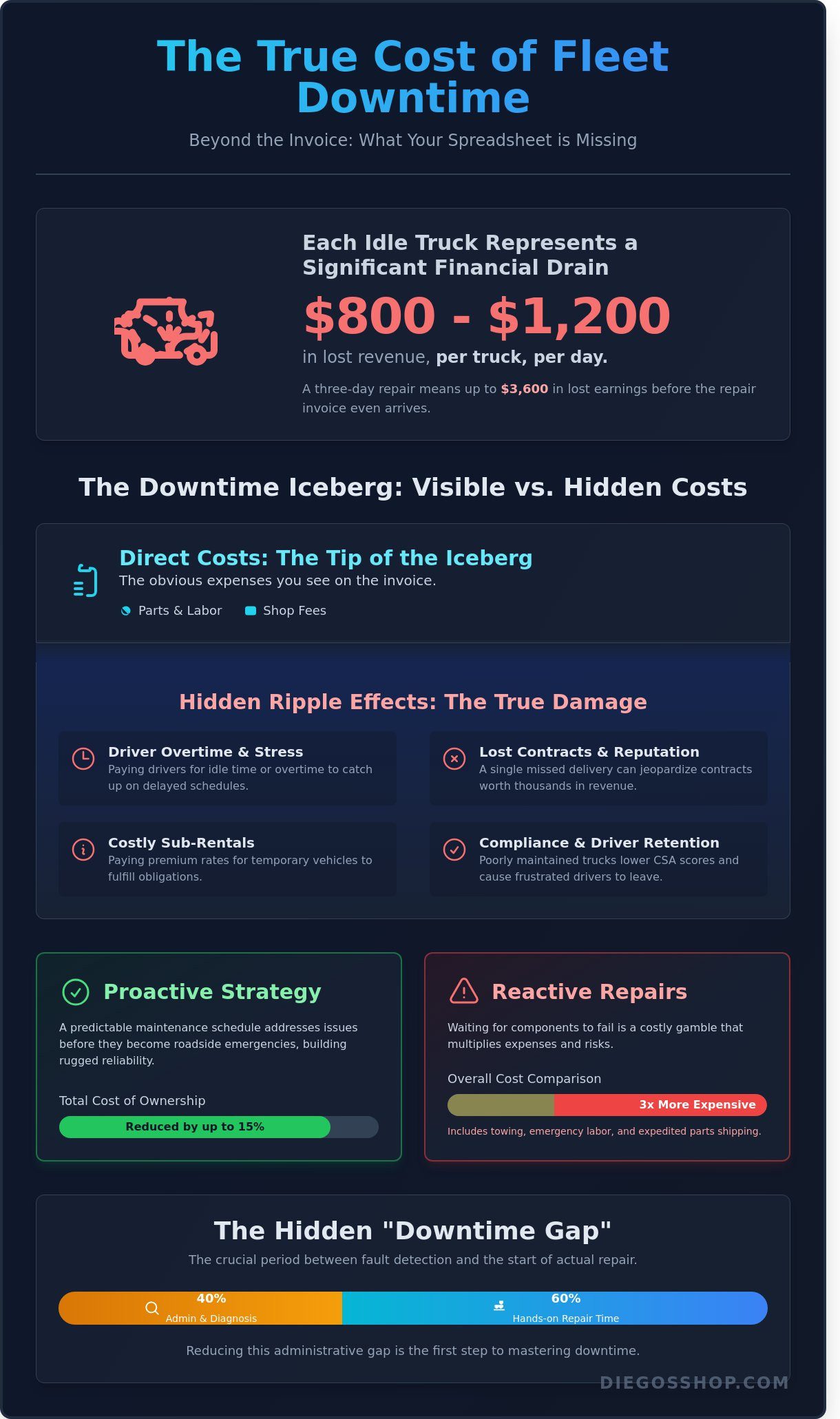
Fleet downtime in 2026 is no longer just a truck parked in a service bay. It represents a total halt in your operational momentum. When you look at your balance sheet, you might only see the direct costs of parts and labor. This narrow view ignores the reality of modern Fleet management; downtime is the sum of every lost minute from the moment a fault is detected until the vehicle returns to a revenue-generating route. True mastery of your fleet requires looking beyond the shop invoice to see the structural damage idle iron does to your bottom line.
The primary costs are the easy ones to track. You see the invoice for the turbocharger replacement or the new injectors. However, the secondary ripple effects carry a much heavier price tag. These include driver overtime pay to make up for lost hours, the cost of sub-rentals to fulfill existing obligations, and the catastrophic risk of lost contracts. If a client relies on your 10:00 AM arrival and your truck is sidelined, they won’t care about your mechanical excuses. They’ll find a more reliable partner. Reliability isn’t just a goal; it’s the foundation of your professional reputation.
One of the most expensive hidden factors is the Downtime Gap. This is the period between the initial fault detection and the actual start of the repair. In many 2026 logistics models, this administrative and diagnostic gap accounts for 40% of the total time a vehicle is out of service. Reducing this gap is the first step in learning how to reduce fleet downtime effectively. Proactive service models address these issues before they trigger a roadside emergency. Industry data confirms that reactive maintenance is 3x more expensive than proactive service. Waiting for a component to fail means paying for towing, emergency labor rates, and expedited parts shipping.
Calculating Your Fleet’s Hourly Burn Rate
To understand the stakes, you must calculate your hourly burn rate. A Class 8 heavy-duty truck often generates between $800 and $1,200 in daily revenue. If that truck sits idle for three days, you’ve lost $3,600 before even paying the mechanic. Reputation damage is harder to quantify but even more dangerous. A single missed delivery can jeopardize a contract worth $500,000 in annual recurring revenue. Unplanned downtime is a preventable drain on net profitability. Our “Done Right” approach ensures your equipment stays on the road where it belongs.
The 2026 Compliance Factor
Compliance is now a major driver of downtime costs. Under current DOT standards, poorly maintained equipment directly lowers your CSA scores. High-risk scores lead to more frequent roadside inspections, which creates a cycle of constant, small delays that kill your productivity. Driver retention also hinges on your maintenance shop. Professional drivers want to operate safe, ruggedly reliable equipment. If they’re constantly stuck on the shoulder waiting for a tow, they’ll leave for a fleet that prioritizes “Done Right” maintenance. High-quality service is your best insurance policy against both audits and turnover. Learning how to reduce fleet downtime is ultimately about protecting your most valuable assets: your drivers and your data.
Mechanical Mastery: Addressing the Top Physical Causes of Diesel Downtime
Telematics provide a mountain of data, but they don’t provide context. A sensor might flag a low-pressure code, but it won’t see the hairline crack in a plastic housing that a seasoned technician identifies in minutes. Relying solely on digital dashboards is a mistake that leads to roughly 15% more roadside failures according to recent industry service data. True mastery involves looking past the code to the physical component. Learning how to reduce fleet downtime requires a shift from reactive repairs to technical mastery where the human eye validates what the computer suspects.
Since 2020, the complexity of diesel engines has surged. The integration of more sensitive sensors and tighter emissions controls means a single failure in a secondary system can now put a truck into “limp mode” instantly. Generalist shops often miss the root cause of these recurring issues because they lack the specialized diagnostic tools and experience required for modern heavy-duty platforms. They clear the code, send the driver back out, and the truck is back on a hook within 48 hours. This cycle is a primary driver of lost revenue.
The National Transportation Safety Board (NTSB) emphasizes that regular vehicle maintenance and inspection is the only proven way to ensure heavy-duty assets remain safe and operational. At Diego’s Shop, we believe in doing it once and doing it right.
The Aftertreatment Trap: DPF and EGR Management
Forced regenerations are a symptom of an underlying problem, not a permanent fix. If your trucks require manual regens more than once every 30 days, your EGR system is likely carbon-choked. A neglected Exhaust Gas Recirculation (EGR) cooler can lead to coolant entering the combustion chamber. This turns a simple $800 cleaning into a $12,000 engine overhaul. We use specific inspection protocols to measure soot density and valve response times to catch buildup before it solidifies into a costly repair.
Fuel System Integrity and Injector Longevity
Modern High-Pressure Common Rail (HPCR) systems are incredibly sensitive to the smallest contaminants. A single micron of sediment can ruin an injector nozzle. Because these systems operate at pressures exceeding 30,000 PSI, failure is often sudden and catastrophic. You can’t afford to wait for a dash light to tell you there’s a problem. Look for these warning signs during your weekly checks:
- Rough idling or “hunting” for RPMs at a stop.
- Increased fuel consumption, even by as little as 0.5 MPG.
- Unexpected blue or white smoke during cold starts.
Monitoring these physical cues is essential for how to reduce fleet downtime effectively. We recommend shortening fuel filter intervals to every 10,000 miles for trucks operating in dusty or high-idle environments. It’s a small investment that protects a fuel system worth upwards of $6,000. If you are struggling with persistent performance issues, our team offers comprehensive diesel diagnostics to find the solution generalist shops miss. Our focus is on rugged reliability, ensuring your fleet stays on the road where it belongs.
The Proactive Framework: Shifting to a ‘Rugged Reliability’ Strategy
Most fleet managers spend their days firefighting. They react to blown head gaskets or failed transmissions instead of preventing them. This cycle is exhausting and expensive. Shifting to a “Rugged Reliability” strategy means applying the 80/20 rule to your shop floor. In the diesel world, 80% of your unscheduled downtime is caused by just 20% of your vehicle components, specifically cooling systems, electrical harnesses, and lubrication cycles. Focusing on these high-impact areas is the most effective way to learn how to reduce fleet downtime without overhauling your entire budget.
Building a customized preventive maintenance (PM) schedule is not a one-size-fits-all task. A heavy-duty Kenworth hauling 80,000 pounds through mountain passes requires a different protocol than a Ford F-250 used for local deliveries. You must base your intervals on real-world duty cycles rather than generic manual recommendations. Using telematics technology allows you to monitor engine hours and load factors in real-time. This data ensures you aren’t changing oil too early or, more importantly, letting a high-idle engine run until the soot loads compromise the turbocharger.
There is a massive difference between “checking the box” and a “Comprehensive Inspection Protocol.” A standard tech might look at a belt and see it’s still there. A master craftsman at Diego’s Shop looks for the micro-cracking and tensioner alignment that signals a failure in the next 5,000 miles. We don’t just look at parts; we look at systems. This mindset is the foundation of how to reduce fleet downtime because it catches the $50 repair today before it becomes a $5,000 tow and engine rebuild next month.
Reactive vs. Proactive Maintenance Comparison
The financial impact of your maintenance philosophy is visible on the balance sheet. Reactive maintenance is inherently chaotic. It forces you to pay premium prices for parts and emergency labor while your drivers sit idle. Proactive maintenance puts the power back in your hands. It allows you to schedule repairs during off-peak hours, ensuring your fleet stays on the road when the work is waiting.
| Metric | Reactive (Breakdown-Based) | Proactive (Rugged Reliability) |
|---|---|---|
| Average Repair Cost | 400% higher than scheduled PM | Predictable and budgeted |
| Vehicle Lifespan | Reduced by 30% on average | Extended by 25% to 40% |
| Operational Stress | High (Emergency logistics) | Low (Peace of mind) |
Moving away from the “if it isn’t broken, don’t fix it” mentality is the only way to secure long-term stability. You can start by Creating a Fleet Preventive Maintenance Plan that aligns with your specific operational goals.
The Role of Warrantied Repair Work
Technical mastery is useless if it isn’t backed by accountability. Re-work is a silent killer of fleet profitability. When a truck returns to the shop three days after a “fix” for the same issue, you’ve doubled your downtime and lost all trust in the repair process. This is why a 100% warranty on all repairs is essential for fleet stability. It guarantees that the job was “Done Right” the first time.
Diego’s Shop eliminates the uncertainty of diesel repair by providing a 100% warrantied work guarantee. We understand that your reputation depends on your trucks moving. By combining honest diagnostics with rugged reliability, we ensure that once a vehicle leaves our bay, it stays on the road. We take pride in our work so you can take pride in your uptime. Accountability is the final piece of the proactive framework, turning technical service into a dependable business partnership.
The Utah Fleet Survival Guide: Managing Mountain Hauls and Local Compliance
Utah’s geography is unforgiving for heavy equipment. Operating at altitudes above 4,500 feet means your turbochargers work 15% harder than they would at sea level just to maintain oxygen intake. This increased workload generates excessive internal heat. When you combine high altitude with the steep 6% grades found on I-80 through Parley’s Canyon, your powertrain faces a relentless stress test. Understanding how to reduce fleet downtime in this region requires a specialized approach to preventative care. You can’t rely on standard manufacturer intervals when your trucks climb 3,000 feet in less than 15 miles on a daily basis.
Temperature swings along the Wasatch Front add another layer of complexity. In July, Salt Lake Valley temperatures frequently hit 100 degrees, while the high country passes remain in the 60s. By January, those same routes face sub-zero cold starts. These 40 degree temperature shifts cause seals to expand and contract rapidly, which leads to premature fluid leaks. A cooling system that works fine in the morning might fail by noon under the weight of a mountain haul. Rugged reliability is the only way to stay profitable here.
Mountain-Grade Maintenance Needs
The constant oscillation of Utah’s terrain puts immense pressure on suspension systems. Leaf springs often develop hairline fractures from repeated weight shifts on winding mountain roads. We’ve found that local fleets reduce suspension failures by 18% when they implement a “Mountain-Spec” inspection every 15,000 miles. This includes a cooling system pressure test. It’s a non-negotiable step. A small leak that stays hidden on flat ground will cause a catastrophic overheat on a steep ascent. For businesses running smaller rigs, our Medium Duty Diesel Repair for Commercial Trucks ensures your fleet handles these vertical challenges without unexpected stops.
Local Compliance and Safety
Utah County enforces strict emission and safety standards that catch many unprepared operators off guard. During the 72-hour CVSA International Roadcheck period, which took place May 14-16, 2024, inspectors focused heavily on tractor-protection systems. In our region, inspectors often pull over 15 trucks per hour at major weigh stations during peak enforcement weeks. Staying ahead of these checks is a critical step in how to reduce fleet downtime for local operators. Working with a local partner who understands Utah’s specific diesel maintenance requirements helps you avoid the $3,500 average cost of an out-of-service violation. We focus on getting the job done right so your drivers pass every inspection with confidence.
- Brake Heat Management: We recommend high-temp synthetic lubricants to prevent glazing during steep descents.
- Emission Standards: Our shop tracks Utah County’s specific diesel opacity requirements to keep you compliant.
- Cooling Efficiency: We verify fan clutch engagement points to handle the 15% increase in turbocharger heat.
Schedule your mountain-ready fleet inspection at Diego’s Shop.
Partnering for Uptime: Why Diego’s Shop is the Strategic Choice
Choosing a service partner is a high-stakes decision for any fleet manager. At Diego’s Shop, we operate under the “Diego’s Way” philosophy. This means personal accountability is baked into every bolt we tighten and every diagnostic code we clear. We combine technical mastery with a direct, grounded approach that eliminates the guesswork often found in corporate repair chains. Our shop isn’t just a place for fixes; it’s a hub for rugged reliability where we treat your uptime as our primary metric of success. Since opening our doors, we’ve focused on the promise that every job is “Done Right” the first time.
Our facility is equipped to service a diverse range of commercial assets. We handle everything from light-duty Ford F-250s used for local deliveries to Peterbilt and Kenworth long-haulers that cross state lines daily. This versatility is a major advantage for diverse fleets. By centralizing diagnostics for all your diesel vehicles, we eliminate the logistical nightmare of hauling different trucks to different specialists. Whether it’s a Volvo semi or a fleet of heavy-duty pickups, you receive consistent, expert care under one roof. This centralized approach saves our clients an average of 12 hours in administrative coordination every month.
The transition from maintenance chaos to a managed fleet plan is where the real savings begin. Most fleets we onboard are stuck in a reactive cycle, only seeing a mechanic when a truck is already on a hook. We shift that dynamic. Our team focuses on how to reduce fleet downtime by creating a predictable rhythm for service. This shift from “broken” to “maintained” helps business owners regain control over their schedules and their budgets. We’ve seen this transition reduce annual repair costs by as much as 18% for fleets of 10 or more vehicles.
Our Comprehensive Inspection Protocol
A Diego’s Shop fleet assessment is a deep dive into the health of your equipment. We perform a detailed 52-point digital inspection that covers everything from fluid analysis to structural integrity. We don’t just find current leaks; we identify “ticking time bombs” like frayed wiring harnesses or aging cooling system components that are likely to fail within the next 5,000 miles. You get an honest, no-nonsense assessment of your equipment. We provide a prioritized list of repairs, separating critical safety issues from items that can be monitored. This transparency has helped our partners reduce roadside breakdowns by 34% within their first year of service.
Your Next Steps to Zero Unplanned Downtime
The path to a more reliable fleet starts with a conversation. When you request a custom fleet service plan, we don’t give you a generic template. Instead, we analyze your specific duty cycles and mileage patterns to ensure the plan fits your real-world usage. During your first consultation at our Springville shop, we’ll review your repair history and identify recurring pain points that are hurting your bottom line. We’ll show you exactly how to reduce fleet downtime through a tailored maintenance calendar that fits your operational needs. It’s time to stop worrying about the next breakdown and start focusing on your growth. Schedule your fleet assessment with Diego’s Shop today and experience diesel service done right.
Drive Your Fleet Toward Rugged Reliability
Managing a fleet across the Wasatch Front requires more than just reactive fixes. It demands a master craftsman’s approach to mechanical health. You now understand how hidden costs in your spreadsheets can drain profits and why mountain hauls require specialized cooling and braking oversight. By moving from a “fix-it-when-it-breaks” mindset to a proactive framework, you ensure your trucks stay on the road where they belong. Understanding how to reduce fleet downtime starts with a partner who knows diesel engines inside and out.
At Diego’s Shop, we specialize in light, medium, and heavy-duty diesel repairs. We back every project with 100% warrantied repair work so you can drive with absolute peace of mind. Whether you’re hauling through Utah County or navigating the steep grades of the canyon, our team delivers the technical mastery your business relies on. Don’t let a preventable breakdown halt your operations. It’s time to build a fleet that’s truly “Done Right.”
Request Your Custom Fleet Maintenance Plan at Diego’s Shop. Your drivers deserve the confidence that comes with a perfectly maintained machine.
Frequently Asked Questions
What is the most common cause of unplanned fleet downtime?
Neglected minor repairs like cooling system leaks and battery corrosion cause 35% of all unplanned fleet downtime. Small leaks often turn into blown head gaskets during long hauls. These preventable failures cost fleet managers an average of $450 to $760 per day in lost revenue. By addressing these issues during routine checks, you ensure your trucks stay on the road instead of the shoulder.
How much can preventive maintenance actually save my business?
Preventive maintenance reduces total repair costs by 25% compared to reactive “fix it when it breaks” strategies. Research from the American Trucking Associations shows that every $1 spent on maintenance saves $4 in emergency repairs. Learning how to reduce fleet downtime through scheduled oil analysis and brake checks prevents the $1,200 average cost of an emergency roadside service call. It’s the most honest way to protect your bottom line.
Do I really need a diesel specialist, or can a general shop handle my fleet?
You need a specialist because modern diesel engines require specific diagnostic software and technical mastery that general shops lack. A generalist might miss a failing fuel injector on a Cummins ISX15, leading to a $15,000 engine rebuild later. At Diego’s Shop, we use OEM-level tools for brands like Peterbilt and Kenworth to ensure every repair is done right the first time. Specialists provide the rugged reliability your heavy-duty trucks demand.
How often should I perform DOT-level inspections on my trucks?
You should perform DOT-level inspections every 90 days or every 25,000 miles to stay compliant and safe. While federal law requires an annual inspection, the Commercial Vehicle Safety Alliance (CVSA) reports that 20% of vehicles are placed out-of-service during surprise roadside checks. Quarterly inspections help you catch worn brake pads or cracked leaf springs before an officer issues a violation. Regular checks are the best way to maintain a high safety rating.
What is the ‘downtime gap’ and how can I close it?
The downtime gap is the 48 to 72 hour period between a mechanical failure and the start of the actual repair. You can close this gap by establishing a priority service agreement with a dedicated diesel shop. This ensures your trucks bypass the standard waiting line. Reducing this administrative lag time can increase your fleet’s monthly utilization rate by 12% without adding new vehicles to your roster.
Does Diego’s Shop offer warranties on commercial fleet repairs?
Yes, we provide a 100% warranty on all commercial fleet repairs to give you complete peace of mind. We stand behind our work with a 12 month or 12,000 mile guarantee on parts and labor. This commitment to accountability is why fleet managers trust us with their light-duty Ford F-250s and heavy-duty Volvo haulers alike. If a repair isn’t done right, we’ll fix it at no extra cost to you.
How does Utah’s climate affect diesel engine maintenance intervals?
Utah’s temperature swings from 100°F summers to sub-zero winters require shortening your fluid change intervals by 15%. Extreme cold causes diesel fuel to gel, while summer heat degrades engine oil 20% faster than in temperate climates. We recommend testing your coolant’s freeze point every October to prevent cracked blocks. Our comprehensive inspection protocols are designed to handle the rugged demands of the Intermountain West and keep your engines running smoothly.
Can proactive maintenance help with my fleet’s fuel efficiency?
Proactive maintenance improves fuel efficiency by 5% to 10% through optimized engine performance and reduced rolling resistance. Clean air filters and properly calibrated fuel injectors ensure your engine doesn’t work harder than necessary. When you focus on how to reduce fleet downtime, you also eliminate the fuel waste caused by idling during breakdowns. Keeping your fleet in peak condition saves an average of $2,000 in annual fuel costs for every truck you own.