
How to Pass a DOT Inspection: The 2026 Fleet Maintenance Checklist

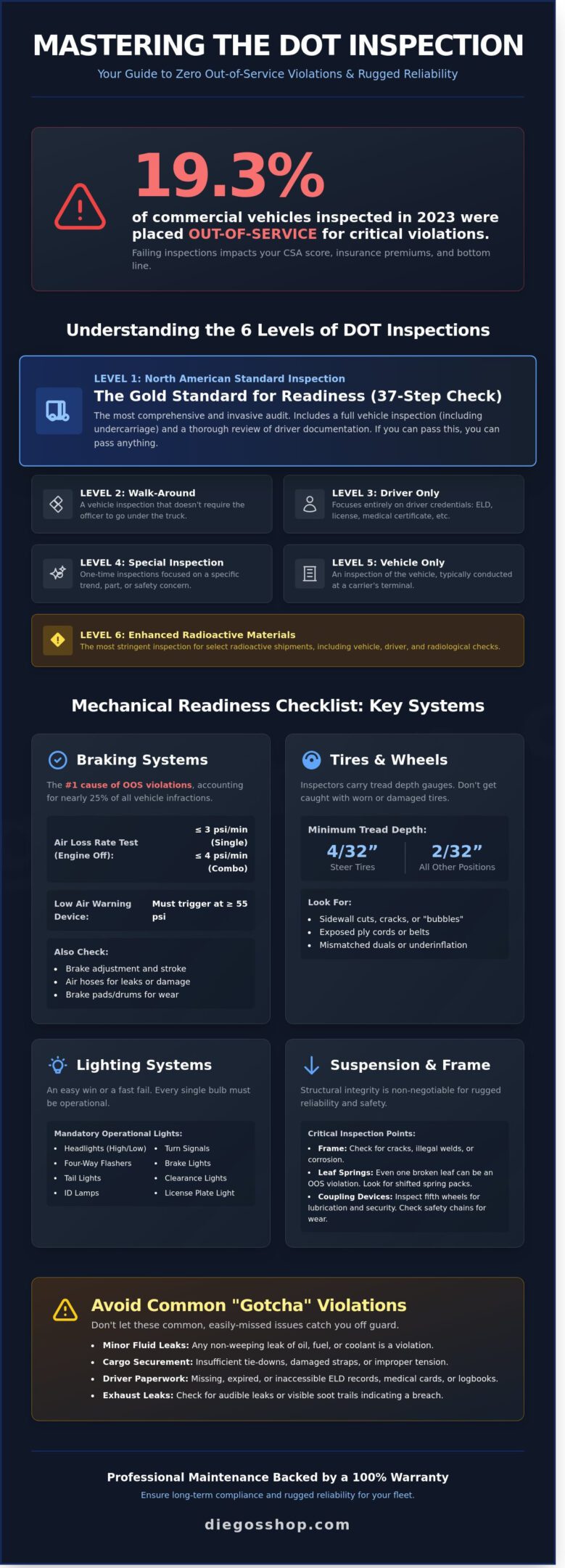
In 2023, the CVSA reported that 19.3% of commercial vehicles inspected were placed out-of-service for critical safety violations. Learning how to pass dot inspection cycles isn’t just about compliance; it’s about protecting your bottom line and your CSA score. You know that FMCSA regulations grow more complex every year, and the stress of a surprise roadside stop can be overwhelming when your reputation is on the line.
We believe maintenance should be grounded in rugged reliability, not guesswork. Our professional mechanic’s guide provides the technical mastery you need to face any inspector with confidence. We’ve distilled our shop’s expertise into a clear, 37-step North American Standard Inspection checklist designed to keep your trucks moving. You’ll gain the peace of mind that comes from knowing your fleet is maintained to the highest standards. This guide covers everything from brake stroke measurements to securement points so your maintenance is handled correctly and done right.
Key Takeaways
- Understand the six levels of FMCSA audits to prepare your fleet for inspections at weigh stations, truck stops, or roadside.
- Learn the critical mechanical specs for brakes and tires to master how to pass dot inspection and avoid costly out-of-service orders.
- Prepare your drivers with the specific ELD documentation and transfer guides required to clear the paperwork phase of any audit.
- Uncover common “gotcha” violations, such as minor fluid leaks and cargo tension issues, that often catch fleet managers off guard.
- Discover how professional maintenance backed by a 100% warranty ensures your repairs are done right for long-term compliance and rugged reliability.
Understanding the 6 Levels of DOT Inspections
A DOT inspection is a formal FMCSA audit that verifies your commercial motor vehicle (CMV) is safe for the road. These checks don’t just happen at weigh stations. You might face an inspection at a truck stop or during a roadside stop by state troopers. The results of these audits are public and permanent. They directly influence your carrier’s CSA score and can hike your insurance premiums by 15% or more if violations pile up. At Diego’s Shop, we focus on technical mastery to ensure you achieve zero Out-of-Service (OOS) violations. Our goal is to keep your freight moving and your reputation intact.
Knowing exactly what an officer looks for is the secret to mastering how to pass dot inspection protocols. These commercial vehicle inspections follow a strict hierarchy. If your maintenance isn’t done right, a simple stop can turn into a costly mechanical breakdown of your business’s bottom line.
From Level 1 to Level 6: What to Expect
The inspection process is divided into six distinct levels. Level 1 is the North American Standard, which is a grueling 37-step check of both the vehicle and the driver. Level 2 is a walk-around vehicle inspection that covers everything visible without the officer crawling under the rig. Level 3 focuses entirely on the driver’s credentials, including ELD records, licenses, and Medical Examiner’s Certificates.
- Level 4: Special one-time inspections focused on a specific trend or part.
- Level 5: Vehicle-only inspections usually conducted at a fleet terminal.
- Level 6: Enhanced protocols for shipments involving radioactive materials.
Why Level 1 is the Gold Standard for Readiness
If you’re prepared for a Level 1, you’re prepared for anything an officer throws your way. This level is the most invasive because it includes an under-the-truck inspection of the frame, fuel system, and exhaust. Officers look for leaks, cracks, and loose components that threaten rugged reliability. The North American Standard Inspection stands as the industry’s most comprehensive safety benchmark. Preparing your fleet for this level ensures that your maintenance program is built on a foundation of honesty and expertise. When you understand how to pass dot inspection requirements at this depth, roadside stops become a routine formality rather than a source of stress.
The Mechanical Readiness Checklist: Systems That Matter
Passing a DOT inspection isn’t about luck; it’s about disciplined maintenance and technical mastery. Braking systems remain the primary cause for out-of-service (OOS) orders, accounting for nearly 25% of all vehicle violations during recent CVSA Roadcheck events. To understand how to pass dot inspection protocols, you have to look beyond the surface and focus on the components that keep the rig controlled and visible.
Air Systems and Brake Stroke Mastery
Silent failures in the air system often lead to immediate grounding. We recommend performing a full air loss rate test every morning. With the engine off and brakes applied, the pressure shouldn’t drop more than 3 psi per minute for a single vehicle or 4 psi for a combination. Your low-air warning device must trigger at 55 psi or higher to meet the Official FMCSA Inspection Regulations. Proper brake adjustment ensures your heavy-duty diesel truck stops when it counts, preventing the mechanical creep that inspectors look for during a Level I walk-around.
Suspension and Frame Integrity
Rugged reliability starts with a chassis that isn’t compromised by unauthorized welds or structural cracks. We check for cracked leaf springs or shifted spring packs; even one broken leaf can result in an OOS violation. A clean, rust-free undercarriage allows you to spot these issues before they become terminal. Don’t forget the coupling devices. Inspect fifth wheels for proper lubrication and ensure safety chains on trailers show no signs of stretching or link wear. If you’re unsure about your fleet’s current status, a comprehensive diesel diagnostic can identify these hidden risks before the flashing lights appear in your rearview mirror.
Tires, Wheels, and Lighting
Inspectors carry a tread depth gauge and they know how to use it. Steer tires require at least 4/32” of tread, while all other positions need 2/32”. Look for “bubbles” or cuts in the sidewall that reveal ply cords. Lighting is the easiest win or the fastest fail on the road. Every single bulb must be operational, including:
- High and low beam headlights.
- Turn signals and four-way flashers.
- Identification lamps and clearance lights.
- The often-overlooked license plate light.
- Rear impact guard reflectors and conspicuity tape.
If a light is mounted on the truck, it has to work. There’s no middle ground with inspectors. By verifying these systems daily, you ensure your equipment stays on the road and out of the repair bay. How to pass dot inspection challenges becomes a simple matter of routine when you prioritize these mechanical essentials.
Driver Compliance: The Paperwork That Powers the Truck
Inspectors start with the person behind the wheel before they ever touch a tire or a brake chamber. If a driver appears disorganized or defensive, the officer will likely dig deeper into the mechanical components. Staying calm and capable is your first line of defense. It’s the most effective way to set a professional tone and is a core component of how to pass dot inspection stops without triggering a full Level I teardown.
The Essential Document Folder
Keep every required document in a dedicated, clean binder. Check the CDL to ensure endorsements like Tanker or Hazardous Materials match the current load requirements for 2026. We recommend tracking Medical Examiner’s Certificate expiration dates in a digital fleet calendar at least 45 days in advance to prevent a sudden “out-of-service” order. Always verify that the cab’s VIN matches the insurance and registration paperwork exactly. Small clerical errors often lead to 10-point CSA hits that are easily avoided with a five-minute folder audit.
Hours of Service (HOS) and ELD Readiness
ELD non-compliance accounts for roughly 25% of driver-related roadside violations. By 2026, inspectors have zero patience for unassigned driving time or missing data. Drivers must be able to present the last 8 days of logs in under two minutes. Keep the ELD ‘Transfer Guide’ laminated and visible on the dashboard; if the driver can’t produce this guide, it’s an automatic violation. Use the ‘Remarks’ section to document yard moves or personal conveyance clearly to eliminate any ambiguity for the officer. If your diesel fleet operates under short-haul exemptions, keep a copy of the 150 air-mile radius rules on hand to prove compliance instantly.
A signed Driver Vehicle Inspection Report (DVIR) is your proof of proactive care. It shows the inspector that you’ve already checked the critical systems before they began their walk-around. Following the CSA Vehicle Inspection Requirements ensures that your pre-trip and post-trip reports act as a legal record of safety. When a driver presents a clean, signed DVIR, it signals that the truck is backed by rugged reliability and professional maintenance. This level of preparation is how to pass dot inspection checks by proving your fleet is serious about safety and technical mastery.
Common DOT ‘Gotchas’ and How to Avoid Them
Passing a roadside check requires more than just a running engine; it demands attention to the details that inspectors use to gauge your overall safety culture. Officers often look for “tells” that suggest a fleet ignores its maintenance. For example, an active fuel leak of any size or an oil leak that drips onto the exhaust manifold results in an immediate Out-of-Service (OOS) order. These small oversights signal to an inspector that you aren’t looking closely enough at your equipment. Understanding these nuances is the first step in learning how to pass dot inspection every single time.
Cargo securement is another frequent trap. If a tie-down strap has a visible 1/4-inch tear or a chain lacks a legible grade marking, you’re looking at a violation. Even the “Clean Cab” rule matters. A dashboard cluttered with loose papers, trash, or unsecured electronics suggests a driver who doesn’t respect their equipment. In Utah, salt corrosion presents a specific challenge. Magnesium chloride used on I-15 corrodes electrical connectors 25% faster than standard road salt. This leads to flickering lights and ABS sensor failures that catch drivers off guard during a level I inspection.
The Dirty Dozen: Most Frequent Violations
Commercial Vehicle Safety Alliance (CVSA) data from 2023 shows that lighting violations account for nearly 20% of all vehicle-related citations. This is the easiest fix many drivers overlook. Check every lamp, including the license plate light and side markers. Ensure your fire extinguisher is fully charged and secured in a mounting bracket. If it’s rolling around the cab floor, it’s a fine. You must also carry three reflective triangles and spare fuses. Missing just one triangle is a common reason for a failed report.
Pre-Trip Inspection: Your Best Defense
A disciplined 15-minute pre-trip routine catches 90% of the issues that lead to roadside fines. Whether you’re operating a Peterbilt 389 or a Kenworth T680, use a standardized checklist to ensure consistency across different diesel brands. A professional shop’s preventive maintenance plan is your ultimate defense. We provide comprehensive inspections that mirror DOT standards, ensuring your rugged reliability isn’t just a claim, but a documented fact. When we handle your maintenance, we ensure the work is Done Right the first time.
Don’t leave your compliance to chance. Ensure your fleet is road-ready with our professional diesel maintenance services today.
How Diego’s Shop Guarantees DOT Readiness
Passing a roadside check requires more than just luck; it demands a shift from the “quick fix” mentality to genuine technical mastery. At Diego’s Shop, we don’t just clear codes. We resolve the underlying mechanical issues that lead to out-of-service orders. Our team provides 100% warrantied repair work, ensuring your compliance is backed by seasoned professionals who understand the high stakes of 2026 regulations. When you understand how to pass dot inspection requirements, you know that every bolt and sensor must be perfect before the wheels turn.
Utah County fleets rely on our “Rugged Reliability” because we understand the different demands of OTR long-hauls and heavy local cycles. Whether you are hauling across the Wasatch Front or traversing state lines, our shop ensures your equipment stays on the road. Learning how to pass dot inspection standards is significantly easier when you have a partner who treats every pre-trip audit with the same intensity as a state trooper. Partnering with us means a stress-free inspection season where the goal is to excel in safety and performance.
Comprehensive Inspection Protocols
Our facility utilizes dealer-level diagnostic tools to identify hidden engine and emission codes before they trigger a DOT officer’s interest. We provide specialized care for heavy-duty powerhouses like Cummins, Detroit, and PACCAR engines. By catching a 5% deviation in fuel rail pressure or a minor exhaust leak early, we prevent costly fines and downtime. We are committed to “Diesel Service and Repair Done Right” for every fleet, regardless of whether you manage three trucks or thirty.
Schedule Your Pre-DOT Audit in Springville
Don’t wait for a surprise roadside stop to find out your brakes are at 25% capacity. A professional shop inspection identifies potential violations before they hit your CSA score. Our Springville location is conveniently situated for fleets operating across the Wasatch Front and throughout Utah County. Take control of your compliance today. Schedule your fleet maintenance and DOT prep at Diego’s Shop today to ensure your trucks remain road-legal, reliable, and ready for any inspection.
Secure Your 2026 Fleet Compliance Today
Passing a DOT inspection requires more than luck. It demands a rigorous maintenance strategy that covers all 6 levels of federal scrutiny. You’ve learned that mechanical readiness, especially regarding brake systems and lighting, accounts for nearly 70% of roadside violations. Pair that with meticulous driver paperwork, and you have the blueprint for how to pass dot inspection every single time. At Diego’s Shop, we don’t leave your uptime to chance. As Springville’s trusted diesel partner, we provide technical mastery for heavy-duty giants like Peterbilt, Kenworth, and Volvo. Our team uses comprehensive diagnostic protocols to ensure every bolt and logbook entry meets federal standards. We stand behind our expertise with 100% warrantied repair work, so you can hit the road with rugged reliability. Don’t wait for a roadside red tag to find a problem. Let our specialists handle your fleet’s health so you can focus on the miles ahead. It’s time to get your service done right.
Keep your fleet compliant; Schedule Service at Diego’s Shop
Frequently Asked Questions
What are the most common reasons for failing a DOT inspection?
Faulty brake systems are the primary reason for failure, accounting for 25.2% of all vehicle out-of-service violations according to recent CVSA data. Other frequent issues include inoperable lighting, which makes up 12.1% of citations, and tire tread depth falling below the 2/32 of an inch limit. We focus on these critical areas to ensure you know how to pass dot inspection every time you leave our shop.
How long does a Level 1 DOT inspection typically take?
A standard Level 1 North American Standard Inspection usually takes between 45 and 60 minutes to complete. This 37-step process is the most thorough review, covering both the driver’s records and the mechanical condition of the tractor and trailer. Our technicians use these same rigorous protocols to identify and fix potential issues before they cause delays at a weigh station.
Can a DOT inspector search my personal belongings in the cab?
No, an inspector cannot search your personal belongings unless they have probable cause or you give them explicit consent. While officers have the authority to enter the cab to check safety equipment or ELD data, they must respect your Fourth Amendment rights regarding private luggage or sleeper berths. Keeping your cab organized shows professionalism and ensures the inspector stays focused on the vehicle’s mechanical fitness.
What happens if my truck is placed Out-of-Service (OOS)?
You’re prohibited from moving the vehicle until the specified safety violations are repaired and verified by a qualified technician. This status results in an average financial loss of $2,500 per day when you factor in fines, towing costs, and lost freight revenue. We provide honest, warrantied repairs to get your equipment back on the road with the rugged reliability you expect.
How often are commercial vehicles required to have a DOT inspection?
Commercial vehicles must undergo a formal federal inspection at least once every 12 months to remain compliant with 49 CFR Part 396.17. Many proactive fleets choose to schedule these checks every 90 days to catch wear and tear early and avoid unexpected roadside breakdowns. Regular maintenance at Diego’s Shop ensures your truck meets these mandatory annual standards without the stress of last-minute repairs.
Does a clean pre-trip inspection report help during a roadside stop?
Yes, a documented pre-trip inspection report demonstrates to the officer that you’re proactive about safety and federal compliance. Under regulation 392.7, you must be satisfied that all parts are in good working order before driving. Presenting a detailed report from that morning shows you’ve done your job, which often leads to a smoother and faster roadside experience.
What is the difference between a state inspection and a DOT inspection?
State inspections focus on local registration and emissions requirements, while a DOT inspection evaluates 37 specific safety points required for interstate commerce. While some state-level checks satisfy federal requirements, you must ensure the paperwork specifically meets 49 CFR Part 396 standards. We have the technical mastery to handle both types of certifications, ensuring your vehicle is legal in every jurisdiction.
How do DOT violations affect my CSA score in 2026?
Violations in 2026 result in points weighted from 1 to 10 that stay on your carrier’s SMS profile for 24 to 36 months. High-severity issues like steering failures or tire blowouts add 10 points to your score, which significantly increases your chances of future interventions and higher insurance premiums. Learning how to pass dot inspection with a clean report is the best way to protect your professional reputation.