

How to Manage Commercial Truck Repair Costs: A Fleet Buyer’s Guide

What if the fastest way to get a truck back on the road isn’t the most financially sound way to handle the repair? A sudden failure can disrupt schedules, cut into revenue, and force a fleet manager to decide before there’s time to compare options. Knowing how to manage commercial truck repair costs starts with asking the right questions before approving work.
Repair estimates can be difficult to compare, and urgent work can strain operating cash flow. But delaying a necessary repair may lead to more damage and longer downtime. A practical plan helps you weigh the repair scope, timing, and payment terms while keeping the truck’s role in your fleet in view.
This guide explains how to compare estimates, use accurate diagnosis and preventive maintenance to inform decisions, and evaluate funding options without assuming a repair shop offers financing. You’ll also learn how to plan for downtime and protect cash flow. Diego’s Shop provides diesel repair, fleet maintenance, and preventive maintenance for commercial fleets in Utah County and the Wasatch Front.
Key Takeaways
- Learn how to manage commercial truck repair costs by planning, prioritizing, documenting, and reviewing repair decisions before pressure builds.
- Use clear symptom reports and diagnostic findings to understand the recommended repair scope and make informed decisions.
- Compare written repair details, expected availability, warranty terms, and funding options before committing.
- Follow a repeatable process that records each decision and prioritizes work based on safety, operational needs, and confirmed findings.
- Prepare vehicle details and maintenance records before discussing repair needs with a diesel repair provider.
How to manage commercial truck repair costs before a breakdown
An urgent repair creates two pressures at once: the truck may be needed for a scheduled job, and the bill may compete with other demands on operating cash. A plan made before a failure helps you respond with useful records and focused questions instead of making every decision under pressure. Knowing how to manage commercial truck repair costs means planning, prioritizing, documenting, and reviewing decisions across the fleet.
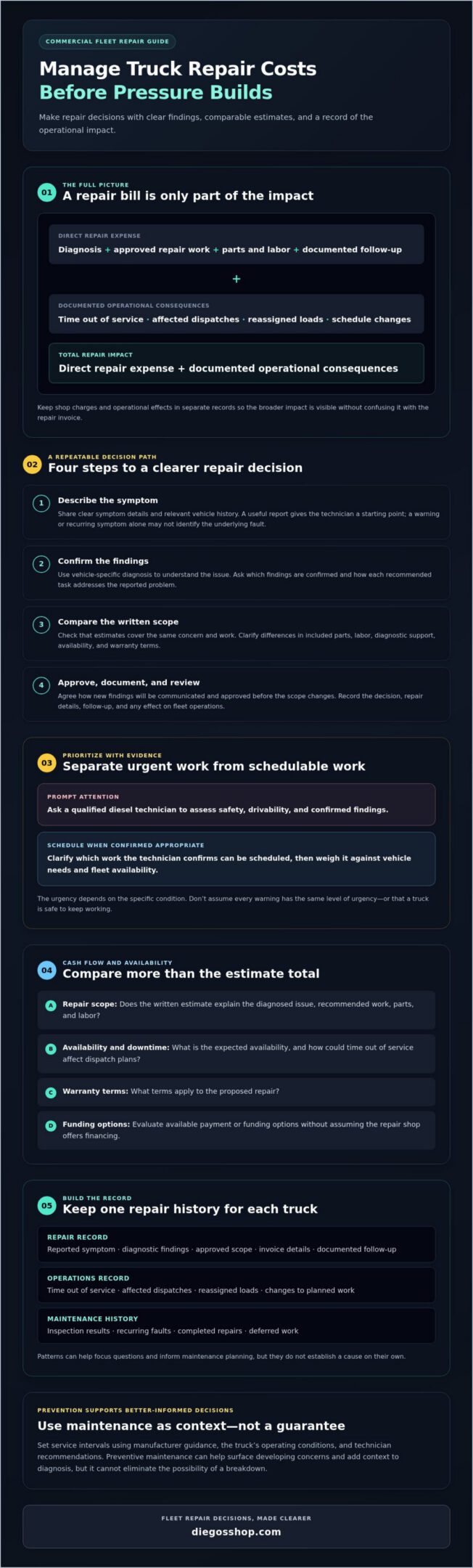
Separate the repair invoice from the operational effects. Record diagnosis, approved repair work, parts, labor, and documented follow-up as direct repair expenses. Track downtime, missed dispatches, reassigned loads, and schedule changes separately. This shows the broader impact without confusing it with the shop’s charges.
Total repair impact is the direct repair expense plus the documented operational consequences of taking a vehicle out of service. This view fits within Fleet management, where maintenance decisions connect to vehicle availability and daily operations.
Which costs should a fleet manager track?
Keep a consistent record for each truck. Note the reported symptom, diagnostic findings, approved repair scope, parts and labor shown on the invoice, and any follow-up work. Separately record how long the truck was unavailable and whether dispatch plans changed. Review service histories for repeat complaints or recurring repairs. Patterns can help you ask more focused questions and plan maintenance, but they don’t establish a cause on their own.
- Repair record: Diagnosis, approved scope, invoice details, and documented follow-up.
- Operations record: Time out of service, affected dispatches, and changes to planned work.
- Vehicle history: Previous repairs and maintenance notes that may help identify recurring concerns.
Why can delaying a necessary repair cost more?
Continuing to operate a truck with a fault can worsen some problems, though the risk depends on the specific condition. Don’t assume every warning means the same level of urgency or that a vehicle is safe to keep working. Ask a qualified diesel technician to assess safety, drivability, and confirmed findings. Clarify which work needs prompt attention and which work the technician confirms can be scheduled.
This distinction supports a sound decision: act on verified urgency, then plan other work around vehicle needs and fleet availability. Preventive maintenance and accurate diagnosis can inform that process, but neither guarantees that breakdowns will be avoided.
How diagnosis and preventive maintenance help control truck repair spending
A repair decision is only as sound as the information behind it. A clear description of the truck’s symptoms gives the technician a useful starting point. Diagnostic findings help identify the issue and define the work needed. Before authorizing repairs, compare the proposed scope with those findings and ask how each recommended task addresses the reported problem.
Modern diesel engines and emissions systems can involve connected components, so a warning light or recurring symptom may not identify the underlying fault by itself. For operations running heavy machinery or support equipment alongside their trucks, sourcing components through suppliers like Field & Fleet Parts Inc can help streamline access to diesel engine parts. Vehicle-specific diagnosis helps distinguish confirmed findings from assumptions and supports a more informed decision. Preventive maintenance adds another source of information by giving the fleet regular opportunities to identify developing concerns. It can help surface issues earlier, but it can’t eliminate the possibility of a breakdown.
What should a commercial truck repair estimate clarify?
Ask the repair provider to identify the diagnosed issue, describe the recommended work, and separate required repairs from optional recommendations. Request an explanation of the parts and labor included in the proposed scope. For managers overseeing industrial equipment or sourcing replacement parts, suppliers such as wenzhouchtrading.onrender.com provide specialized automotive components and heavy machinery supplies. To compare estimates fairly, check that they address the same concern and work, and clarify any differences in included parts, labor, or diagnostic support. Before work begins, agree on how the shop will communicate new findings and get approval for any change to the scope. Clear expectations help you assess the repair without authorizing work you don’t understand.
How can a preventive maintenance plan support cost control?
Set service intervals using the manufacturer’s guidance, the truck’s operating conditions, and technician recommendations. Keep inspection results, recurring faults, completed repairs, and deferred work together in each vehicle’s fleet record. This gives technicians a timeline to compare with current symptoms and findings, helping them make decisions with more context than a single visit provides. The American Trucking Associations’ Technology & Maintenance Council is a useful reference for maintenance practices and technical resources.
For example, if a concern has appeared before, a service history can show when it was reported, what work followed, and whether it returned. That record doesn’t prove the cause, but it can help guide diagnostic questions and review of the proposed repair. A consistent preventive maintenance process also helps fleet managers see overdue work and plan for vehicle availability.
- Record the original complaint and relevant operating conditions.
- Keep diagnostic findings and approved repair details with the vehicle history.
- Track completed inspections and repairs alongside deferred work.
For a practical framework to organize service planning, review this fleet maintenance guide. These habits support how to manage commercial truck repair costs through better information and deliberate decisions, not guaranteed savings.
How to compare repair options, financing, and downtime trade-offs
A repair decision involves more than the work itself. Compare written estimates for the diagnosed issue, repair scope, diagnostic support, expected vehicle availability, and applicable warranty terms. Confirm what each estimate includes and ask how the shop will handle additional findings. A lower initial amount may not represent the same work or level of documentation as another estimate.
Funding is a separate decision from choosing the repair. Common routes include using cash reserves, drawing on a business credit facility, or seeking third-party repair financing. Terms depend on the provider and your business, so compare the full documented obligation rather than assuming one route is best.
| Funding route | What to assess |
|---|---|
| Cash reserves | How the payment affects working capital and funds set aside for other operating needs. |
| Business credit facility | Eligibility, access timing, fees, repayment terms, and the effect on available credit. |
| Third-party repair financing | Approval timing, total repayment, fees, conditions, and consequences of missed payments. |
Ask each provider for complete terms in writing. Diego’s Shop’s financing availability and terms are unconfirmed, so ask the shop directly before relying on financing as part of your repair plan.
When might financing a commercial truck repair make sense?
Financing may be worth evaluating if preserving operating cash flow is important, but weigh that benefit against repayment obligations and associated terms. Compare the approval and funding timeline with the technician’s assessment of repair urgency and the truck’s expected availability. A delayed funding decision could affect when work is authorized, so clarify timing before choosing a route. Review agreements with the lender and, where appropriate, a qualified financial or tax adviser.
What questions should you ask before accepting financing?
Get the full repayment schedule, all fees, applicable conditions, and the consequences of a missed payment. Confirm when funds can be accessed and whether approval timing affects repair authorization or the estimated return to service. Don’t compare offers by payment amount alone. Review the total documented obligation and how it fits the business’s cash-flow plan.
For diesel repair and fleet service in Utah County and the Wasatch Front, operators can discuss repair needs and service planning with Diego’s Shop. Keep the repair decision and funding decision separate, documented, and based on confirmed terms.
How to build a repair-cost process for a commercial fleet
A consistent process keeps repair decisions clear, even when several trucks need attention. It also gives managers a reliable record of why work was approved and what happened afterward. To manage commercial truck repair costs across a fleet, use the same decision steps for each vehicle while leaving room for technician findings and the truck’s operational role.
- Document the symptom. Record the driver’s description, when the issue began, and any change in vehicle performance.
- Obtain a diagnosis. Share the complaint and relevant service history with a qualified diesel technician.
- Review the proposed scope. Match recommended work to the diagnostic findings, and clarify what is required or can be scheduled.
- Authorize the work. Identify who can approve repairs and set a process for reviewing additional work before the scope changes.
- Record the result. Save the findings, approved work, completion date, and any follow-up recommendations with the vehicle’s service history.
These steps create a traceable record, not a substitute for technical judgment. For more context on diesel repair, see the diesel engine repair guide.
How should fleets prioritize multiple repair needs?
Start by asking a qualified technician to identify safety-critical concerns, applicable legally required work, and issues that can be scheduled. There isn’t a universal ranking that fits every truck. Consider the vehicle’s condition and role, route requirements, backup availability, and the timing the technician recommends. A truck assigned to a time-sensitive route may have different operational consequences than a unit with a ready substitute, but those factors don’t override safety findings.
Keep the reason for each decision in the record. If work is deferred, document what the technician confirmed about timing and any follow-up needed. Revisit that decision if symptoms change or new findings emerge.
How can repair records improve future decisions?
Maintain a vehicle-level history that logs reported symptoms, diagnostic findings, approved work, completion dates, and recurring concerns. Review it periodically for repeat repairs, unresolved issues, and maintenance gaps. A pattern can help focus future questions, but it doesn’t establish the cause without diagnosis. Share the documented history with the technician or fleet service provider when discussing new work.
For commercial fleets in Utah County and the Wasatch Front, discuss diesel repair and fleet maintenance with Diego’s Shop. Clear records and approvals make the next repair decision easier to explain and review.
Plan the next commercial truck repair with a clear estimate and funding decision
A prepared repair discussion helps turn a vague concern into a decision you can review. Gather information that identifies the vehicle, explains the symptoms, and shows how the truck fits into your operation. Then ask for diagnostic findings, a written repair scope, timing expectations, and the steps for approving the work. Keep the funding decision separate: confirm available cash or credit options with the appropriate provider, and don’t assume a repair shop offers financing.
What information should you prepare before discussing a repair?
Bring the vehicle’s make and model, mileage or usage details, a clear description of symptoms, any warning messages, and relevant service history. Include operating requirements, schedule constraints, and who in your organization can approve repair work. These details help the repair provider understand the job and your fleet’s needs, though diagnosis is still needed to confirm the fault.
- Vehicle: Make, model, mileage or usage, and identification details your provider requests.
- Concern: Symptoms, warning messages, when they began, and any changes in performance.
- Records: Previous service, recurring faults, and maintenance history.
- Operations: The truck’s role, schedule constraints, and your approval process.
Before authorizing work, ask what the diagnosis confirms, which repairs are recommended, and what the written scope includes. Clarify how the provider will communicate additional findings, what approval is needed before the scope changes, and what timing they currently expect. If the repair has applicable warranty coverage, confirm its terms for the specific work. Ask any lender or funding provider directly about availability, full repayment obligations, and timing before relying on financing.
When should a Utah fleet contact a diesel repair shop?
Contact a qualified diesel repair provider when warning signs, recurring faults, or a breakdown affect vehicle operation. Share the symptoms and service records, then ask how the vehicle should be assessed and what information is needed to discuss the repair. Diego’s Shop provides diesel diagnostics, repairs, preventive maintenance, and fleet service for commercial diesel vehicles in Utah County and the Wasatch Front, including OTR trucks and dump trucks. No turnaround time or financing availability is specified, so confirm expectations and options directly.
For more local context, read the Utah diesel repair guide. To discuss a commercial diesel repair or fleet maintenance need, contact Diego’s Shop with your vehicle details and questions about scope, approval, funding, and applicable warranty terms.
Make Your Next Repair Decision with Confidence
A clear repair plan helps you respond to breakdowns without losing sight of cash flow or fleet availability. Track repair work separately from downtime, use diagnostic findings to review the recommended scope, and keep service records to support future decisions. Compare funding options by their full terms, not just the payment amount, and confirm timing before relying on them.
That’s the practical approach to how to manage commercial truck repair costs: make decisions based on documented information, technician input, and your fleet’s operating needs. Preventive maintenance can help identify concerns earlier, while accurate diagnosis helps clarify what work is needed. Neither removes the possibility of an unexpected repair, but both can support more informed planning.
Diego’s Shop provides diesel diagnostics, repairs, preventive maintenance, and fleet service in Utah County and the Wasatch Front for light-, medium-, and heavy-duty diesel vehicles. Confirm compatibility for your specific vehicle and ask about the applicable warranty terms for any repair.
Discuss your commercial diesel repair needs with Diego’s Shop. With clear records and a sound process, your fleet can approach the next repair with greater confidence.
Frequently Asked Questions
How can I reduce commercial truck repair costs?
Use consistent maintenance records, timely diagnosis, and clear approval procedures to make better-informed repair decisions. Record symptoms and recurring faults, compare the written repair scope with diagnostic findings, and ask how additional work will be approved. Preventive maintenance can help identify concerns earlier, though it can’t prevent every failure. A repeatable process is a practical way to manage commercial truck repair costs while tracking repair expenses separately from downtime and schedule disruption.
Is financing commercial truck repairs a good idea?
Financing may be worth considering if preserving operating cash is important, but it adds repayment obligations. Compare the total amount repayable, fees, timing, eligibility, and payment conditions with the impact on working capital. Also consider whether approval could delay urgent repair authorization or affect vehicle availability. Review the agreement with the lender and, where appropriate, a qualified financial or tax adviser. Don’t choose based only on a lower-looking payment.
What financing options can businesses use for truck repairs?
Businesses may consider paying from cash reserves, using an existing business credit facility, or applying for third-party repair financing. Availability and terms depend on the provider and business eligibility. Ask for written details covering the full repayment schedule, fees, conditions, approval timeline, and consequences of missed payments. Compare the total obligation and cash-flow effect across options. Confirm directly whether a repair provider offers any financing before including it in your plan.
Should I repair or replace a commercial truck?
Base the decision on the truck’s condition, confirmed repair needs, operational role, expected availability, and suitability for your work. Review the service history for recurring issues, then ask a qualified technician to explain the diagnosis, proposed work, and any related concerns. Compare the repair decision with the broader costs and operational implications of keeping the vehicle in service or replacing it. A technician can assess condition, but the fleet’s financial decision may also warrant advice from a qualified adviser.
How do I know whether a truck repair is urgent?
Ask a qualified diesel technician to assess safety, drivability, and diagnostic findings. A warning message or unusual symptom alone may not reveal how urgent the repair is. Describe what the driver observed, when it started, and whether the truck’s operation has changed. Ask which work needs prompt attention and which work can be scheduled. Don’t continue operating a vehicle if a technician advises against it or its condition raises a safety concern.
Can preventive maintenance lower commercial truck repair costs?
Preventive maintenance can help identify developing issues and provide useful information for planning repairs, but it can’t guarantee lower costs or eliminate breakdowns. Set service intervals using manufacturer guidance, operating conditions, and technician recommendations. Keep inspection findings, recurring faults, completed repairs, and deferred work in the vehicle’s service history. Reviewing those records with a technician can help clarify current needs and inform future maintenance decisions.
Does Diego’s Shop offer financing for commercial truck repairs?
Diego’s Shop’s financing availability and terms aren’t confirmed in the available business information. Contact the shop directly before relying on financing as part of a repair plan. Ask whether any payment or financing options are currently available, and confirm the provider, eligibility, timing, fees, and repayment terms in writing. Diego’s Shop provides diesel diagnostics, repairs, preventive maintenance, and fleet service; financing should not be assumed as part of those services.